


摘要
温度是影响花卉生长发育的重要因子。氧化锌纳米粒子(ZnO-NPs)和二氧化硅纳米粒子(SiO2-NPs)在增强植物抗逆性方面展现出潜力。为明确ZnO-NPs+SiO2-NPs预处理对洋桔梗在温度胁迫下的调控机制,该研究以洋桔梗幼苗为材料,首先采用正交试验设计 [L9(34)],通过ZnO-NPs和SiO2-NPs在不同浓度、配比及喷施次数下对洋桔梗幼苗生长的影响,筛选最优喷洒方案,然后预处理幼苗,并分别进行 42 ℃(24 h)高温和 4 ℃(24 h)低温胁迫,测定生理指标及相关抗逆基因表达。结果表明:(1)当纳米粒子总浓度为0.03%(m/V),ZnO-NPs∶SiO2-NPs 配比为1∶2(V/V),叶面喷施 2 次时,幼苗生长最佳。(2)ZnO-NPs+SiO2-NPs预处理提高了正常生长条件下叶片叶绿素含量;降低了42 ℃和4 ℃胁迫下的相对电导率、丙二醛(MDA)含量和过氧化氢(H2O2)含量;提高了超氧化物歧化酶(SOD)、过氧化氢酶(CAT)和过氧化物酶(POD)的活性。(3)ZnO-NPs+SiO2-NPs预处理上调了 Mn-SOD、Cu/Zn-SOD、Fe-SOD、CAT 和 POD 基因的表达水平。(4)42 ℃胁迫下,ZnO-NPs+SiO2-NPs预处理促进了热休克蛋白90基因(HSP90)的表达和4 ℃胁迫下冷调节基因(COR413)的表达。综上认为,适宜的ZnO-NPs+SiO2-NPs预处理通过促进抗氧化酶活性的升高及相关抗逆基因的表达来增强洋桔梗幼苗对温度胁迫的抗性。该研究揭示了ZnO-NPs+SiO2-NPs预处理增强洋桔梗抗温度胁迫的分子机制,并为纳米材料在花卉抗逆研究中提供了理论依据。
关键词
Abstract
Temperature is a crucial environmental factor affecting the growth and development of flowers. Zinc oxide nanoparticles (ZnO-NPs) and silicon dioxide nanoparticles (SiO2-NPs) have demonstrated significant potential in enhancing plant stress resistance. To elucidate the regulatory mechanism of ZnO-NPs+SiO2-NPs pretreatment on Eustoma grandiflorum under temperature stress, this study employed E. grandiflorum seedlings as materials and adopted an orthogonal experimental design [L9(34)]. Initially, the effects of ZnO-NPs+SiO2-NPs on the growth of E. grandiflorum seedlings under different concentrations, proportions, and spraying times were investigated to screen the optimal spraying scheme. Subsequently, the seedlings were pretreated and subjected to high temperature (42 ℃ for 24 h) and low temperature (4 ℃ for 24 h) stress treatments, respectively. Physiological indicators and related stress-resistant gene expression were measured. The results were as follows: (1) When the total concentration of nanoparticles was 0.03% (m/V), the proportion of ZnO-NPs to SiO2-NPs was 1∶2 (V/V), and the seedlings were sprayed twice on the leaves, the seedling growth was optimal. (2) The ZnO-NPs + SiO2-NPs pretreatment increased the chlorophyll content of the leaves under normal growth condition, reduced relative electrical conductivity, malondialdehyde (MDA) content, and hydrogen peroxide (H2O2) content under 42 ℃ and 4 ℃ stresses; enhanced the activities of superoxide dismutase (SOD), catalase (CAT), and peroxidase (POD). (3) ZnO-NPs+SiO2-NPs pretreatment upregulated the expression levels of Mn-SOD, Cu/Zn-SOD, Fe-SOD, CAT, and POD genes. (4) Under 42 ℃ stress, ZnO-NPs+SiO2-NPs pretreatment promoted the expression of heat shock protein 90 gene (HSP90); under 4 ℃ stress, it upregulated the expression of cold-regulated gene (COR413). In conclusion, suitable ZnO-NPs+SiO2-NPs pretreatment effectively improves the growth of E. grandiflorum seedlings and enhances their resistance to temperature stress by promoting increases in antioxidant enzyme activities and the expressions of related stress-resistant genes. This study reveals the molecular mechanism by which ZnO-NPs+SiO2-NPs pretreatment enhances the resistance of E. grandiflorum to temperature stress, and provides a theoretical basis for the application of nanomaterials in flower stress-resistant research.
纳米粒子(nanoparticles, NPs)是指粒径在1~100 nm之间的材料,凭借其独特的化学、物理、生物医学和光学性质,在多个科学领域展现出应用潜力(Ahmed et al., 2021)。在农业中,纳米技术已应用于纳米肥料、纳米农药及纳米除草剂等新型农业投入品的开发(Aqeel et al., 2022)。纳米粒子可通过多种途径影响植物代谢过程,包括提供必需微量元素、调控基因表达,从而改变植物的形态和发育(Aqeel et al., 2022)。
硅(Si)被植物学界认定为“准必需”元素(Siddiqui et al., 2020)。在植物体内,硅主要以非晶态 SiO2·nH2O 的形式沉积于细胞壁,增强其机械强度与刚性,并作为反应底物参与多酚和果胶的合成,这些物质在植物防御和发育中发挥关键作用(El-Saadony et al., 2022)。二氧化硅纳米粒子(SiO2-NPs)在缓解植物非生物胁迫方面具有显著效果。已有研究发现,SiO2-NPs 处理可减轻砷胁迫下水稻细胞的氧化应激(El-Saadony et al., 2022),在百合中调控抗氧化活性,延长切花采后寿命(Shaheen et al., 2015),在番茄中喷施可增强干旱条件下的抗氧化酶活性及植物激素相关代谢物积累,从而提高耐旱性(Wang et al., 2025)。Si在植物组织中的积累可增强酶系统功能,促进营养物质、游离脯氨酸和氨基酸的积累,改善水分吸收,最终提高抗逆能力(Wang et al., 2015;Ranjan et al., 2016)。这些研究表明,SiO2-NPs 不仅作为物理屏障或营养源,更可能作为信号激发子,参与植物逆境应答的核心调控网络。
锌(Zn)是植物生长所必需的微量元素,参与多种生理反应(Aqeel et al., 2022)。氧化锌纳米粒子(ZnO-NPs)目前已广泛应用于农业领域(Ahemd et al., 2024)。ZnO-NPs 具有良好的生物相容性,能有效促进生物活性物质的合成并激活酶防御系统(Sánchez-Pérez et al., 2023)。ZnO-NPs 可通过调节光合作用与活性氧代谢以促进植物生长(Ahemd et al., 2024)。例如,在小麦中减轻氧化损伤(Rizwan et al., 2019);在辣椒和番茄中提高过氧化氢酶(catalase,CAT)和过氧化物酶(peroxidase,POD)活性(Sánchez-Pérez et al., 2023);在棉花中,ZnO-NPs 处理使超氧化物歧化酶(superoxide dismutase,SOD)和POD活性分别显著增加264.2%和182.8%(Venkatachalam et al., 2017)。
近年来,纳米复合材料因其优于单一纳米颗粒的特性而受到关注(Aththanayaka et al., 2022)。Ochoa-Chaparro等(2025)研究表明,ZnO+SiO2复合使用可增强辣椒幼苗抗氧化防御系统;TiO2-NPs 与多壁碳纳米管(multi-wall carbon nanotubes,MWCNTs)复合使用能有效减轻芝麻中的氧化损伤(Mahmoud & Abdelhameed, 2023);SiO2/TiO2纳米材料能改善土壤肥力并促进玉米生长(Rolón-Cárdenas & Rodríguez-González, 2025)。Sánchez-Reyna等(2025)发现,ZnO-NPs与石墨烯纳米片复合使用比单一纳米材料更能增加番茄植株的营养发育和对生物胁迫的防御,表明纳米复合材料在协同增强植物抗逆性方面潜力显著。虽然SiO2-NPs和ZnO-NPs在单独应用时均表现出良好的抗逆功能,但是关于两者复合处理在温度胁迫下的协同效应及其分子机制尚无系统研究。
洋桔梗(Eustoma grandiflorum)是龙胆科(Gentianaceae)洋桔梗属(Eustoma Salisb.)1年生、2年生草本花卉,其花色艳丽丰富,瓶插期长且较耐贮运,是重要的鲜切花。然而,洋桔梗幼苗在生长过程中对环境条件要求较高,其中极端温度是影响其生长发育的关键限制因子。鉴于SiO2-NPs和ZnO-NPs对植物生长和耐胁迫方面具有明确益处,本研究首次以洋桔梗幼苗为研究对象,通过叶面喷施ZnO-NPs和SiO2-NPs混合溶液,通过正交试验筛选最优处理方案,并根据筛选的方案预处理洋桔梗幼苗,测定温度胁迫下其生理生化指标及耐逆相关基因表达水平,旨在探讨以下问题:(1)ZnO-NPs+SiO2-NPs预处理的最佳浓度、配比及喷施方案;(2)ZnO-NPs+SiO2-NPs预处理增强洋桔梗幼苗42 ℃和4 ℃抗性的作用机制。本研究以期为ZnO-NPs+SiO2-NPs预处理增强洋桔梗幼苗在温度胁迫下的抗逆机制提供理论依据,并为缓解温度胁迫对幼苗产生的伤害提供可行方法。
1 材料与方法
1.1 试验材料和定植
选取生长状况良好且植株高度均为4~5 cm 的洋桔梗“露西塔”幼苗(由昆明宁群经贸有限公司提供)为试验材料。
塑料花盆(上、下直径分别为20 cm 和13 cm,高为20 cm)每盆装入800 g土壤(土培基质购自昆明斗南花卉市场,成分为40%泥炭、20%椰糠、20%蛭石、10%珍珠岩和10%碳化谷壳),每盆栽种3 株长势一致的幼苗,置于温室内培养。
1.2 试验设计
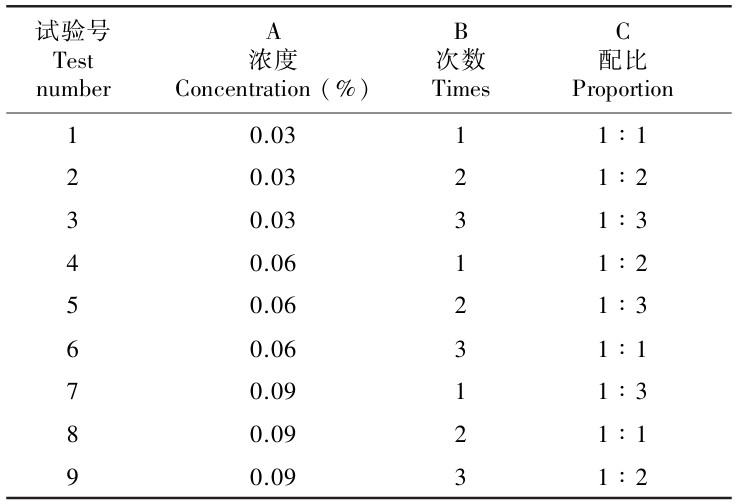
正交试验:ZnO-NPs(平均粒径为30~50 nm,相对介电常数为8.9,电导率为101~103 S·m-1,真密度为6.0 g·cm-3)和SiO2-NPs(平均粒径为30~50 nm,相对介电常数为3.8,电导率为1.4×10⁻⁹ S·m-1,真密度为2.5 g·cm-3)购自华翔科技有限公司,其中ZnO-NPs和SiO2-NPs的具体参数见Das(2024),以纳米粒子混合浓度(A,m/V),喷洒次数(B),两者的混合配比(C,V/V)为参考因素,进行L9(34)正交试验(表1)。每盆3株为1个重复,每个处理重复3次,每次喷洒间隔5 d。将混合液喷洒洋桔梗叶片正反面至滴水为止,对照组(CK)用同样方法喷蒸馏水。以地上部分相对含水量、地下部分相对含水量、叶绿素含量及株高的最大值各计为100分,按权重计算综合得分:综合得分= 地上部分相对含水量得分 × 25%+ 地下部分相对含水量得分 × 25%+ 叶绿素含量得分 × 25%+ 株高得分 × 25%,筛选最优组合。
表
1
因素水平表
Table
1
Factor level table
温度胁迫:预处理洋桔梗幼苗(根据第一阶段筛选的组合方案→将幼苗置于人工气候箱中培养15 d(25 ℃,14 h光照/10 h黑暗,光通量密度为 400 μmol·m-2·s-1,相对湿度为55%)→温度胁迫24 h(对照组温度25 ℃,高温42 ℃,低温4 ℃)。温度胁迫结束后立即取材,于-196 ℃液氮中保存。
1.3 试验方法
1.3.1 株高和相对含水量的测定
参照刘鹏等(2024)的方法,使用精确到1 mm的直尺测定株高。参照Zhao等(2024)的方法测定相对含水量。
1.3.2 叶绿素含量的测定
参照李合生(2000)的方法测定总叶绿素含量。
1.3.3 过氧化氢(hydrogen peroxide,H2O2)、丙二醛(malondialdehyde,MDA)的含量和相对电导率测定
(1)H2O2含量:用H2O2测试盒(A064-1-1,南京建成生物工程研究所)测定叶片中H2O2含量,具体操作步骤和计算方法按照试剂盒说明书。
(2)MDA含量的测定:使用MDA试剂盒(A003-1,南京建成生物工程研究所),具体操作步骤和计算方法按照试剂盒说明书。
(3)相对电导率的测定:用打孔器切取洋桔梗幼苗叶片圆片,按照李合生(2000)的方法测定电导率。
1.3.4 抗氧化酶活性的测定
SOD活性测定使用SOD试剂盒(A001-1-1,南京建成生物工程研究所),CAT活性测定使用CAT试剂盒(A007-1-1,南京建成生物工程研究所),POD活性测定使用POD试剂盒(A084-3-1,南京建成生物工程研究所),具体操作步骤和计算方法按照各试剂盒说明书。
1.3.5 实时荧光定量PCR(qPCR)
利用Trizol法提取RNA(尹慧等,2008),用Revert Aid First Strand cDNA Synthesis Kit 试剂盒(赛默飞世尔技术公司)将总RNA 反转录成cDNA。扩增反转录的第一链cDNA。反应体系如下:RNA 5 μL、Oligod(dT)Primer 1 μL、Water 6 μL。扩增程序:98 ℃变性10 s,55.6 ℃退火30 s,72 ℃延伸1 min, 30个循环。将产物cDNA溶液贮藏于-20 ℃冰箱,用于后续的qPCR实验。
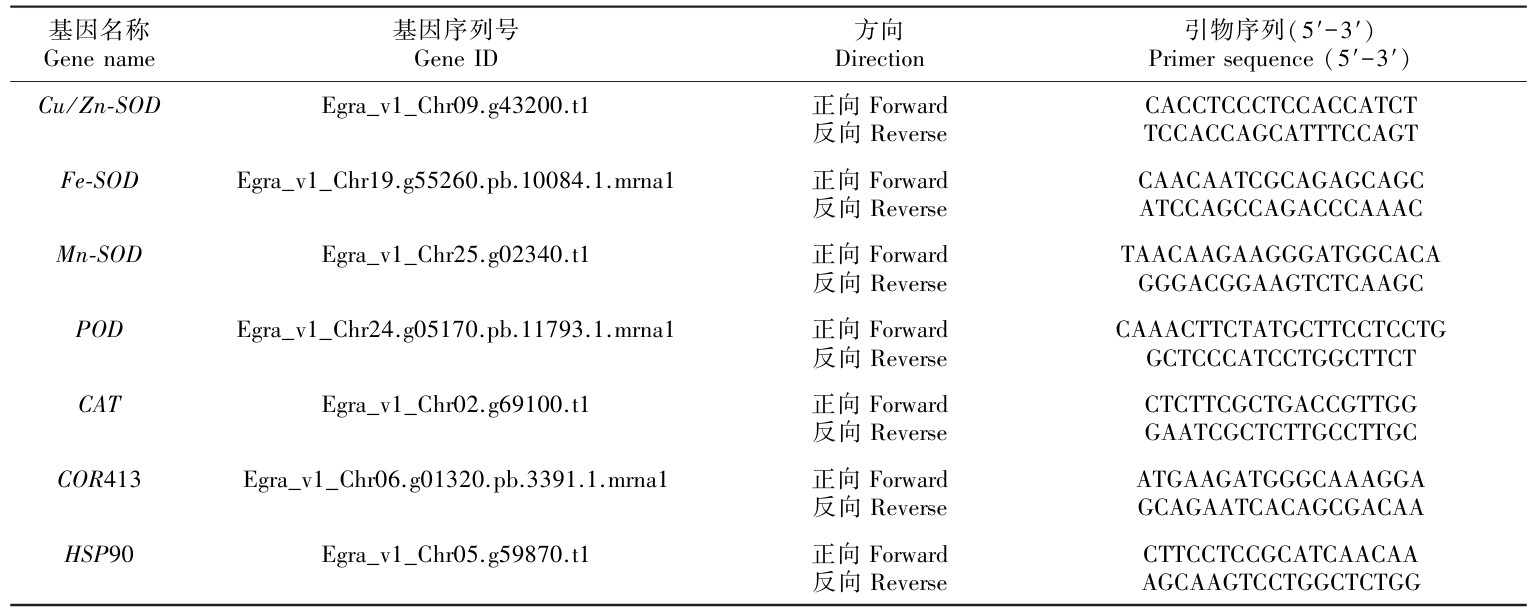
根据洋桔梗Cu/Zn-SOD、Fe-SOD、Mn-SOD、POD、CAT、HSP90及COR413(序列来源:Plant GARDEN,https://plantgarden.jp)基因序列,用Primer Premier 5.0 设计基因特异性引物并合成引物(昆明擎科生物技术有限公司)(表2)。反应体系:Hieff® qPCR SYBR® Green Master Mix(No Rox)试剂10 μL,正反引物各0.4 μL,模板DNA 2 μL,无菌超纯水7.2 μL。扩增程序:95 ℃ 预变性5 min,95 ℃变性10 s,60 ℃ 退火30 s,40个循环。每个样品3个重复,使用2-△△Ct计算相对表达量。
1.4 数据分析
所有试验重复3 次,用Microsoft Excel 2019 整合数据,采用SPSS 27.0软件(SPSS Inc,Chicago,IL,USA)进行方差和差异性分析,利用Sigmaplot 14.0作图。
2 结果与分析
2.1 正交试验筛选ZnO-NPs+SiO2-NPs最佳处理方案
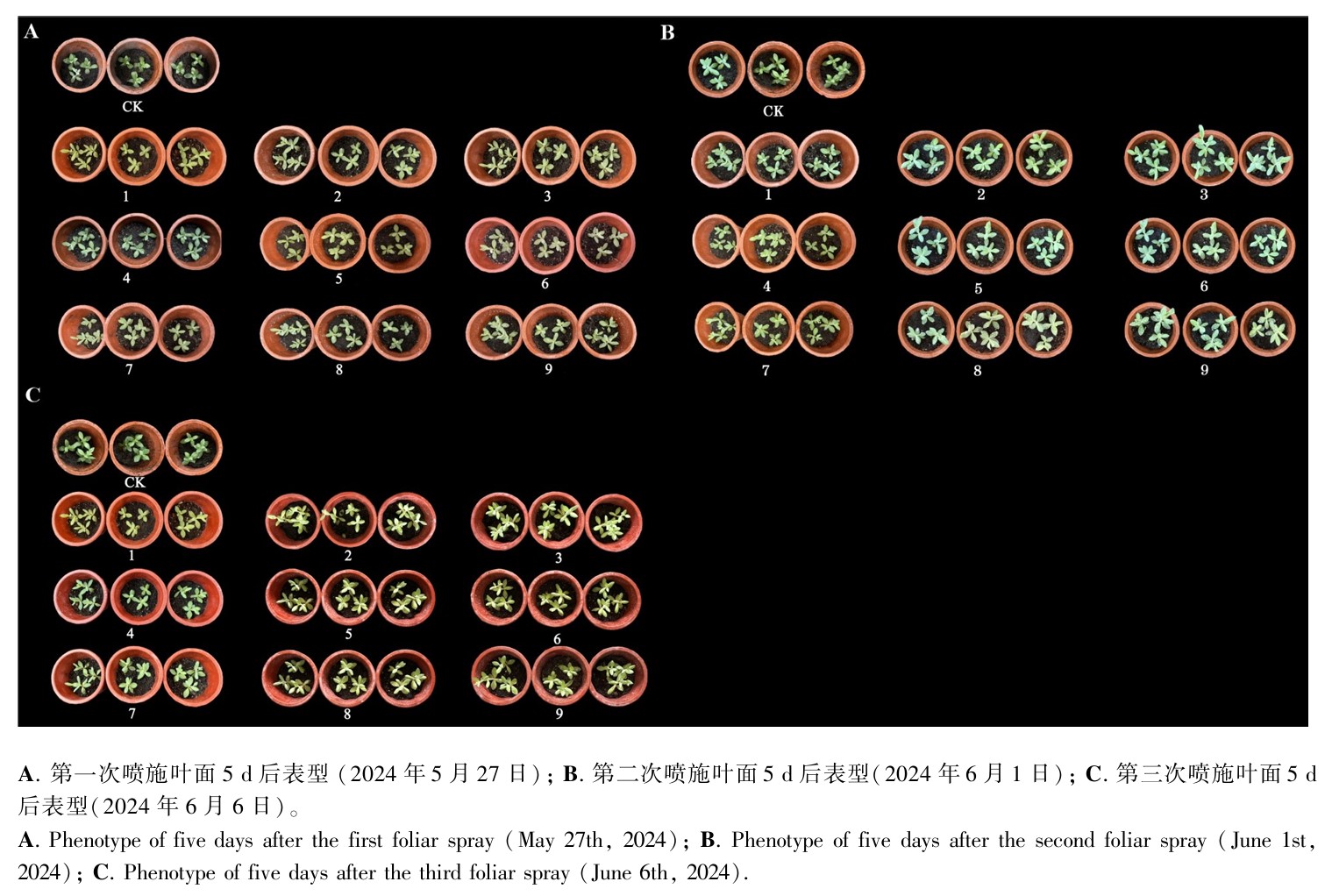
用正交试验设计了9组处理(表1),对洋桔梗幼苗叶面喷施后,如图1所示,组合2(浓度0.03%,喷施2次,配比1∶2)幼苗生长旺盛,叶片舒展、叶色浓绿、株高增加。地上部与地下部相对含水量(分别为84.27%和90.76%)及叶绿素含量(0.85 mg·g-1)显著高于其他处理组(表3)。极差R分析表明,各因素影响程度为浓度(A)>配比(C)>次数(B)。因此,后续温度胁迫实验采用组合2方案预处理洋桔梗幼苗。
2.2 ZnO-NPs+SiO2-NPs预处理对温度胁迫下洋桔梗幼苗形态的影响
由图2可知,当洋桔梗幼苗在24 h的42 ℃胁迫后,对照组幼苗的叶色变暗淡,ZnO-NPs+SiO2-NPs预处理的幼苗叶片颜色保持鲜亮;当幼苗受4 ℃胁迫后,对照组的幼苗不仅叶片暗淡且明显萎缩,试验组胁迫前后在形态上无明显变化。
2.3 ZnO-NPs+SiO2-NPs预处理对温度胁迫下洋桔梗幼苗叶片的叶绿素含量、相对电导率、MDA含量和H2O2含量的影响
如图3:A所示,温度胁迫后,对照组与ZnO-NPs+SiO2-NPs预处理的叶绿素均降低,而ZnO-NPs+SiO2-NPs预处理的含量高于对照组。如图3:B所示,42 ℃和4 ℃胁迫均导致洋桔梗叶片的相对电导率上升;与对照组相比,ZnO-NPs+SiO2-NPs预处理能极显著降低洋桔梗幼苗在4 ℃胁迫后的叶片相对电导率。如图3:C所示,在温度胁迫前,对照组MDA含量高于ZnO-NPs+SiO2-NPs预处理(P<0.01);ZnO-NPs+SiO2-NPs预处理在42 ℃和4 ℃胁迫后,MDA含量极显著低于对照组。如图3:D所示,温度胁迫导致对照组的H2O2含量显著增加(P<0.01);与对照组相比,ZnO-NPs+SiO2-NPs预处理在42 ℃和4 ℃胁迫后H2O2含量极显著降低(P<0.01)。
表
2
qPCR引物序列
Table
2
Primer sequence for qPCR
图
1
洋桔梗幼苗生长状况
Fig.
1
Growth status of Eustoma grandiflorum seedlings
表
3
正交试验设计及结果
Table
3
Orthogonal experimental design and result
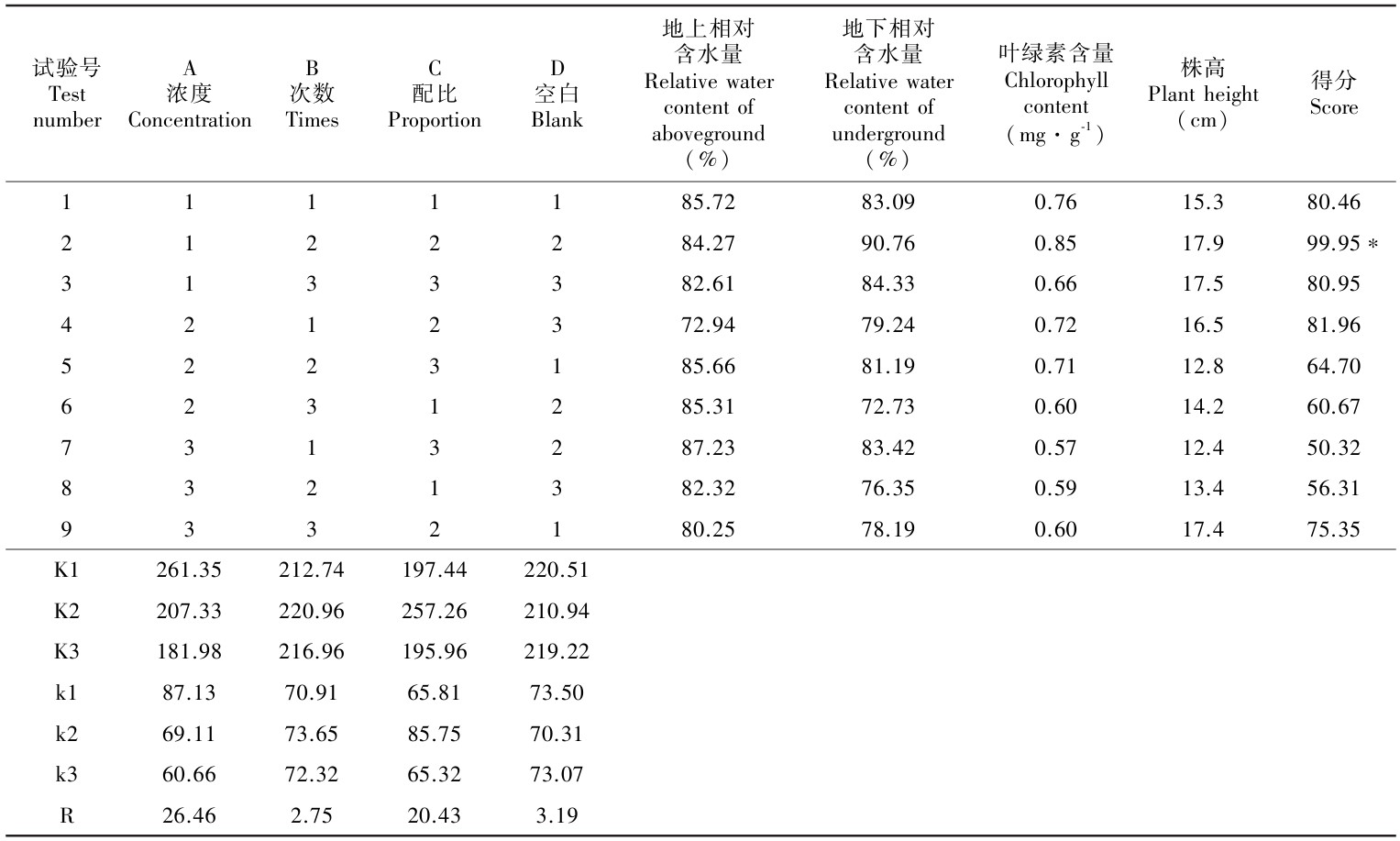
注:K1、K2、K3代表某一因素在不同水平下所有指标值的总和;k1、k2、k3代表某一因素在不同水平下所有指标值的平均值;得分=地上部分相对含水量得分 × 25%+ 地下部分相对含水量得分 × 25%+ 叶绿素含量得分 × 25%+ 株高得分 × 25%;*表示得分最高的组。
Note: K1, K2, and K3 represent the sum of all indicator values for a certain factor at different levels; k1, k2, and k3 represent the average of all indicator values for a certain factor at different levels; score= score of relative water content of above-ground × 25%+ score of relative water content of under-ground × 25%+ score of chlorophyll content × 25%+ score of plant height × 25%;* indicates the group with the highest score.
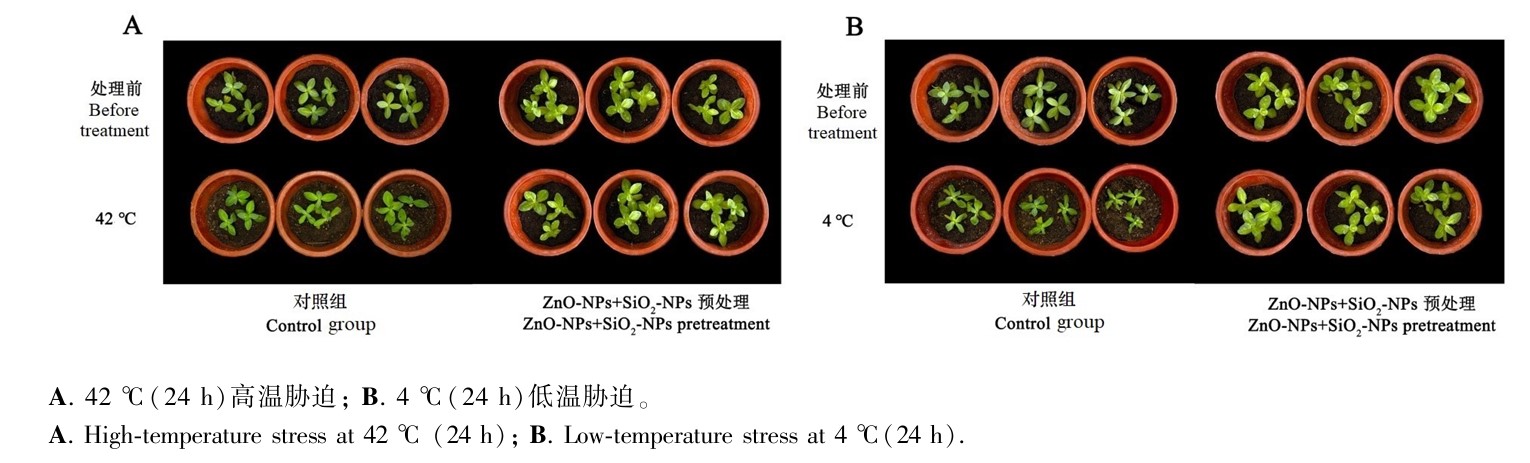
图
2
温度胁迫下洋桔梗幼苗的形态变化
Fig.
2
Morphological changes in Eustoma grandiflorum seedlings under temperature stress
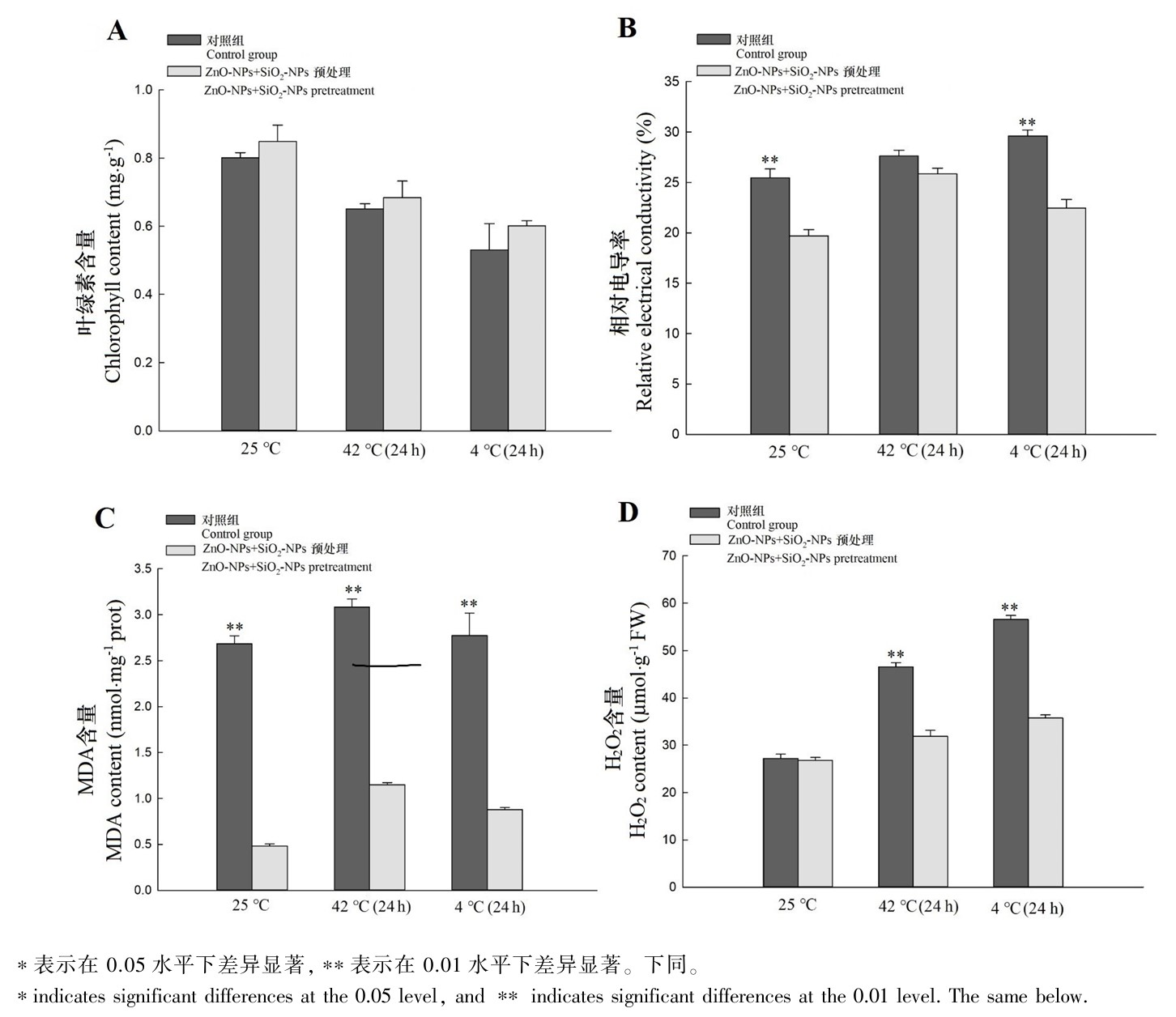
图
3
温度胁迫对洋桔梗叶绿素含量、相对电导率、MDA含量和H2O2含量的影响
Fig.
3
Effects of temperature stress on chlorophyll content, relative electrical conductivity, MDA content, and H2O2 content in Eustoma grandiflorum
2.4 ZnO-NPs+SiO2-NPs预处理对温度胁迫下洋桔梗幼苗叶片中抗氧化酶活性的影响
SOD是细胞中抗氧化酶系统清除活性氧的第一道防线。如图4:A所示,温度胁迫前ZnO-NPs+SiO2-NPs预处理SOD活性极显著高于对照组;在42 ℃与4 ℃胁迫处理后,对照组SOD活性极显著低于ZnO-NPs+SiO2-NPs预处理组(P<0.01)。如图4:B所示,对照组在温度胁迫后CAT活性升高,其中4 ℃诱导的CAT活性高于42 ℃诱导;此外,ZnO-NPs+SiO2-NPs预处理能显著提高42 ℃胁迫下洋桔梗幼苗叶片中CAT活性(P<0.01)。如图4:C所示,ZnO-NPs+SiO2-NPs预处理能显著提高温度胁迫后洋桔梗幼苗叶片中POD的活性(P<0.01),42 ℃和4 ℃胁迫后分别是对照组的2.55倍和4.07倍。
2.5 ZnO-NPs+SiO2-NPs预处理对温度胁迫下洋桔梗幼苗叶片中抗逆相关基因表达的影响
如图5:A、B、C所示,与对照组相比,ZnO-NPs+SiO2-NPs预处理均能显著提高3种SOD酶基因的表达,其中Cu/Zn-SOD基因的表达在42 ℃和4 ℃胁迫后分别为对照组的1.40倍和1.15倍,Fe-SOD基因的表达分别为对照组的1.39倍和2.51倍,Mn-SOD基因的表达分别为对照组的1.16倍和4.86倍。
如图5:D所示,无论42 ℃还是4 ℃胁迫,均能诱导POD表达量升高,但ZnO-NPs+SiO2-NPs预处理的POD表达量与对照组差异不显著。温度胁迫前,对照组的CAT表达量低于ZnO-NPs+SiO2-NPs预处理组;42 ℃和4 ℃胁迫后,ZnO-NPs+SiO2-NPs预处理的洋桔梗幼苗中CAT基因的表达分别是对照组的5.07倍和3.87倍(图5:E)。如图5:F、G所示,在25 ℃下,ZnO-NPs+SiO2-NPs预处理的HSP90表达量显著高于对照组;42 ℃胁迫后,ZnO-NPs+SiO2-NPs预处理HSP90的表达是对照组的2.67倍;在4 ℃胁迫后,ZnO-NPs+SiO2-NPs预处理的COR413表达量是对照组的2.29倍(P<0.05)。
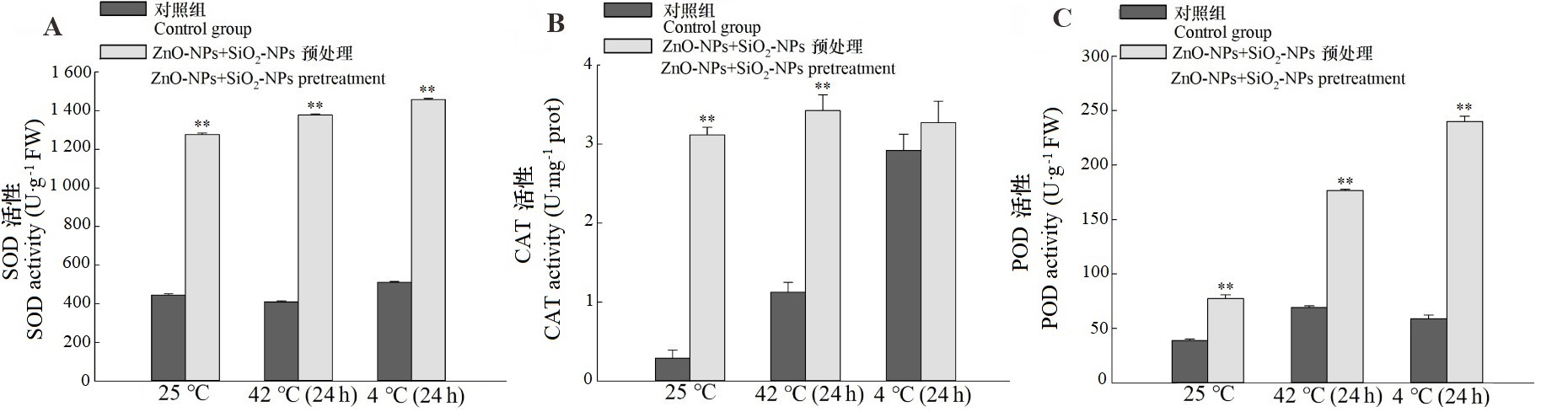
图
4
温度胁迫对洋桔梗SOD、CAT、POD的活性的影响
Fig.
4
Effects of temperature stress on activities of SOD, CAT, and POD in Eustoma grandiflorum
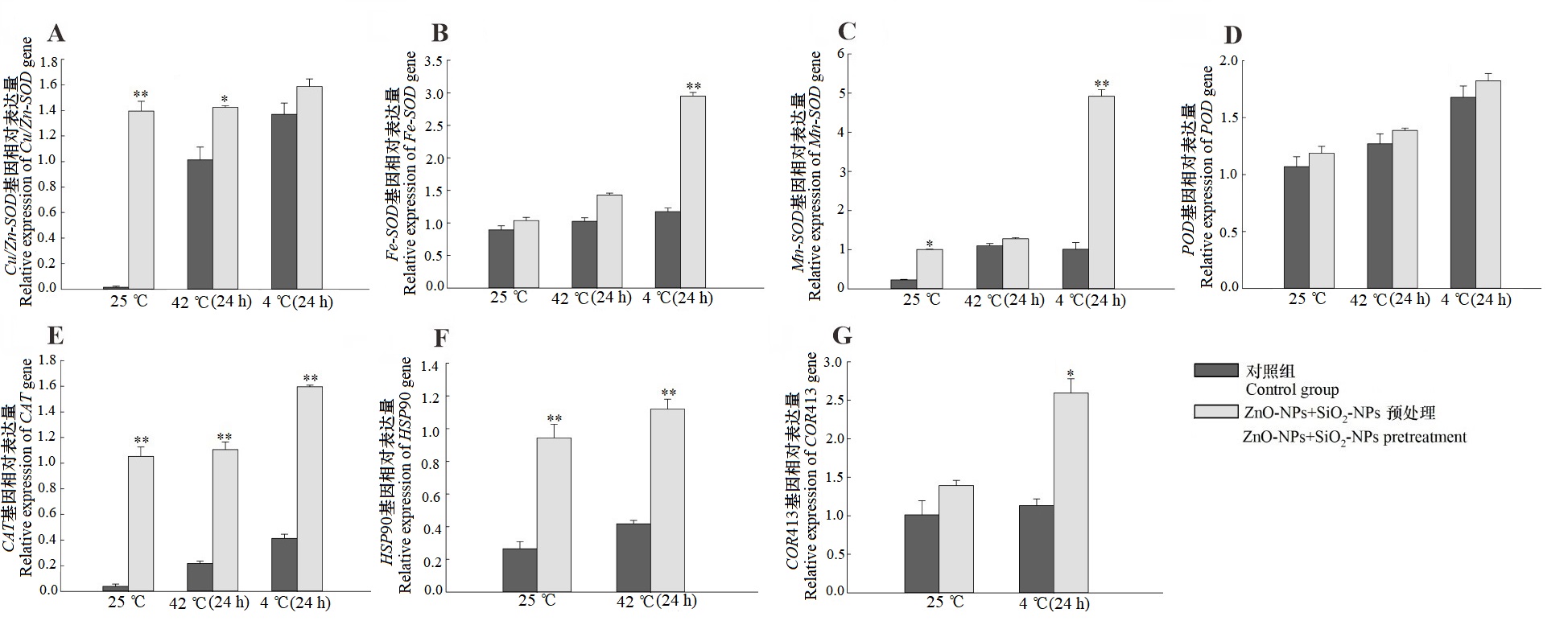
图
5
温度胁迫对洋桔梗抗氧化相关基因表达的影响
Fig.
5
Effects of temperature stress on the expressions of antioxidant-related genes in Eustoma grandiflorum
3 讨论
纳米粒子因具有易于获得、成本较低及对植物毒性较小等特点,近年来在农业生产中的应用规模正逐渐扩大。在本研究中,通过正交试验确定了ZnO-NPs+SiO2-NPs预处理的最佳方案(浓度0.03%,喷施2次,配比1∶2),该处理显著促进了洋桔梗幼苗生长,使叶片维持较高的叶绿素浓度和相对含水量,而高浓度处理则抑制洋桔梗幼苗的生长。Ochoa-Chaparro等(2025)的研究也证实,ZnO+SiO2复合处理使辣椒幼苗鲜重增加了40%;Shaheen等(2015)发现6 mg·kg-1的Zn可改善百合的花径、花数、茎长和茎粗等特性;Amooaghaie 等(2017)也报道,低浓度的Zn和ZnO-NPs可促进番茄和小麦种子萌发与幼苗生长,而高浓度则表现出抑制作用。此外,在洋葱幼苗中,高剂量的硅纳米颗粒(Si-NPs)则会抑制种子萌发和根长生长,并引起遗传毒性效应,如染色体畸变和微核形成(Silva et al., 2017)。Simko等(2025)研究也发现,进行高浓度SiO2-NPs(29.30 mmol·L-1)叶面喷施可导致生菜生物量下降和叶片黄化,表明其促进作用随喷施浓度升高而减弱。这些研究表明,纳米粒子对植物的效应通常呈浓度依赖性,适宜浓度可促进植物生长,而过高浓度则可能引起毒性效应,抑制植物发育(Seydmohammadi et al., 2020),而使用复合纳米粒子,能更有效地促进植物的生长。
本研究将ZnO-NPs+ SiO2-NPs预处理用于温度胁迫下的洋桔梗,发现其可显著提高叶片叶绿素含量,叶绿素含量提升可能与 ZnO-NPs 增强光捕获复合体稳定性、镁离子生物利用度(Mishra et al., 2019),以及硅通过抑制叶绿素酶活性(Alamri et al., 2020)减少叶绿素降解有关;同时还观察到ZnO-NPs+ SiO2-NPs预处理降低温度胁迫下叶片的相对电导率、H2O2含量和MDA含量,这与 Khalid 等(2022)在多种作物中的报道一致。本研究还发现,经预处理的幼苗叶片中SOD、CAT和POD的活性无论是温度胁迫前还是胁迫后均比对照组高。相似的报道也较多,如ZnO-NPs 处理可提高辣椒和番茄幼苗中 CAT 和 POD的活性(Sánchez-Pérez et al., 2023),在棉花中显著增强SOD和POD的活性(Venkatachalam et al., 2017),用ZnO+SiO2处理辣椒幼苗,脯氨酸含量增加,抗氧化能力提升,总酚含量增长(Ochoa-Chaparro et al., 2025)。此外,有研究表明,ZnO-NPs 在干旱和盐胁迫下促进脯氨酸积累、改善根系构型,从而提高水分吸收能力(Chandrashekar et al., 2023);SiO2-NPs可在细胞壁沉积形成硅-碳层,增强机械强度,并提升水分利用效率(El-Saadony et al., 2022)。由此可见,ZnO-NPs和SiO2-NPs能通过多种途径显著提升植物的抗逆能力。
通过对抗氧化酶基因的表达分析,本研究结果显示,在温度胁迫下,经ZnO-NPs+ SiO2-NPs预处理的洋桔梗幼苗中5个抗氧化酶基因(Cu/Zn-SOD、Fe-SOD、Mn-SOD、CAT、POD)表达显著上升,与Torabian 等(2016)、Farhangi-Abriz和Torabian(2018)及Bhat等(2021)的结果一致。Cu/Zn-SOD在4 ℃下的显著高表达可能与 ZnO-NPs 提供锌离子直接激活该酶活性,以及SiO2-NPs通过维持细胞完整性间接减少 ROS 对酶的抑制有关(El-Saadony et al., 2022),这种协同机制可能也是复合处理效果优于单一处理的主要原因。
热激蛋白HSP90与冷调节蛋白COR413是植物在逆境条件下诱导合成的应激蛋白,已有研究证实它们分别在高温和低温胁迫中发挥了保护作用(Breton et al., 2003;杨德双等,2026)。本研究结果显示,在ZnO-NPs+SiO2-NPs预处理后,洋桔梗幼苗中HSP90在42 ℃胁迫下表达显著上调,以及COR413在4 ℃胁迫下表达显著升高,这可能是纳米离子被细胞吸收后,会作为一种应激源,激活细胞的应激反应通路。
本研究通过24 h的42 ℃与4 ℃胁迫处理,初步证实ZnO-NPs+SiO2-NPs预处理可通过提升抗氧化酶活性,以及上调抗氧化酶基因HSP90与COR413的表达量,有效增强洋桔梗幼苗的抗温度胁迫能力,为复合纳米材料在花卉育苗中缓解温度胁迫提供理论依据。
4 结论
本研究采用正交试验设计,筛选出ZnO-NPs和SiO2-NPs喷施洋桔梗幼苗的最佳方案为二者配比1∶2(V/V),总浓度 0.03%(m/V),叶面喷施 2 次。叶面喷施ZnO-NPs+ SiO2-NPs预处理能显著提升洋桔梗幼苗对温度胁迫的抗性,植株表现为叶片平展和叶色浓绿,叶片中H2O2和MDA的含量下降,抗氧化酶活性显著增加,逆境响应相关基因表达上调。