


摘要
为探明桃(Prunus persica)PP2C基因家族成员在桃花芽休眠期间的表达特性,该研究从休眠期桃花芽转录组数据中鉴定出7个PpPP2C基因,利用生物信息学方法分析其理化性质、系统进化关系、保守基序及启动子顺式作用元件等,并采用qRT-PCR方法检测不同需冷量(chilling requirement,CR)桃花芽PpPP2C基因从休眠前至休眠解除的表达情况。结果表明:(1)7个PpPP2C基因编码氨基酸序列的理化性质和保守基序结构具有较高相似性。7个PpPP2C均属于A亚族,而A亚族是脱落酸(ABA)信号通路的关键因子,说明在桃花芽休眠过程中PpPP2C是通过ABA信号转导过程参与休眠调控。(2)PpPP2C启动子区域存在丰富的脱落酸响应元件、光响应元件和茉莉酸甲酯响应元件,推测这3类元件能够调控PpPP2C基因转录进而调控休眠。(3)qRT-PCR结果显示,PpPP2C基因在进入休眠前表达量较高,进入休眠后表达量降低,说明休眠会抑制PpPP2C的表达;而CR≥400 h品种PpPP2C基因表达量比CR≤200 h品种更早开始降低,这种差别可能是由需冷量不同导致进入休眠的时期不一致,CR≤200 h品种需要更短的日照或低温从而延迟进入休眠。该研究初步阐明了PP2C 基因在ABA调控休眠中的作用,为后续深入解析其调控网络提供了重要依据。
Abstract
To characterize the expression of PP2C gene family members during peach flower bud dormancy, seven PpPP2C genes were identified from transcriptome data of dormant peach flower buds. Bioinformatics methods were used to analyze the physicochemical properties, phylogenetic relationships, conserved motifs, and promoter cis-acting elements, and qRT-PCR was employed to measure PpPP2C expression levels in varieties with differing chilling requirements from pre-dormancy to dormancy release. The results were as follows: (1)The amino acid sequences encoded by the seven PpPP2C genes exhibited highly similar physicochemical properties and conserved motif structures. All seven PpPP2C genes belonged to Subfamily A, a key component of the abscisic acid (ABA) signaling pathway, suggesting their involvement in dormancy regulation through ABA signal transduction. (2) The promoter regions of PpPP2C genes contained abundant abscisic acid, light, and methyl jasminate response elements, which are thought to regulate PP2C transcription during dormancy. (3) qRT-PCR results showed higher PpPP2C expression before dormancy, with levels declining after dormancy onset, indicating that dormancy suppressed PpPP2C expression. However, in varieties with CR≥400 h, this decrease began earlier than in those with CR≤200 h. This discrepancy might be attributed to different periods of dormancy resulting from varying chilling requirements, where varieties with CR≤200 h required shorter day lengths or lower temperature and consequently entered dormancy later. This study preliminarily elucidated the role of PP2C genes in ABA-mediated dormancy regulation, providing an important basis for further analysis of its regulatory network.
Keywords
在多年生木本植物中,芽休眠是应对冬季低温等不利环境的重要生存策略。脱落酸(abscisic acid,ABA)是调控芽休眠的关键激素,ABA信号转导途径参与了ABA对休眠过程的调控(Cooke et al.,2012)。ABA信号通路由ABA受体、蛋白磷酸酶2C(protein phosphatases 2C,PP2Cs)和SNF1相关蛋白激酶2(SNF1-related protein kinase 2s,SnRK2s)3个关键组分组成。ABA与RCAR/PYR/PYL受体结合后与PP2C形成复合物,使PP2C失活,释放SnRK2s蛋白,从而磷酸化下游转录因子,触发下游ABA反应。磷酸化的SnRK2s激活下游转录因子,触发下游ABA反应(Soon et al.,2012)。
PP2C是植物中最大的丝氨酸/苏氨酸蛋白磷酸酶家族之一,PP2C蛋白C端具有保守的催化结构域,而N端可变区域赋予其功能多样性(Fuchs et al.,2013)。根据氨基酸序列相似性,PP2C大致可分为12个亚族(A-L):A亚族是ABA信号通路中的关键因素(Hirayama & Umezawa,2010);B亚族参与抑制丝裂原活化蛋白激酶(mitogen-activated protein kinase,MAPK)在损伤或病原体胁迫下的激活(Schweighofer et al.,2007);C亚族参与调节花发育(Song et al.,2008;Gagne & Clark,2010);E亚族参与气孔信号调节(Servet et al.,2008);F亚族参与诱导应激反应(Lee et al.,2008)。总体而言,同一亚族的PP2C基因具有相似的生物学功能。其中,A亚族因参与ABA信号转导而被研究得最为深入(Hirayama & Umezawa,2010)。
PP2C-A磷酸酶是ABA信号途径的负调控组分,通过抑制SnRK2,阻断ABA信号途径。Li等(2018)在梨的转录组学研究中发现,ABA信号抑制因子PP2C的表达在休眠期间保持低水平,随着ABA含量的下降而增加。此外,外源ABA促进SnRK2s表达,抑制PP2C表达。在日本梨研究中也得到了类似的结果,在芽解除休眠后,PP2C基因上调,SnRK2s基因下调(Bai et al.,2013)。PP2C也参与调控休眠基因,种子休眠的关键调节因子DOG1可直接与A亚族PP2C成员(AHG1和AHG3)相互作用,控制种子休眠(Née et al.,2017;Nishimura et al.,2018)。在小麦中,TaPP2C-a10与TaDOG1L1和TaDOG1L4相互作用调控种子休眠与萌发(Yu et al.,2020)。这些研究结果均表明,PP2C可能通过ABA信号转导与休眠基因调控,在植物休眠中发挥核心作用。然而,目前研究大多集中于单一通路的研究,ABA信号转导与休眠基因两者间是否存在调控网络,PP2C是否能通过信号转导调控下游休眠基因(如DAMs)的表达,从而介导休眠的建立、维持与解除,以及休眠过程中调控PP2C转录的因子有哪些,仍有待进一步阐明。
基于前期桃花芽休眠期转录组测序,鉴定到7个差异表达的PpPP2C基因。通过对 7个PpPP2C基因进行鉴定,分析其理化性质、进化关系、保守基序、启动子顺式作用元件及在休眠过程中的表达模式等,为进一步研究PP2C 基因在ABA调控休眠中的作用及为休眠调控网络的构建奠定基础。
1 材料与方法
1.1 PP2C蛋白特征分析
利用在线程序Expasy(https://web.expasy.org/protparam/) 对PpPP2C基因编码蛋白的氨基酸数、等电点、不稳定系数、分子量和亲水性指数(grard average of hydropathicity,GRAVY)等进行分析。利用PSORT(https://wolfpsort.hgc.jp/)进行亚细胞定位预测。
1.2 PP2C系统发育分析
在拟南芥数据库(https://www.arabidopsis.org/)中下载其PP2C蛋白序列,采用 MEGA X 软件对PP2C蛋白进行多序列比对,利用邻接法(neighbor-joining method,NJ)构建系统发育树,设置bootstrap值为1 000。
1.3 PP2C蛋白保守基序分析
利用 MEME(https://meme-suite.org/)在线工具分析PpPP2C 蛋白的保守基序,设置输出值为20,下载xml文件,再利用TBtools 软件对PpPP2C 蛋白保守基序(motif)进行可视化。
1.4 启动子顺式作用元件分析
利用TBtools软件提取PpPP2C基因起始密码子(ATG)上游2 000 bp序列进行启动子分析,利用在线软件PlantCARE(http://bioinformatics.psb.ugent.be/webtools/plantcare/html/)分析其顺式作用元件,利用Excel统计分析数据。
1.5 实时荧光定量表达分析
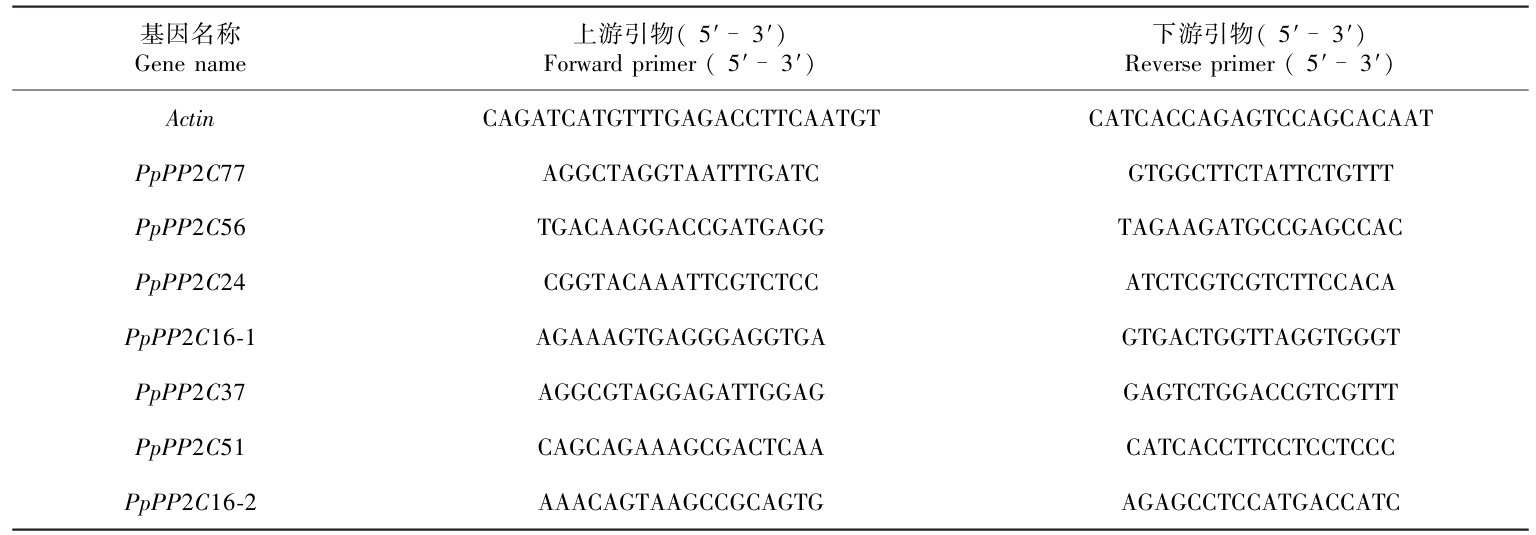
从10月花芽进入休眠前开始,每隔15 d选取桃树1年生枝条花芽置于液氮中速冻1 min,之后保存于-80 ℃以备用。采用华越洋植物RNA提取试剂盒提取花芽RNA;采用风生贝尔FonSuperTM RTⅢAll-in-One Mix(with dsDNase)试剂盒进行反转录;采用MonAmpTM SYBR Green qPCR Mix试剂盒进行荧光定量。以桃Actin基因作为内参,使用美国BIO CFX Opus 96荧光定量PCR仪进行分析。反应程序如下:95 ℃预变性5 min;95 ℃变性15 s,59 ℃退火30 s,72 ℃延伸20 s,40个循环。采用2-ΔΔCt方法计算基因的相对表达量,使用Excel进行数据分析,使用TBtools进行绘图。所用引物见表1。
2 结果与分析
2.1 PpPP2C蛋白理化性质分析
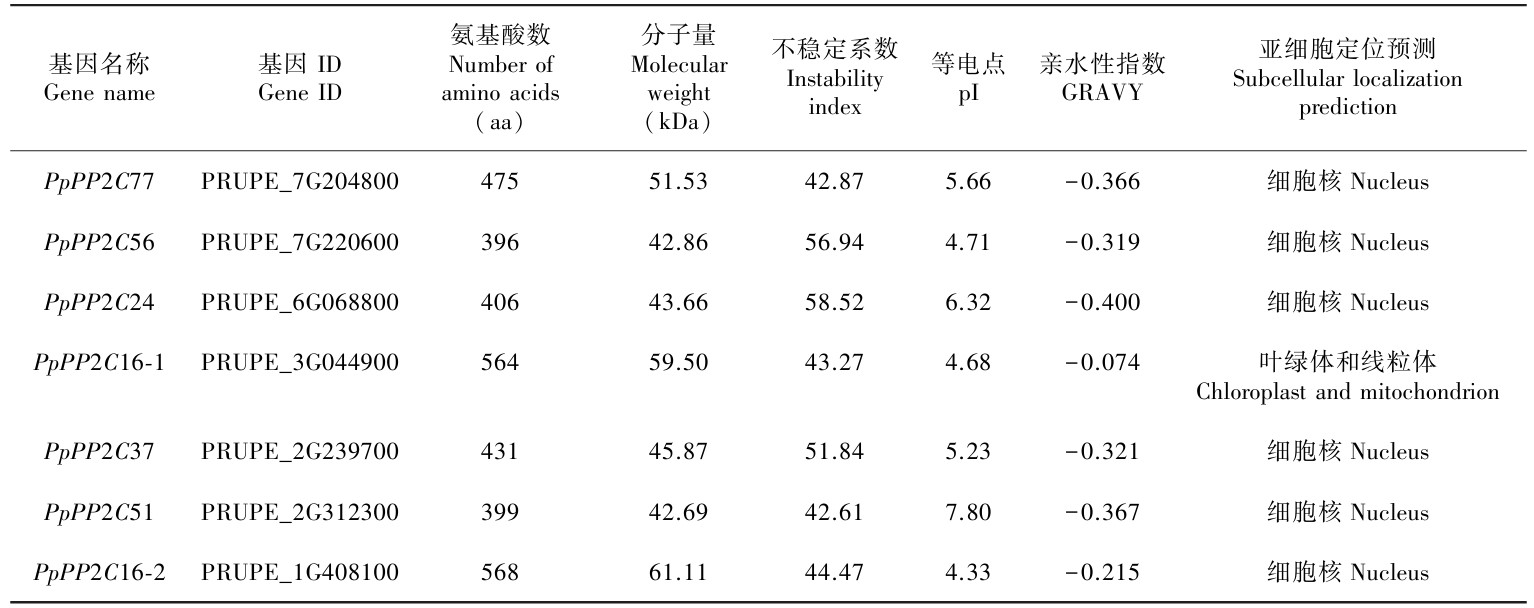
通过对桃休眠期花芽转录组测序,共鉴定到7个差异表达显著的PpPP2C基因家族成员,氨基酸数为396~568 aa,分子量为42.69~61.11 kDa;PpPP2C51等电点大于7,为碱性蛋白,其余6个成员均为酸性蛋白;7个PpPP2C蛋白的不稳定系数为42.61~58.52,均大于40,为不稳定蛋白;蛋白亲水性指数为-0.400~-0.074,均小于0,为亲水性蛋白;亚细胞定位预测结果显示,PpPP2C16-1蛋白被定位到叶绿体和线粒体,其余6个PpPP2C 蛋白被定位到细胞核中,结果见表2。
2.2 基因系统进化树分析
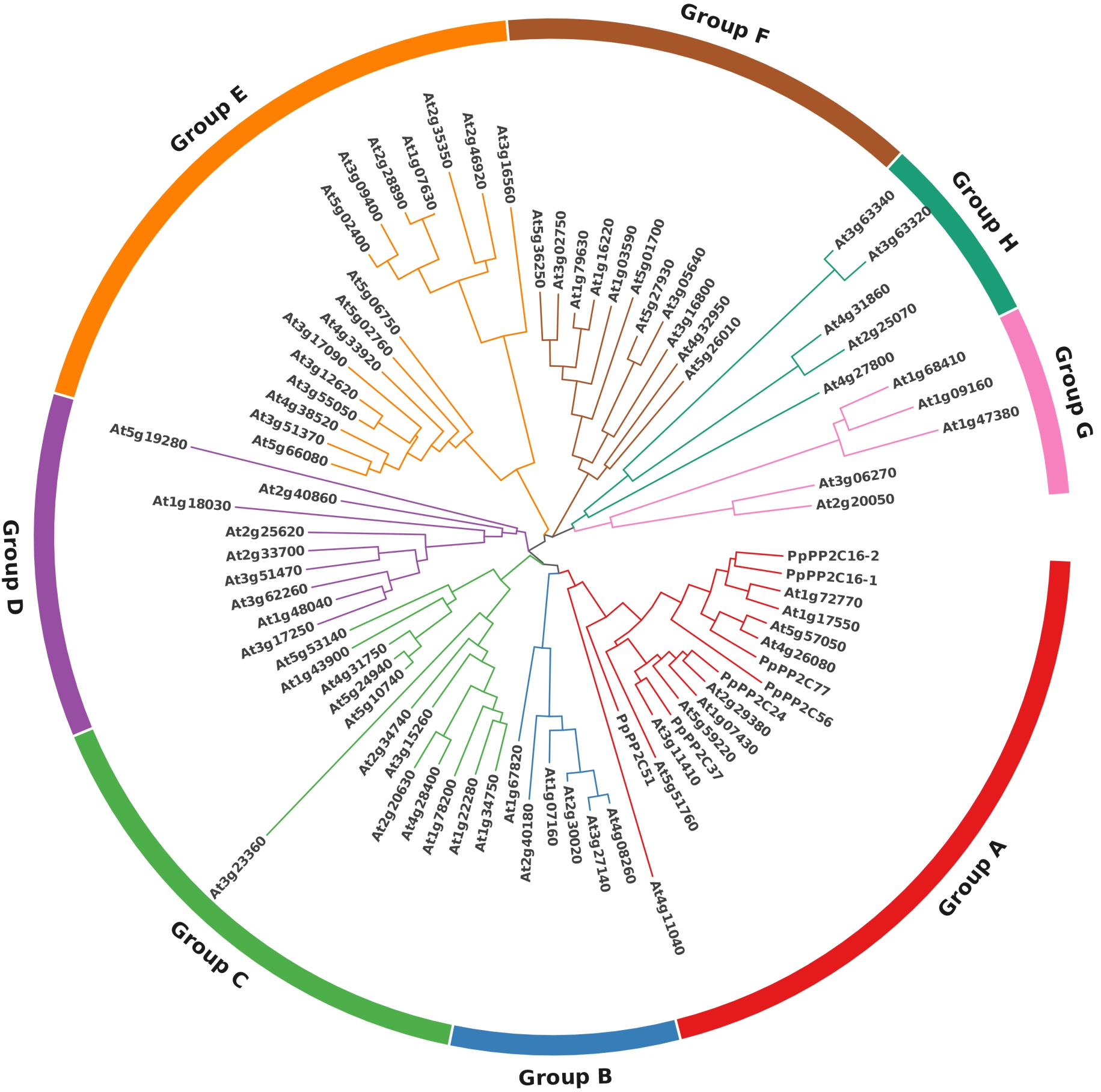
将7个PpPP2C基因与拟南芥(Arabidopsis thaliana)中已报道的PP2C基因构建系统进化树。结果(图1)表明,7个PpPP2C与拟南芥AtPP2C A亚族(Group A)同源性最高,全部属于PP2C A亚族基因,说明在桃休眠过程中主要是A亚族PP2C参与调控。
2.3 PpPP2C蛋白的保守基序分析
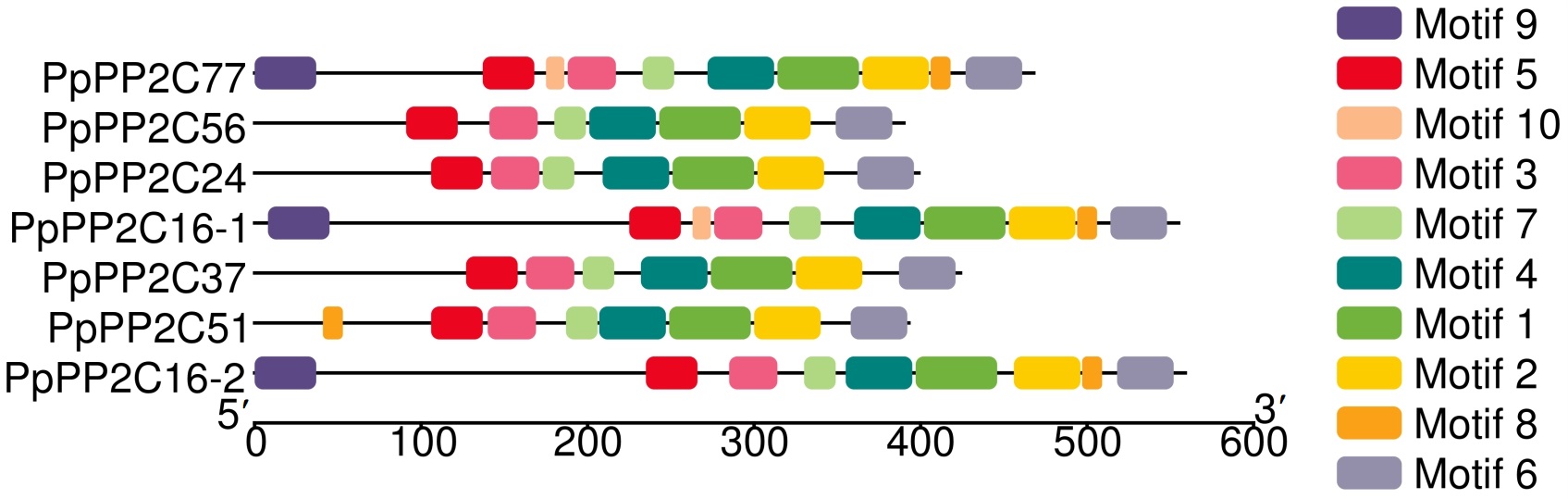
为进一步探究PP2C蛋白的序列特征,对PpPP2C蛋白保守基序组成进行分析(图2),得到10个保守基序,基序数量差异不大,为7~10个。在7个PpPP2C 蛋白中均含有Motif 1-Motif 7的基序结构,说明其保守基序的构成具有高度相似性。
2.4 PpPP2C基因的启动子顺式作用元件
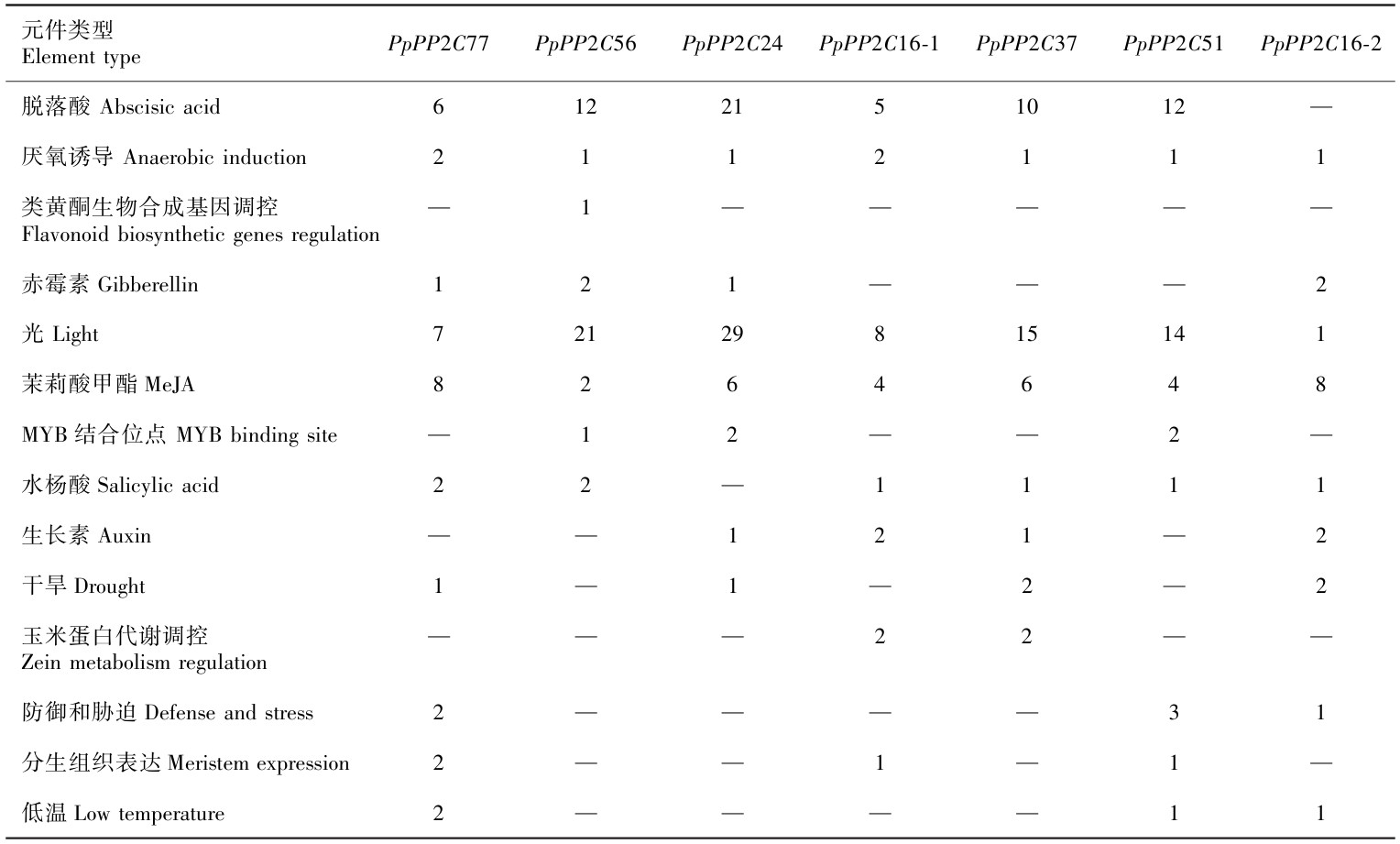
对7个PpPP2C的启动子进行分析,结果(表3)表明PpPP2C启动子区域存在脱落酸(abscisic acid) 响应元件、光(light) 响应元件、茉莉酸甲酯(methyl jasminate, MeJA) 响应元件、水杨酸(salicylic acid) 响应元件、赤霉素(gibberellin) 响应元件、生长素(auxin) 响应元件、低温(low temperature) 响应元件和MYB结合位点(MYB binding site)相关的响应元件等。7个PpPP2C基因中有6个均含有较丰富的脱落酸响应元件、光响应元件和MeJA响应元件,说明在休眠过程中PpPP2C可能主要受脱落酸、光和MeJA的调控。值得注意的是,PpPP2C77、PpPP2C51和PpPP2C16-2 3个基因启动子区含有1~2个低温响应元件,说明低温也参与调控PP2C。
表
1
引物信息
Table
1
Primer information
表
2
PpPP2C蛋白信息
Table
2
Information of PpPP2C protein
图
1
桃7个PpPP2C与拟南芥AtPP2C系统发育分析
Fig.
1
Phylogenetic analysis of seven peach PpPP2C and Arabidopsis thaliana AtPP2C
2.5 休眠期PpPP2C基因表达分析
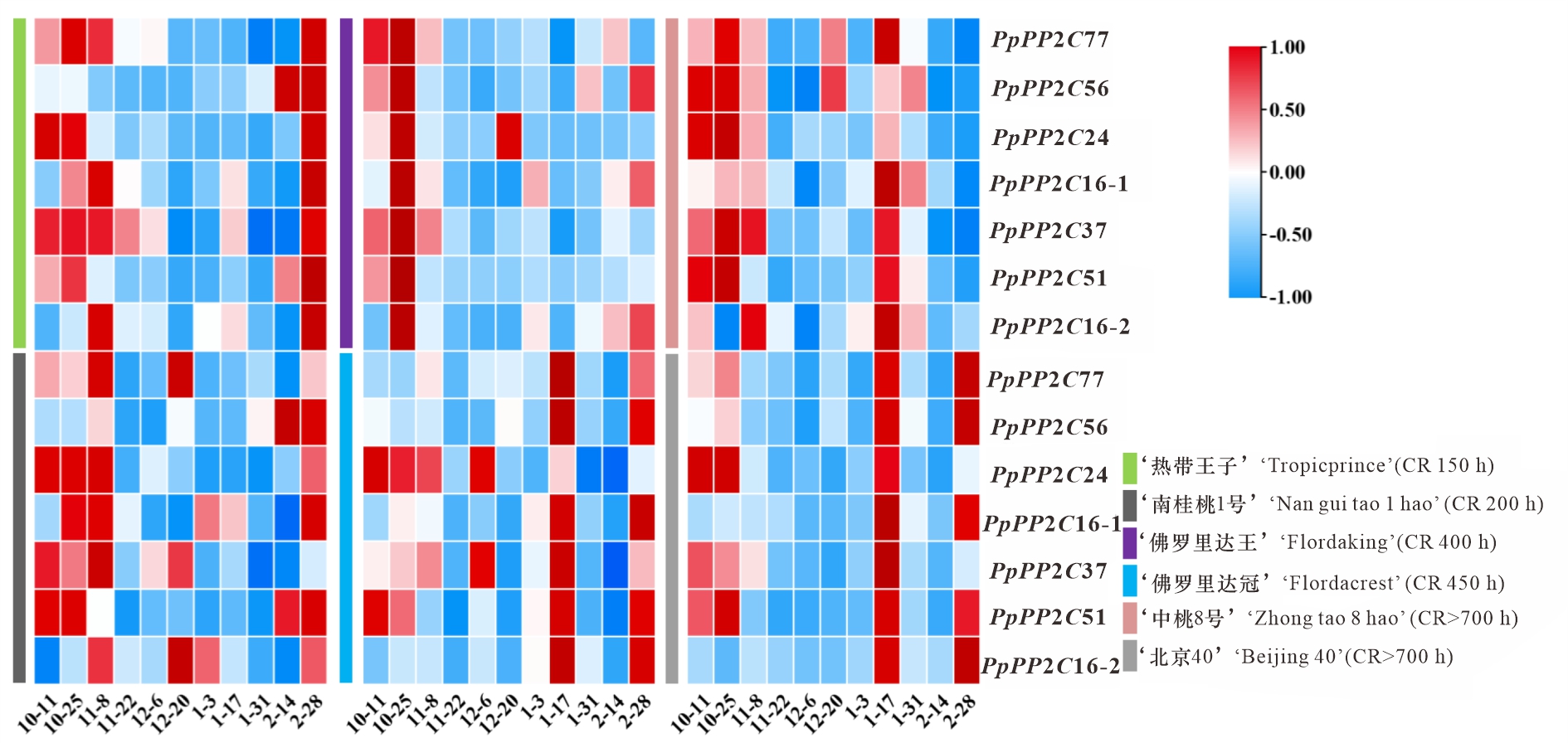
为探究PpPP2C基因在桃花芽休眠中的可能功能,本研究选取不同需冷量桃品种,分析其花芽从休眠前至休眠解除的PpPP2C基因相对表达量。结果(图3)显示,7个PpPP2C基因在进入休眠前在不同需冷量桃品种中表达量较高,进入休眠后表达量降低,并且不同需冷量桃品种的基因表达量降低时期存在差异。在CR≤200 h品种中,7个PpPP2C基因大多在11月22日开始降低,而在CR≥400 h及以上品种中,在11月8日就显著降低,这种差别可能是由品种需冷量差异导致进入休眠的时期不一致。CR≤200 h品种中基因表达量降低后持续维持在较低水平,直到2月14日,此时花芽开始萌动,部分基因表达量显著升高,在2月28日所有基因表达量均升高;在CR≥400 h及以上品种中,进入休眠后基因表达量同样维持在较低水平,但在1月17日基因表达量存在一个显著升高趋势,这种趋势在CR>700 h品种中更为突出,随后基因表达量再次降低,直到2月28日花芽开始萌动时基因表达量再次升高。
3 讨论与结论
本研究从休眠期桃花芽转录组数据中,鉴定出7个差异表达显著的PpPP2C家族基因。对PpPP2C蛋白保守基序组成进行分析,得到10个保守基序,7个PpPP2C蛋白均含有Motif 1-Motif 7的基序结构,其理化性质和保守基序的构成具有高度相似性。与拟南芥PP2C基因构建系统发育进化树,发现7个PpPP2C同属于A亚族。Hao等(2011)研究认为只有A 亚族参与ABA 信号转导过程,说明在桃花芽休眠过程中主要诱导A亚族PP2C的表达,PpPP2C是通过ABA信号转导过程参与休眠调控。
启动子区域的顺式元件与基因转录密切相关,它们通过与同源转录因子相互作用,在植物信号转导中起着关键作用。本研究发现,7个PpPP2C启动子区存在较丰富的脱落酸响应元件、光响应元件、茉莉酸甲酯响应元件。有研究表明,光周期是影响休眠进程的重要因子,短日照促进休眠,而长日照延迟休眠。光周期变化会通过调节呼吸代谢、芽体水分、钙信号、ABA代谢等影响休眠进程(高东升等,2002;简令成等,2004;Pang et al.,2007;Zheng et al.,2015)。ABA 含量在类休眠至内休眠转变过程中增加,而在内休眠至生态休眠过程中下降(Zheng et al.,2015;Wang et al.,2015;Tuan et al.,2017)。ABA可能是通过PpCYP707A-3、PpNCEDs、PpPP2Cs、PpSnRK2s和PpABI4/PpABI5s等代谢及信号转导基因来调控芽休眠(Li et al., 2018)。Ruttink等(2007)认为休眠的诱导是光周期和ABA共同作用的结果,这与本研究在PpPP2C启动子上同时发现光与ABA响应元件的结果相一致。关于MeJA参与休眠调控的报道较少,有研究发现茉莉酸(jasmonic acid,JA)处理可促进苹果种子萌发(Ranjan & Lewak,1992;Yildiz et al.,2007),在苹果种子低温层积过程中,JA通过调节GA/ABA平衡影响休眠(Lewak,2011)。高浓度MeJA减弱BZR2对PpyDAM3启动子的抑制,从而延缓休眠解除(Wang et al.,2024)。基于PpPP2C基因家族启动子顺式元件的分析结果,本研究认为光周期、ABA及MeJA可能通过调控PpPP2C的转录,共同参与桃花芽休眠进程。
表
3
PpPP2C基因启动子顺式作用元件分析
Table
3
Analysis of cis-acting elements of PpPP2C gene promoters
注:数字表示顺式作用元件的数量。
Note:The numbers represent the number of cis-acting elements.
图
2
PpPP2C蛋白的保守基序
Fig.
2
Conserved motifs of PpPP2C protein
图
3
PpPP2C基因在桃花芽中的表达量
Fig.
3
Expression levels of PpPP2C genes in peach flower buds
低温调控PP2C的表达,小麦中PP2C基因表达受低温胁迫显著抑制(胡伟等,2014)。辣椒2个PP2C家族A亚族基因(CaPP2C97和CaPP2C3)在低温处理24 h时在叶片中呈现显著的下调表达(马玉虎等,2023)。这些结果表明,PP2C可能作为低温响应的负调控组分,其表达下调有助于增强植物对低温胁迫的适应性。本研究在3个PpPP2C基因启动子中鉴定出低温响应元件,而低温不仅是诱导休眠的环境因子,也是休眠解除关键因子之一(Niu et al.,2016),结合前人研究结果,低温信号可能直接作用于PpPP2C的转录调控,进而参与休眠进程。
对7个PpPP2C基因在不同需冷量桃花芽中的表达特性进行分析,发现这些基因在进入休眠前在不同需冷量桃品种中表达量较高,进入休眠后表达量显著降低,说明休眠对PpPP2C的表达具有抑制作用。在天女木兰休眠解除过程中,3个PP2C基因表达量总体均呈“先下降”趋势(孙宏涛,2022)。在杨树中,PtdPP2C1的表达在休眠诱导期上调,可能通过抑制SnRK2活性促进休眠(Ruttink et al.,2007)。在梨中,PP2C基因表达量在休眠期间保持低水平(Li et al., 2018)。上述结果均表明,PpPP2C表达量的抑制及持续维持的低表达水平能够促进休眠建立与维持。本研究还发现,CR≥400 h品种PpPP2C基因表达量比CR≤200 h品种更早开始降低,这种差别可能是由需冷量差异导致进入休眠的时期不一致。高需冷量品种通常对秋季短日照和低温信号更敏感,更早启动休眠以避免冬季伤害(Allard et al.,2016),低需冷量品种可能需要更短的日照或低温刺激而延迟休眠诱导(Myking & Heide,1995;Liu & Sherif,2019)。因此,PpPP2C表达下调的时期差异可能反映了不同需冷量品种休眠诱导时间和深度不同,其较早抑制可能通过ABA信号途径更早地诱导其进入休眠状态。
综上所述,光周期、ABA、MeJA及低温等信号可能通过调控PpPP2C的转录参与桃花芽休眠调控。PpPP2C在休眠期间的表达受抑制,并通过介导ABA信号转导参与调控休眠启动的早晚与深度。本研究初步阐明了PpPP2C基因家族在桃花芽休眠中的表达特性及其调控因子,为后续深入解析其调控网络提供了重要依据。