


摘要
为研究黄花棘豆的化学成分及其抗氧化活性,该研究采用硅胶色谱柱、Sephadex LH-20色谱柱及半制备高效液相色谱等色谱技术对黄花棘豆醇提物进行分离纯化,并综合运用UV、IR、HR-MS、NMR等波谱学方法鉴定其化合物结构,以及通过1,1-二苯基-2-三硝基苯肼(DPPH)和2,2-联氮-二(3-乙基-苯并噻唑-6-磺酸)(ABTS)的自由基清除实验评价化合物的抗氧化活性。结果表明:(1)从黄花棘豆中分离鉴定出12个黄酮类成分,分别为ochrocephalamine Q(1)、(6aR,11aR)-10-hydroxy-3,9-dimethoxypterocarpan(2)、3′,7-二羟基-2′,4′-二甲氧基异黄烷(3)、bosenegaloside A(4)、5-hydroxy-2-(4-hydroxyphenyl)-7-methoxy-3-[6-O-(1-oxohexadecyl)-α-D-altropyranosyl]-4H-1-benzopyran-4-one(5)、鼠李柠檬素(6)、3,5,7-三羟基-4′-甲氧基黄酮醇(7)、3-O-鼠李柠檬素-6-O-苯甲酰基-β-D-吡喃葡萄糖苷(8)、鼠李柠檬素-3-O-β-D-半乳糖苷(9)、异槲皮苷(10)、鼠李素-3-O-β-D-半乳糖苷(11)及鼠李柠檬素-3-O-β-D-葡萄糖苷(12)。其中,化合物1为新化合物,化合物2、4、5为首次从该物种中分离得到。(2)化合物6、10、11在DPPH自由基清除实验中表现出较强的抗氧化活性,其IC50值分别为(4.90±0.35)、(0.80±0.06)、(1.07±0.02)μg·mL-1,强于阳性对照维生素C [IC50值为(5.72±0.52)μg·mL-1]。同时,在ABTS自由基清除实验中,化合物11亦表现出较强的抗氧化活性,其IC50值为(0.32±0.05)μg·mL-1。该研究结果进一步丰富了黄花棘豆的化学成分,为其潜在资源的开发与利用提供了研究资料。
Abstract
To investigate the chemical constituents of Oxytropis ochrocephala and their antioxidant activities, the ethanol extract of O. ochrocephala was separated and purified using chromatographic techniques including silica gel column chromatography, Sephadex LH-20 chromatography and semi-preparative high-performance liquid chromatography. The structures of the isolated compounds were elucidated by comprehensive spectroscopic analyses, including UV, IR, HR-MS and NMR. The antioxidant activities of the isolated compounds were evaluated using 1, 1-diphenyl-2-picrylhydrazyl (DPPH) and 2, 2-azinobis-(3-ethyl-benzothiazole-6-sulfonic acid) (ABTS) radical scavenging assays. The results were as follows: (1) Twelve compounds were isolated and identified as ochrocephalamine Q (1), (6aR, 11aR)-10-hydroxy-3, 9-dimethoxypterocarpan (2), 3′, 7-dihydroxy-2′, 4′-dimethoxyisoflavan (3), bosenegaloside A (4), 5-hydroxy-2-(4-hydroxyphenyl)-7-methoxy-3-[6-O-(1-oxohexadecyl)-α-D-altropyranosyl]-4H-1-benzopyran-4-one (5), rhamnocitrin (6), 3, 5, 7-trihydroxy-4′-methoxyflavonol (7), 3-O-rhamnocitrin-6-O-benzoyl-β-D-glucopyranoside (8), rhamnocitrin-3-O-β-D-galactoside (9), isoquercitrin (10), rhamnetin 3-O-β-D-galactoside (11) and rhamnocitrin 3-O-β-D-glucoside (12). Among these, Compound 1 was a new compound, while compounds 2, 4 and 5 were reported in this species for the first time. (2) Compounds 6, 10 and 11 exhibited notable antioxidant activities in the DPPH radical scavenging assay, with IC50 values of (4.90±0.35), (0.80±0.06) and (1.07±0.02) μg·mL-1, respectively, which were stronger than that of the positive control vitamin C [IC50 value of (5.72±0.52) μg·mL-1]. In addition, in the ABTS radical scavenging assay, Compound 11 also showed strong antioxidant activity, with an IC50 value of (0.32±0.05) μg·mL-1. These findings further enrich the chemical constituents of O. ochrocephala and provide valuable information for its potential resource development and utilization.
黄花棘豆(Oxytropis ochrocephala)为豆科(Fabaceae)棘豆属(Oxytropis DC.)多年生草本植物,是我国特有的一种植物资源(中国科学院中国植物志编辑委员会,1998)。牧草缺乏的季节,羊、马、牛、骆驼等家畜常因饥饿被迫采食黄花棘豆,而发生中毒,给当地畜牧业造成严重经济损失(赵宝玉和莫重辉,2017)。
近年来,土地盐碱化、荒漠化、过度放牧等因素导致该植物在我国宁夏南部、甘肃南部和西部、青海东南部、四川西部、西藏东南部及新疆昆仑山北坡的天然草原大量蔓延,并已成为当地优势物种,分布面积超过1 100万hm2(张洪艳等,2024)。在不破坏生态平衡的条件下,通过系统分离和鉴定其化学成分,并开展药理活性研究,有助于探索其潜在药用价值,对西部草场的资源利用具有重要意义。
课题组前期从黄花棘豆中发现了48个生物碱成分,其中ochrocephalamines C-F表现出较好的抗HBV的生物活性(Zhou et al., 2019;Xue et al., 2022;张洪艳等,2024)。Zhang等(2026)以从黄花棘豆中分离得到的生物碱-槐定碱为母体化合物,合成了11个衍生物用于抗斜纹夜蛾活性测试,首次发现了兼具杀虫、促进植物生长作用的槐定碱衍生物。除生物碱成分以外,黄花棘豆中是否还有其他的药用成分未被发现。鉴于此,本研究以黄花棘豆为研究对象,继续对黄花棘豆化学成分进行分离和纯化,结果从中发现了12个黄酮类化合物,其中化合物1为一个新的黄酮醇类化合物。通过1,1-二苯基-2-三硝基苯肼(1, 1-diphenyl-2-picrylhydrazyl,DPPH)和2,2-联氮-二(3-乙基-苯并噻唑-6-磺酸)[2, 2-azinobis-(3-ethyl-benzothiazole-6-sulfonic acid), ABTS]自由基清除实验,评价了化合物的抗氧化活性。
1 材料与方法
1.1 实验材料
1.1.1 材料来源
实验材料于2023年9月采自青海省海东市平安区石灰窑回族乡红崖村,由青海大学莫重辉教授鉴定为黄花棘豆,植物编号为Tancj 202309,保存于贵州民族大学民族医药学院天然药物化学实验室。
1.1.2 试剂和仪器
高效液相色谱(high-performance liquid chromatography,HPLC)仪(赛默飞世尔科技有限公司,UItiMate 3000);Nucifera C18E色谱柱(江苏汉邦科技有限公司);旋转蒸发仪(Heidolph,Made in Germany);循环水式真空泵(巩义市予华仪器有限公司);层析柱(江苏三爱思科学仪器有限公司);GF 254薄层板(青岛海洋化工产品);甲醇、无水乙醇、二氯甲烷、正丁醇(分析纯,成都科隆化学品有限公司);1,1-二苯基-2-三硝基苯肼(DPPH)(福州飞净生物科技有限公司);D-葡萄糖、L-葡萄糖(上海源叶生物科技有限公司);L-半胱氨酸甲酯盐酸盐、邻甲苯异硫氰酸酯(上海阿拉丁生化科技股份有限公司);维生素C(Vitamin C,Vc)、2,2-联氮-二(3-乙基-苯并噻唑-6-磺酸)(ABTS)(合肥巴斯夫生物科技有限公司);过硫酸钾(分析纯,天津市百世化工有限公司);全波长酶标仪(Thermo Fisher)。
1.2 化学成分提取和分离
黄花棘豆全草11.5 kg,经干燥粉碎后以95%乙醇加热回流提取3次,得粗浸膏2.0 kg。热水溶解后,依次用石油醚、二氯甲烷和正丁醇萃取。得到石油醚部位138.73 g、二氯甲烷部位129.75 g和正丁醇部位656.58 g。二氯甲烷部位通过硅胶色谱柱(石油醚-乙酸乙酯,6/1、4/1、2/1、1/1,V/V)洗脱,得8个组分Fr. A-Fr. H。正丁醇部位通过RP-18色谱柱(甲醇-水,40%~100%,V/V)洗脱,得到组分Fr. I-Fr. P。
Fr.D(26.05 g)通过硅胶色谱柱(石油醚-乙酸乙酯,6/1、4/1、2/1、1/1,V/V)洗脱,得到Fr.D1-Fr.D9。Fr.D5(1.39 g)通过Sephadex LH-20色谱柱(二氯甲烷-甲醇,1/1,V/V)纯化,得到化合物3(30.0 mg)和化合物6(161.0 mg)。Fr.D6(2.49 g)通过Sephadex LH-20色谱柱(二氯甲烷-甲醇,1/1,V/V)纯化,重结晶得到化合物7(258.70 mg)。
Fr.E(46.78 g)通过硅胶色谱柱(石油醚-乙酸乙酯,6/1、4/1、2/1、1/1,V/V)分离得到Fr.E1-Fr.E8。Fr.E3(1.76 g)经过Sephadex LH-20(二氯甲烷-甲醇,1/1,V/V)纯化得到Fr.E3-1-Fr.E3-7,Fr.E3-5(0.69 g)通过硅胶色谱柱(二氯甲烷-甲醇,25/1,V/V)分离,得到化合物2(5.0 mg)。
Fr.G(22.64 g)利用RP-18色谱柱(甲醇-水,20%~100%,V/V)洗脱,得到Fr.G1-Fr.G11。Fr.G6(1.54 g)通过Sephadex LH-20色谱柱(纯甲醇)纯化得Fr.G6-1-Fr.G6-6,Fr.G6-5(100.1 mg)通过半制备HPLC(甲醇-水,65/35,V/V,2 mL·min-1)分离,得到化合物4(45.0 mg,tR= 17.55 min)。Fr.G7(1.66 g)通过Sephadex LH-20色谱柱(纯甲醇)纯化得到Fr.G7-1-Fr.G7-6,Fr.G7-4(0.19 g)通过硅胶色谱柱(二氯甲烷-甲醇,30/1,V/V)洗脱,得到Fr.G7-4-1-Fr.G7-4-3,Fr.G7-4-2(111.0 mg)借助半制备HPLC(甲醇-水,67/33,V/V,2 mL·min-1)分离,得到化合物1(18.0 mg,tR= 28.2 min)和化合物8(41.0 mg,tR= 21.5 min)。Fr.G9(4.21 g)通过硅胶色谱柱(二氯甲烷-甲醇,25/1,V/V)洗脱,得到Fr.G9-1-Fr.G9-7,Fr.G9-3(0.27 g)通过Sephadex LH-20色谱柱(二氯甲烷-甲醇,1/1,V/V)纯化得Fr.G9-3-1和Fr.G9-3-2。Fr.G9-3-2(0.24 g)以硅胶层析柱(二氯甲烷-甲醇,25/1,V/V)洗脱,再通过Sephadex LH-20色谱柱(二氯甲烷-甲醇,1/1,V/V)纯化,得到化合物5(60.0 mg)。
Fr.H(49.72 g)通过硅胶色谱柱(二氯甲烷-甲醇,50/1,V/V)洗脱,得到Fr.H1-Fr.H6。Fr.H5(11.83 g)通过Sephadex LH-20色谱柱(二氯甲烷-甲醇,1/1,V/V)分离纯化,得到Fr.H5-1-Fr.H5-4,Fr.H5-4(0.59 g)通过硅胶层析柱(二氯甲烷-甲醇,15/1,V/V)洗脱,得到化合物9(60.0 mg)。
Fr.K(17.0 g)通过Sephadex LH-20色谱柱(纯甲醇)分离得到Fr.K1-Fr.K10,Fr.K8(0.59 g)通过硅胶色谱柱(二氯甲烷-甲醇,15/1,V/V)洗脱得Fr.K8-1-Fr.K8-3。Fr.K8-3(0.45 g)通过Sephadex LH-20色谱柱(二氯甲烷-甲醇,1/1,V/V)纯化,得到化合物10(128.0 mg)。
Fr.M(22.92 g)通过硅胶色谱柱(二氯甲烷-甲醇,50/1,V/V)洗脱,得Fr.M1-Fr.M4,Fr.M2(7.06 g)通过Sephadex LH-20色谱柱(纯甲醇)纯化,得到化合物11(75.0 mg)。
Fr.N(19.96 g)通过Sephadex LH-20色谱柱(纯甲醇)分离得到Fr.N1-Fr.N8,Fr.N5(8.17 g)以硅胶色谱柱(二氯甲烷-甲醇,20/1,V/V)洗脱,得到化合物12(26.0 mg)。
1.3 化合物1的酸水解和衍生化
取化合物1约1 mg,加入2 mol·L-1 HCl(3 mL)在90 ℃条件下加热2.5 h,水解。减压浓缩溶液,干燥后加入1 mL水溶解,乙酸乙酯萃取3次,每次1 mL。乙酸乙酯萃取得其苷元;水层减压浓缩后得单糖。向单糖中加入1 mg的L-半胱氨酸甲酯盐酸盐和1mL吡啶,于60 ℃水浴加热1.5 h。再加入20 μL邻甲苯异硫氰酸酯反应1.5 h。另取D-葡萄糖、L-葡萄糖标准品进行相同衍生化操作,将所得衍生化样品和衍生化标准品通过液相色谱仪分析,色谱条件如下:0.3 mL·min-1,流动相为A(甲醇)∶B(水)(0~10 min,10% A;10~20 min,40% A;20~30 min,60% A;30~40 min,80% A;40~60 min,100% A),通过对比供试品衍生物与各标准品衍生物的保留时间,判断化合物所含单糖结构(牛惠莹等,2025)。
1.4 抗氧化实验
1.4.1 DPPH自由基清除实验
分别取100 μL 0.2 mmol·L-1 DPPH乙醇溶液和100 μL不同浓度样品溶液于96孔板中混合,室温下静置30 min,在517 nm波长下测定吸光值A。另取100 μL DPPH乙醇溶液和100 μL去离子水混合测定吸光值A0,取100 μL去离子水和100 μL不同浓度样品混合测定吸光值A1(霍晓敏等,2021)。以Vc为阳性对照,按上述方法进行测定,计算其清除率。
1.4.2 ABTS自由基清除实验
将浓度为7.0 mmol·L-1 ABTS二铵盐溶液和5.0 mmol·L-1过硫酸钾溶液等体积混合,避光反应18 h后用无水乙醇将其稀释,使其吸光度在734 nm波长下为0.7 ± 0.02,即得ABTS溶液。分别取100 μL ABTS溶液和100 μL不同浓度样品溶液混合,避光反应10 min,于734 nm波长下测定吸光值A。另取100 μL ABTS和100 μL去离子水混合测定吸光值A0,取100 μL去离子水和100 μL不同浓度样品溶液混合测定吸光值A1(霍晓敏等,2021)。以Vc为阳性对照,按上述方法进行测定,计算其清除率。
2 结果与分析
2.1 结构鉴定
化合物1:黄色固体,溶于吡啶,[α]\begin{equation}_{D}^{25}\end{equation}= 27.5°(c= 0.104,吡啶),:203(3.24);IR(KBr)νmax 3 428、2 940、1 656、1 596、1 501、1 279、1 213、1 177。高分辨质谱准分子离子峰HR-ESI-MS m/z:705.178 6 [M+Na]+(计算值705.179 5,C34H34NaO15),确定化合物1的分子式为C34H34O15,不饱和度为18。
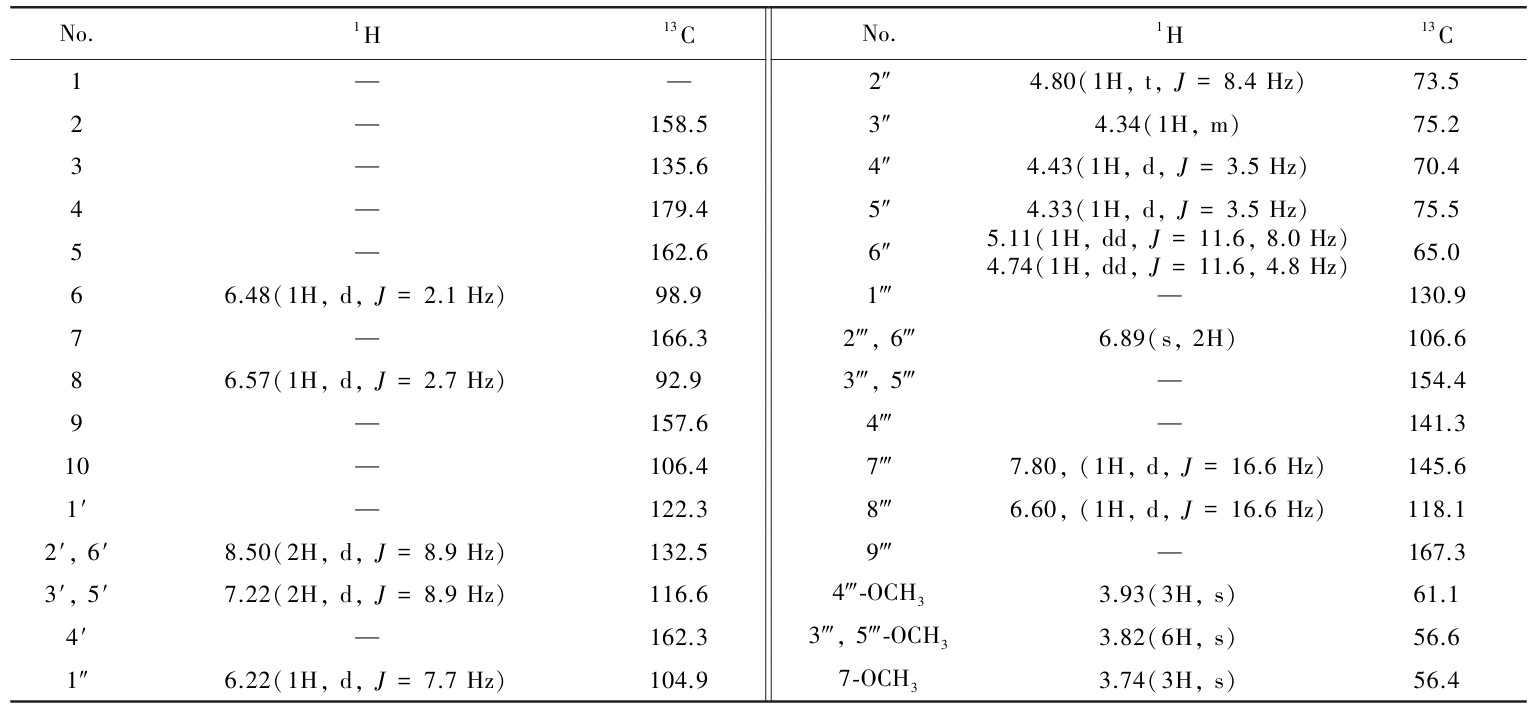
1H-NMR数据(表1)显示化合物含有鼠李柠檬素特征吸收峰δH 6.48(1H, d, J= 2.1 Hz, H-6)、6.57(1H, d, J= 2.7 Hz, H-8)、8.50(2H, d, J= 8.9 Hz, H-2′, 6′)、7.22(2H, d, J= 8.9 Hz, H-3′, 5′)和1个甲氧基信号δH 3.74(3H, s)。13C-NMR显示化合物含有34个碳信号,包括鼠李柠檬素基团信号δC 98.9(C-6)、92.9(C-8)、179.4(C-4)、158.5(C-2)、135.6(C-3)、162.6(C-5)、166.3(C-7)、157.6(C-9)、106.4(C-10)、56.4(7-OCH3)、122.3(C-1′)、132.5(C-2′, 6′)、116.6(C-3′, 5′)、162.3(C-4′),葡萄糖基团信号δC 104.9(C-1″)、73.5(C-2″)、75.2(C-3″)、70.4(C-4″)、75.5(C-5″)、65.0(C-6″),1个羰基信号δC 167.3,1个双键信号δC 145.6、118.1,3个甲氧基信号δC 61.1、56.6、56.6和其他6个芳香碳信号δC 154.4、154.4、141.3、130.9、106.6、106.6。结合1H-NMR图谱中1个糖端基质子信号δH 6.22(J= 7.7 Hz)和酸水解及其衍生化结果,确定该结构中含有β-D-葡萄糖。1H-NMR中2个反式耦合常数(J= 16.6 Hz)的烯烃质子δH 6.60(H-8''')、7.80(H-7'''),2个芳香质子信号δH 6.89(2H, s)及3个甲氧基信号δH 3.93(s, 3H)、3.82(s, 6H),推测化合物含有1,3,4,5-四取代苯丙烯酸结构。除C-5'''(δC 116.65)向低场位移了37.75 ppm,C-6'''(δC 124.07)向高场位移了17.47 ppm以外,其核磁共振数据与bosenegaloside A相似(Morgan et al., 2014)。因此,推测化合物的C-5'''被甲氧基取代。
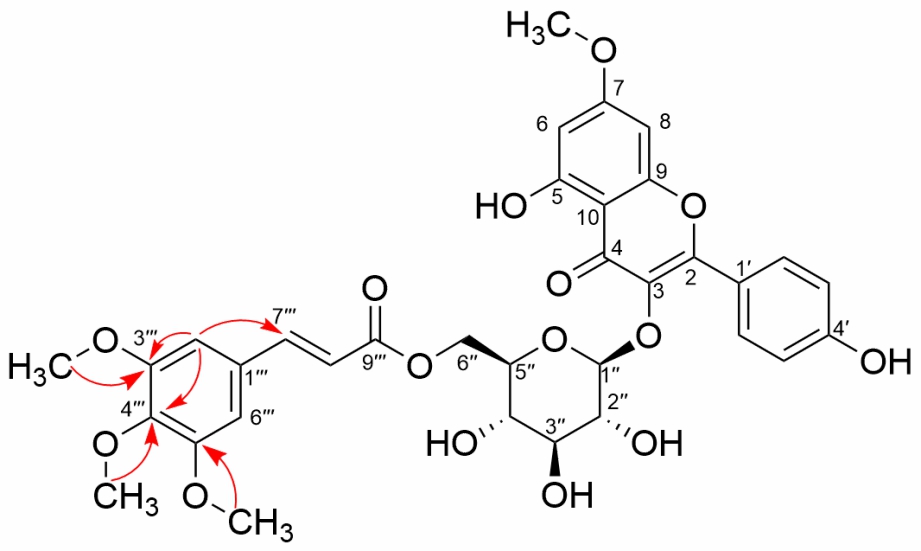
根据HMQC和HMBC谱图可知,δH 3.82(3'''、5'''-OCH3)与C-3'''(C-5''')相关,δH 3.93(4'''-OCH3)与C-4'''相关,表明C-3'''、C-4'''和C-5'''各自与甲氧基相连,且H-2'''(δH 6.89)与C-4'''、C-3'''(C-5''')、C-7'''相关,进一步确定了化合物的C-5'''被甲氧基取代。基于上述分析,最终确定化合物1的结构(图1)。
化合物2:白色针状结晶。ESI-MS m/z:301 [M+H]+,分子式为C17H16O5。1H-NMR(400 MHz, Pyridine-d5)δ:12.36(1H, s, H-10), 11.23(1H, m, H-1), 10.85(1H, m, H-7), 10.63(2H, m, H-2, H-8), 10.51(s, 1H, H-4), 10.20(1H, m, H-11a), 9.29(1H, m, H-6), 4.95(1H, m, H-6a), 7.97(3H, s,-OCH3), 7.38(3H, s,-OCH3);13C-NMR(101 MHz, Pyridine-d5)δ:161.0(C-3), 157.7(C-4a), 154.1(C-9), 152.5(C-11), 135.1(C-10), 133.2(C-1), 122.8(C-6b), 119.3(C-7), 112.0(C-11b), 111.2(C-2), 105.9(C-8), 104.5(C-4), 80.0(C-11a), 66.9(C-6), 60.7(-OCH3), 56.6(-OCH3), 40.6(C-6a)。以上数据与文献(Dong et al., 2010)报道的基本一致,故鉴定化合物2为(6aR,11aR)-10-hydroxy-3,9-dimethoxypterocarpan。
表
1
化合物1的1H-NMR和13C-NMR波谱数据(500/126 MHz,Pyridine-d5)
Table
1
1H-NMR and 13C-NMR spectral data of Compound 1(500/126 MHz,Pyridine-d5)
图
1
化合物1的结构和相关的HMBC信号
Fig.
1
Structure and related HMBC signals of Compound 1
化合物3:白色针状结晶。ESI-MS m/z:303 [M+H]+,分子式为C17H18O5。1H-NMR(400 MHz, CD3OD)δ:2.75(1H, dd, J= 16.3, 5.4 Hz, 4-Heq), 2.84(1H, dd, J= 16.1, 11.3 Hz, 4-Hax), 3.40(1H, m, 3-H), 3.80(3H, s,-OCH3), 3.81(3H, s,-OCH3), 3.88(1H, t, J= 10.5 Hz, 2-Hax), 4.15(1H, d, J= 10.8 Hz, 2-Heq), 6.25(1H, d, J= 2.9 Hz, 8-H), 6.33(1H, dd, J= 8.5, 2.5 Hz, 6-H), 6.56(1H, d, J= 8.5 Hz, 6′-H), 6.67(1H, d, J= 8.8 Hz, 5′-H), 6.85(1H, d, J= 8.2 Hz, 5-H)。13C-NMR(101 MHz, CD3OD)δ:157.5(C-7), 156.2(C-9), 149.0(C-2′), 147.2(C-4′), 140.6(C-3′), 131.2(C-5), 128.5(C-1′), 117.7(C-6′), 114.8(C-10), 109.1(C-6), 108.4(C-5′), 103.8(C-8), 71.6(C-2), 61.3(-OCH3), 56.6(-OCH3), 33.1(C-3), 32.4(C-4)。以上数据与文献(Li et al., 2025)报道的基本一致,故鉴定化合物3为3′,7-二羟基-2′,4′-二甲氧基异黄烷。
化合物4:黄色固体。ESI-MS m/z:661 [M+Na]+,分子式为C32H30O14。1H-NMR(400 MHz, DMSO-d6)δ:6.16(1H, s, H-6), 6.58(1H, s, H-8), 8.08(2H, d, J= 8.8 Hz, H-2′, 6′), 6.88(2H, d, J= 8.9 Hz, H-3′, 5′), 5.42(1H, d, J= 8.5 Hz, H-1″), 4.26(1H, dd, J= 11.2, 8.5 Hz, H-6″), 4.04(1H, dd, J= 11.6, 4.4 Hz, H-6″), 7.12(1H, d, J= 1.9 Hz, H-6'''), 6.75(1H, d, J= 8.9 Hz, H-5'''), 6.86(1H, d, J= 1.9Hz, H-2'''), 7.26(1H, d, J= 15.7 Hz, H-7'''), 6.17(1H, d, J= 15.7 Hz, H-8'''), 3.89(3H, s, 3'''-OCH3), 3.71(3H, s, 7-OCH3);13C-NMR(101 MHz, DMSO-d6)δ:177.6(C-4), 166.2(C-9'''), 165.0(C-7), 160.8(C-5), 160.1(C-4′), 156.7(C-2), 156.2(C-8a), 149.3(C-4'''), 147.8(C-3'''), 144.9(C-7'''), 133.3(C-3), 131.0(C-2′, 6′), 125.5(C-1'''), 123.0(C-6'''), 120.8(C-1′), 115.3(C-3′, 5′), 115.1(C-5'''), 113.8(C-8'''), 110.9(C-2'''), 104.8(C-4a), 101.4(C-1″), 97.7(C-6), 92.2(C-8), 73.1(C-3″), 72.9(C-2″), 71.0(C-5″), 68.3(C-4″), 63.0(C-6″), 55.9(7-OCH3), 55.6(3'''-OCH3)。以上数据与文献(Morgan et al.,2014)报道的基本一致,故鉴定化合物4为bosenegaloside A。
化合物5:黄色无定型粉末。ESI-MS m/z:701 [M+H]+,分子式为C38H52O12。1H-NMR(400 MHz, DMSO-d6)δ:12.56(1H, s, 5-OH), 10.17(1H, s, 4′-OH), 6.27(1H, s, H-6), 6.68(1H, s, H-8), 8.04(2H, d, J= 9.2 Hz, H-2′, 6′), 6.84(2H, d, J= 9.2 Hz, H-3′, 5′), 3.81(3H, s, 7-OCH3);13C-NMR(101 MHz, DMSO-d6)δ:177.9(C-4), 172.6(C-1'''), 165.3(C-7), 161.2(C-5), 160.4(C-4′), 156.9(C-2), 156.5(C-8a), 133.6(C-3), 131.2(C-2′, 6′), 120.9(C-1′), 115.3(C-3′, 5′), 105.1(C-4a), 101.6(C-1″), 98.0(C-6), 92.3(C-8), 73.3(C-5″), 73.1(C-3″), 71.2(C-2″), 68.5(C-4″), 63.4(C-6″), 56.2(7-OCH3), 14.1(CH3(-CH2)14)。以上数据与有关专利(Taisho Pharma Co. Ltd., 1993)记载的基本一致,故鉴定该化合物为5-hydroxy-2-(4-hydroxyphenyl)-7-methoxy-3-[6-O-(1-oxohexadecyl)-α-D-altropyranosyl]-4H-1-benzopyran-4-one。
化合物6:黄色絮状晶体。ESI-MS m/z:301 [M+H]+,分子式为C16H12O6。1H-NMR(400 MHz,DMSO-d6)δ:12.48(1H, s, 5-OH), 8.06(2H, d, J= 8.8 Hz, H-2′, H-6′), 6.93(2H, d, J= 8.8 Hz, H-3′, H-5′), 6.73(1H, d, J=2.2 Hz, H-8), 6.33(1H, s, H-6)和3.84(3H, s, 7-OCH3);13C-NMR(101 MHz, DMSO-d6)δ:176.1(C-4), 164.9(C-7), 160.4(C-9), 159.4(C-5), 156.1(C-4′), 147.3(C-2), 136.0(C-3), 129.6(C-2′, 6′), 121.6(C-1′), 115.5(C-3′, 5′), 104.1(C-10), 97.5(C-6), 92.0(C-8), 56.0(-OCH3)。以上数据与文献(Hu et al.,2017)报道的基本一致,故鉴定化合物6为鼠李柠檬素。
化合物7:黄色针状结晶。ESI-MS m/z:301 [M+H]+,分子式为C16H12O6。1H-NMR(400 MHz, DMSO-d6)δ:12.49(1H, s, 5-OH), 10.11(1H, s, 7-OH), 9.41(1H, s, 3-OH), 8.04(2H, d, J= 8.6 Hz, H-2′, 6′), 6.92(2H, d, J= 8.9 Hz, H-3′, 5′), 6.70(1H, m, H-8), 6.30(1H, m, H-6)和3.74(3H, s, 4′-OCH3);13C-NMR(101 MHz, DMSO-d6)δ:175.8(C-4), 164.7(C-7), 160.2(C-4′), 159.1(C-9), 155.9(C-5), 147.1(C-2), 135.8(C-3), 129.4(C-2′, 6′), 121.4(C-1′), 115.3(C-3′, 5′), 103.8(C-10), 97.3(C-6), 91.8(C-8), 55.8(-OCH3)。以上数据与文献(刘志平等,2007)报道的基本一致,故鉴定化合物7为3,5,7-三羟基-4′-甲氧基黄酮醇。
化合物8:黄色无定型粉末。ESI-MS m/z:567 [M+H]+,分子式为C29H26O12。1H-NMR(400 MHz, Pyridine-d5)δ:8.48(2H, d, J= 8.9 Hz, H-2′, 6′), 8.05(2H, d, J= 7.8 Hz, H-3''', 5'''), 7.47(1H, t, J= 7.8 Hz, H-4'''), 7.34(2H, m, H-2''', 6'''), 6.63(2H, s, H-3′, 5′), 6.25(1H, d, J= 8.9 Hz, H-8), 5.05(1H, d, J= 8.2 Hz, H-6), 5.02(1H, d, J= 7.6 Hz, H-1″), 4.87(1H, dd, J= 11.4, 4.6 Hz, H-6″), 4.81(1H, t, J= 7.9 Hz, H-6″), 4.46(1H, d, J= 2.6 Hz, H-5″), 4.37(1H, m, H-4″), 4.34(1H, m, H-2″), 3.81(3H, s,-OCH3), 3.63(1H, m, H-3″);13C-NMR(101 MHz, Pyridine-d5)δ:179.1(C-4), 166.6(C-7'''), 166.1(C-7), 162.5(C-5), 162.1(C-4′), 158.2(C-2), 157.5(C-9), 135.3(C-3), 133.4(C-4'''), 132.2(C-2′, 6′), 130.9(C-1'''), 130.0(C-2''', C-6'''), 128.9(C-3''', C-5'''), 122.0(C-1′), 116.4(C-3′, 5′), 106.4(C-10), 104.4(C-1″), 98.9(C-6), 92.7(C-8), 75.3(C-5″), 74.8(C-3″), 73.2(C-2″), 70.1(C-4″), 65.2(C-6″), 56.3(-OCH3)。以上数据与文献(Li et al.,2013)报道的基本一致,故鉴定化合物8为3-O-鼠李柠檬素-6-O-苯甲酰基-β-D-吡喃葡萄糖苷。
化合物9:黄色粉末。ESI-MS m/z:463 [M+H]+,分子式为C22H22O11。1H-NMR(400 MHz, DMSO-d6)δ:5.95(1H, d, J= 2.2 Hz, H-6), 6.31(1H, d, J= 2.3 Hz, H-8), 7.70(2H, d, J= 9.5 Hz, H-2′, 6′), 6.47(2H, d, J= 9.1 Hz, H-3′, 5′), 4.99(1H, d, J= 7.1 Hz, H-1″), 2.78(1H, s, H-6″), 2.12(1H, s, H-6″), 4.21(3H, s, 7-OCH3);13C-NMR(101 MHz, DMSO-d6)δ:178.2(C-4), 165.7(C-7), 161.4(C-9), 160.6(C-5), 157.4(C-4′), 156.9(C-2), 134.1(C-3), 131.7(C-2′, 6′), 121.3(C-1′), 115.7(C-3′, 5′), 105.5(C-10), 102.2(C-1″), 98.5(C-6), 92.8(C-8), 76.3(C-3″), 73.7(C-2″), 71.8(C-5″), 68.5(C-4″), 60.8(C-6″), 56.7(-OCH3)。以上数据与文献(刘忠艳等,2016)报道的基本一致,故鉴定化合物9为鼠李柠檬素-3-O-β-D-半乳糖苷。
化合物10:黄色粉末。ESI-MS m/z:465 [M+H]+,分子式为C21H20O12。1H-NMR(400 MHz, DMSO-d6)δ:12.54(1H, s, 5-OH), 7.49(2H, m, H-2′, 6′), 6.74(1H, d, J= 9.8 Hz, H-5′), 6.31(1H, d, J= 2.1 Hz, H-8), 6.11(1H, d, J= 2.1 Hz, H-6);13C-NMR(101 MHz, DMSO-d6)δ:177.5(C-4), 164.2(C-7), 161.3(C-5), 156.4(C-2), 156.2(C-9), 148.5(C-4′), 144.9(C-3′), 133.4(C-3), 121.7(C-6′), 121.2(C-1′), 116.3(C-5′), 115.3(C-2′), 104.0(C-10), 100.9(C-1″), 98.7(C-6), 93.6(C-8), 77.6(C-5″), 76.6(C-3″), 74.2(C-2″), 70.0(C-4″), 61.0(C-6″)。以上数据与文献(苗青等,2008)报道的基本一致,故鉴定化合物10为异槲皮苷。
化合物11:黄色固体。ESI-MS m/z:501 [M+Na]+,分子式为C22H22O12。1H-NMR(400 MHz, DMSO-d6)δ:6.36(1H, d, J= 2.3 Hz, H-6), 6.69(1H, d, J= 2.2 Hz, H-8), 7.68(1H, dd, J= 8.2, 2.3 Hz, H-6′), 7.59(1H, d, J= 2.3 Hz, H-2′), 6.85(1H, d, J= 8.7 Hz, H-5′), 3.85(3H, s, 7-OCH3);13C-NMR(101 MHz, DMSO-d6)δ:177.7(C-4), 165.2(C-7), 161.0(C-5), 156.7(C-2), 156.3(C-9), 148.7(C-4′), 144.9(C-3′), 133.8(C-3), 122.1(C-6′), 121.1(C-1′), 116.2(C-2′), 115.2(C-5′), 105.0(C-10), 101.8(C-1″), 97.9(C-6), 92.2(C-8), 75.9(C-5″), 73.3(C-3″), 71.3(C-2″), 68.0(C-4″), 60.2(C-6″), 56.2(-OCH3)。以上数据与文献(汪洋等,2024)报道的基本一致,故鉴定化合物11为鼠李素-3-O-β-D-半乳糖苷。
化合物12:黄色粉末。ESI-MS m/z:463 [M+H]+,分子式为C22H22O11。1H-NMR(400 MHz, DMSO-d6)δ:12.60(1H, s, 5-OH), 8.07(2H, d, J= 8.8 Hz, H-2′, 6′), 6.91(2H, d, J= 8.6 Hz, H-3′, 5′), 6.36(1H, s, H-6), 6.72(1H, s, H-8), 5.50(1H, d, J= 7.6 Hz, H-1″), 3.85(3H, s, 7-OCH3);13C-NMR(101 MHz, DMSO-d6)δ:177.5(C-4), 165.0(C-7), 160.8(C-9), 159.9(C-5), 156.4(C-4′), 156.2(C-2), 133.3(C-3), 130.8(C-2′, 6′), 120.7(C-1′), 115.0(C-3′, 5′), 104.8(C-10), 100.7(C-1″), 97.7(C-6), 92.1(C-8), 77.4(C-3″), 76.3(C-2″), 74.1(C-5″), 69.7(C-4″), 60.7(C-6″), 56.0(-OCH3)。以上数据与文献(Zhou et al., 2009)报道的基本一致,故鉴定化合物12为鼠李柠檬素-3-O-β-D-葡萄糖苷。
化合物1-12的化学结构见图2。
2.2 抗氧化实验结果
化合物3、4、6、7、10-12表现出抗氧化活性(表2)。其中,化合物6、10和11对DPPH自由基清除的IC50值分别为(4.90±0.35)、(0.80±0.06)、(1.07±0.02)μg·mL-1,清除效果强于Vc。化合物3和11对ABTS自由基清除的IC50分别为(0.72±0.05)、(0.32±0.05)μg·mL-1,其清除效果与Vc相当。这表明黄花棘豆中黄酮类化合物具有较强抗氧化活性。
3 讨论与结论
本研究从黄花棘豆中分离得到12个单体化合物,包括10个黄酮醇类化合物 [ochrocephalamine Q(1)、bosenegaloside A(4)、5-hydroxy-2-(4-hydroxyphenyl)-7-methoxy-3-[6-O-(1-oxohexadecyl)-α-D-altropyranosyl]-4H-1-benzopyran-4-one(5)、鼠李柠檬素(6)、3,5,7-三羟基-4′-甲氧基黄酮醇(7)、3-O-鼠李柠檬素-6-O-苯甲酰基-β-D-吡喃葡萄糖苷(8)、鼠李柠檬素-3-O-β-D-半乳糖苷(9)、异槲皮苷(10)、鼠李素-3-O-β-D-半乳糖苷(11)、鼠李柠檬素-3-O-β-D-葡萄糖苷(12)],1个异黄酮类化合物 [3′,7-二羟基-2′,4′-二甲氧基异黄烷(3)]和1个紫檀烷类化合物 [(6aR,11aR)-10-hydroxy-3,9-dimethoxypterocarpan(2)]。化合物1为新的黄酮醇类化合物,化合物2、4和5首次从黄花棘豆中分离得到。
通过DPPH和ABTS的自由基清除实验评价化合物1-12的抗氧化活性。化合物3、4、6、7、10-12均表现出自由基清除活性,其中化合物6、10和11在DPPH自由基清除实验的IC50值分别为(4.90±0.35)、(0.80±0.06)和(1.07±0.02)μg·mL-1,强于阳性对照Vc [IC50值为(5.72±0.52)μg·mL-1]。在ABTS自由基清除实验中,化合物11亦表现出较强的抗氧化活性,其IC50值为(0.32±0.05)μg·mL-1。
化合物1没有表现出对DPPH和ABTS的自由基清除活性,但是从化学结构上看,其以苯丙烯酸与鼠李柠檬素-3-O-β-D-葡萄糖C-6″连接的形式存在(化合物1和4),且首次在黄花棘豆中发现。化合物4对可溶性环氧化物水解酶(soluble epoxide hydrolase,sEH)具有抑制作用,抑制常数Ki为(7.6±3.2)μmol·L-1(Morgan et al., 2014)。sEH的抑制可以有效维持内源性环氧二烯三烯酸水平,降低二羟二烯三烯酸水平,对心血管、中枢神经系统和代谢性疾病具有治疗潜力(Sun et al., 2021)。然而,化合物1是否具有治疗心血管疾病和神经性疾病的作用,有待于进一步研究。
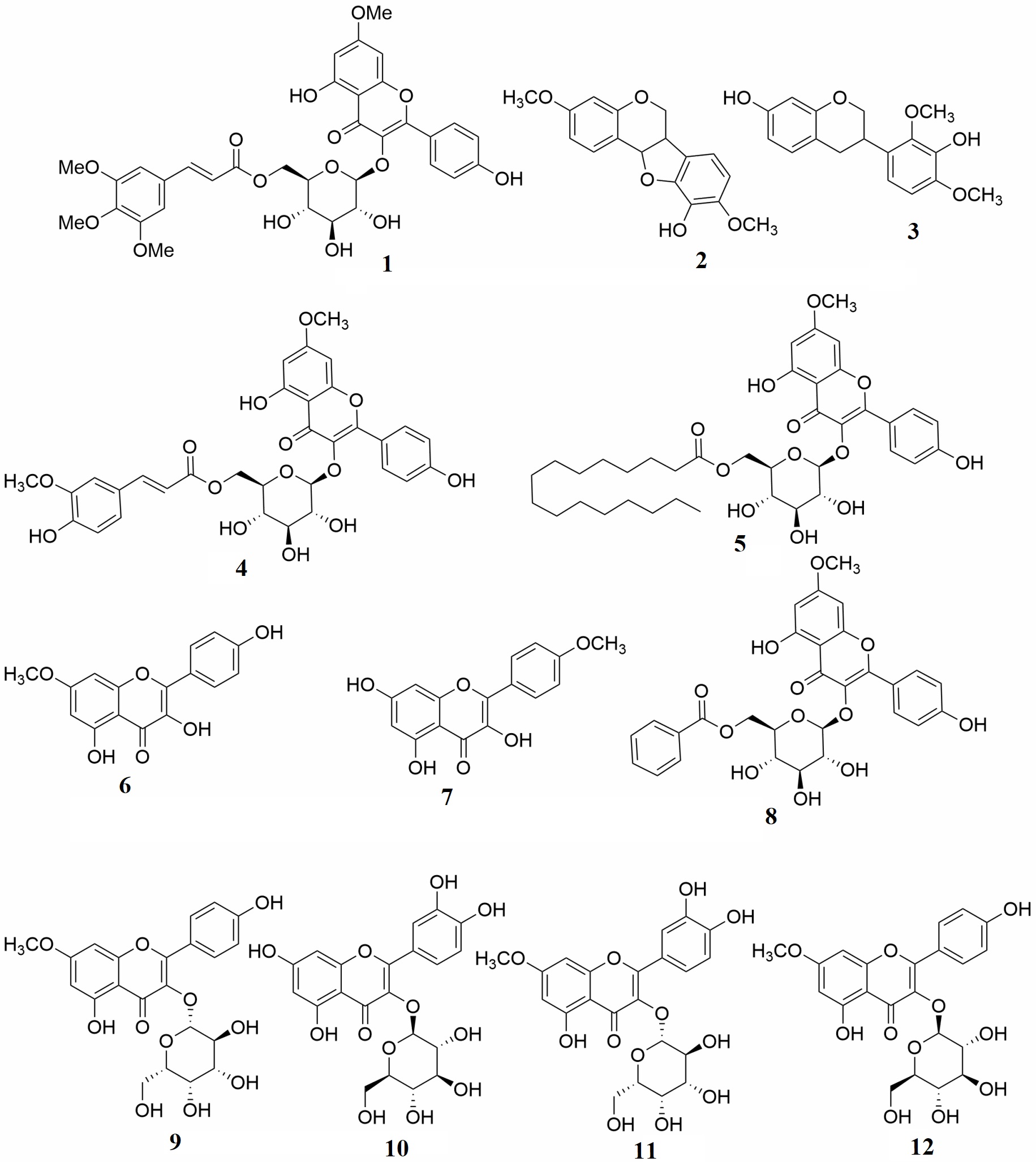
图
2
化合物1-12的化学结构式
Fig.
2
Chemical structural formulas of compounds 1-12
综上所述,黄花棘豆在我国的资源储备丰富,所含黄酮类化学成分表现出较强的抗氧化活性。本研究进一步丰富了黄花棘豆中的化学成分,为其在功能食品、保健品及化妆品等领域的应用提供了基本的研究资料。
表
2
化合物的自由基清除实验结果
Table
2
Radical scavenging experiment results for compounds
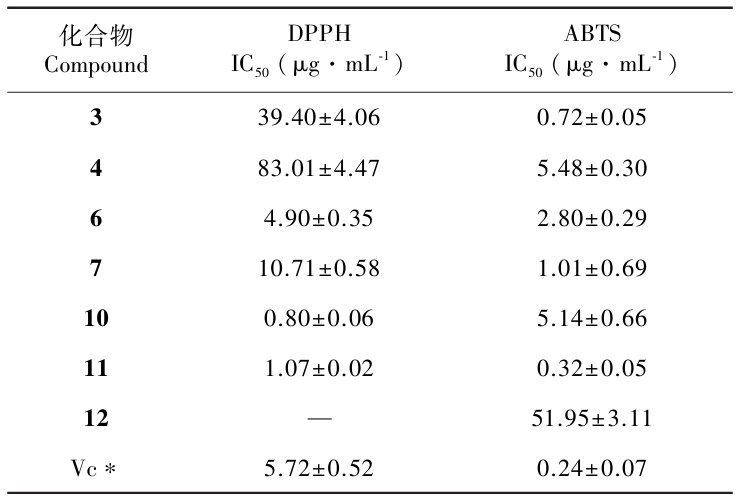
注:*表示阳性对照;—表示无清除作用。
Note:* indicates positive control;—indicates no clearing effect.