


摘要
宽叶匙羹藤在傈僳族的药名为“片鲁爪”,民间常用于糖尿病的治疗。为探究宽叶匙羹藤(Gymnema latifolium)的化学成分及其降血糖活性,该研究综合运用大孔树脂、硅胶、MCI、Sephadex LH-20柱色谱和半制备高效液相色谱等多种分离方法对宽叶匙羹藤乙酸乙酯部位的化学成分进行分离纯化,结合质谱(MS)、核磁共振(NMR)谱及电子圆二色(ECD)谱等方法确定化合物的结构,采用基于HepG2细胞对葡萄糖摄取的方法评价分离所得化合物的体外降血糖活性。结果表明:(1)从乙酸乙酯部位中分离得到15个化合物,分别为calomembranone L(1)、calopolyanic acid(2)、blancoic acid(3)、apetalic acid(4)、isoapetalic acid(5)、apetalic acid methyl ester(6)、isoapetalic acid methyl ester(7)、calopolyanolide B(8)、2-羟基呫吨酮(9)、异胡椒酮 B(10)、lacexanthone(11)、caledonixanthone Q(12)、(7,8-cis-8,8′-trans)-2′,4′-二羟基-3,5-二甲氧基-落叶松脂素(13)、(7R,8S)-去氢双松柏醇(14)、(+)-松脂醇(15)。其中,化合物1为新的色原酮类化合物,其余化合物均为首次从匙羹藤属植物中分离得到。(2)降血糖活性实验结果表明,在无显著细胞毒性的浓度下,化合物1、2、3、8、13的HepG2细胞对葡萄糖摄取量分别是对照组的1.47倍、1.47倍、1.12倍、1.49倍和1.23倍,且细胞活力维持在90%以上,这说明以上化合物具有促进HepG2细胞对葡萄糖的摄取作用。该研究结果丰富了宽叶匙羹藤的化学成分库,初步阐明了其降血糖的药效物质基础,为其进一步开发与应用提供了理论依据。
关键词
Abstract
Gymnema latifolium, referred to as “Pian Lu Zhao” in the Lisu ethnic group, is traditionally employed to treat diabetes mellitus. To explore the chemical constituents and hypoglycemic activity of G. latifolium, this study comprehensively employed various separation techniques, including macroporous resins, silica gel, MCI, Sephadex LH-20 column chromatography, and semi-preparative high-performance liquid chromatography to isolate and purify the chemical constituents from the ethyl acetate fraction of G. latifolium. The structures of the compounds were determined using techniques including mass spectrum (MS), nuclear magnetic resonance (NMR) spectroscopy, and electronic circular dischroism (ECD) spectroscopy. The in vitro hypoglycemic activities of the isolated compounds were assessed using glucose uptake assay based on HepG2 cells. The results were as follows: (1) Fifteen compounds were isolated and identified as calomembranone L (1), calopolyanic acid (2), blancoic acid (3), apetalic acid (4), isoapetalic acid (5), apetalic acid methyl ester (6), isoapetalic acid methyl ester (7), calopolyanolide B (8), 2-hydroxy-xanthone (9), isocudraniaxanthone B (10), lacexanthone (11), caledonixanthone Q (12), (7,8-cis-8,8′-trans)-2′,4′-dihydroxy-3,5-dimethoxy-lariciresinol (13), (7R,8S)-dehydrodiconiferyl alcohol (14), (+)-pinoresinol (15). Among them, Compound 1 was a new chromone compound, and compounds 2-15 were isolated from Gymnema plants for the first time. (2) Hypoglycemic activity assays showed that compounds 1, 2, 3, 8 and 13 increased glucose uptake to 1.47, 1.47, 1.12, 1.49 and 1.23 times that of the control group in HepG2 cells, respectively, while exhibiting minimal cytotoxic effects, maintaining cell viability above 90%. This indicated that the above compounds had effects of promoting glucose uptake in HepG2 cells. This study enriches the chemical profile of G. latifolium and preliminarily clarifies the material basis for its hypoglycemic effect, providing a theoretical foundation for its further development and application.
Keywords
宽叶匙羹藤(Gymnema latifolium)为夹竹桃科(Apocynaceae)匙羹藤属(Gymnema R. Br.)植物,国内主产于云南南部,国外主要分布于印度、缅甸、越南等国家(中国科学院中国植物志编辑委员会,1977)。文献记载宽叶匙羹藤的种毛可作为刀伤药,有止血、收敛作用,其根煎煮服用可治心口疼痛等症(云南省怒江傈僳族自治州卫生局,1992)。匙羹藤属植物在印度阿育吠陀医学体系中作为药用植物治疗糖尿病已有上千年的历史,在印度传统医学中具有重要地位(Pagadala et al., 2015; Damor & Polaiah, 2022)。目前,从宽叶匙羹藤中分离得到的主要是C21甾体和齐墩果烷型三萜类化合物,这些成分具有显著的降血糖活性,并能通过多种机制抑制肿瘤细胞生长,展现出良好的抗肿瘤作用(Pham et al., 2020,2023; Yen et al., 2021),表明宽叶匙羹藤具有较好的药用价值,但其化学成分研究尚不充分,药效物质基础不明确。
课题组前期已从同属植物匙羹藤(G. sylvestre)和大叶匙羹藤(G. inodorum)中分离鉴定170余种化合物,其结构类型主要有C21甾体类、三萜类和木脂素类等,其中C21甾体和三萜类成分具有显著的降血糖活性(Liu et al., 2021, 2025; He et al., 2023)。本研究采用高效液相色谱-质谱(high-performance liquid chromatography-mass spectrum,HPLC-MS)联用技术进行初步对比分析,发现宽叶匙羹藤与同属植物成分类型相似,主要含C21甾体类、三萜类和木脂素类成分,但也存在其他类型的差异性成分;进一步采用基于HepG2细胞的葡萄糖摄取测试方法对其粗提物的不同极性部位进行降血糖活性初步筛选,发现乙酸乙酯部位具有较好的降血糖作用。为深入挖掘宽叶匙羹藤的化学成分,以便进一步探究其药效物质基础,本研究采用中药化学技术方法,对宽叶匙羹藤具有降血糖活性部位的化学成分进行系统分离和鉴定,并采用基于HepG2细胞葡萄糖摄取实验测定单体化合物的活性,以期发现降血糖活性成分,为宽叶匙羹藤的开发与利用提供理论依据。
1 材料与方法
1.1 材料
药材于2024年8月采自云南省勐腊县,经广西中医药大学韦松基教授鉴定为夹竹桃科匙羹藤属植物宽叶匙羹藤地上部分。药材标本号为No. 20240910,现存放于广西中医药大学药学院。
1.2 仪器和试剂
AvanceIII-500 MHz核磁共振波谱仪(德国Bruker公司);TOF-6200 Series质谱仪(美国Agilent公司);LC-20AR半制备型、LC-2030分析型液相色谱仪(日本Shimadzu公司);Luna Omega-Polar(C18半制备柱5 μm,250 mm × 10 mm、C18 100Å分析柱5 μm,250 mm × 4.6 mm,美国Phenomenex公司);YMC-Pack SIL(5 μm,250 mm × 10 mm,深圳凯米斯科技有限公司);中压分离REVELERIS X2系统(美国Grace公司);ZF-7型紫外分析仪(上海安亭电子仪器厂);J-1500圆二色谱仪(日本Jasco公司);100~400目硅胶、HGSF254硅胶板(青岛海洋化工公司);D101大孔树脂、MCI(日本三菱化学公司);Sephadex LH-20凝胶(美国Pharmacia公司);色谱级试剂(美国Thermo Fisher Scientific公司);分析纯试剂(西陇科学股份有限公司);CLM-170型CO2培养箱(新加坡Esco公司);TAL-5A型离心机(常州金坛良友仪器有限公司);SpectraMax iD3酶标仪[美谷分子仪器(上海)有限公司];胰岛素、胎牛血清、CCK-8试剂盒(北京索莱宝科技有限公司);DMEM培养基(美国Gibco公司);葡萄糖摄取试剂盒(南京建成生物工程研究所);HepG2人肝癌细胞(中国科学院细胞库,ID:CVCL_0027)。
1.3 研究方法
1.3.1 提取和分离
宽叶匙羹藤干燥藤茎粗粉30.0 kg,采用70%乙醇加热回流提取3次(每次2 h),合并提取液,减压浓缩得到乙醇总提取物约3.0 kg。总浸膏加等量水分散均匀后用石油醚(60~90 ℃)、乙酸乙酯和正丁醇萃取,各萃取液减压浓缩获得对应部位浸膏PE(12.0 g)、EtOAc(430.0 g)、n-BuOH(1 350.0 g)。
取EtOAc部位400.0 g,经D101大孔吸附树脂柱色谱,以30%~100%乙醇-水(10%梯度)洗脱,得Fr.y1-Fr.y6。Fr.y4(120.0 g)经硅胶柱色谱(二氯甲烷-甲醇,50∶1→0∶1,V/V,下同)分离,得Fr.y4-1-Fr.y4-12。其中,Fr.y4-4(1.0 g)经Sephadex LH-20凝胶柱色谱(石油醚-二氯甲烷-甲醇,1∶1∶1,V/V/V,下同)等度洗脱,得4个组分;Fr.y4-4-2(100.0 mg)经Luna Omega-Polar C18制备柱(乙腈-水,75∶25,V/V,下同)纯化,得化合物1(5.5 mg,tR= 80 min)。Fr.y4-6(40.0 g)经ODS柱(甲醇-水,15%→100%,10%梯度)分离得7个组分,Fr.y4-6-5(2.0 g)经凝胶柱分离得4个亚组分,Fr.y4-6-5-2(1.4 g)经C18制备柱(乙腈-水,63∶37)纯化,得化合物4(6.9 mg,tR= 42 min)、5(54 mg,tR= 75 min)。Fr.y4-6-3(310.0 mg)放置析出固体,重结晶得化合物9(2.9 mg)。Fr.y4-6-6(3.0 g)经硅胶柱(石油醚-乙酸乙酯,30∶1→0∶1)梯度洗脱得5个亚组分。Fr.y4-6-6-4(2.0 g)经C18制备柱(乙腈-水,75∶25)得化合物7(200 mg,tR= 75 min)。Fr.y4-6-6-5(1.5 g)经凝胶柱分离得4个次级组分,Fr.y4-6-6-5-2(1.0 g)经C18制备柱(乙腈-水,67∶33)分离得化合物2(19.8 mg,tR= 53 min)、8(10.0 mg,tR = 74 min)。Fr.y4-6-6-3(0.9 g)经凝胶柱分离得3个次级组分,Fr.y4-6-6-3-3(0.2 g)经C18制备柱(乙腈-水,68∶32)分离得化合物3(20.0 mg,tR= 48 min),Fr.y4-6-6-3-2(0.35 g)经正相制备柱YMC-Pack SIL(正己烷-异丙醇,70∶30)分离得化合物10(4.8 mg,tR= 25 min)。Fr.y4-8(9.0 g)经硅胶柱(石油醚-乙酸乙酯,30∶1→0∶1)分离得7个亚组分。Fr.y4-8-2(0.6 g)经凝胶柱等度洗脱得4个组分,Fr.y4-8-2-4(0.1 g)经C18制备柱(乙腈-水,75∶25)分离得化合物6(10.0 mg,tR= 55 min)。Fr.y4-8-5(1.9 g)经凝胶柱分离得5个组分,Fr.y4-8-5-4(50.0 mg)经C18制备柱(甲醇-水,56∶44→100∶0)分离得化合物15(5.0 mg,tR= 15 min)。Fr.y4-8-3(3.5 g)经MCI柱色谱和C18制备柱分离得化合物11(2.0 mg,tR= 90 min)。Fr.y4-10(10.0 g)经ODS柱(甲醇-水,25%→100%,10%梯度)分离得6个组分,Fr.y4-10-4(3.8 g)经凝胶柱和正相制备柱(正己烷-异丙醇,64∶36)分离得化合物12(9.8 mg,tR=64 min)。
Fr.y2(90.0 g)经硅胶柱(二氯甲烷-甲醇,100∶1→0∶100)分离得9个亚组分。Fr.y2-5(10.7 g)经MCI柱(甲醇-水,10%→100%,10%梯度)分离得7个组分,Fr.y2-5-3(2.2 g)经凝胶柱和C18制备柱(乙腈-水,11∶89)分离得化合物13(1.6 mg,tR= 81 min)、14(20.1 mg,tR= 98 min)。化合物1-15的结构具体见图1。
1.3.2 单体化合物促HepG2细胞葡萄糖摄取活性筛选实验
葡萄糖摄取测试参考李卉子等(2024)方法。实验设置空白对照组、阴性对照组、阳性对照组(胰岛素组)和给药组,各组设置复孔。96孔板以每孔3×10⁴细胞的密度接种HepG2细胞(对数生长期),于37 ℃、5%CO2培养箱中培养24 h。24 h后吸去培养基,加入100 μL含有100 nmol·L-1胰岛素或50 μmol·L-1实验组单体化合物的DMEM(dulbecco's modified eagle medium)培养基,于恒温细胞培养箱中孵育24 h。另取一96孔板,从上述培养板各孔中取2.5 μL细胞培养上清液作为样本孔,标准孔加入2.5 μL葡萄糖标准品溶液,空白孔加入2.5 μL蒸馏水,最后分别加入250 μL工作液(葡萄糖氧化酶法)混匀。于培养箱中反应10 min,用酶标仪在505 nm波长处测定各孔吸光度值。按下列公式计算上清液中的葡萄糖含量。
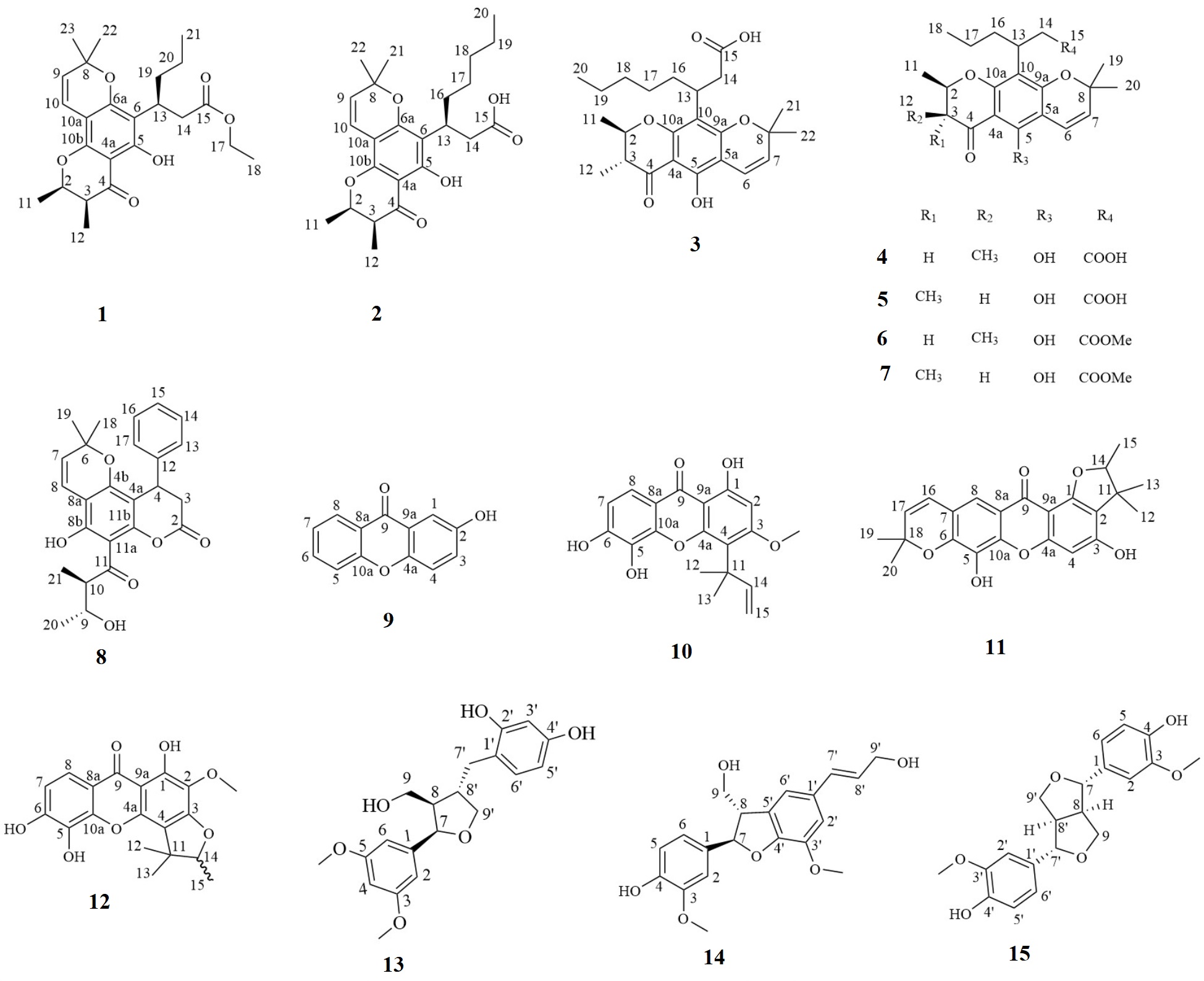
图
1
宽叶匙羹藤中的化合物1-15
Fig.
1
Compounds 1-15 from Gymnema latifolium
葡萄糖含量(mmol·L-1)=(A测定-A空白)/(A标准-A空白)×C标准×样品稀释倍数。
1.3.3 细胞活力测试
种板培养条件与上述葡萄糖摄取活性筛选条件一致。培养24 h后吸去培养基,每孔加入100 μL含DMEM培养基∶CCK-8溶液=9∶1(V/V)的培养液[其中CCK-8为八肽胆囊收缩索(cholecystokinin octapeptide)],培养板置于培养箱内避光孵育2 h,用酶标仪测定在450 nm波长处的吸光度值,按以下公式计算每孔细胞活力。
细胞活力(%)=(A给药组-A空白对照组)/(A阴性对照组-A空白对照组)×100。
1.3.4 统计学处理
统计分析使用GraphPad Prism 10.0软件,统计学分析运用单因素方差分析(one-way ANOVA)方法,数据以“平均值±标准差”()形式呈现,*标记表示相应数据存在显著性差异(P<0.05)。
2 结果与分析
2.1 结构鉴定
化合物1 淡黄色油状物, + 3.10 (c = 0.20, MeOH),UV λmax (MeOH):203.0、274.0 nm,IR光谱中3 451 cm-1为羟基的伸缩振动吸收,2 958 cm-1为甲基 C-H 伸缩振动吸收;1 733 cm-1为羰基的伸缩振动吸收;1 628 cm-1为双键的伸缩振动吸收;1 592 cm-1、1 444 cm-1为苯环的骨架振动吸收。HR-ESI-MS显示 [M + H]+峰(m/z):417.227 3(C24H33O6,计算值:417.227 7),确定其分子式为C24H32O6,不饱和度为9。化合物1的结构具体见图2。
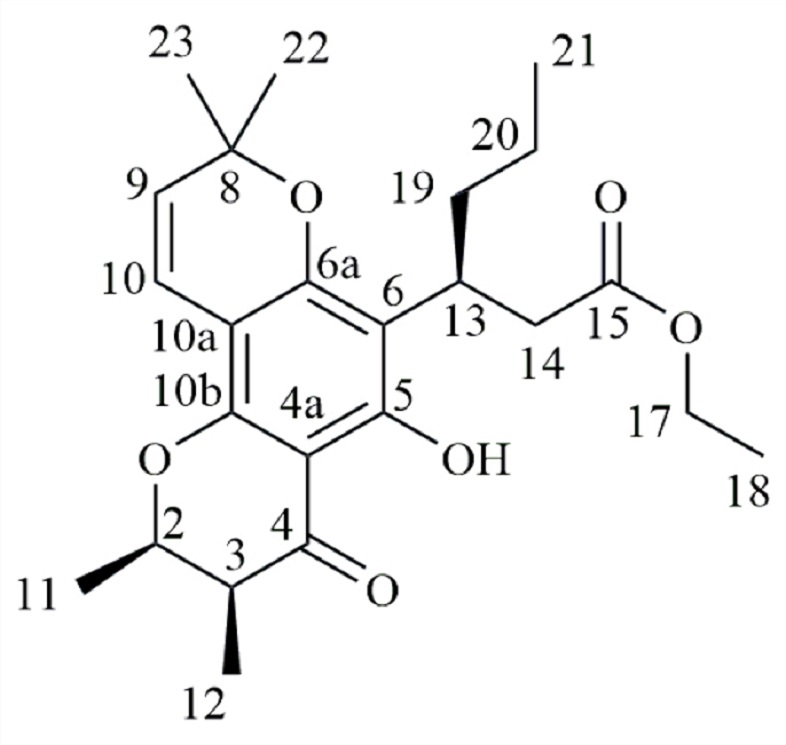
图
2
化合物1结构
Fig.
2
Structure of Compound 1
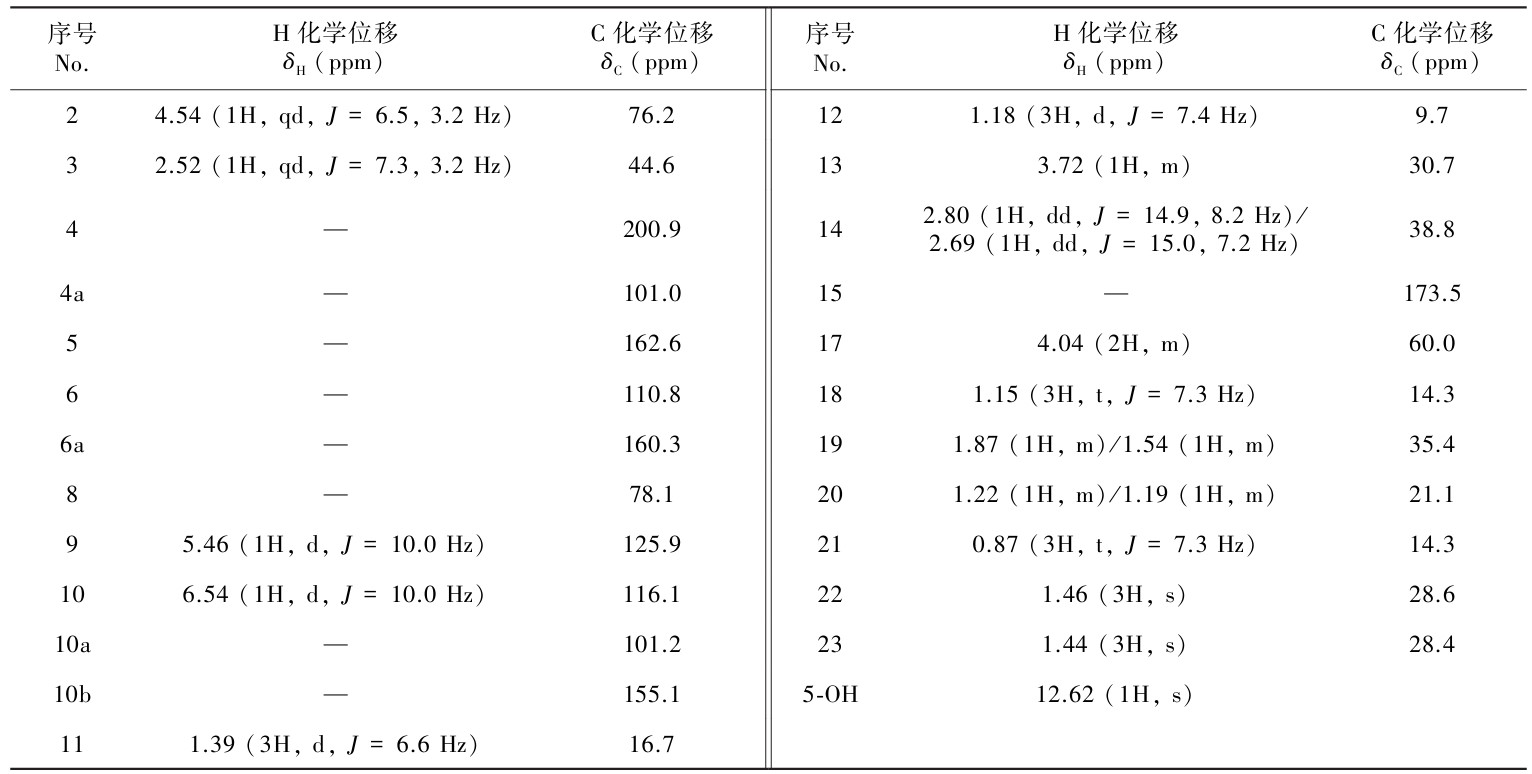
化合物1的NMR数据(表1),1H-NMR谱图显示在低场区存在1个缔合的酚羟基信号δH 12.62(1H, s);6个高场甲基氢信号 [δH 1.46(3H, s)、1.44(3H, s)、1.39(3H, d, J= 6.6 Hz)、1.18(3H, d, J= 7.4 Hz)、1.15(3H, t, J= 7.3 Hz)、0.87(3H, t, J= 7.3 Hz)];1组顺式双键氢信号 [δH 6.54(1H, d, J= 10.0 Hz)、5.46(1H, d, J= 10.0 Hz)];此外,谱图中存在1个连氧亚甲基氢信号 [δH 4.04(2H, m)]以及1组亚甲基氢信号 [δH 2.80(1H, dd, J= 14.9, 8.2 Hz)/2.69(1H, dd, J= 15.0, 7.2 Hz)]。13C-NMR谱显示有24个碳信号,结合DEPT谱可知其分别为6个伯碳、4个仲碳、5个叔碳以及9个季碳(其中2个羰基碳)。以上信号与已知化合物calomembranone F(Shen et al., 2022)的数据较为相似,区别在于侧链片段。由HMBC图谱(图3)可知,H-17 [δH 4.04(2H, m)]与C-15和C-18存在远程相关,证实了乙酯基团的存在;同时,亚甲基H-14(δH2.80/2.69)与C-13和C-15存在相关,表明该酯基侧链通过C-14连接在C-13位上,化合物1的平面结构由此确定。
结合H-2与H-3之间较小的耦合常数(J2,3=3.2 Hz),可判断H-2与H-3呈顺式构型,此外结构中还存在一个手性中心C-13,且其立体构型难以仅依靠电子圆二色(electronic circular dischroism,ECD)谱计算来确定,因此我们采用密度泛函理论(density functional theory,DFT)分别计算了该化合物可能的两种构型13R-1和13S-1的NMR化学位移(图 4:A)。通过计算获得的理论13C-NMR化学位移与实测结果进行比对,结果显示,13S-1的曲线拟合度良好,各碳原子的实测值与理论值最大绝对偏差几乎都在4 ppm以内(图 4:B)。进一步经过DP4+概率分析验证,13S-1的可能性为100%。最后,为进一步确定化合物1的绝对构型,对该化合物实测的圆二色(circular dischroism,CD)谱与理论计算CD谱进行比对,结果(图5)显示,实验测得的Cotton效应与(2R, 3S, 13S)-1的理论计算谱图高度吻合,从而确定了化合物1的绝对构型。经文献检索确定化合物1为新化合物,命名为calomembranone L。
化合物2 淡黄色油状物,ESI-MS (m/z): 417 [M + H]+,分子式C24H32O6。1H-NMR (500 MHz, CDCl3)δ: 12.62 (1H, s, 5-OH), 6.54 (1H, d, J = 10.0 Hz, H-10), 5.45 (1H, d, J = 10.0 Hz, H-9), 4.55 (1H, qd, J = 6.5, 3.2 Hz, H-2), 3.68 (1H, m, H-13), 2.85 (1H, dd, J = 15.6, 7.7 Hz, H-14α), 2.74 (1H, dd, J = 15.6, 7.1 Hz, H-14β), 2.52 (1H, qd, J = 7.3, 3.2 Hz, H-3), 1.86 (1H, m, H-16α), 1.58 (1H, m, H-16β), 1.45 (3H, s, H-21), 1.41 (3H, s, H-22), 1.40 (3H, d, J = 6.9 Hz, H-11), 1.24 (1H, m, H-17α), 1.24 (2H, m, H-18), 1.18 (3H, d, J = 7.4 Hz, H-12), 1.20 (2H, m, H-19), 1.12 (1H, m, H-17β), 0.82 (3H, t, J = 6.7 Hz, H-20)。13C-NMR (126 MHz, CDCl3)δ: 201.0 (C-4), 179.2(C-15), 162.8 (C-5), 160.2 (C-6a), 155.2 (C-10b), 125.8 (C-9), 116.0 (C-10), 110.5 (C-6), 101.2 (C-4a), 101.1 (C-10a), 78.2 (C-8), 76.2 (C-2), 44.7 (C-3), 38.3 (C-14), 33.0 (C-16), 32.0 (C-18), 30.5 (C-13), 28.6 (C-21), 28.3 (C-22), 27.6 (C-17), 22.7 (C-19), 16.7 (C-11), 14.2 (C-20), 9.7 (C-12)。该化合物的波谱数据与Wang等(2010)报道的相符,故鉴定化合物2为calopolyanic acid。
表
1
化合物1的NMR数据(CDCl3, 500/126 MHz)
Table
1
NMR spectral data of Compound 1(CDCl3, 500/126 MHz)
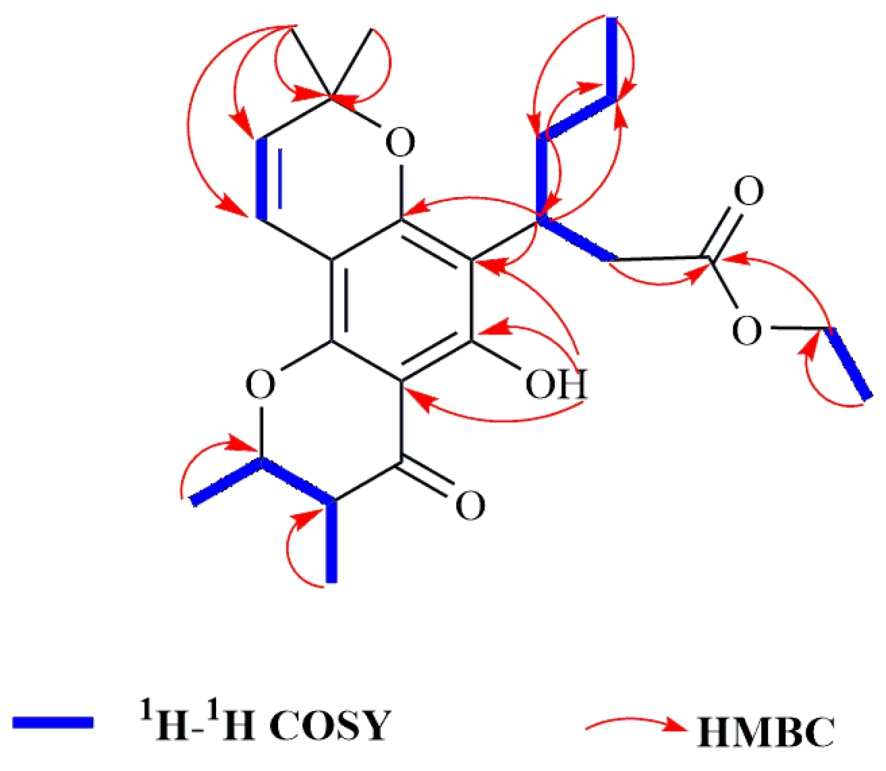
图
3
化合物1主要的1H-1H COSY 和HMBC相关信号
Fig.
3
Key related 1H-1H COSY and HMBC signals of Compound 1
化合物3 淡黄色油状物,ESI-MS (m/z): 417 [M + H]+,分子式C24H32O6。1H-NMR (500 MHz, CDCl3)δ: 12.48 (1H, s, 5-OH), 6.60 (1H, d, J = 10.0 Hz, H-6), 5.46 (1H, d, J = 10.0 Hz, H-7), 4.12 (1H, m, H-2), 3.66 (1H, m, H-13), 2.80 (1H, m, H-14a), 2.70 (1H, m, H-14b), 2.53 (1H, m, H-3), 1.82 (1H, m, H-16α), 1.56 (1H, m, H-16β), 1.47 (3H, d, J = 6.3 Hz, H-11), 1.45 (3H, s, H-21), 1.37 (3H, s, H-22), 1.31 (2H, m, H-18), 1.21 (2H, m, H-19), 1.19 (3H, d, J = 6.7 Hz, H-12), 1.13 (2H, m, H-17), 0.83 (3H, t, J = 6.3 Hz, H-20)。13C-NMR (126 MHz, CDCl3)δ: 199.5 (C-4), 179.1 (C-15), 160.0 (C-9a), 157.2 (C-5, C-10a, overlapped), 125.8 (C-7), 115.8 (C-6), 109.1 (C-10), 102.7 (C-5a), 102.0 (C- 4a), 79.0 (C-2), 78.3 (C-8), 45.8 (C-3), 38.7 (C-14), 33.1 (C-16), 33.0 (C-18), 30.8 (C-13), 29.1 (C-21), 28.6 (C- 22), 28.2 (C-17), 22.6 (C-19), 19.6 (C-11), 14.2 (C-20), 10.7 (C-12)。此化合物的核磁数据与Lim等(2019)报道的一致,故鉴定化合物3为blancoic acid。
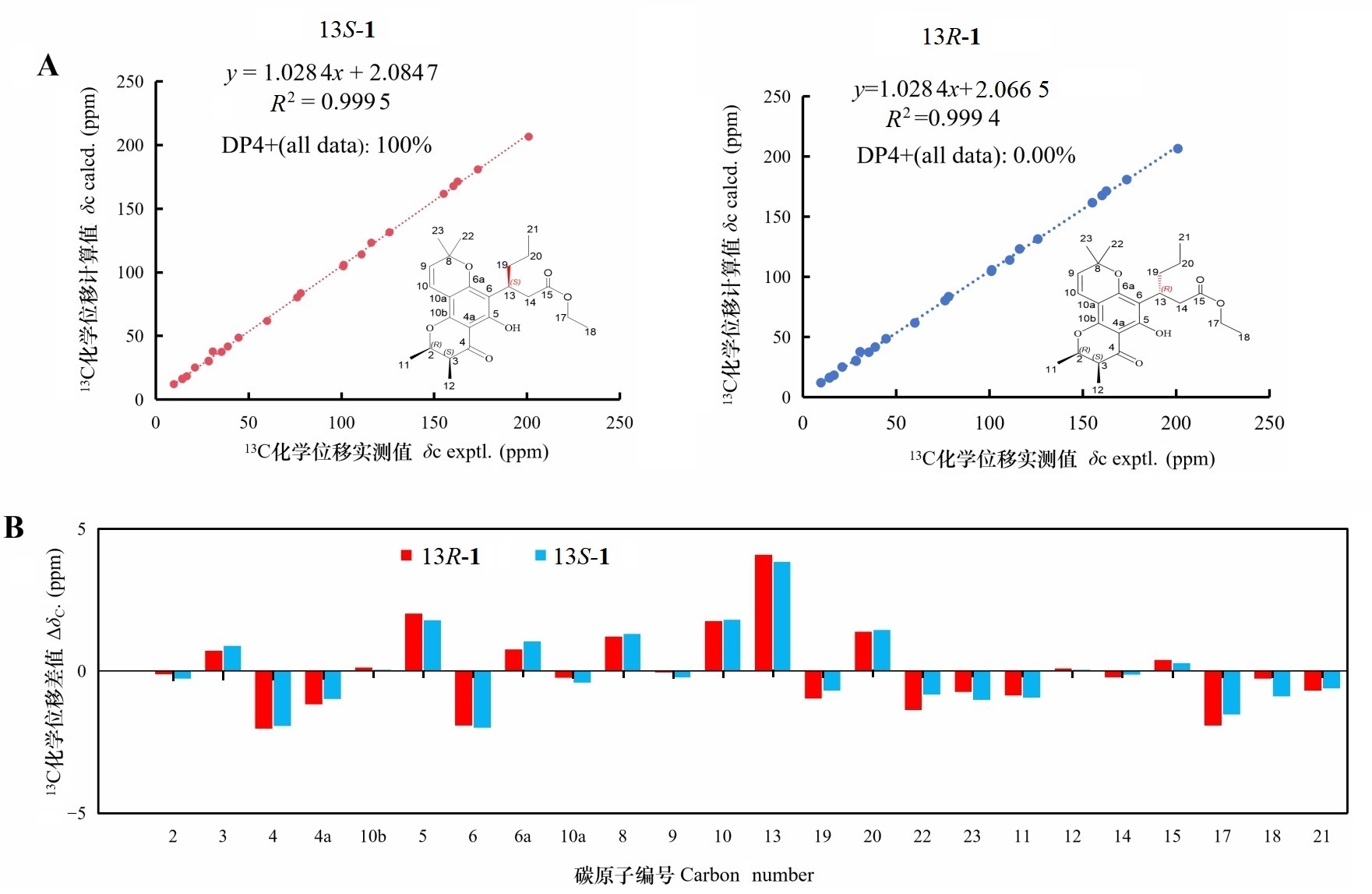
图
4
化合物1的13C-NMR化学位移计算值与实验值线性相关图(A)及差值图(B)
Fig.
4
Linear correlation plots (A) and the difference (B) of experimental versus calculated 13C-NMR chemical shift for Compound 1
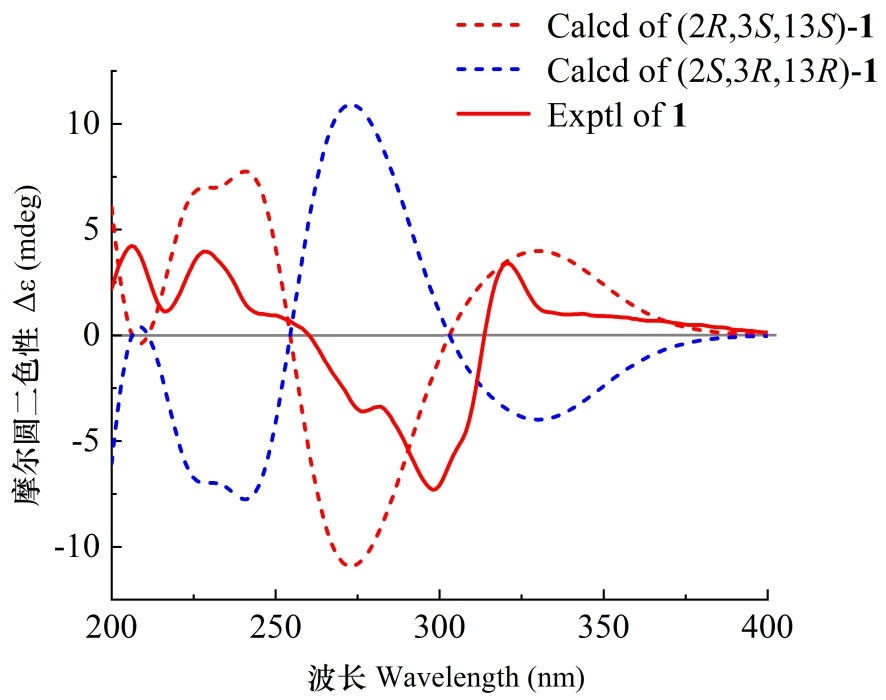
图
5
化合物1的实验ECD图谱和理论ECD图谱
Fig.
5
Experimental and calculated ECD spectra of Compound 1
化合物4 黄色油状物,ESI-MS (m/z): 389 [M + H]+,分子式C22H28O6。1H-NMR (500 MHz, CDCl3)δ: 12.62 (1H, s, 5-OH), 6.54 (1H, d, J = 10.0 Hz, H-6), 5.46 (1H, d, J = 10.0 Hz, H-7), 4.54 (1H, qd, J = 6.5, 3.1 Hz, H-2), 3.70 (1H, m, H-13), 2.84 (1H, m, H-14β), 2.74 (1H, dd, J = 15.6, 7.1 Hz, H-14α), 2.52 (1H, qd, J = 7.3, 3.1 Hz, H-3), 1.88 (1H, m, H-16β), 1.54 (1H, m, H-16α), 1.45 (3H, s, H-20), 1.41 (3H, s, H-19), 1.39 (3H, d, J = 6.6 Hz, H-11), 1.18 (3H, d, J = 7.3 Hz, H-12), 1.15 (2H, m, H-17), 0.87 (3H, t, J = 7.2 Hz, H-18)。13C-NMR (126 MHz, CDCl3)δ: 201.0 (C-4), 178.7 (C-15), 160.2 (C-10a), 155.2 (C-9a), 155.2 (C-5), 125.9 (C-7), 116.0 (C-6), 110.5 (C-10), 101.2 (C-5a), 101.1 (C-4a), 78.9 (C-8), 78.1 (C-2), 45.7 (C-3), 38.3 (C-14), 35.3 (C-16), 30.3 (C-13), 28.7 (C-20), 28.2 (C-19), 21.1 (C-17), 19.8 (C-11), 14.2 (C-18), 10.2 (C-12)。该化合物的波谱数据与Shen等(2004)报道的一致,故鉴定化合物4为apetalic acid。
化合物5 淡黄色油状物,ESI-MS (m/z): 389 [M + H]+,分子式C22H28O6。1H-NMR (500 MHz, CDCl3)δ: 12.47 (1H, s, 5-OH), 6.60 (1H, d, J = 9.8 Hz, H-6), 5.46 (1H, d, J = 10.0 Hz, H-7), 4.16 (1H, dq, J = 12.7, 6.5 Hz, H-2), 3.71 (1H, m, H-13), 2.86 (1H, m, H-14β), 2.73 (1H, m, H-14α), 2.55 (1H, m, H-3), 1.88 (1H, m, H-16α), 1.53 (1H, m, H-16β), 1.50 (3H, d, J = 6.2 Hz, H-11), 1.46 (3H, s, H-19), 1.39 (3H, s, H-20), 1.21 (3H, d, J = 6.9 Hz, H-12), 1.16 (2H, m, H-17), 0.85 (3H, t, J = 7.1 Hz, H-18)。13C-NMR (126 MHz, CDCl3)δ: 199.5 (C-4), 179.2 (C-15), 160.1 (C-10a), 157.1 (C-9a), 157.1 (C-5), 125.9 (C-7), 115.8 (C-6), 109.1 (C-10), 102.8 (C-5a), 102.0 (C-4a), 78.9 (C-2), 78.1 (C-8), 45.8 (C-3), 38.9 (C-14), 35.7 (C-16), 30.6 (C-13), 28.7 (C-20), 28.1 (C-19), 21.0 (C-17), 19.8 (C-11), 14.2 (C-18), 10.2 (C-12)。上述核磁数据与Shen等(2004)报道的基本一致,故鉴定化合物5为isoapetalic acid。
化合物6 淡黄色油状物,ESI-MS (m/z): 425 [M + Na]+,分子式C23H30O6。1H-NMR (500 MHz, CDCl3)δ: 12.63 (1H, s, 5-OH), 6.54 (1H, d, J = 10.0 Hz, H-6), 5.46 (1H, d, J = 10.0 Hz, H-7), 4.54 (1H, dq, J = 6.5, 3.2 Hz, H-2), 3.72 (1H, m, H-13), 3.58 (3H, m, 15-COOCH3), 2.73 (2H, m, H-14), 2.54 (1H, dq, J = 7.4, 3.2 Hz, H-3), 1.88 (1H, m, H-16β), 1.53 (1H, m, H-16α), 1.46 (3H, s, H-19), 1.43 (3H, s, H-20), 1.39 (3H, d, J = 6.6 Hz, H-11), 1.23 (1H, m, H-17), 1.18 (3H, d, J = 7.3 Hz, H-12), 1.15 (1H, m, H-17), 0.86 (1H, d, J = 7.2 Hz, H-18)。13C-NMR (126 MHz, CDCl3)δ: 201.0 (C-4), 174.0 (C-15), 160.1 (C-10a), 157.0 (C-9a), 154.0 (C-5), 125.8 (C-7), 116.1 (C-6), 110.7 (C-10), 101.2 (C-5a), 101.1 (C-4a), 78.1 (C-2), 76.2 (C-8), 51.4 (15-COO H3), 44.6 (C-3), 38.5 (C-14), 35.4 (C-16), 30.6 (C-13), 28.6 (C-20), 28.4 (C-19), 21.1 (C-17), 16.7 (C-11), 14.3 (C-18), 9.6 (C-12)。该化合物的波谱数据与Shen等(2004)报道的基本一致,故鉴定化合物6为apetalic acid methyl ester。
H3), 44.6 (C-3), 38.5 (C-14), 35.4 (C-16), 30.6 (C-13), 28.6 (C-20), 28.4 (C-19), 21.1 (C-17), 16.7 (C-11), 14.3 (C-18), 9.6 (C-12)。该化合物的波谱数据与Shen等(2004)报道的基本一致,故鉴定化合物6为apetalic acid methyl ester。
化合物7 淡黄色油状物,ESI-MS (m/z): 425 [M + Na]+,分子式C23H30O6。1H-NMR (500 MHz, CDCl3)δ: 12.48 (1H, s, 5-OH), 6.61 (1H, d, J = 10.0 Hz, H-6), 5.46 (1H, d, J = 9.9 Hz, H-7), 4.14 (1H, dq, J = 10.4, 6.1 Hz, H-2), 3.70 ( 1H, m, H-13), 3.58 (3H, s, 15-COOCH3), 2.73 (2H, m, H-14), 2.54 (1H, m, H-3), 1.81 (1H, m, H-16β), 1.52 (1H, m, H-16α), 1.50 (3H, d, J = 6.3 Hz, H-11), 1.14 (2H, m, H-17), 1.44 (3H, s, H-19), 1.42 (3H, s, H-20), 1.20 (3H, d, J = 7.0 Hz, H-12), 0.86 (3H, t, J = 7.2 Hz, H-18)。13C-NMR (126 MHz, CDCl3)δ: 199.5 (C-4), 173.8 (C-15), 160.1 (C-10a), 157.1 (C-5), 157.1 (C-9a), 125.8 (C-7), 115.9 (C-6), 109.3 (C-10), 102.8 (C-5a), 102.0 (C-4a), 79.0 (C-2), 78.2 (C-8), 51.4 (15-COO H3), 45.9 (C-3), 38.8 (C-14), 35.7 (C-16), 30.8 (C-13), 28.3 (C-19), 28.3 (C-20), 20.9 (C-17), 19.7 (C-11), 14.1 (C-18), 10.5 (C-12)。上述核磁数据与Shen等(2004)报道的一致,故鉴定化合物7为isoapetalic acid methyl ester。
H3), 45.9 (C-3), 38.8 (C-14), 35.7 (C-16), 30.8 (C-13), 28.3 (C-19), 28.3 (C-20), 20.9 (C-17), 19.7 (C-11), 14.1 (C-18), 10.5 (C-12)。上述核磁数据与Shen等(2004)报道的一致,故鉴定化合物7为isoapetalic acid methyl ester。
化合物8 淡黄色油状物,ESI-MS (m/z): 445 [M + Na]+,分子式C25H26O6。1H-NMR (500 MHz, CDCl3)δ: 12.50 (s, 8b-OH), 7.29 (2H, d, J = 7.6 Hz, H-13, 17, overlapped), 7.22 (2H, t, J = 7.5 Hz, H-14, 16, overlapped), 7.14 (1H, t, J = 7.2 Hz, H-15), 6.57 (1H, d, J = 9.9 Hz, H-8), 5.43 (1H, d, J = 10.0 Hz, H-7), 5.01 (1H, m, H-4), 4.55 (1H, qd, J = 6.5, 3.1 Hz, H-9), 3.22 (2H, br·d, J = 8.0 Hz, H-3ab), 2.51 (1H, dq, J = 10.4, 6.5 Hz, H-10), 1.45 (3H, d, J = 6.9 Hz, H-20), 1.41, (3H, s, H-19), 1.20 (3H, d, J = 7.0 Hz, H-21), 1.11 (3H, s, H-18)。13C-NMR (126 MHz, CDCl3)δ: 199.4 (C-11), 178.5 (C-2), 159.6 (C-4b), 159.3 (C-8b), 157.5 (C-11b), 143.5 (C-12), 128.1 (C-14, 16, overlapped), 127.6 (C-13, 17, overlapped), 126.1 (C-7), 126.1 (C-15), 115.8 (C-8), 110.0 (C-4a), 103.1 (C-8a), 102.0 (C-11a), 79.2 (C-9), 78.5 (C-6), 45.8 (C-10), 37.2 (C-3), 35.3 (C-4), 28.4 (C-19), 27.6 (C-18), 19.6 (C-20), 10.8 (C-21)。该化合物的核磁数据与陈纪军等(2001)报道的一致,故鉴定化合物8为calopolyanolide B。
化合物9 淡黄色针状晶体,ESI-MS (m/z): 213 [M + H]+,分子式C13H8O3。1H-NMR (500 MHz, DMSO-d6)δ: 9.96 (1H, s, 2-OH), 8.17 (1H, dd, J = 8.0, 1.8 Hz, H-8), 7.84 (1H, td, J = 7.8, 1.7 Hz, H-6), 7.63 (1H, d, J = 8.3 Hz, H-5), 7.55 (1H, d, J = 9.0 Hz, H-4), 7.46 (1H, d, J = 7.1 Hz, H-1), 7.44 (1H, d, J = 7.4 Hz, H-7), 7.32 (1H, dd, J = 9.0, 3.1 Hz, H-3)。13C-NMR (126 MHz, DMSO-d6)δ: 175.9 (C-9), 155.6 (C-10a), 154.0 (C-2), 149.2 (C-4a), 135.3 (C-6), 126.0 (C-8), 124.6 (C-3), 124.0 (C-7), 121.7 (C-9a), 120.7 (C-8a), 119.6 (C-4), 118.1 (C-5), 108.9 (C-1)。上述波谱数据与蔡晨秋等(2012)报道的一致,故鉴定化合物9为2-羟基呫吨酮。
化合物10 黄色油状物,ESI-MS (m/z): 343 [M + H]+,分子式C19H18O6。1H-NMR (500 MHz, DMSO-d6)δ: 7.50 (1H, d, J = 8.7 Hz, H-8), 6.95 (1H, d, J = 8.7 Hz, H-7), 6.46 (1H, s, H-2), 6.31 (1H, dd, J = 17.4, 10.5 Hz, H-14), 4.84 (1H, dd, J = 17.4, 1.3 Hz, H-15α), 4.77 (1H, dd, J = 17.4, 1.3 Hz, H-15β), 3.81 (3H, s, 3-OCH3), 1.67 (3H, s, H-12), 1.67 (3H, s, H-13)。13C-NMR (126 MHz, DMSO-d6)δ: 180.6 (C-9), 164.9 (C-3), 161.6 (C-1), 115.7 (C-8), 154.7 (C-4a), 151.9 (C-14), 150.3 (C-6), 146.1 (C-10a), 132.9 (C-5), 113.1 (C-4), 112.9 (C-8a), 112.6 (C-7), 107.4 (C-15), 102.3 (C-9a), 95.4 (C-2), 55.9 (-OCH3), 40.7 (C-11), 29.6 (C-12), 29.6 (C-13)。以上数据与Kobayashi等(1997)报道的一致,故鉴定化合物10为异胡椒酮 B。
化合物11 黄色油状物,ESI-MS (m/z): 417 [M + Na]+,分子式C23H22O6。1H-NMR (500 MHz, DMSO-d6)δ: 7.25 (1H, s, H-8), 6.53 (1H, d, J = 9.9 Hz, H-16), 6.41 (1H, s, H-4), 5.82 (1H, d, J = 9.9 Hz, H-17), 4.48 (1H, q, J = 6.5 Hz, H-14), 1.43 (6H, s, H-19, 20, overlapped), 1.38 (3H, s, H-13), 1.35 (3H, d, J = 6.6 Hz, H-15), 1.11 (3H, s, H-12)。13C-NMR (126 MHz, DMSO-d6)δ: 173.1 (C-9), 160.0 (C-1), 159.4 (C-3), 157.1 (C-4a), 145.6 (C-10a), 144.8 (C-6), 132.9 (C-17), 131.3 (C-5), 121.5 (C-16), 118.1 (C-2), 117.7 (C-7), 116.1 (C-8a), 112.5 (C-8), 101.8 (C-9a), 95.8 (C-4), 90.2 (C-14), 77.3 (C-18), 42.6 (C-11), 27.9 (C-19, 20, overlapped), 25.3 (C-13), 20.7 (C-12), 14.2 (C-15)。该化合物的核磁数据与Akosung等(2021)报道的数据一致,故鉴定化合物11为lacexanthone。
化合物12 白色粉末,ESI-MS (m/z): 381 [M + Na]+,分子式C19H18O7。1H-NMR (500 MHz, DMSO-d6)δ: 13.48 (1H, s, 1-OH), 7.51 (1H, d, J = 8.7 Hz, H-8), 6.94 (1H, d, J = 8.7 Hz, H-7), 4.62 (1H, m, H-14), 3.78 (3H, s, 2-OCH3), 1.56 (3H, s, H-13), 1.39 (3H, d, J = 6.5 Hz, H-15), 1.26 (3H, s, H-12)。13C-NMR (126 MHz, DMSO-d6)δ: 180.3 (C-9), 157.5 (C-3), 154.5 (C-1), 152.2 (C-6), 147.8 (C-4a), 146.1 (C-10a), 132.7 (C-5), 127.1 (C-2), 116.0 (C-8), 113.5 (C-8a), 112.9 (C-7), 112.7 (C-4), 102.7 (C-9a), 91.1 (C-14), 60.1 (2-OCH3), 43.8 (C-11), 25.1 (C-12), 21.1 (C-13), 14.2 (C-15)。该化合物的波谱数据与Chambaud等(2024)报道的基本一致,故鉴定化合物12为caledonixanthone Q。
化合物13 白色粉末,ESI-MS (m/z): 361 [M + H]+,分子式C20H24O6。1H-NMR (500 MHz, CD3OD)δ: 6.91 (1H, s, H-4), 6.81 (1H, d, J = 1.9 Hz, H-3′), 6.77 (2H, s, H-2, 6, overlapped), 6.72 (1H, d, J = 8.0 Hz, H-6′), 6.65 (1H, dd, J = 8.0, 1.9 Hz, H-5′), 4.75(1H, d, J = 6.9 Hz, H-7), 3.99 (1H, m, H-9′), 3.85 (3H, s, 5-OCH3), 3.84 (3H, s, 3-OCH3), 3.73 (1H, m, H-9′), 3.63 (1H, m, H-9), 3.83 (1H, m, H-9), 2.94 (1H, dd, J = 13.5, 4.9 Hz, H-7′), 2.74 (1H, m, H-8′), 2.50 (1H, m, H-7′), 2.38(1H, m, H-8)。13C-NMR (126 MHz, CD3OD)δ: 149.0 (C-3), 149.0 (C-5), 147.1 (C-2′), 145.8 (C-4′), 135.7 (C-1), 133.5 (C-1′), 122.2 (C-5′), 119.8 (C-6′), 116.2 (C-6), 116.0 (C-2), 113.7 (C-3′), 110.6 (C-4), 84.1 (C-7), 73.5 (C-9′), 60.5 (C-9), 56.4 (5-OCH3), 56.4 (3-OCH3), 54.1 (C-8), 43.9 (C-8′), 33.7 (C-7′)。该化合物的核磁数据与周大铮等(2004)报道的一致,故鉴定化合物13为(7,8-cis-8,8′-trans)-2′,4′-二羟基-3,5-二甲氧基-落叶松脂素。
化合物14 淡黄色油状物,ESI-MS (m/z): 381 [M + Na]+,分子式C20H22O6。1H-NMR (500 MHz, CD3OD)δ: 6.97 (1H, br, s, H-6′), 6.95 (2H, s, H-2, 2′, overlapped), 6.83 (1H, d, J = 8.1 Hz, H-5), 6.78 (1H, d, J = 8.1 Hz, H-6), 6.54 (1H, d, J = 16.1 Hz, H-7′), 6.23 (1H, dt, J = 15.9, 5.9 Hz, H-8′), 5.53 (1H, d, J = 6.4 Hz, H-7), 4.21 (2H, d, J = 5.9 Hz, H-9′), 3.87 (3H, s, 3′-OCH3), 3.81 (3H, s, 3-OCH3), 3.79 (2H, m, H-9), 3.50 (1H, q, J = 6.2 Hz, H-8)。13C-NMR (126 MHz, CD3OD)δ: 149.2 (C-3), 149.0 (C-4′), 147.5 (C-4), 145.5 (C-3′), 134.5 (C-1), 132.5 (C-1′), 132.0 (C-5′), 130.3 (C-7′), 127.5 (C-8′), 119.8 (C-6), 116.5 (C-6′), 116.1 (C-5), 112.0 (C-2′), 110.5 (C-2), 89.3 (C-7), 64.8 (C-9), 63.8 (C-9′), 56.7 (3′-OCH3), 56.4 (3-OCH3), 55.1 (C-8)。上述核磁数据与Hong等(2006)报道的基本一致,故鉴定化合物14为(7R,8S)-去氢双松柏醇。
化合物15 白色晶体,ESI-MS (m/z): 359 [M + H]+,分子式C20H22O6。1H-NMR (500 MHz, CDCl3)δ: 6.90 (2H, d, J = 1.7 Hz, H-2, 2′), 6.89 (2H, d, J = 8.1 Hz, H-5, 5′), 6.82 (2H, dd, J = 8.1, 1.9 Hz, H-6, 6′), 5.62 (2H, s, 4, 4′-OH), 4.74 (2H, d, J = 4.2 Hz, H-7, 7′), 4.25 (2H, m, H-9β, 9′β), 3.91 (6H, s, H-3, 3′-OCH3), 3.88 (2H, dd, J = 9.3, 3.4 Hz, H-9, 9′α), 3.10 (2H, m, H-8, 8′)。13C-NMR (126 MHz, CDCl3)δ: 146.8 (C-3, 3′), 145.4 (C-4, 4′), 133.1 (C-1, 1′), 119.1 (C-6, 6′), 114.4 (C-5, 5′), 108.7 (C-2, 2′), 86.0 (C-7, 7′), 71.8 (C-9, 9′), 56.1 (3, 3′-OCH3), 54.3 (C-8, 8′)。该化合物的波谱数据与张艳玲等(2010)报道的一致,故鉴定化合物15为(+)-松脂醇。
2.2 HepG2细胞葡萄糖摄取实验结果
本研究对分离得到的化合物进行HepG2细胞葡萄糖摄取实验。由图6可知,胰岛素阳性组葡萄糖摄取量是对照组的2.21倍,在50 μmol·L-1浓度下,化合物1、2、3、8、13能不同程度地促进HepG2细胞对葡萄糖的摄取,葡萄糖摄取量分别是对照组的1.47倍、1.47倍、1.12倍、1.49倍和1.23倍,表明这些化合物具有较强的降血糖活性。同时进行细胞活力测定,结果见图7,在药物浓度为50 μmol·L-1条件下,给药组所有化合物细胞活力均≥90%,表明化合物在此浓度下无显著细胞毒性。
3 讨论与结论
本研究主要对宽叶匙羹藤降血糖活性部位(乙酸乙酯)差异组分段进行分离,结果从中分离鉴定7个色原酮类、4个𠮿酮类、3个木脂素类和1个香豆素类化合物,其中化合物1为新的色原酮类化合物,其余化合物均为首次从匙羹藤属植物中分离得到。
本研究分得的色原酮化合物此前未见报道于匙羹藤属植物成分中,色原酮类化合物是一类重要的含氧杂环天然产物,根据结构骨架差异的特点可分为内酯类、羧酸类及多聚异戊烯基类(明萌,2016),此次分得的色原酮多为羧酸类,母核以三环为主。本研究在化合物2、4中发现了开链单键上的亚甲基(CH2)同碳氢耦合现象,这主要与该类化合物高度受限的空间构象及其特殊的立体化学环境密切相关。以化合物2为例,第一,C-13是一个手性碳,它旁边的C-14及C-16上的亚甲基质子(H-14a和H-14b;H-16a和H-16b)在空间上就成了非对映异位质子,因此,即便单键可以旋转,这两个质子所处的平均磁环境也并非完全等价,这就为它们彼此之间发生自旋耦合裂分提供了理论基础。第二,该结构多环母核产生了极大的空间位阻,严重阻碍了侧链单键的自由旋转;而C-15位的羧基极易与C-5位的酚羟基形成分子内氢键,并形成一个类似七元环的刚性环结构。在这个环的束缚下,C-14上的两个质子空间朝向被严格固定(一个朝向“环”内,一个朝向“环”外)。这种空间环境使得它们表现出类似于刚性环上CH2质子特征,进而在谱图上展现出清晰的同碳耦合信号,这一现象在文献(Shen et al., 2004;Wang et al., 2010)中也有类似的报道。
化合物8既具有二氢香豆素结构,也可看成是色原酮的开环衍生物,结构比较特殊,提示其可能是宽叶匙羹藤特殊的次生代谢产物。除了色原酮类化合物之外,本次分离得到的𠮿酮类和木脂素类化合物,在匙羹藤属植物中也不常见。𠮿酮类化合物主要有三元氧化和四元氧化结构,此次研究中分离得到的𠮿酮化合物以三元氧化为主。有研究报道匙羹藤属植物中的木脂素包括苯骈呋喃型木脂素、单环氧木脂素和双环氧木脂素(刘美余等,2023,2025),此次分得的木脂素类也是这3种结构类型,研究结果丰富了该属植物的化学成分库,拓展了对其成分多样性的认识,为植物的化学分类学提供了参考依据。
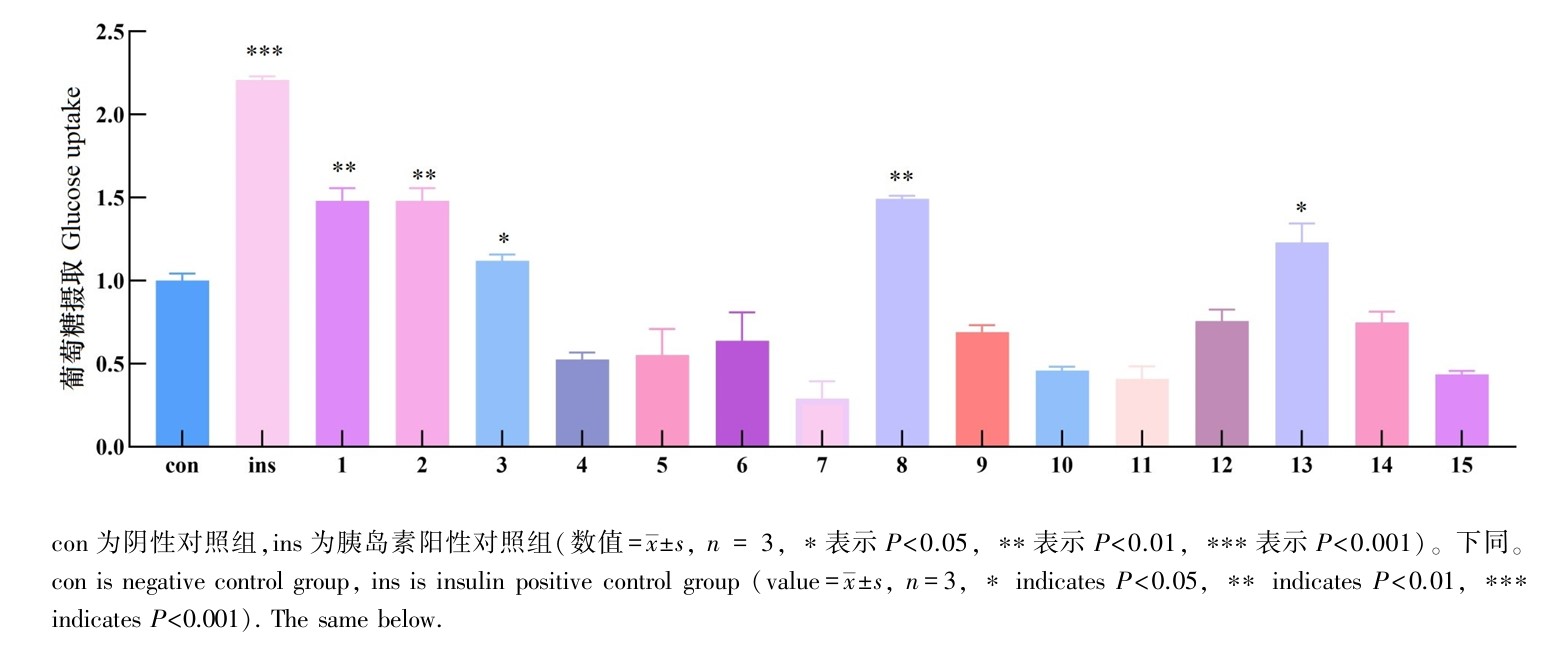
图
6
化合物 1-15(50 μmol·L-1) 对 HepG2 细胞摄取葡萄糖的影响
Fig.
6
Effects of compounds 1-15(50 μmol·L-1) on glucose uptake in HepG2 cells
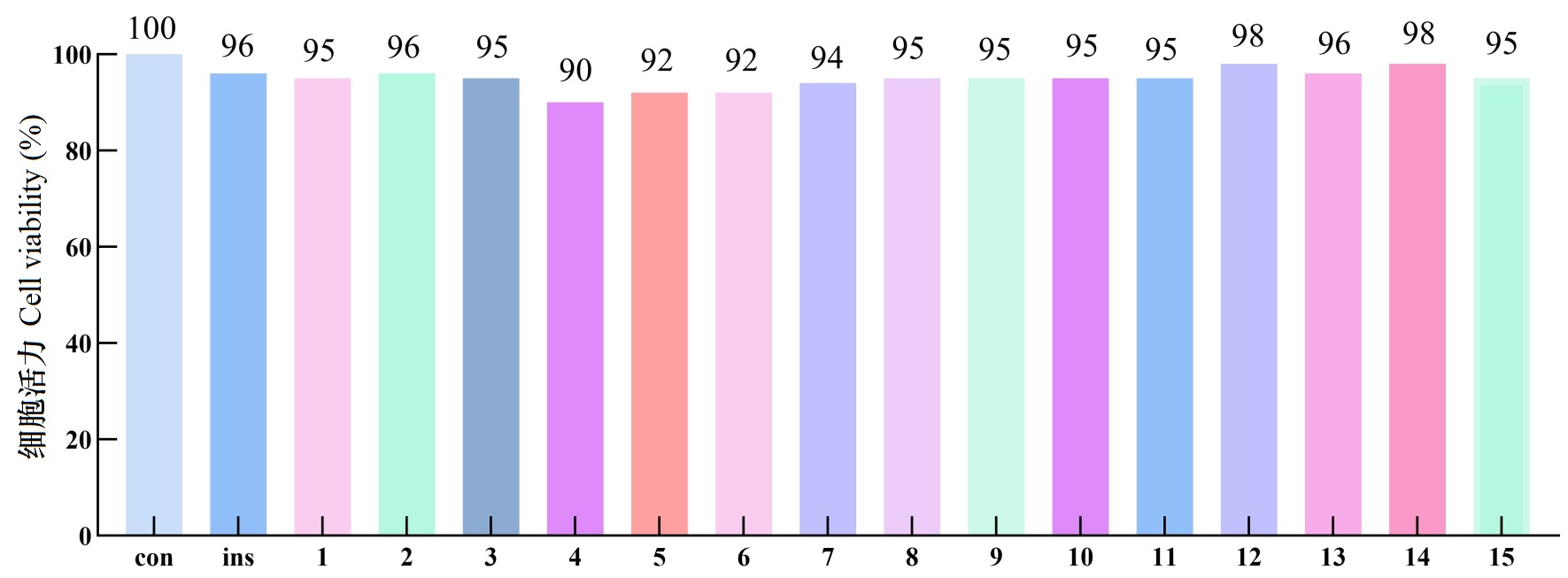
图
7
化合物 1-15(50 μmol·L-1)的细胞活力
Fig.
7
Cell viabilities of compounds 1-15(50 μmol·L-1)
药理研究表明,色原酮类化合物具有抗炎、抗病毒和酶抑制活性等作用(Kashman et al., 1992; Shen et al., 2024; Cao et al., 2025),目前尚未见其降血糖作用的报道。本研究通过促HepG2细胞葡萄糖摄取活性筛选,发现分得的多个色原酮化合物具有降血糖活性,而且色原酮母核与吡喃环的骈合方式不同,降血糖活性差异显著,色原酮母核与吡喃环角型骈合的化合物(1、2、8)降血糖活性明显强于直型骈合的化合物(3-7),推测母核的环系结构、取代基位置及立体构型对活性可能具有影响(Kaneda et al., 2022),但需要进一步开展构效关系研究加以验证。此外,对化合物1-15进行细胞活力测试,结果表明在有效浓度下,化合物对HepG2细胞的毒性较低,排除了因细胞受损或死亡导致糖代谢异常的假阳性干扰,证实了其降糖活性的真实性,并表现出较好的初步安全性,但相关作用机制是否通过激活AMPK能量代谢感应通路、调节PI3K/Akt胰岛素信号通路、干预糖异生关键酶(如PEPCK或G6Pase)活性,或是促进细胞葡萄糖转运蛋白(如GLUT4)的胞膜转位等途径发挥作用,仍有待进一步阐明。𠮿酮类化合物因其独特的稠环共轭体系,文献中报道其通过亚油酸和鞘脂代谢表现出显著的抗纤维化作用(董惠敏,2021)。此外,Brownlee(2005)研究表明,糖尿病的发生发展常伴随长期的氧化应激损伤,𠮿酮类成分的存在可能通过改善机体氧化应激状态,与降糖成分发挥协同或保护胰岛β细胞的作用,这对于缓解糖尿病引发的肝脏脂质代谢紊乱及慢性炎症具有积极意义。这些不同骨架类型成分的共同存在,提示宽叶匙羹藤在民间用于治疗消渴症(糖尿病)可能具有“多成分、多靶点、多途径”协同干预的天然药物特点。
宽叶匙羹藤在广西壮族民间用于糖尿病的治疗具有深厚的民族用药基础。其化学结构类型丰富,活性多样,具有良好的开发利用前景,然而目前的基础研究相对薄弱。一方面,可以在活性导向下继续加强对宽叶匙羹藤化学成分的系统研究,选择不同的葡萄糖摄取细胞模型和多靶点药理活性筛选方法对其作用进行全面深度解析;另一方面,可在体外实验的基础上引入糖尿病动物模型,在体内水平验证其降糖疗效,并结合转录组学和蛋白质组学等前沿分子生物学方法技术,多维阐释其作用机制。本研究结果可为系统深入开展宽叶匙羹藤的化学成分与药理研究奠定基础,为发现结构新颖的降血糖先导化合物提供科学依据,同时也有助于建立更具专属性的药材质量评价标准,为更好地挖掘和开发宽叶匙羹藤的现代临床药用价值提供有力参考。