


摘要
蕙兰(Cymbidium faberi)属兰科兰属植物,野生蕙兰被列入联合国《濒危野生动植物种国际贸易公约》附录Ⅱ和中国珍稀濒危植物信息系统保护范围。秦岭是我国南北气候的地理分界线和重要的生态安全屏障。为了解秦岭野生蕙兰的遗传背景,该研究利用筛选出的2对叶绿体DNA引物psbA-trnH和rpl14-rpl36,对秦岭蕙兰15个种群271个个体进行序列扩增和测序,分析其遗传多样性,检测遗传结构并估算种群间基因流。结果表明:(1)秦岭蕙兰种群平均单倍型多样性为0.725,平均核苷酸多态性为3.1 × 10⁻³,具有较高遗传多样性水平。(2)分子方差分析(AMOVA)结果表明,秦岭蕙兰遗传变异主要发生在种群内(88.84%),种群间遗传变异仅占11.16%,种群间遗传分化水平较低(ΦST=0.112,P<0.01),没有形成明显谱系地理结构。(3)基因流估算结果显示,除3个种群存在不对称双向基因流(迁出的基因流较强,迁入的基因流较弱)以外,其余种群间基因流强度(Nm)均大于1,表明秦岭蕙兰种群间种子介导的基因交流频繁。综上认为,蕙兰种子长距离传播和扩散能力可能是该遗传结构形成的原因,建议就地保护时优先保护单倍型多样性较高的LSZ和NCZ种群。该研究可为该物种种质资源保护提供理论依据。
Abstract
Cymbidium faberi is a species of the genus Cymbidium in Orchidaceae. It is listed in Appendix Ⅱ of the Convention on International Trade in Endangered Species (CITES) and Information System of Chinese Rare and Endangered Plants (ISCREP). The Qinling Mountains are a geographically north-south climate boundary and an important ecological barrier in China. To understand the genetic background of wild C. faberi in this region, 271 samples from 15 populations were subjected to sequence amplification and sequencing, and were analyzed to evaluate the genetic diversity, genetic structure and gene flow among populations based on psbA-trnH and rpl14-rpl36 intergenic spacers of chloroplast DNA. The results were as follows: (1) The mean haplotype diversity was 0.725 and nucleotide diversity was 3.1 × 10⁻³, indicating a high level of genetic diversity. (2) The results of analysis of molecular variance (AMOVA) revealed that as much as 88.84% of molecular variance was distributed within populations, only small percentage of the total genetic variation was attributed to genetic differences among populations (11.16%), and the level of genetic differentiation was low (ΦST = 0.112,P<0.01), and no obvious phylogeography structure was formed. (3) Estimation results of gene flow indicated that unidirectional gene flow moving from these populations to other populations was stronger than that from other populations. However, gene flow intensity (Nm) was superior to 1.0 in most cases, suggesting the presence of frequent seed-mediated gene flow between populations. In conclusion, long-distance dispersal and spread capabilities of C. faberi seeds may result in the lack of population genetic structure. It is recommend that LSZ and NCZ populations should be given priority for in-situ conservation because these two populations have much higher haplotype diversity. This study provides a theoretical basis for the conservation of germplasm resources of this species.
秦岭山脉是南北气候的地理分界线和重要的生态安全屏障,具有调节气候、保持水土、涵养水源等诸多功能,其复杂的地形特征与多样化的生境为众多珍稀物种提供了独特的生存环境,是全球生物多样性最为丰富的地区之一。Yuan等(2012)利用14对微卫星分子标记,研究了秦岭牡丹种群遗传结构,结果表明秦岭牡丹种群间存在有限的基因流,遗传分化程度较高(FST=0.302),这可能是因其受到生境片段化和人为干扰的影响。Zhao等(2013)对秦岭和长白山柴胡的研究表明,柴胡种群间存在显著遗传分化,其可能原因为第四纪冰期气候变化。Liu等(2014)对秦岭桃儿七的研究也表明,63.27%的遗传变异存在于种群间,种群间基因流有限(Nm=0.358),种子的短距离传播可能限制了基因流。Wang等(2018)对秦岭中华猕猴桃的研究则表明,有25.97%的遗传变异发生在种群间,74.03%的遗传变异发生在种群内,部分种群间存在高水平基因流。由此可见,物种扩散机制、地形隔离、历史气候变化以及人类活动等因素对秦岭种群遗传格局具有重要影响。
蕙兰(Cymbidium faberi)又名九子兰,属兰科(Orchidaceae)兰属(Cymbidium)植物,野生蕙兰已被列入联合国《濒危野生动植物种国际贸易公约》附录Ⅱ和中国珍稀濒危植物信息系统保护范围。蕙兰产中国陕西南部、安徽、浙江、江西、河南南部、四川、云南、贵州等地,尼泊尔、印度北部也有分布(中国科学院中国植物志编辑委员会,1999)。目前,学者对蕙兰开展的研究主要集中在花的挥发性成分和形态多样性、光合特性、染色体核型、微卫星分子标记群体遗传和根际土壤微生物多样性等方面(陈君梅等,2016,2017;Song & Zhang,2018;费昭雪等,2020;Liang et al., 2021;Lv et al., 2023)。此外,也有研究者对江西蕙兰的群体遗传结构进行了研究。例如,汤秀菲(2012)采用ISSR分子标记,对江西省野生蕙兰进行群体遗传分析,发现蕙兰种群间遗传分化水平较高,基因流为0.936;龚黄莎(2013)对江西省野生蕙兰种群ITS和叶绿体DNA基因间隔区进行了分析,ITS序列分子方差分析结果表明,种群间的遗传变异为18.22%,种群内的遗传变异为67.87%,叶绿体DNA分析结果表明,种群间遗传变异占50.03%;谢慧敏(2020)对江西主要山脉的3种兰属植物蕙兰、建兰和寒兰景观遗传学进行研究,petB-petD序列分析结果表明,蕙兰17个种群共168个个体,共有11种单倍型,部分种群之间通过山脉形成的自然生态廊道进行遗传交流。
植物基因流包括花粉介导的基因流和种子介导的基因流,仅种子介导的基因流能够建立新的种群。叶绿体DNA(chloroplast DNA, cpDNA)结构简单、分子量小,在大多数被子植物中是母系遗传(吴诗琪等,2023),被广泛应用于植物谱系地理学和种群间种子介导的基因流研究中。例如,Fay等(2009)对杓兰开展了遗传学研究,认为cpDNA非编码区rps16 和accD-psaI可作为研究种子基因流的分子标记;Jermakowicz等(2015)基于cpDNA片段trnL、rps16、trnL-trnF 和accD-psaI对欧亚沼兰种群开展研究,发现单倍型H1在大部分欧洲种群中均存在,即没有形成明显的谱系地理结构;Pérez-Escobar等(2017)利用内转录间隔区ITS、ycf1和trnS-trnG序列,对兰科植物Cycnoches 进行了遗传学研究,发现安第斯山脉不会成为该兰科植物种子传播的障碍。
秦岭是野生蕙兰分布的最北端,秦岭蕙兰叶形优美、花香浓郁、花大且瓣型独特,受到人们的喜爱。近年来由于过度采挖、生境破碎化和气候变化等因素,野生蕙兰种群的分布范围和个体数量显著缩减,其遗传多样性维持与种群续存面临严峻挑战。在此背景下,做好野生蕙兰资源收集和遗传背景分析工作,对制定科学保护策略具有重要理论和实践意义。尽管近年来学者对兰科植物的研究不断深入,在群体遗传学方面取得显著进展,但是针对秦岭蕙兰的遗传多样性现状、遗传结构和种群间种子介导的基因流研究仍较为匮乏。本研究以秦岭野生蕙兰15个种群271个个体为研究对象,通过cpDNA中 psbA-trnH和rpl14-rpl36的测序分析,旨在探究秦岭蕙兰种群的遗传结构及其可能影响因素,为秦岭蕙兰的就地保护提供科学依据。
1 材料与方法
1.1 材料
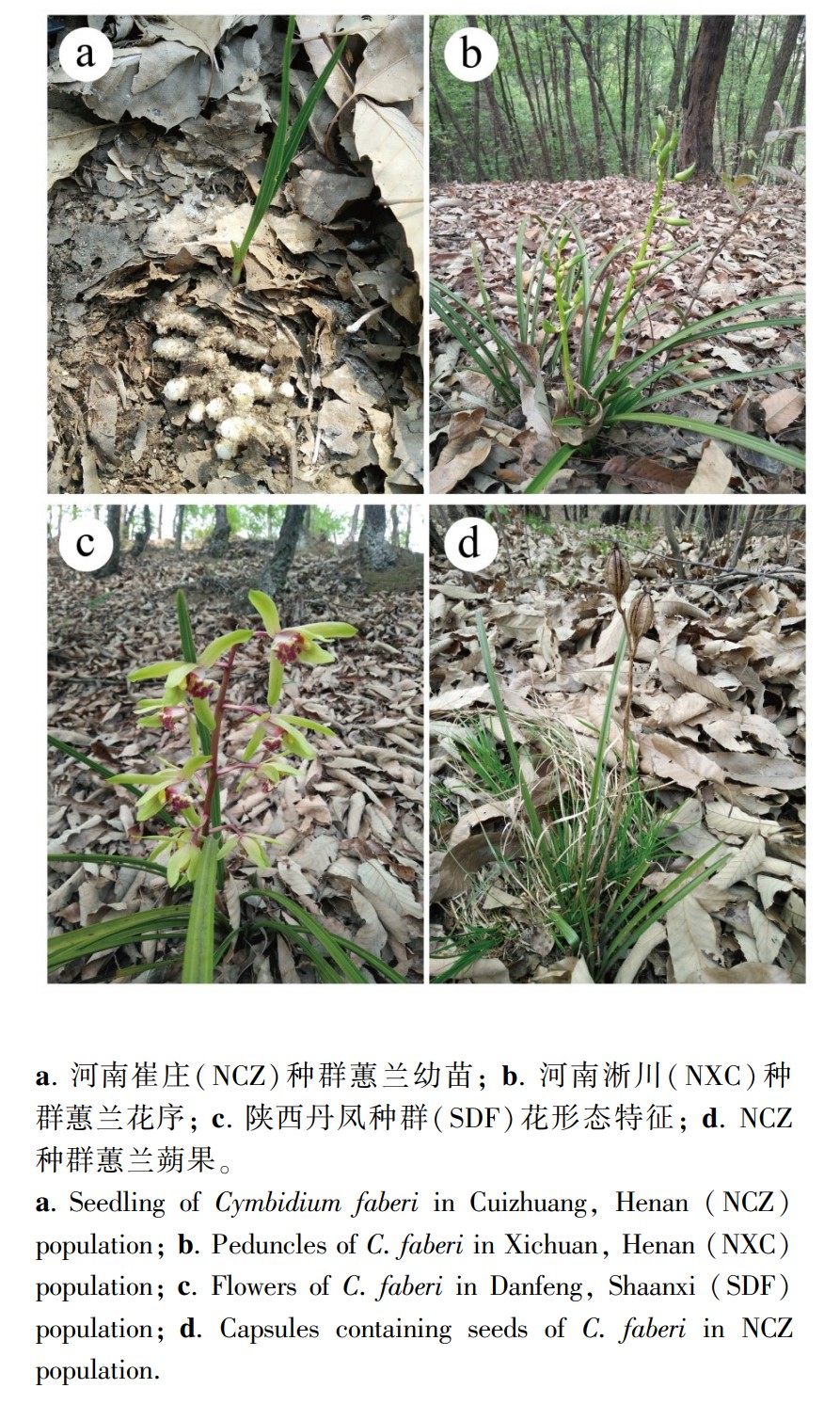
采集秦岭蕙兰15个种群271个样本的叶片。采集样本时,每个种群采集15~21个样本,每个个体采集2~3个幼嫩叶片,硅胶干燥后室温保存,用于基因组总DNA提取。部分种群蕙兰的形态特征如图1所示。在15个种群中,河南崔庄种群(NCZ)和陕西西乡种群(SXX)地理距离最远(463 km)。NCZ种群位于秦岭东麓坡地,该区年平均气温为14.8 ℃,年降水量800~1 000 mm,植被类型为落叶阔叶林,林冠层透光率较好,乔灌木有栓皮栎(Quercus variabilis)、黄栌(Cotinus coggygria)和大花溲疏(Deutzia grandiflora)等;SXX种群位于秦岭腹地村庄附近;河南淅川种群(NXC)伴生种有栓皮栎、有柄石韦(Pyrrosia petiolosa)和蕨类植物,土壤腐殖质丰富;河南薛家沟种群(LXG)伴生有杜鹃(Rhododendron simsii);河南狮子坪乡种群(LSZ)位于海拔1 261 m的坡地。
图
1
秦岭蕙兰形态特征
Fig.
1
Morphological characteristics of Cymbidium faberi in the Qinling Mountains
1.2 仪器与试剂
制冰机(SIM-F140型)、超纯水机(AKJY-20型)、PCR仪(德国Biometra)、涡旋混匀仪(XK96-B型)、高压灭菌锅(SANYO MLS-3750型)、高速冷冻离心机(HITACHI CF16RX Ⅱ型)、凝胶成像分析系统(Alpha Innotech)、植物基因组DNA提取试剂盒 [天根生化科技(北京)有限公司]等。
1.3 基因组总DNA提取和序列扩增
使用天根试剂盒提取蕙兰基因组总DNA。利用筛选出的psbA-trnH(F: GTTATGCATGAACGTA ATGCTC,R: CGCGCATGGTGGATTCACAAATC)(Sang et al., 1997)和rpl14-rpl36(F: AAGGAAAT CCAAAAGGAACTCG,R: GGRTTGGAACAAATTACT ATAATTCG)(Shaw et al., 2007)两对叶绿体DNA引物,对所有蕙兰样本进行PCR扩增,PCR反应总体系20 μL,10×buffer 2 μL,dNTPmix 0.2 mmol·L-1,Taq酶0.5 U,上、下游引物均为0.2 μmol·L-1,DNA模板50~100 ng。扩增程序:94 ℃预变性5 min;94 ℃变性35 s,56 ℃退火45 s,72 ℃延伸90 s,35个循环;72 ℃延伸10 min,4 ℃保存。扩增产物送北京六合华大基因科技有限公司进行测序。
1.4 序列分析
根据测序峰图对序列进行人工校正,拼接后在ClustalX2.1软件(Thompson et al., 1997)中进行序列比对;由于插入缺失位点(insertion/deletion sites, InDels)也包含有遗传信息,因此使用SeqState 软件(Müller, 2005)中“simple indel-coding”方法(Simmons & Ochoterena, 2000)对其进行编码;利用DnaSP 5.10 软件(Rozas & Rozas,1995)统计单倍型多样性(haplotype diversity,Hd)和核苷酸多态性(nucleotide diversity, π);利用Network软件构建单倍型网络图(Bandelt et al., 1999);在ArcGIS中绘制单倍型地理分布图;从NCBI网站(https://www.ncbi.nlm.nih.gov/)下载兰科兰属植物墨兰(Cymbidium sinense)叶绿体全基因组序列(ON969301.1),以墨兰作为外类群,利用MEGA 7.0 软件中“Kimura’s two-parameter model”计算种群间遗传距离并构建邻接树(Kumar et al., 2016),1 000次重复;用Arlequin 3.5.2软件(Excoffier & Lischer,2010)对DNA序列进行分子方差分析(analysis of molecular variance, AMOVA);利用Migrate 5.0.4软件(Beerli, 2006)估算种群间基因流强度(gene flow intensity,Nm),其中遗传参数的估计采用Bayesian方法,步长设置为10 000,burn-in设置为 1 000。基因流强度为xNm=M×θ,其中M为迁移率估计值,θ表示有效种群大小,单倍型x=1。
2 结果与分析
2.1 单倍型多态性
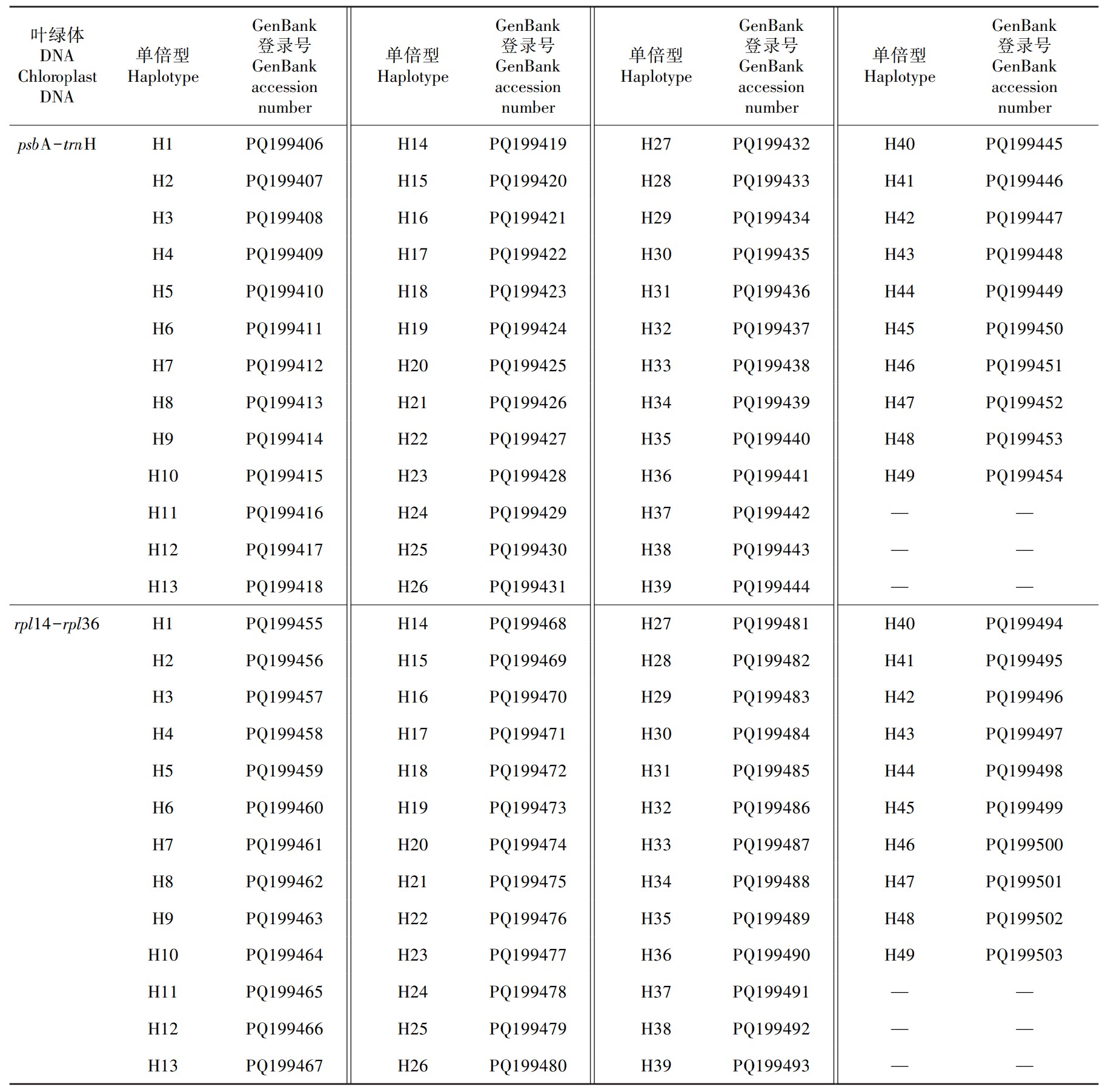
叶绿体DNA psbA-trnH 和 rpl14-rpl36序列拼接后总长1 344 bp,共检出29个InDels,49种单倍型,将序列提交至NCBI网站,获得GenBank登录号为PQ199406-PQ199503,如表1所示。
表
1
49种单倍型GenBank登录号
Table
1
GenBank accession number of 49 haplotypes
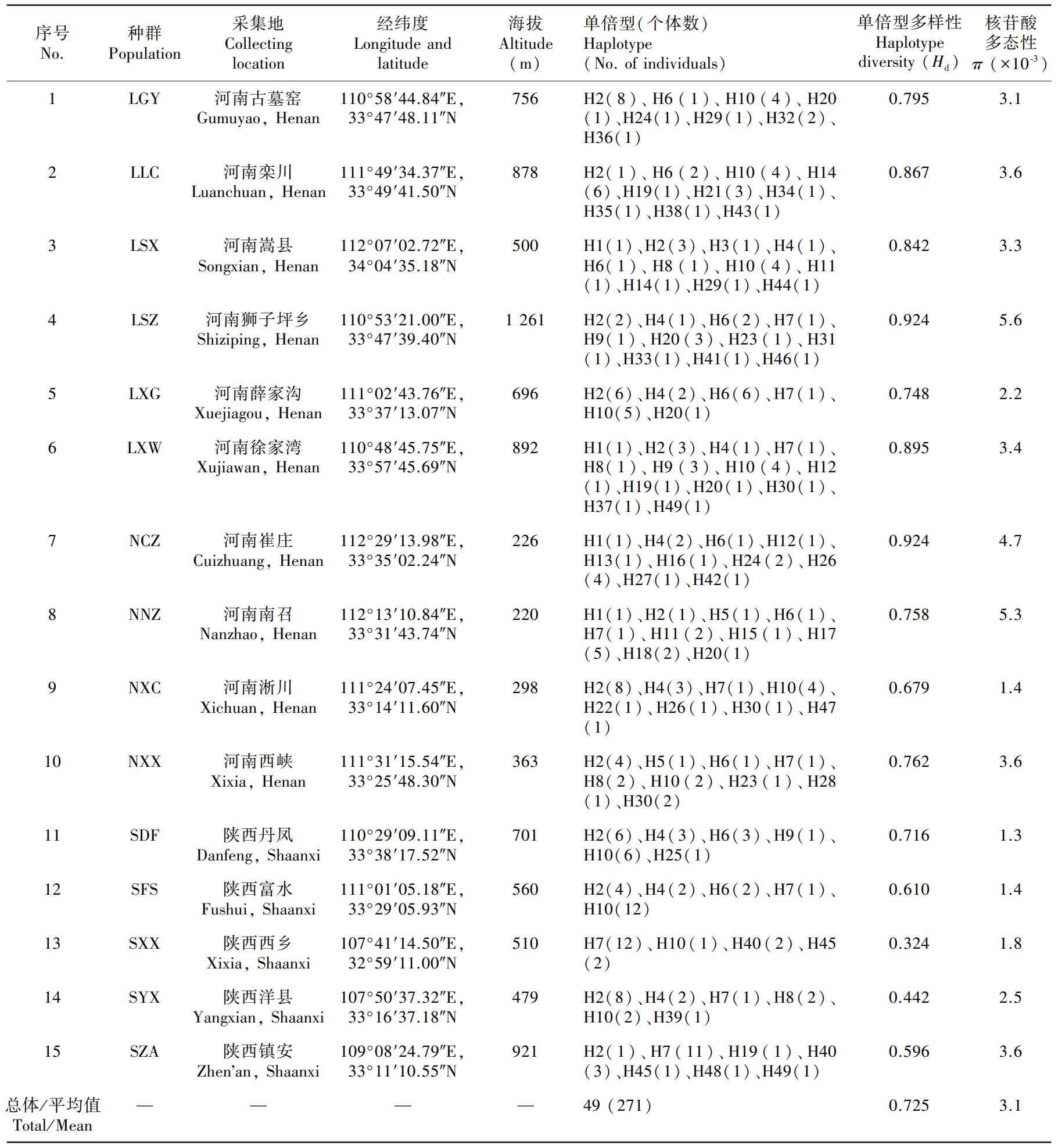
15个种群单倍型多样性(Hd)范围为0.324~0.924,均值为0.725(表2)。其中,LSZ和NCZ种群的Hd最高(0.924),SXX种群的Hd最低(0.324)。15个种群的核苷酸多态性(π)范围为1.3 × 10⁻³(SDF)~ 5.6 × 10⁻³(LSZ)。总体而言,秦岭蕙兰具有较高的单倍型多样性。
表
2
蕙兰种群单倍型多态性
Table
2
Haplotype diversity for Cymbidium faberi populations
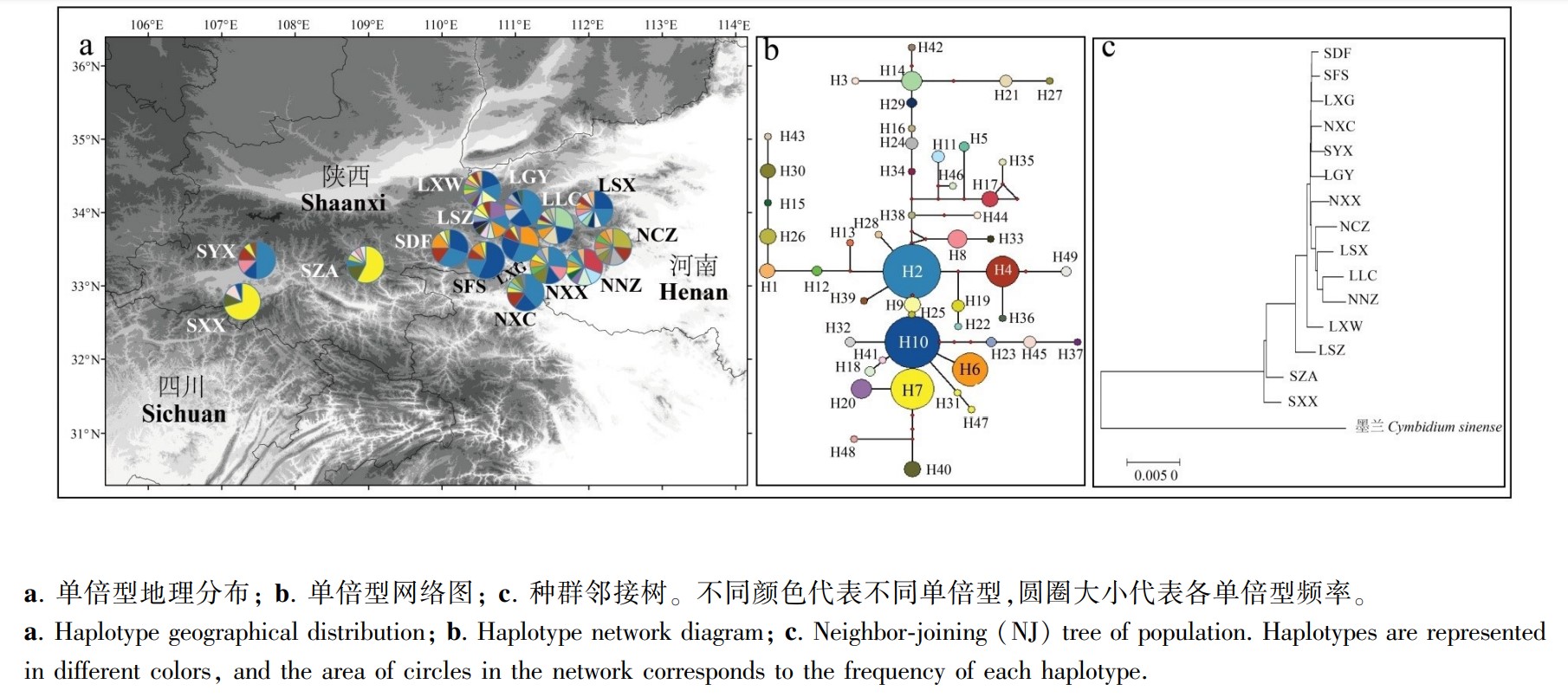
利用DnaSP 5.10软件分析得到的49种单倍型中,27种单倍型是单个蕙兰种群特有单倍型,22种单倍型分布在2个或多个种群中。其中,单倍型H2出现频率最高,在13个种群中均有分布,包括SYX和LSX(2个种群地理距离为434 km)。单倍型H10在11个种群中均有分布,H7在10个种群中均有分布(图2)。
图
2
秦岭蕙兰单倍型地理分布
Fig.
2
Haplotype geographical distribution of Cymbidium faberi in the Qinling Mountains
2.2 分子方差分析结果
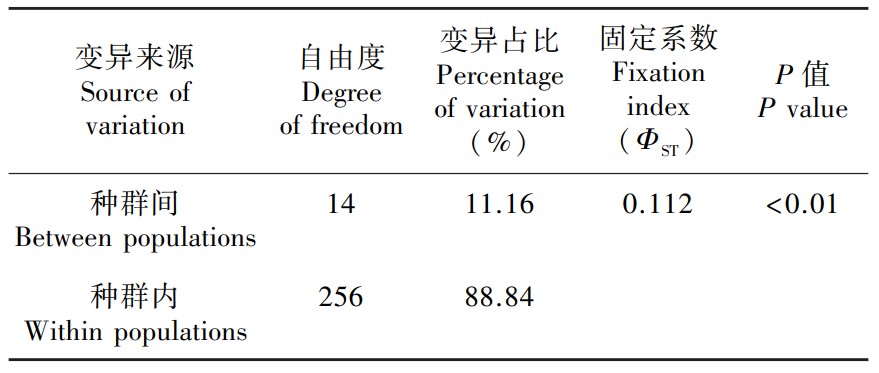
以墨兰作为外类群,利用MEGA软件构建秦岭野生蕙兰15个种群的邻接树。由图2:c可知,秦岭野生蕙兰大部分种群聚为一类。分子方差分析(AMOVA)结果表明,88.84%的遗传变异发生在蕙兰种群内,种群间的遗传变异仅占11.16%(P<0.01)(表3),表明秦岭蕙兰种群间遗传分化水平较低,没有形成明显的谱系地理结构。
表
3
蕙兰种群分子方差分析
Table
3
Analysis of molecular variance (AMOVA) of Cymbidium faberi populations
2.3 基因流
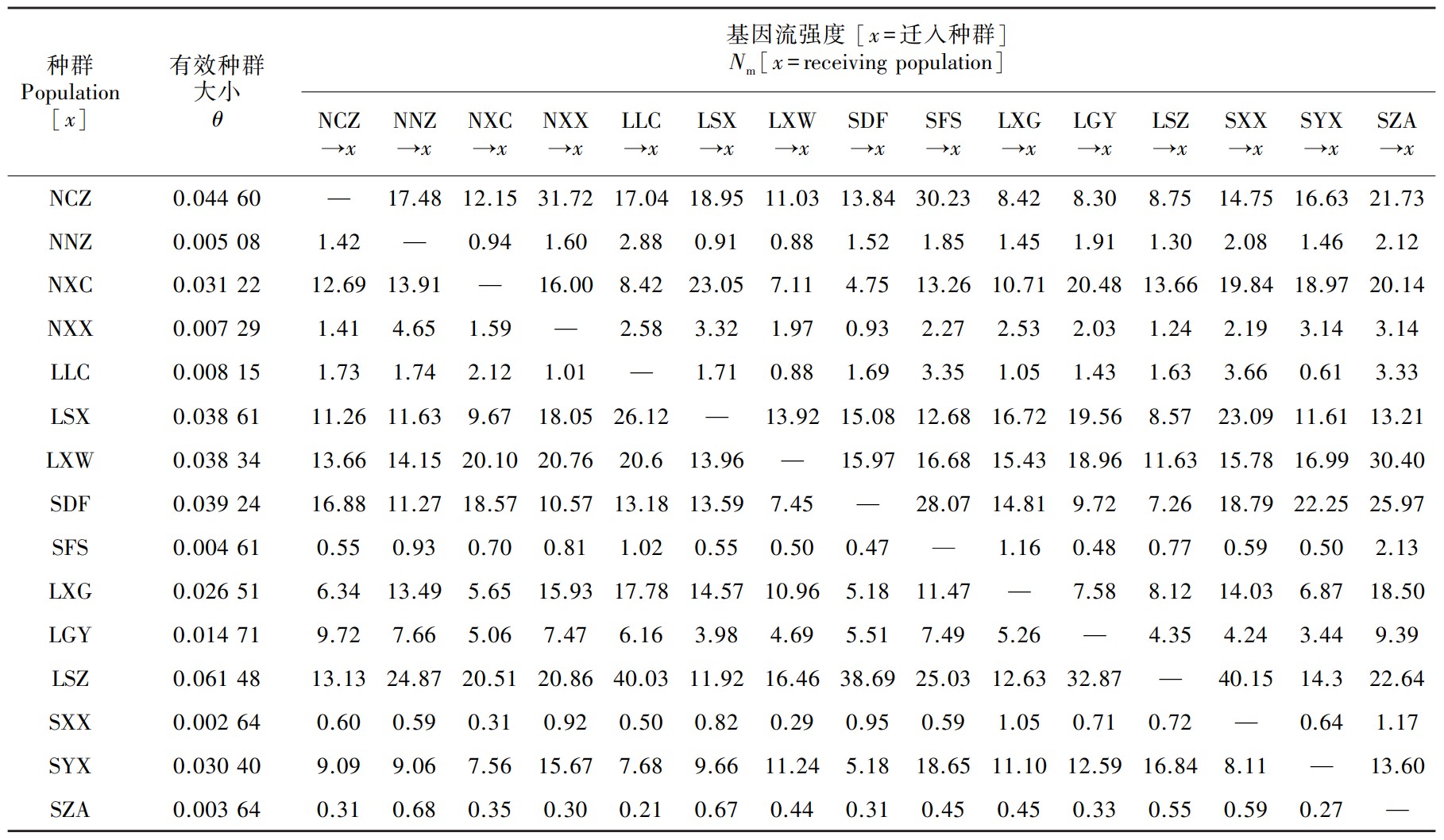
由Migrate软件估算结果(表4)可知,除SFS、SXX和SZA种群存在不对称双向基因流(迁出的基因流较强,迁入的基因流较弱)以外,蕙兰大部分种群间的双向基因流强度(Nm)均大于1,表明秦岭蕙兰种群间种子介导的基因交流频繁,种子在蕙兰物种扩散中起着重要作用。
表
4
蕙兰种群间种子介导的基因流
Table
4
Seed-mediated gene flow between Cymbidium faberi populations
注:箭头表示基因流的方向。
Note: The arrows indicate the direction of gene flow.
3 讨论与结论
3.1 遗传多样性
生物多样性保护是生态系统保护的重要组成部分,了解遗传变异信息是制定遗传多样性保护策略的前提。通过对秦岭蕙兰15个种群271个个体的2个cpDNA序列分析,结果显示秦岭蕙兰种群平均单倍型多样性为0.725,平均核苷酸多态性π为3.1 × 10⁻³,高于兰科植物Epidendrum fulgens (Hd: 0~0.508)(Pinheiro et al., 2011)、Vexillabium yakushimense(π:1.30 × 10⁻³)(Saeki et al., 2014)、Malaxis monophyllos(Hd:0.702; π:1.96 × 10⁻³)(Jermakowicz et al., 2015)、Liparisloeselii (HT=0.356)(Wiland-Szymańska et al., 2016)、E. atrorubens(Hd: 0.292~0.686; π: 0.50 × 10⁻³~1.50 × 10⁻³)(Hens et al., 2017)、Cypripedium calceolus(Hd: 0~0.689)(Minasiewicz et al., 2018)和Pelatantheria scolopendrifolia(π: 1.88 × 10⁻³)(Yun et al., 2020),但略低于Phalaenopsis amabilis(Hd=0.758)(Tsai et al., 2015)。
由此可见,秦岭蕙兰种群保持有较高的单倍型多样性水平。一方面,推测与秦岭作为第四纪冰期避难所(Qiu et al., 2011),其生境异质性和连续的山地森林可能为蕙兰提供了长期稳定的进化环境,使其形成一定的种群规模有关。另一方面,植物叶绿体基因组大小为148~163 kb(刘浩宇等,2023),叶绿体平均同义核苷酸替代率每年每位点为1.0×10⁻⁹~3.0×10⁻⁹,高于线粒体同义核苷酸替代率(0.2×10⁻⁹~1.0×10⁻⁹)(Wolfe et al., 1987),叶绿体平均同义核苷酸替代率约为线粒体的3倍(Drouin et al., 2008),并且叶绿体基因组非编码区序列因其功能上的限制较少,缺乏选择压力,往往比编码区表现出更快的核苷酸变异速率(Gielly& Taberlet,1994),这些因素导致蕙兰种群具有较高的单倍型多样性。值得注意的是,人类活动导致的生境破碎化会对蕙兰种群遗传多样性造成影响,如SXX种群Hd仅为0.324。
3.2 遗传结构和基因流
种群遗传结构受历史气候、生境和种子特性等多种因素的影响。本研究发现,秦岭没有形成蕙兰种群基因交流的屏障,种群间种子介导的基因交流频繁,大部分种群间的双向基因流强度(Nm)均大于1,这可能与兰科植物种子结构特性有关。大部分兰科植物种子细小如粉末,根据Arditti和Ghani(2000)的研究可知,兰科植物每个蒴果能产生大约150万粒种子,每粒种子的平均长度为(0.94 ± 0.33) mm,平均宽度为(0.22 ± 0.08) mm,每粒种子的平均重量仅为(3.2 ± 1.63) μg。兰科植物的种子不仅细小,而且有些兰科植物种子中的气腔占到种子总体积的79.26%以上,这些特征使得兰科植物种子能够随风或水等媒介进行长距离传播和扩散,秦岭地区频繁的谷地环流与山脊强风可以为蕙兰种子扩散提供载体。
本研究结果与Phillips等(2012)、Vanden Broeck 等(2014)和Hedrén等(2018)的研究结果一致,但显著不同于依赖专一性传粉或菌根共生导致扩散受限的物种,如Cypripedium japonicum的ΦST在0.3以上(Li et al., 2016)。此外,帖聪晓等(2023)以江西省5个山脉和福建省1个山脉共17个蕙兰种群为材料,利用ISSR分子标记对其进行群体遗传结构分析,发现各山脉蕙兰种群基因流大于1,而总体基因流强度(Nm)较低,为0.936 6。蕙兰传粉者中华蜜蜂(Apis cerana)有限的飞行能力及江西省年均高降水量对传粉者活动的影响(He et al., 2013; 杨静秋,2017;杨美华,2023),可能会导致这些山脉蕙兰种群总基因流水平较低。该研究与本文研究结果有明显差异,这可能与所采用的分子标记类型不同以及气候对传粉者传粉能力的影响有关。
此外,本研究还发现,位于秦岭腹地的SXX、SZA和SFS种群存在不对称双向基因流,迁出的基因流较强而迁入的基因流较弱,这可能与西南地区是我国野生兰科分布中心有关。石昌魁(2008)对标本馆4 000余份兰科植物馆藏标本进行了文献整理,认为我国横断山区是兰科植物的分布中心;此外,张晓龙(2014)研究表明,中国野生兰科植物集中分布在我国的西南地区和台湾省;Wu 等(2023)利用单核苷酸多态分子标记(SNPs)和叶绿体基因组,对兰科独蒜兰属(Pleione)的物种起源和演化进行了分析,发现我国独蒜兰属起源于西南地区的横断山脉,之后向我国南部和东南部扩散。推测我国西南或南部地区的蕙兰种子扩散到秦岭后,SXX和SFS种群由于人类活动的干扰,缺乏种子萌发所需环境,导致有效迁入率降低,而SZA种群所处海拔较高,高海拔种子可能被强风带至低海拔区域,但逆风向的种子回迁因风力减弱而受限。
3.3 保护建议
种子扩散后,由于兰科植物种子胚发育不完全,没有胚乳。因此,大部分兰科植物,特别是地生兰种类,在种子萌发初期,需要土壤中共生真菌为其提供养分(王美娜等,2021);Li等(2021) 从野生蕙兰根际土壤中分离得到共生真菌Hyphomycete sp.、Umbelopsis sp.和 Ceratorhiza sp.,这些共生真菌能够促进蕙兰种子的萌发及种苗生长;此外,Lv等(2023)研究发现,子囊菌门(Ascomycota)是秦岭蕙兰土壤中的一种共生真菌。所以,蕙兰种子萌发需要特殊的土壤环境。
兰科植物作为最进化的物种之一,对环境的依赖性很强。因此,蕙兰种群的保护应从以下几个方面进行。首先,要从保护生境开始,减少植被破坏,以维持土壤共生真菌群落多样性。其次,应减少化肥农药的使用,以维护对传粉昆虫友好的生态环境,如前所述,蕙兰依赖于昆虫授粉且种子萌发依赖于土壤中的共生真菌,一旦生存环境受到破坏,传粉昆虫和共生真菌的生存就会受到影响,进而影响蕙兰的传粉、结实和种子萌发。最后,强化市场监管,禁止野生蕙兰市场贸易,禁止其在电商平台和线下市场的非法流通;同时加强宣传,组织开展“世界野生动植物日”主题宣传活动,不断提高原住居民保护野生蕙兰的意识,营造人与自然和谐共生的良好氛围。高遗传多样性种群是物种适应性进化的“基因库”,对维持种群进化潜力非常重要。因此,开展就地保护工作时,建议优先保护单倍型多样性较高的秦岭LSZ 和NCZ种群。