


摘要
甘油-3-磷酸酰基转移酶(GPAT)在植物生长发育和适应逆境胁迫过程中具有重要作用,为探究GPAT基因家族成员对高山植物水母雪兔子(Saussurea medusa)适应高山极端生境时发挥的作用,该研究采用HMM和BLASTp方法对SmGPAT基因家族成员进行全基因组鉴定,对家族成员的理化性质、染色体定位、基因结构、保守基序和顺式作用元件进行分析,并基于转录组数据和qRT-PCR技术分析SmGPAT家族成员的组织表达模式。结果表明:(1)共鉴定出15个SmGPAT家族成员,随机分布在10条染色体上,分别编码357~566个氨基酸,蛋白质相对分子质量为40.16~63.86 kD,等电点为5.93~10.02,亲脂系数为79.56~104.60,亚细胞定位预测位于线粒体或内质网(除SmGPAT7以外)。(2)系统进化分析发现,SmGPAT家族分为3个亚族(Group 1-Group 3),各亚族的基因结构和保守基序相似。SmGPAT家族蛋白质二级结构以α-螺旋和无规则卷曲为主,各亚族蛋白质三级结构模型相似。(3)顺式作用元件预测分析结果显示,SmGPAT家族含有大量逆境胁迫响应、激素响应和光响应相关的元件。(4)不同组织转录组数据分析结果表明,SmGPAT家族成员在叶和花中的表达量较茎和根高,并且qRT-PCR结果与转录组结果基本一致。综上认为,水母雪兔子中鉴定出的15个SmGPAT家族成员在不同组织间的表达模式存在差异,其中在花和叶中表达量较高,推测其在水母雪兔子叶和花发育过程中发挥重要作用,该研究为进一步开展SmGPAT基因在适应高山极端环境过程中的功能研究提供理论基础。
关键词
Abstract
Glycerol-3-phosphate acyltransferase (GPAT) plays essential roles in plant growth and development and stress adaptation. To investigate the role of SmGPAT gene family members in Saussurea medusa's adaptation to alpine extremes, we performed genome-wide identification using HMM and BLASTp methods and analyzed physicochemical properties, chromosome localization, gene structures, conserved motifs, and cis-acting elements. We also examined expression patterns across tissues using transcriptomic data and qRT-PCR validation. The results were as follows: (1) A total of 15 SmGPAT family members were identified which randomly distributed on 10 chromosomes. These genes encoded 357-566 amino acid proteins (relative molecular mass of 40.16-63.86 kD) with isoelectric points of 5.93-10.02. Their aliphatic index ranged from 79.56 to 104.60. Subcellular localization predictions indicated that the SmGPAT gene was predominantly localized to mitochondria or the endoplasmic reticulum (except for SmGPAT7). (2) Phylogenetic analysis divided SmGPATs into three subgroups (Group 1 - Group 3), with members within subgroups shared similar gene structures and conserved motifs. The secondary structure of SmGPAT family protein mainly contained α-helix and random coil, and the tertiary structure models were similar across subgroups. (3) The prediction analysis of cis-acting elements revealed abundant stress-responsive, hormones-responsive, and light-responsive elements of SmGPAT family. (4) Transcriptomic data analysis showed higher SmGPATs expression levels in leaf and flower than in stem and root. qRT-PCR results were largely consistent with the transcriptomic results. In conclusion, the expression patterns of the 15 SmGPAT family members indentified in S. medusa vary among different tissues, with higher expression levels in flower and leaf. These findings suggest that SmGPAT members may play key roles in leaf and flower development in S. medusa. This study provides a theoretical basis for further functional investigations of SmGPAT genes adapting to the alpine extreme environment.
甘油-3-磷酸酰基转移酶(glycerol-3-phosphate acyltransferase,GPAT)作为三酰甘油(triacylglycerol,TAG)生物合成的关键限速酶,通过催化甘油酯酰化反应的起始步骤调控代谢进程(Yang et al., 2010)。其催化机制包含催化甘油-3-磷酸(glycerol-3-phosphate,G3P)与脂酰基结合形成溶血磷脂酸(lysophosphatidic acid,LPA),继而由LPA酰基转移酶(LPA acyltransferase,LPAAT)催化生成磷脂酸(PA)(杨成兰,2022)。GPAT具有独特的分子结构和活性调控,并在时间和空间上呈现特定的分布,为多种脂质合成提供底物,参与膜磷脂、糖脂、甘油三酯以及角质和软木脂等胞外脂质的生物合成(Wang et al., 2020)。这些脂质在非生物胁迫信号的传递中发挥作用,并形成抵御病原体入侵的屏障,同时调节水分和溶质的运输,在植物的生长、发育及逆境应对中具有重要功能(高森等,2018;Xin & Herburger, 2021)。
目前,已在多个物种中开展了GPAT基因的研究,在拟南芥(Arabidopsis thaliana)中将GPAT基因家族根据亚细胞定位的差异划分为GPAT1-GPAT8、GPAT9和质体ATS1三类。GPAT1-GPAT8并不直接参与膜脂和油脂的合成,而是专注于陆生植物所特有的角质和软木脂等胞外脂质的合成(Xu et al., 2006;Li et al., 2007)。具体而言,GPAT1主要负责花器官的角质合成,GPAT4、GPAT6和GPAT8定位于内质网,并参与角质和蜡质的合成(Zheng et al., 2003)。GPAT4和GPAT8协同参与拟南芥叶片和花序茎角质的合成(Li et al., 2007),而GPAT6也特异参与拟南芥花中角质的合成,它们的突变体会影响花瓣的角质层厚度和组分,进而影响植物的生长发育和抗逆性(高华妮,2022)。只有定位于内质网的AtGPAT9表现出GPAT酶活性,直接参与真核途径中的膜脂和油脂的合成(Singer et al., 2016)。同时,质体中的可溶性酶ATS1利用脂酰基-ACP作为底物,催化甘油-3-磷酸(G3P)的sn-1位脂酰化,从而参与脂质合成(Xu et al., 2006;李昊根,2019)。在水稻(Oryza sativa)中,GPAT蛋白主要位于细胞膜部分,并参与去磷酸化、磷脂酰甘油、长链脂肪酸合成等多种脂质生物合成过程(Safder, 2021)。沙冬青的叶绿体GPAT可以增加磷脂酰甘油中的不饱和脂肪酸水平(Xue et al., 2019;杨成兰等,2022)。
水母雪兔子(Saussurea medusa)是菊科(Asteraceae)风毛菊属(Saussurea DC.)雪兔子亚属(subg. Saussurea)的多年生多次结实草本植物,主要分布在中国的甘肃、青海、新疆、四川、云南和西藏等地区海拔3 000~5 600 m之间的砾石山坡和高山流石滩。水母雪兔子作为青藏高原生物多样性的关键物种,其研究对于维持高寒生态系统功能具有重要意义。在2021年公布的《国家重点保护野生植物名录》中,该物种已被列为国家二级重点保护野生植物。目前,水母雪兔子的研究主要集中在资源开发和利用方面(曾智等,2021;张燕丽等,2023),只有郭佳磊(2021)和蒋欣悦等(2023)通过表皮毛和通气组织相关基因的克隆对极端环境的适应机制进行了研究。然而,在水母雪兔子中GPAT基因家族尚未得到系统鉴定和研究。因此,本研究基于水母雪兔子基因组及不同组织转录组数据,并整合模式植物拟南芥GPAT蛋白序列,系统鉴定了水母雪兔子SmGPAT基因家族成员,并且对15个SmGPAT基因进行理化性质、系统发育、二级和三级结构预测、亚细胞定位预测、顺式作用元件预测等分析,以及在不同组织中的表达模式分析,为后续开展水母雪兔子SmGPAT基因功能的深入研究奠定基础。同时,对SmGPAT基因家族进行组织表达模式分析,不仅能阐明该基因家族成员的结构特征与表达规律,而且还能为解析高原珍稀植物适应环境胁迫的分子机制提供重要理论依据。
1 材料与方法
1.1 材料
水母雪兔子作为国家二级保护野生植物,在2023年7月10日获得由青海省林业和草原局关于采集水母雪兔子的行政许可决定书后,于2023年8月4日在青海省都兰县阿拉克湖路崖口(97°19′13″E、35°41′03″N;海拔4 914 m)获取水母雪兔子根、茎、叶、花样本。采集后立即将样本密封于无菌冻存管,经液氮速冻后至-80 ℃超低温冰箱保存。
1.2 方法
1.2.1 水母雪兔子GPAT基因家族成员鉴定
以水母雪兔子基因组序列为基础,在EMBL-Pfam数据库(http://pfam.xfam.org/)中获取拟南芥GPAT家族保守结构域HMM模型(PF01553),利用HMMER3.1软件(E值≤1×10-5)对水母雪兔子蛋白组进行结构域搜索。同时采用BLASTp工具将拟南芥的10个GPAT蛋白序列与水母雪兔子蛋白质序列进行搜索比对,联合分析HMM和BLASTp筛选结果,剔除冗余序列。为验证候选蛋白序列的分子特征,将目标序列导入PFAM(https://www.ebi.ac.uk/interpro/entry/pfam/)、NCBI CDD(https://www.ncbi.nlm.nih.gov/cdd/)及SMART(http://smart.embl.de/)数据库中进行保守结构域验证,以此获得水母雪兔子SmGPAT基因家族成员。
1.2.2 水母雪兔子GPAT基因家族的信号肽、亚细胞定位、跨膜结构预测及理化性质分析
通过ExPASy数据库(https://web.expasy.org/protparam/)分析SmGPAT基因家族成员的氨基酸组成、理论等电点及分子量等基本理化参数;利用WoLF PSORT平台(https://wolfpsort.hgc.jp/)进行亚细胞定位预测(黄汉唐,2020),用ProtScale工具(https://web.expasy.org/protscale/)评估蛋白质疏水特性;用TMHMM算法(http://www.cbs.dtu.dk/services/TMHMM/)检测跨膜结构域分布。
1.2.3 水母雪兔子GPAT基因家族的染色体定位
从水母雪兔子基因组数据中获取基因的位置信息,并将提取结果和SmGPAT基因家族成员的基因ID提交至TBtools(杨杰等,2024)软件绘制染色体定位图。
1.2.4 水母雪兔子GPAT基因家族的蛋白质二级结构、三级结构预测
用Prabi(https://npsaprabi.ibcp.fr/cgibin/npsa_automat.plpage=npsa_sopma.html)在线网站预测水母雪兔子SmGPAT家族成员二级结构,SWISS-MODEL(https://swissmodel.expasy.org/interactive)在线网站预测水母雪兔子SmGPAT家族成员的三级结构。
1.2.5 水母雪兔子GPAT基因家族的系统发育、基因结构和保守基序分析
对拟南芥与水母雪兔子GPAT蛋白序列用MEGA 7软件的Clustal W进行多序列比对。运用邻接法(neighbor-joining, NJ)构建进化树。利用Evolvie在线工具(http://www.omicsclass.com/article/963)对进化树进行美化。此外,通过GSDS网站(http://gsds.gao-lab.org/)对基因序列的内含子和UTR进行分析,并使用MEME 5.5.4(https://meme-suite.org/meme/tools/meme)(Nystrom &Mckay, 2021)在线工具预测GPAT蛋白序列的保守基序。搜寻motif值设置为15,结构域宽度的最小值为6,最大值为100,其余参数保持默认。最后利用TBtools软件绘制保守基序图。
1.2.6 水母雪兔子GPAT基因家族顺式作用调节元件分析
在PlantCARE(http://bioinformatics.psb.ugent.be/webtools/plantcare/html/)数据库鉴定水母雪兔子SmGPAT基因家族成员启动子区域的顺式作用调控元件(起始密码子上游1 500 bp)。
1.2.7 水母雪兔子GPAT基因家族的RNA提取、组织表达和qRT-PCR分析
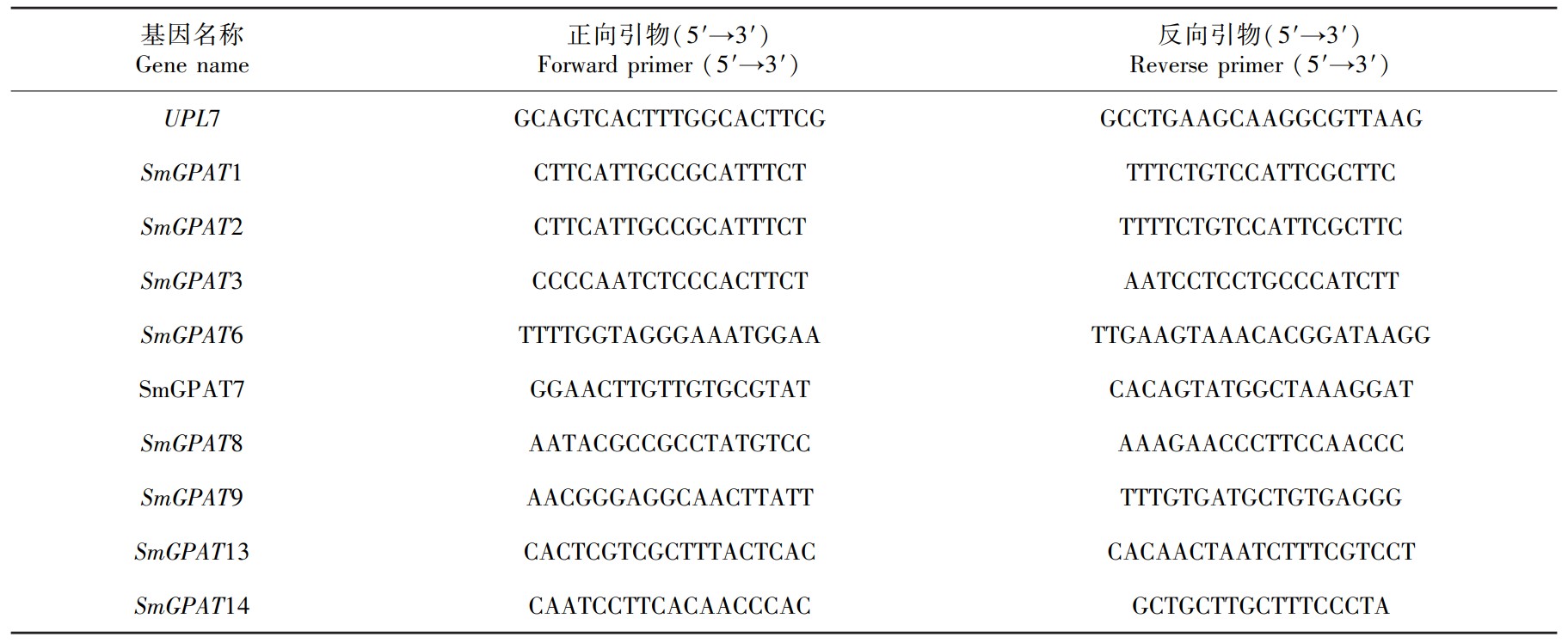
采用植物总RNA提取试剂盒RNAprep Pure [天根生化科技(北京)有限公司]完成水母雪兔子根、茎、叶、花组织总RNA提取,cDNA合成用PrimeScriptTMⅡ反转录试剂盒(TaKaRa,大连)进行。根据水母雪兔子不同组织(根、茎、叶和花)转录组FPKM(Fragments Per Kilobase Million)表达量数据,利用TBtools软件作组织表达量热图。通过Primer Premier 5软件设计基因特异性引物(表1),采用文献报道的泛素连接酶UPL7(郭佳磊,2021)作为内参,使用FastReal qPCR PreMix Plus(SYBR Green)荧光定量预混试剂盒 [天根生化科技(北京)有限公司]进行qRT-PCR,每组试验设置3个生物学重复。荧光定量PCR数据使用LightCycler仪器系统专属软件查看,按照2-ΔΔCt计算茎、叶和花相对根的表达量,用GraphPad Prism 10软件作图。
表
1
内参及qRT-PCR引物序列
Table
1
Primer sequences for internal reference and qRT-PCR
2 结果与分析
2.1 水母雪兔子GPAT基因家族鉴定与理化性质分析
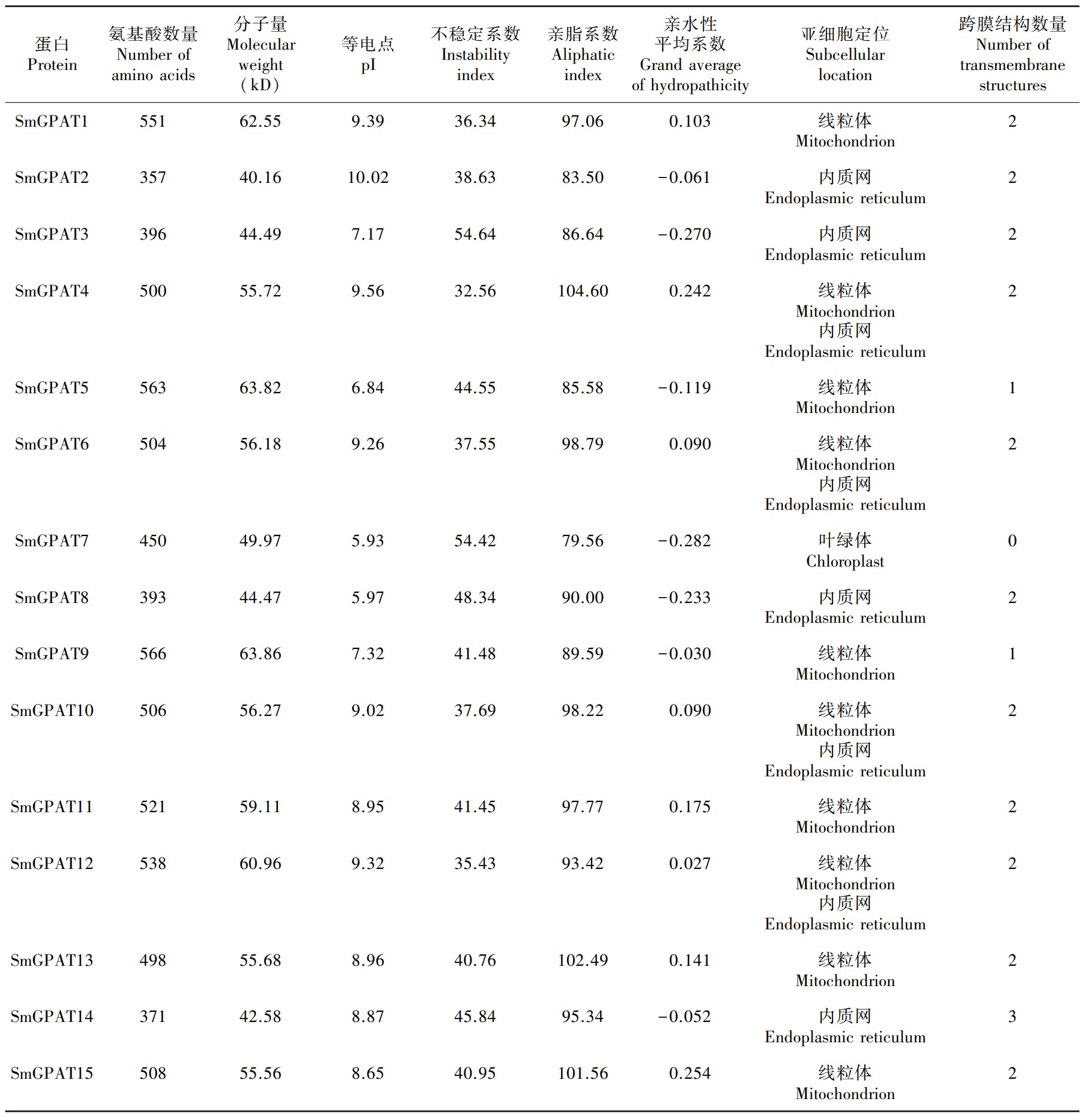
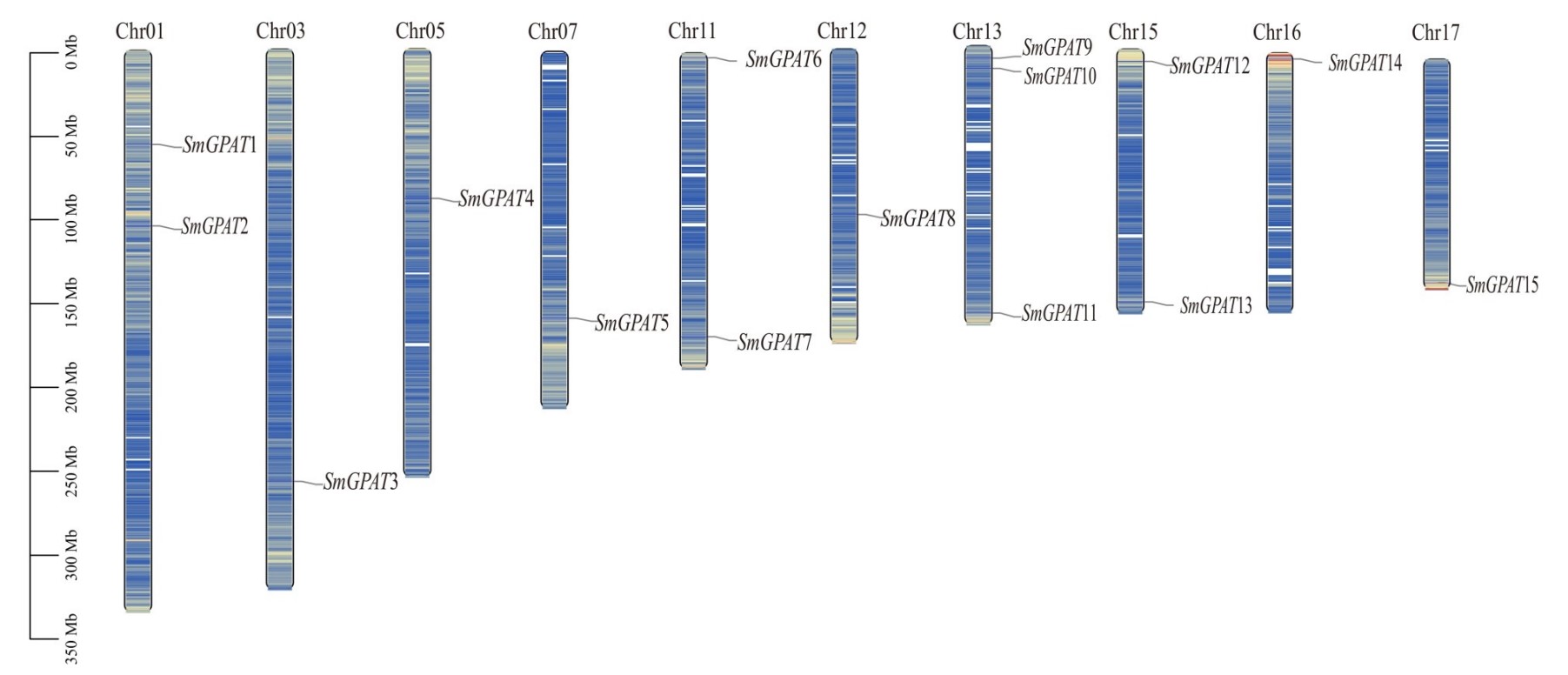
经全基因组鉴定,本研究在水母雪兔子中共发现15个GPAT家族成员。根据染色体定位信息,这些基因被系统命名为SmGPAT1-SmGPAT15(图1)。对15个SmGPAT基因理化性质分析,分析结果如表2所示,SmGPAT基因家族成员编码氨基酸数量为357(SmGPAT2)~566(SmGPAT9),平均长度约为482个氨基酸残基;分子量在40.16 kD(SmGPAT2)~63.86 kD(SmGPAT9)之间,平均分子量为54.09 kD;等电点在5.93(SmGPAT7)~10.02(SmGPAT2)之间,其中SmGPAT3、SmGPAT5、SmGPAT7、SmGPAT8和SmGPAT9等电点分别为7.17、6.84、5.93、5.97和7.32,属于酸性蛋白,其余10个蛋白等电点均大于8,属于碱性蛋白;不稳定系数为32.56(SmGPAT4)~54.64(SmGPAT3),其中SmGPAT1、SmGPAT2、SmGPAT4、SmGPAT6和SmGPAT10共5个成员为稳定蛋白,其余10个成员为不稳定蛋白;GPAT家族成员的亲脂系数为79.56~104.60;其中7个蛋白(SmGPAT2、SmGPAT3、SmGPAT5、SmGPAT7、SmGPAT8、SmGPAT9和SmGPAT14)属于亲水性蛋白(亲水性平均系数小于0),其余成员均呈现典型疏水蛋白特征;亚细胞定位预测表明水母雪兔子中SmGPAT1、SmGPAT5、SmGPAT9、SmGPAT11、SmGPAT13和SmGPAT15主要定位于线粒体,SmGPAT2、SmGPAT3、SmGPAT8和SmGPAT14主要定位于内质网,SmGPAT4、SmGPAT6、SmGPAT10和SmGPAT12同时定位于线粒体和内质网,SmG PAT7 定位于叶绿体。
表
2
SmGPAT 基因家族理化性质、亚细胞定位、跨膜结构分析
Table
2
Physicochemical properties, subcellular localization, and transmembrane structure analysis of SmGPAT gene family
图
1
SmGPAT基因家族的染色体定位分析
Fig.
1
Chromosomal localization analysis of SmGPAT gene family
2.2 水母雪兔子GPAT基因家族的染色体定位
通过染色体定位进一步分析SmGPAT家族成员。结果如图1所示,水母雪兔子15个SmGPAT基因在10条染色体上呈现不均匀分布。其中,Chr13有3个SmGPAT基因(SmGPAT9、SmGPAT10和SmGPAT11),Chr01(SmGPAT1和SmGPAT2)、Chr11(SmGPAT6和SmGPAT7)、Chr15(SmGPAT12和SmGPAT13)上均有2个SmGPAT基因。其余6条染色体上各有1个基因,其中SmGPAT3分布在Chr03上,SmGPAT4分布在Chr05上,SmGPAT5分布在Chr07上,SmGPAT8分布在Chr12上,SmGPAT14分布在Chr16上,SmGPAT15分布在Chr17上。
2.3 水母雪兔子GPAT基因家族的蛋白质二级与三级结构分析
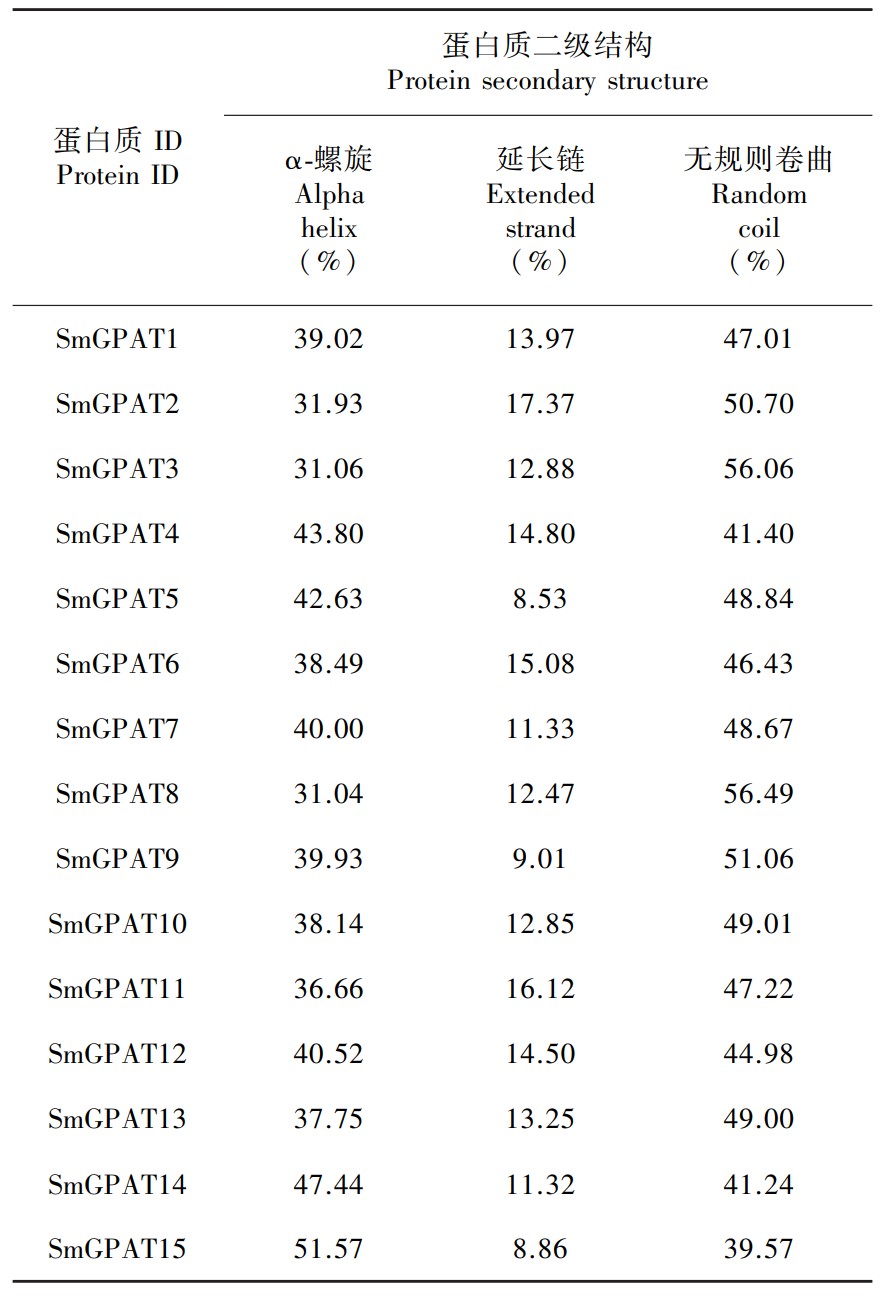
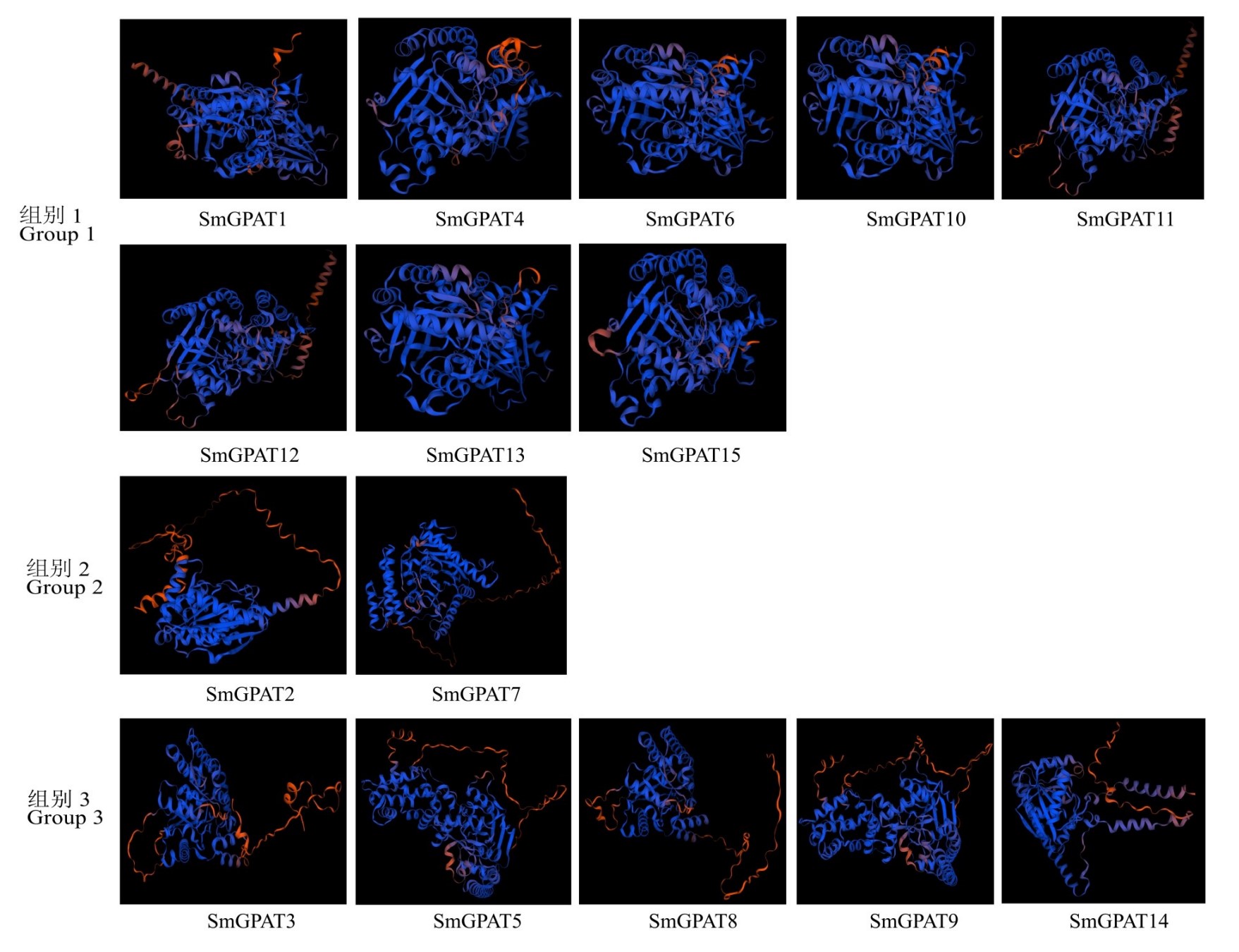
对SmGPAT基因家族的蛋白质序列进行二级结构的预测。由表3可知,SmGPAT基因家族的成员蛋白质主要由3种结构形式组成,即α-螺旋、延长链和无规则卷曲。其中,α-螺旋的比例在31.04%(SmGPAT8)~51.57%(SmGPAT15)之间,延长链的比例在8.53%(SmGPAT5)~17.37%(SmGPAT2)之间,无规则卷曲的比例则从39.57%(SmGPAT15)至56.49%(SmGPAT8)不等。这些结构的平均占比分别为39.33%、12.82%和47.85%。此外,通过Swiss-Model平台构建SmGPAT蛋白三维构象模型,预测显示各亚族成员间三级结构呈现高度保守性,其空间排布与二级结构预测具有一致性,主要结构元件为α-螺旋及无规卷曲(图2)。
表
3
SmGPAT蛋白质二级结构预测
Table
3
Secondary structure prediction of SmGPAT proteins
图
2
SmGPAT 蛋白质三级结构预测
Fig.
2
Tertiary structure prediction of SmGPAT proteins
2.4 水母雪兔子GPAT基因家族的系统发育分析
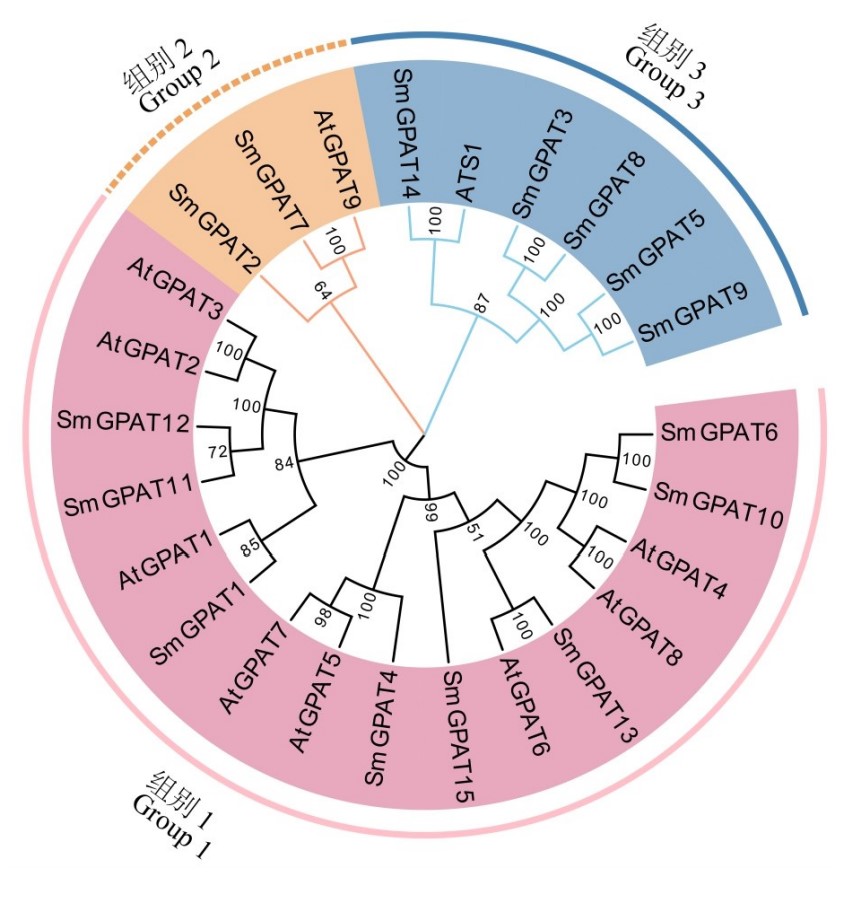
为深入解析SmGPAT基因家族蛋白之间的进化关系,构建水母雪兔子(15个SmGPAT蛋白)与拟南芥(10个GPAT蛋白)序列的系统发育树。如图3所示,以模式植物拟南芥的蛋白家族为分类基准,将15个SmGPAT蛋白分为Group 1(8个)、Group 2(2个)、Group 3(5个),其中Group 1对应拟南芥AtGPAT1-AtGPAT8,Group 2对应拟南芥的AtGPAT9,Group 3和拟南芥的ATS1在同一亚族中。
图
3
水母雪兔子与拟南芥 GPAT 蛋白家族的系统发育树
Fig.
3
Phylogenetic tree of GPAT protein family of Saussurea medusa and Arabidopsis thaliana
2.5 水母雪兔子GPAT基因家族保守基序和基因结构分析
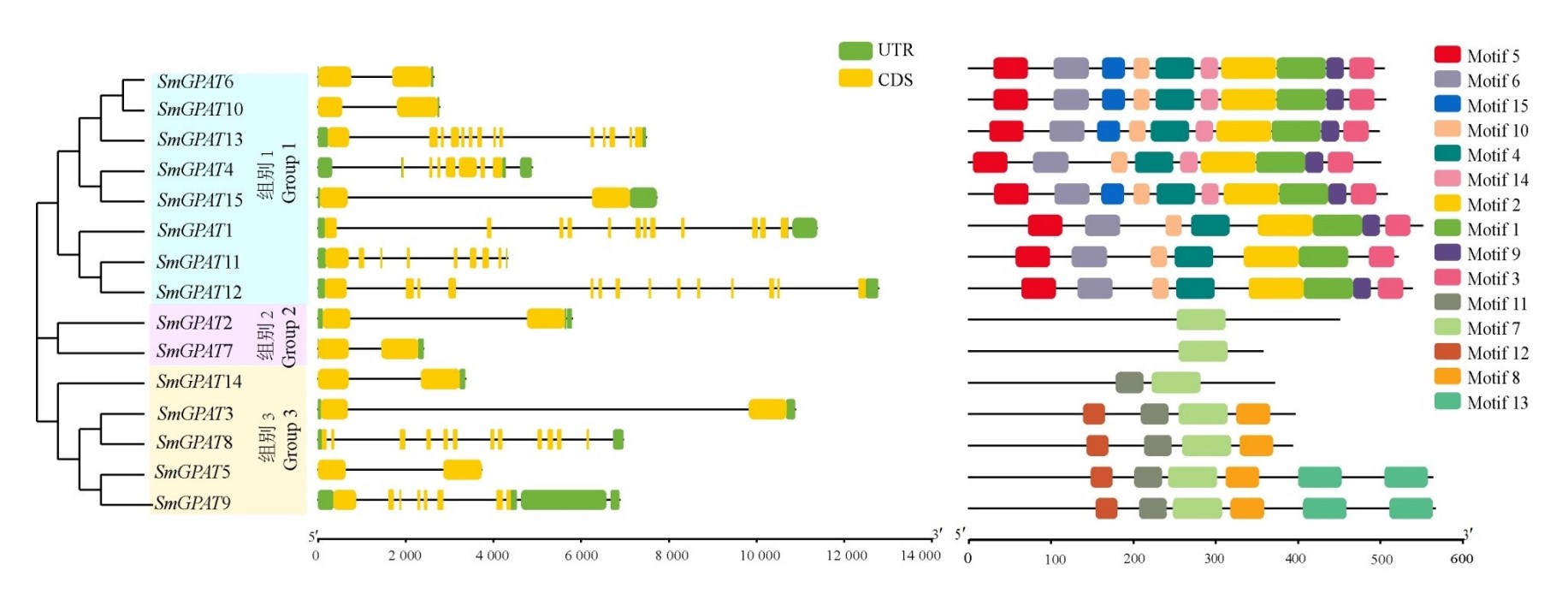
对SmGPAT基因家族成员进行系统发育树、基因结构和保守基序分析,结果如图4所示,SmGPAT基因家族成员分为3类(Group 1-Group 3),与蛋白进化树分类相一致。对水母雪兔子SmGPAT基因家族成员进行保守基序的分析,在Group 1中SmGPAT6、SmGPAT10、SmGPAT15基因结构较为相似,外显子数目均为2,其余5个基因(SmGPAT1、SmGPAT4、SmGPAT11、SmGPAT12、SmGPAT13)外显子数目为7~14。在Group 2中2个基因(SmGPAT2和SmGPAT7)结构也相似,均有2个外显子,在Group 3中5个基因(SmGPAT3、SmGPAT5、SmGPAT8、SmGPAT9、SmGPAT14)的外显子数目变化最大,为2~12。总体而言,不同SmGPAT基因的外显子数目和基因长度都具有显著差异,从而预测SmGPAT基因家族成员之间可能存在功能上的分化。
就SmGPAT基因家族成员的基序结构(图4)而言,Group 1-Group 3中同一组中成员含有的Motif结构相似,如Group 1中8个SmGPAT家族成员基序较多,均含有Motif 1、Motif 2、Motif 3、Motif 4、Motif 5、Motif 6和Motif 10,因此可以推测该组SmGPAT基因在功能上可能存在一定的相似性。Group 2成员(SmGPAT2和SmGPAT7)仅保留Motif 7单一基序组件,而Group 3则含有2~6个基序,多数呈现Motif 7、Motif 8、Motif 11、Motif 12及Motif 13的特征性组合。进一步分析表明,同一组内成员间motif排列模式保持高度保守性,基因架构呈现同源特征,不同组间比较显示motif组合呈现显著异质性,推测SmGPAT基因家族成员不同组别中的SmGPAT基因在植物生长发育中具有不同的生物学功能。
图
4
SmGPAT基因家族的基因结构、系统发育和保守基序分析
Fig.
4
Analysis of gene structures, phylogeny, and conserved motifs of SmGPAT gene family
2.6 水母雪兔子GPAT基因家族顺式作用元件分析
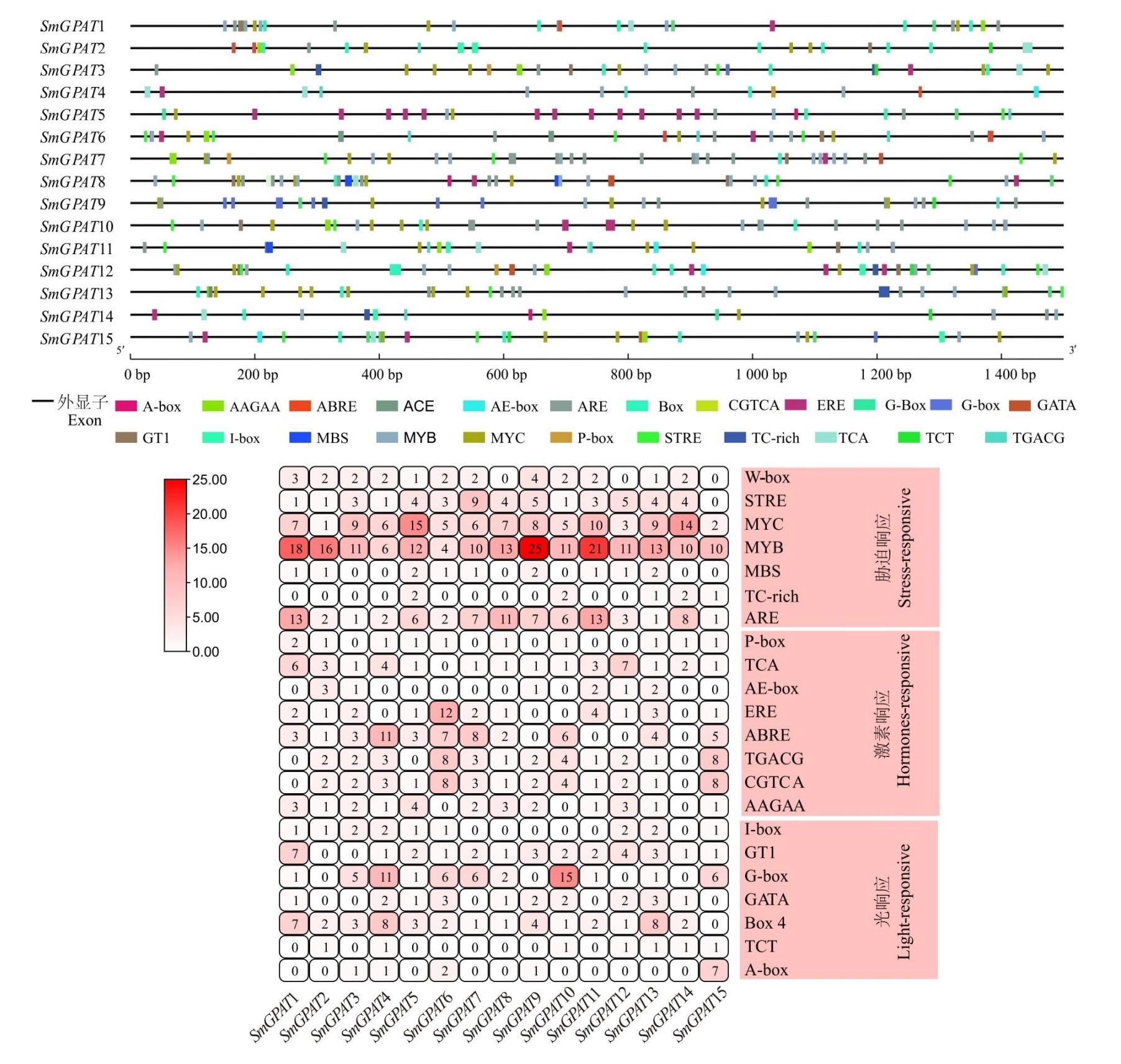
对上游1 500 bp的起始密码子进行顺式作用元件预测,结果如图5所示,SmGPAT基因主要包含激素响应、光响应和胁迫响应的元件,其中胁迫响应元件包括参与环境适应性的MYB、MYC、MBS等7种。在水母雪兔子15个SmGPAT家族成员中MYB、MYC、ARE这3种胁迫相关的元件数最多,在SmGPAT9和SmGPAT11中MYB元件分别有25个和21个,表明SmGPAT家族成员在植物生长发育和适应逆境时具有调控作用,这可能与水母雪兔子在适应高山流石滩低温、高海拔、强紫外线等极端生境时所做出的适应性进化相关。与激素响应相关的元件包括ABRE、AAGAA、ERE、CGTCA等8种,与光响应相关的元件包括G-box、GT1、Box 4等7种。这些结果表明,SmGPAT基因家族成员参与了各种胁迫的响应、激素的信号转导等过程。因此,SmGPAT基因家族在水母雪兔子的生长发育中起重要作用。
图
5
水母雪兔子GPAT基因顺式作用元件分析
Fig.
5
Analysis of cis-acting elements of GPAT genes in Saussurea medusa
2.7 水母雪兔子GPAT基因家族的组织表达分析
基于SmGPAT基因家族成员4个组织(根、茎、叶、花)FPKM标准化表达量,构建组织特异性表达热图,如图6所示,水母雪兔子SmGPAT基因在茎中表达量较低,在根中只有SmGPAT14的表达量较高,推测其在根的生长发育过程中发挥重要作用,而SmGPAT2、SmGPAT5、SmGPAT7、SmGPAT11在叶中表达量比根、茎、花高,推测其在叶的生长发育过程中发挥重要作用,而其余10个SmGPAT基因(SmGPAT1、SmGPAT3、SmGPAT4、SmGPAT6、SmGPAT8、SmGPAT9、SmGPAT10、SmGPAT12、SmGPAT13、SmGPAT15)在花中的组织表达量比在根、茎、叶高,推测其在花的生长发育过程中发挥了重要作用。
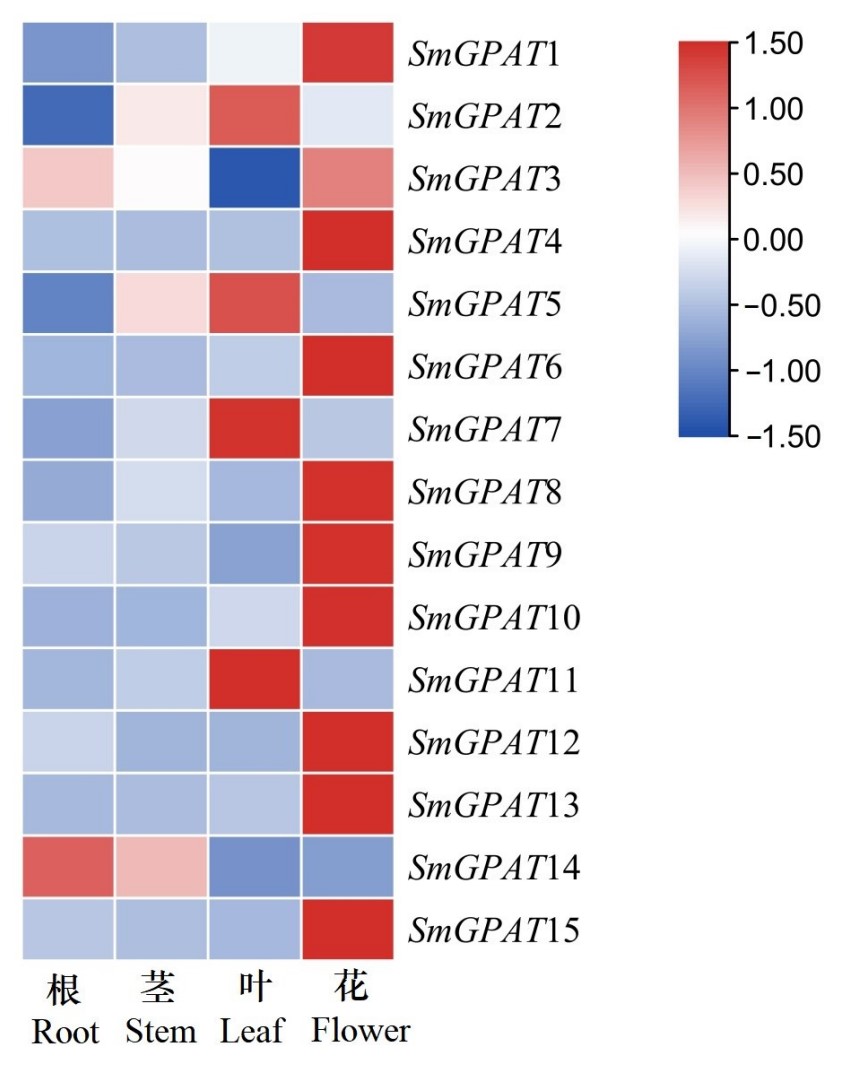
图
6
水母雪兔子SmGPAT基因的组织表达分析
Fig.
6
Tissue expression analysis of SmGPAT genes in Saussurea medusa
2.8 水母雪兔子GPAT基因qRT-PCR验证分析
从水母雪兔子SmGPAT基因家族成员中随机挑选9个基因(SmGPAT1、SmGPAT2、SmGPAT3、SmGPAT6、SmGPAT7、SmGPAT8、SmGPAT9、SmGPAT13和SmGPAT14),通过qRT-PCR技术验证这9个基因在不同组织中的差异表达变化。结果如图7所示,这9个基因中有7个基因(SmGPAT1、SmGPAT2、SmGPAT3、SmGPAT6、SmGPAT8、SmGPAT9和SmGPAT13)在花中的相对表达量较高,与转录组组织表达结果相一致。然而,SmGPAT7在叶中的相对表达量最高,同样与转录组数据相一致。只有SmGPAT14在茎中的相对表达量高于其他3个组织,而在转录组数据中其在根和茎中的表达量高于叶和花。
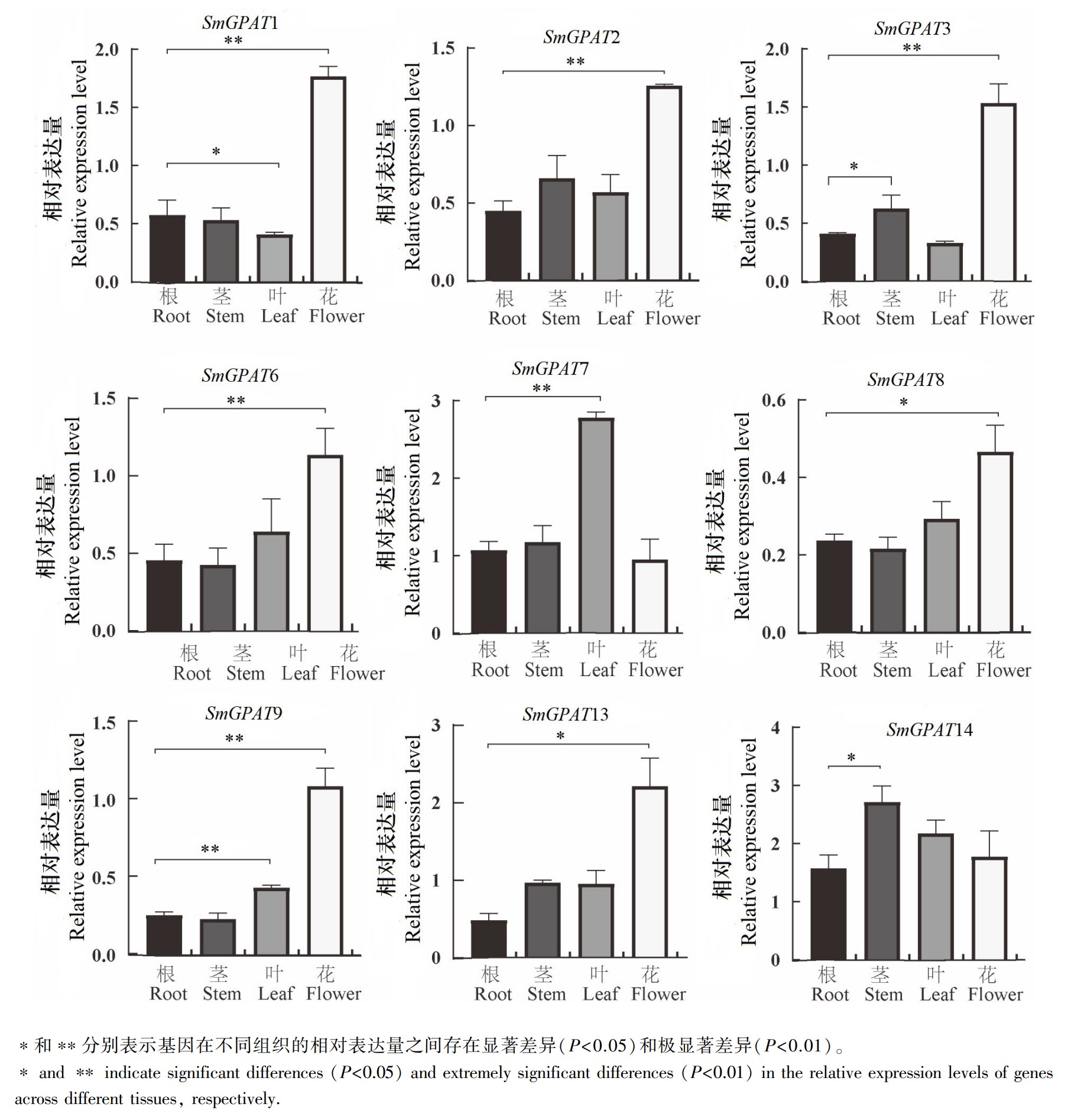
图
7
9个SmGPAT基因的qRT-qPCR分析
Fig.
7
qRT-qPCR analysis of nine SmGPAT genes
3 讨论
GPAT作为植物脂质代谢的关键酶,其合成途径可分为原核与真核两种途径(Li et al., 2007)。原核途径在叶绿体中催化G3P生成PA(Kunst et al., 1988; Xu et al., 2006),而真核途径(Kennedy途径)在内质网中通过GPAT和LPAAT依次催化G3P的sn-1、sn-2位酰基化形成PA,最终由二酰甘油酰基转移酶(DGA acyltransferase, DGAT)催化形成TAG(Yang et al., 2010)。本研究鉴定出的水母雪兔子15个SmGPAT基因家族成员的亚细胞定位呈现显著分化,SmGPAT7定位于叶绿体(原核途径场所),提示其可能参与磷脂酸合成,SmGPAT2、SmGPAT3、SmGPAT8和SmGPAT14定位于内质网,内质网作为TAG合成核心场所,催化酰基辅酶A与甘油-3-磷酸的初始反应,SmGPAT1、SmGPAT5、SmGPAT9、SmGPAT11、SmGPAT13和SmGPAT15定位于线粒体,线粒体则是通过脂肪酸前体供应或脂质重塑间接调节TAG代谢,SmGPAT4、SmGPAT6、SmGPAT7、SmGPAT10和SmGPAT12则呈现内质网-线粒体共定位,而内质网-线粒体接触位点已被证实可介导脂质交换(Edar et al., 2018),因此我们推测SmGPAT基因家族的共定位成员可能参与脂质转运调控。Singer等(2016)在拟南芥中研究表明,只有GPAT9直接参与真核途径。本研究在水母雪兔子中构建的系统发育树分析结果显示,SmGPAT基因家族中Group 2(SmGPAT7和SmGPAT2)与拟南芥的GPAT9在同一分支上,其中只有SmGPAT2的亚细胞定位预测在内质网上。因此,推测SmGPAT2在真核途径磷脂的合成过程中发挥了重要作用。
近年来,有研究表明GPAT基因家族在植物生长发育过程中具有关键调控功能。例如,水稻的GPAT3基因通过参与花粉粒外壁角质合成途径调控绒毡层程序性退化,其功能缺失突变会显著抑制角质层形成,导致绒毡层异常滞留并引起花粉败育(Men et al., 2017)。GPAT6基因在番茄(Solanum lycopersicum)花蕾/幼果表皮组织(Petit et al., 2016)及油茶(Camellia oleifera)花瓣器官(魏琦琦等,2016)均呈现特异性高表达。不同GPAT基因在不同时期和组织中的表达存在差异,表明它们在脂质代谢及生物学过程中具有多样功能。在拟南芥中,AtGPAT1和AtGPAT6对花器官发育至关重要,它们的缺失会导致绒毡层细胞和花器官结构异常,影响正常开花,降低种子的结实率,并改变种子脂肪成分(Yang et al., 2012)。此外,缺失AtGPAT6会导致花器官形态异常及花瓣融合,gpat1/gpat6双缺失突变体的表型变化更为显著,表现为花丝缩短及花粉完全败育(Li-Beisson et al., 2009;Li et al., 2012;高华妮,2022)。综合上述研究结果可知,植物GPAT1/GPAT6可能调控花器官角质和发育过程。在水母雪兔子与拟南芥构建系统发育树后,与AtGPAT1、AtGPAT6在同一分支中的SmGPAT1和SmGPAT13这2个基因在花中的表达量相比于其他组织较高,并且qRT-PCR验证分析结果同样表明SmGPAT1和SmGPAT13在花中的相对表达量较高,由此推测水母雪兔子中SmGPAT1和SmGPAT13与拟南芥中的AtGPAT1和AtGPAT6发挥相同的功能,均在水母雪兔子花器官的合成和发育中发挥重要作用。
目前,Sui等(2007)研究表明GPAT基因可通过调整膜脂饱和度适应不同温度的胁迫。在低温胁迫下番茄(Lycopersicon esculentum)GPAT过表达可增强耐冷/耐盐性。在碱蓬(Suaeda salsa)中的SsGPAT过表达可提高磷脂酰甘油的不饱和脂肪酸含量,可以增强拟南芥耐盐性并缓解盐胁迫下PS Ⅱ和PS Ⅰ的光抑制(Sui et al., 2017)。郑国伟(2010)研究表明,水母雪兔子在长期适应高山流石滩生境时,通过改变膜脂分子含量(如溶血磷脂的轻微增加),维持膜功能稳定性。此外,高海拔地区的UV-B辐射可直接损伤光系统反应中心,并通过产生活性氧(ROS)攻击膜脂中的多不饱和脂肪酸,而Pu等(2021)研究表明,GPAT介导的膜脂不饱和脂肪酸可作为ROS清除剂,与类异戊二烯化合物(如β-胡萝卜素)协同减轻UV损伤。因此,我们推测水母雪兔子能够良好地适应高山流石滩极端环境(低温、低氧、强UV-B辐射、高海拔等),表明SmGPAT基因家族成员不仅在膜脂质的形成过程中发挥重要作用,还可能通过调控膜脂不饱和度增强抗逆性。
进一步对水母雪兔子SmGPAT基因家族顺式作用元件预测分析,结果表明SmGPAT基因启动子包含多种逆境胁迫和激素响应元件,包括参与生长素、赤霉素、水杨酸和低温等非生物逆境响应元件等。其中,MYB、MYC、MBS、ARE等多种胁迫相关的元件在SmGPAT家族中最多,尤其SmGPAT9和SmGPAT11与MYB相关的元件分别达到25个和21个,同时SmGPAT9和SmGPAT11分别在花和叶中表达量较高。对高山植物水母雪兔子而言,其花和叶器官长时间裸露在具有高海拔、低氧、强紫外线等自然的逆境胁迫环境中,却能良好地适应此种生境,离不开与逆境胁迫相关基因的调控,因此可以推测在水母雪兔子适应极端生境时,SmGPAT9和SmGPAT11在叶和花器官发育中发挥了重要的作用。此外,在很多物种中,GPAT基因家族成员在各种非生物胁迫下均进行响应。例如,大麦(Hordeum vulgare)HvGPAT基因在干旱、盐、低温逆境胁迫下根和叶中相对表达量均显著上调,表明其积极参与大麦的非生物胁迫响应并可能发挥正调控作用(马健芝等,2025);甘蓝型油菜(Brassica napus)BnGPATs基因在干旱、盐胁迫及低温条件下呈现显著表达调控(邢蔓等,2017;耿思宇等,2019);紫花苜蓿(Medicago sativa)MsGPAT11基因在盐、干旱胁迫9 h后,其表达量显著上调(唐芳等,2023);蒿叶猪毛菜(Salsola abrotanoides)SaGPAT032基因在干旱胁迫后表达量极显著升高(杜明阳等,2024);花生(Arachis hypogaea)AhGPAT1、AhGPAT6、AhGPAT8及AhATS1基因干旱胁迫后在根中的表达水平显著升高(郝翠翠等,2018;沈悦等,2023);玉米(Zea mays)中ZmGPAT13基因也在干旱、盐、高温和低温等非生物胁迫后进行响应(朱涛涛,2022;李鑫等,2023)。因此,以上研究均表明SmGPAT基因在非生物胁迫响应中具有重要作用。鉴于当前高山植物基因功能验证技术体系尚未完善(特别是在模式植物中建立的成熟方法难以直接应用于高山特殊物种),本研究对基因家族的理论研究为后续SmGPAT基因的分子功能解析提供了关键理论基础。水母雪兔子作为青藏高原的典范植物,其GPAT基因家族的系统研究不仅能够提供该物种适应极端环境的分子基础,而且更重要的是可建立高山植物环境适应研究的共性分析,其研究成果可与同域分布的其他高山植物,如雪莲(Saussurea involucrate)、塔黄(Rheum nobile)等高山植物适应高山环境的分子机理研究提供重要参考,具有区域生物多样性保护与生态系统研究的双重价值。
4 结论
本研究从水母雪兔子基因组中鉴定出了15个SmGPAT基因,进行理化性质、亚细胞定位、系统发育、基因结构、保守基序、蛋白质二级/三级结构预测和启动子顺式作用元件的分析。结果表明,水母雪兔子中15个SmGPAT基因分为3个亚族(Group 1-Group 3),同一亚族中基因结构和motif相似;蛋白质二级结构以α-螺旋和无规则卷曲为主;启动子顺式作用元件分析表明,水母雪兔子SmGPAT基因家族含有多种MYB、MYC、MBS、ARE等抵抗逆境相关的元件。根据SmGPAT基因家族在不同组织转录组数据中的表达热图和qRT-PCR验证了其在不同组织中的相对表达量。这为深入了解水母雪兔子SmGPAT基因家族成员的具体功能提供了理论基础。