


摘要
为探究迁地条件下诗琳通含笑(Michelia sirindhorniae)的开花生殖特性,阐明其在自然状态下结籽率低的原因,促进种质资源的可持续利用,该研究于2023—2024年对栽培诗琳通含笑的花部形态特征、开花物候动态及传粉昆虫行为进行系统观测,测定不同开花阶段的花粉活力及柱头可授性变化规律,并通过控制授粉实验对柱头活性及授粉亲和性进行了系统评估。结果表明:(1)诗琳通含笑的花期主要集中于4月下旬至5月中下旬,而个别植株在10月至12月期间会出现二次开花的现象。(2)单花花期3~4 d,根据形态特征可划分为7个连续发育阶段,即绿蕾期、黄蕾期、白蕾期、初开期、盛开期、凋落期、幼果期,其中花被片展开过程有明显的时间节律,主要集中在清晨5:00—7:00时段完成开放,其伸展姿态易受环境因子影响。(3)雌蕊先雄蕊成熟,白蕾期柱头可授性最佳,花药在盛开期散粉,花粉离体萌发率为65.30%。(4)访花昆虫主要有黑蚂蚁(Polyrhachis dives)、蓟马(Thysanoptera sp.)、意大利蜜蜂(Apis mellifera ligustica),但昆虫访花行为及被访花朵的结籽情况表明,这些昆虫的传粉行为均无效。(5)花蕾的石蜡切片结果表明,小孢子发育过程存在严重败育:绒毡层提前解体导致四分体败育率高达85.55%;在单核靠边期,约29.51%的小孢子出现萎缩变形等败育特征。(6)人工控制授粉结果表明,诗琳通含笑具严格的自交不亲和性,不存在无融合生殖,与含笑属其他物种存在不同程度种间隔离。综上认为,诗琳通含笑繁育系统为专性异交,迁地条件下有效传粉昆虫的缺乏和小孢子败育严重是导致其结籽率低的关键因素。该研究揭示了诗琳通含笑在迁地条件下的繁育障碍,为其资源保护和利用提供了科学依据。
Abstract
To investigate the flowering and reproductive characteristics of Michelia sirindhorniae under ex situ conservation conditions, to clarify the reasons for the low seed setting rate in its natural state, and to promote the sustainable utilization of germplasm resources, this study conducted systematic observations on floral morphological characteristics, flowering phenology dynamic, and pollinator behavior of cultivated M. sirindhorniae from 2023 to 2024, and analyzed the variation patterns of pollen viability and stigma receptivity at different flowering stages, and systematically evaluated stigma activity and pollination compatibility through controlled pollination experiments. The results were as follows: (1) The flowering period of M. sirindhorniae mainly concentrated from late April to mid-late May, with some individuals exhibiting a secondary flowering phenomenon from October to December. (2) The lifespan of individual flower was 3-4 d, progressing through seven consecutive developmental stages: green bud stage, yellow bud stage, white bud stage, initial opening stage, full blooming stage, withering stage, and young fruit stage. The tepal unfolding process exhibited a significant temporal rhythm, primarily completing unfolding between 5:00-7:00 am, with its posture influenced by environmental factors. (3) The pistil matured before the stamen, with the stigma receptivity being optimal during the white bud stage. Anthers dehisced during the full blooming stage, and the in vitro pollen germination rate was 65.30%. (4) The main flower-visiting insects were Polyrhachis dives, Thysanoptera sp., Apis mellifera ligustica. However, observations of insect behavior and the fruit set of visited flowers indicated that the pollination behavior of these insects was ineffective. (5) Paraffin sectioning of flower buds revealed severe abortion during microspore development: premature disintegration of the tapetum led to a tetrad abortion rate as high as 85.55%; at the unicellular stage, approximately 29.51% of microspores exhibited shrinkage and deformation, indicating abortion characteristics. (6) Controlled pollination experiments demonstrated strict self-incompatibility of Michelia sirindhorniae, absence of apomixis, and varying degrees of interspecific isolation with other Michelia species. In summary, the breeding system of M. sirindhorniae is obligate outcrossing, and lack of effective pollinators and microspore abortion are the key factors affecting its low seed setting rate under ex situ conditions. This study reveals the breeding barriers of M. sirindhorniae in ex situ conditions, provides a scientific basis for its conservation and propagation.
目前,濒危野生植物有两种保护方式,就地保护(in situ conservation)与迁地保护(ex situ conservation)。因全球气候变化与人类活动加剧,部分野生植物栖息地遭严重破坏,迁地保护因此成为拯救濒危物种的重要手段,同时也是开展人工扩繁、种群恢复和资源开发利用的关键路径(孙卫邦,2025)。尽管目前华盖木(Pachylarnax sinica)、景宁木兰(Yulania sinostellata)、毛果木莲(Manglietia ventii)等木兰科植物在迁地保护上取得了显著的成效(孙卫邦等,2019;邓莎等,2020;梅中海等,2021),但是在迁地条件下仍有很多种类存在结实率低与种子发育异常等问题,如峨眉拟单性木兰(Parakmeria omeiensis)、石碌含笑(Michelia shiluensis)及金叶含笑(M. foveolata)等(余道平等,2019;张峥,2023;莫丽文等,2024a)。很多濒危植物在迁地条件下的开花物候动态、传粉者行为模式及其与繁殖特性的互作机制仍缺乏系统性研究,导致人工干预策略的普适性与长效性受限。因此,掌握迁地植物开花生物学及繁殖特性对濒危植物的迁地保护及应用意义重大。
诗琳通含笑(Michelia sirindhorniae)为木兰科(Magnoliaceae)含笑属(Michelia)常绿乔木,高达25 m,胸径可达70 cm;花极芳香,花被片12~15枚。诗琳通含笑生长迅速、枝叶茂密、树形优美、花量繁多且芳香,是优良的景观绿化新物种。1999年泰国科学技术研究所Piya Chalermglin博士于泰国华富里府(Lop Buri Province)他銮县(Tha Luang District)的淡水沼泽中发现该种。为纪念玛哈·扎克里·诗琳通(Maha Chakri Sirindhorn)公主殿下,经泰国皇家许可,将该种命名为Magnolia sirindhorniae Noot. & Chalermgli(Nooteboom & Chalermglin, 2000;Chomchalow, 2014)。2007年被世界自然保护联盟(International Union for Conservation of Nature,IUCN)评估为濒危(endangered,EN)物种(Cicuzza et al., 2007; Rivers et al., 2016)。
诗琳通含笑生长在泰国淡水沼泽的低地原始雨林,在众多不耐水湿的木兰科植物中,是唯一能在水中生长的树种,可作为木兰科耐湿耐热育种的优质种质资源。其现存种群分布范围极为狭窄,总占地面积仅约35 km2,其有限的栖息地也因遭受持续性的破坏而缩减,仅存于3个相互隔离的地点(Rivers et al., 2016)。目前,国内外关于诗琳通含笑相关研究较少,主要集中在光合及固碳生理特性和水分生理生态研究、组织快繁体系的建立、花芽及叶片内精油的提取及成分分析(许逸林,2017;陆晨,2018;Cui et al., 2019;Ghosh et al., 2021)。关于诗琳通含笑的开花生物学特性和繁育特性尚未见报道。
诗琳通含笑在栽培圃地花量很大,但几乎不结实。为了实现该物种遗传资源的可持续利用,本研究以栽培条件下的诗琳通含笑开花植株为研究对象,通过跟踪观测、切片观察、活性测定和人工控制授粉等方法,拟明晰如下问题:(1)迁地环境下诗琳通含笑的开花生物学及繁育特性;(2)其自然结籽率低的内在原因。
1 材料与方法
1.1 试验地与试验材料
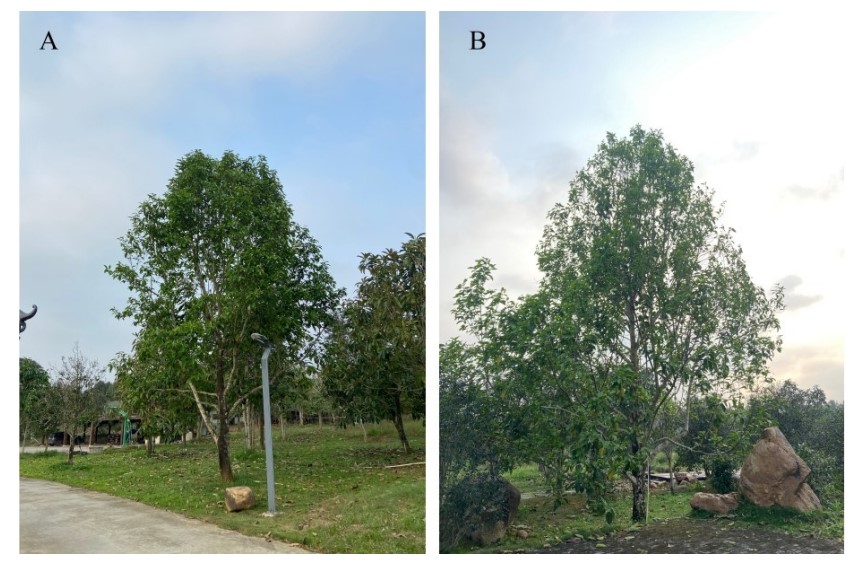
试验地在海南儋州天香木兰园(109°34′11″E、19°31′02″N)属热带季风气候。2023—2024年平均气温25.3 ℃,日照充足,年平均降水量2 960 mm,海拔132~148 m,雨季主要在5—10月。诗琳通含笑原生地(100°39′05″E、14°48′02″N)年平均气温28.2 ℃,年平均降水量1 232.27 mm,海拔182 m。两地气候条件较接近。试验地为红壤土,水肥条件良好,其中全氮含量0.64~0.99 g·kg-1、全磷含量285.48~377.08 mg·kg-1、全钾含量4.61~5.21 g·kg-1、pH值6.72~7.84、有机质含量10.11~16.82 g·kg-1。2015年,园区从广东湛江某苗圃成功引种2株胸径10 cm的开花植株。目前,该植物株高8~10 m,胸径40~50 cm,长势良好,分别标记为A树和B树(图1)。
图
1
诗琳通含笑试验材料
Fig.
1
Michelia sirindhorniae test materials
1.2 诗琳通含笑物候及花部综合特征观察
于2023年至2024年连续两年观测诗琳通含笑展叶、开花、结实、落叶进程。每年盛花期在植株中上部的各个方向上摘取花朵各10朵,测量花被片和雌雄蕊数量,用游标卡尺测量花的直径和雌雄蕊长度。选取10朵花通过延时拍摄观察单花开花动态,直至花被片完全脱落。记录各阶段花被片及雌雄蕊形态变化。
1.3 诗琳通含笑小孢子发育观察
于2024年3月到4月采集不同时期的花蕾,用FAA溶液固定,经脱水、包埋后,用莱卡RM 2016切片机切片,番红-固绿染色,封片后在Nikon Eclipse E 100光学显微镜下观察诗琳通含笑小孢子发育情况。
1.4 花粉活性及柱头可授性的测定
1.4.1 花粉活性的观察和测定
花粉离体萌发法:选用课题组筛选的最优培养基(蔗糖50 g·L-1+硼酸100 mg·L-1+CaCl2 200 mg·L-1),在温度25 ℃、湿度90%的气候箱中培养花粉6 h(莫丽文等,2024b)。以花粉管长>直径1倍示为萌发,随机取3个视野(每个视野≥50粒花粉),重复3次,计算萌发率。
花粉萌发率(%)=萌发花粉数/总花粉数×100。
MTT染色法:随机选取散粉时期的花朵,收集花粉均匀混合置于载玻片上,加入MTT染色液,搅匀后盖上玻片,30 min后在光学显微镜10倍镜下观察,重复3次。
花粉活力(%)=紫色花粉数/总花粉数×100。
1.4.2 柱头可授性测定
随机选取不同开花时期的柱头,浸入含有联苯胺-过氧化氢反应液的离心管中,置于光学显微镜10倍镜下观察其柱头的可授性(Dafni, 1992)。
人工授粉法:随机选取不同时期花朵各10朵进行授粉,在果熟期统计其坐果率。
1.5 访花昆虫观测
在盛花期用网捕具有访花行为和在花上停留过的昆虫,带回室内进行物种鉴定。同时,肉眼观察访花昆虫的访花行为,并拍摄访花昆虫,统计访花昆虫的种类、数量。在光学显微镜下观察花粉携带数量并分析花粉在访花昆虫体表的分布位置,以及受访花朵柱头接收花粉的情况,最后套袋跟踪统计后续坐果和结籽数量,每种15朵,以确定有效传粉昆虫。
1.6 繁育系统测定
随机选取植株中上部花蕾开花前套袋,雄蕊散粉前去雄、授粉、套袋,5个月后统计坐果率和结籽率(表1)。
表
1
诗琳通含笑繁育系统测定
Table
1
Measurement of the breeding system of Michelia sirindhorniae
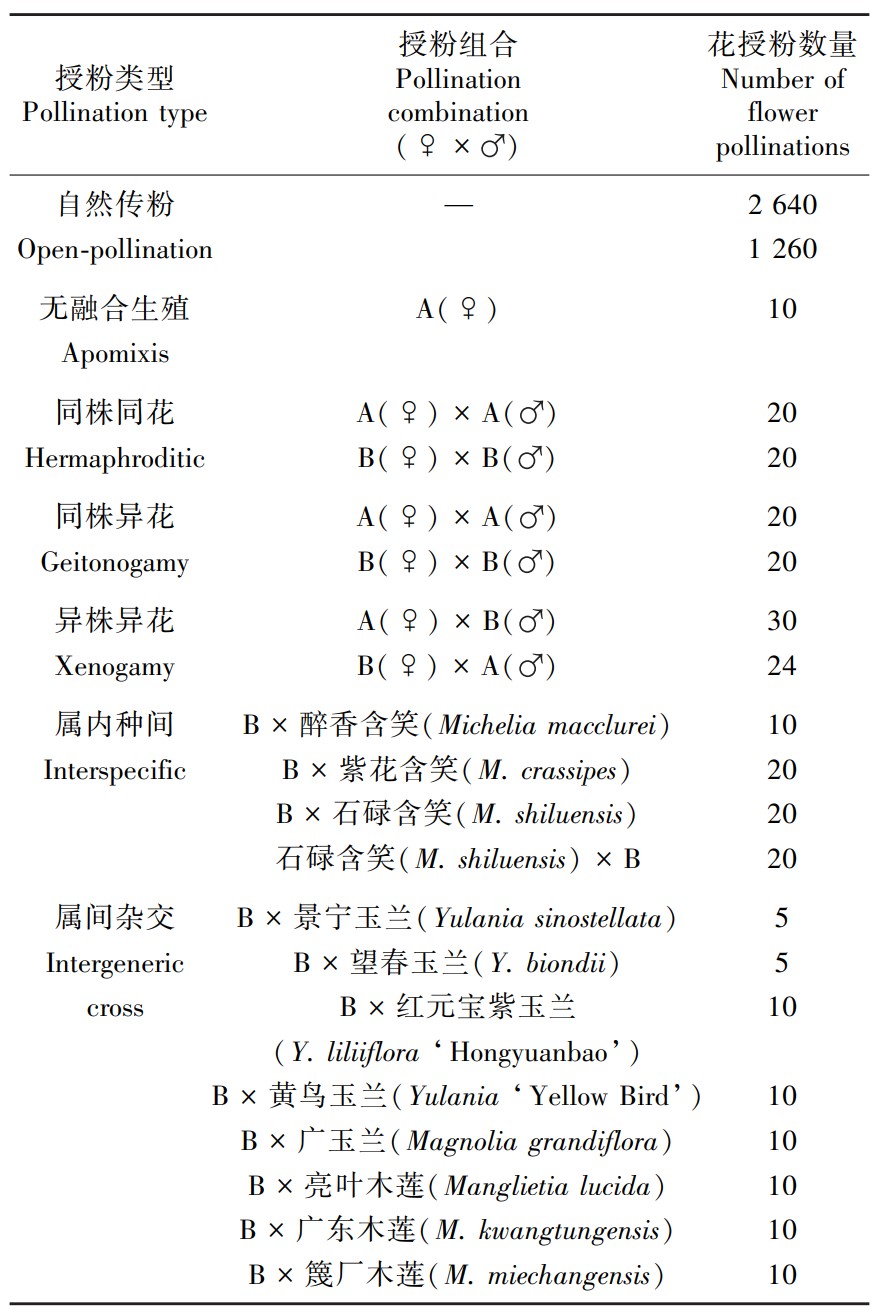
注:同株同花授粉类型授粉时期为盛开期,其他授粉类型授粉时期均为柱头活性最强的初开期。
Note: The pollination type of hermaphroditic is during the full blooming stage, and other pollination types are during the initial opening stage.
1.7 数据处理
利用Excel 2016进行数据整理,使用Adobe Photoshop 2018软件处理图片,使用SPSS 26.0软件进行数据分析,采用单因素方差分析法对坐果率和结籽率进行分析,统计数据均用平均值±标准差表示。
2 结果与分析
2.1 诗琳通含笑物候特征及开花动态观察
2.1.1 物候特征
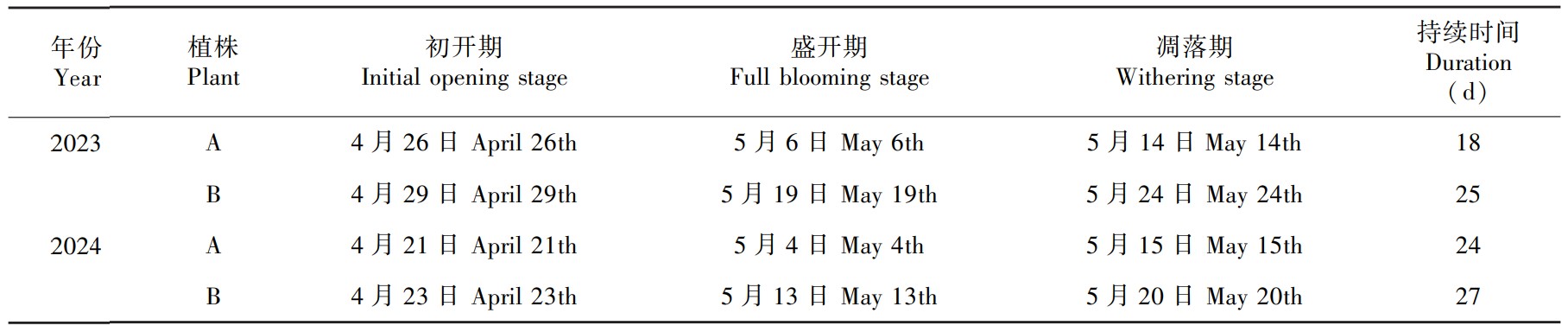
诗琳通含笑于2月下旬开始抽出新枝并展叶。3月上旬开始在当年生枝条上形成花蕾,花着生于叶腋,每新枝具1~4朵;同一小枝上的花发育及开放不同步,通常枝条基部的花蕾先发育也先开放。4月下旬进入初开期,5月上旬进入盛开期,5月中下旬为凋落期,整个花期约25 d(表2);果熟期9—10月;10—12月B树可二次开花,但花量不大,开放不集中,二次花发育正常,偶见结实。在1月上旬海南的旱季,诗琳通含笑会有90%的叶片集中变黄及黄褐后掉落。
表
2
诗琳通含笑花期物候观察结果
Table
2
Observation result of flowering phenology of Michelia sirindhorniae
2.1.2 花部形态特征
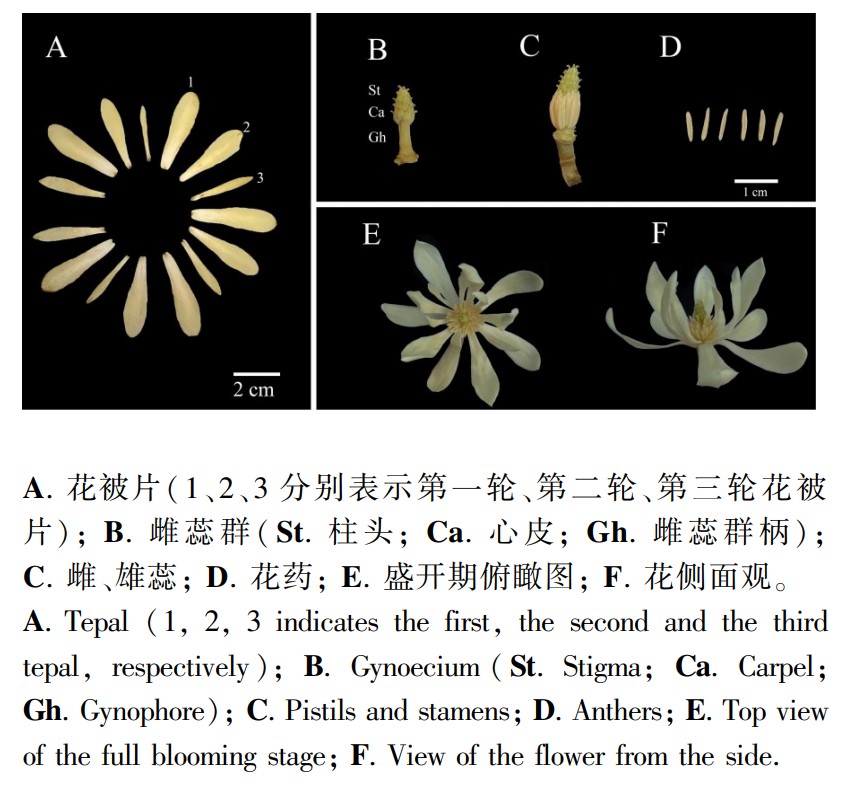
诗琳通含笑为两性花。具佛焰苞状苞片3枚,外表面具白色柔毛。盛开时花径约(77.0±2.0) mm。花被片3轮,14~17枚,多为15枚;乳白色肉质,条形,外轮长(40.8±0.5) mm,宽(11.6±0.2) mm;中轮花被片略小,长(39.7±0.6) mm,宽(10.0±0.2) mm;内轮花被片长(32.0±0.5) mm,宽(5.2±0.1) mm。雄蕊群长(13.1±0.8) mm,宽(9.1±0.5) mm,花药数67±1,米黄色,内侧向开裂;雌蕊群黄绿色,长(8.0±0.3) mm,宽(4.5±0.1) mm,心皮24±1个,每心皮具胚珠6~7枚(图2)。
图
2
诗琳通含笑花部特征
Fig.
2
Flower characteristics of Michelia sirindhorniae
2.1.3 开花阶段
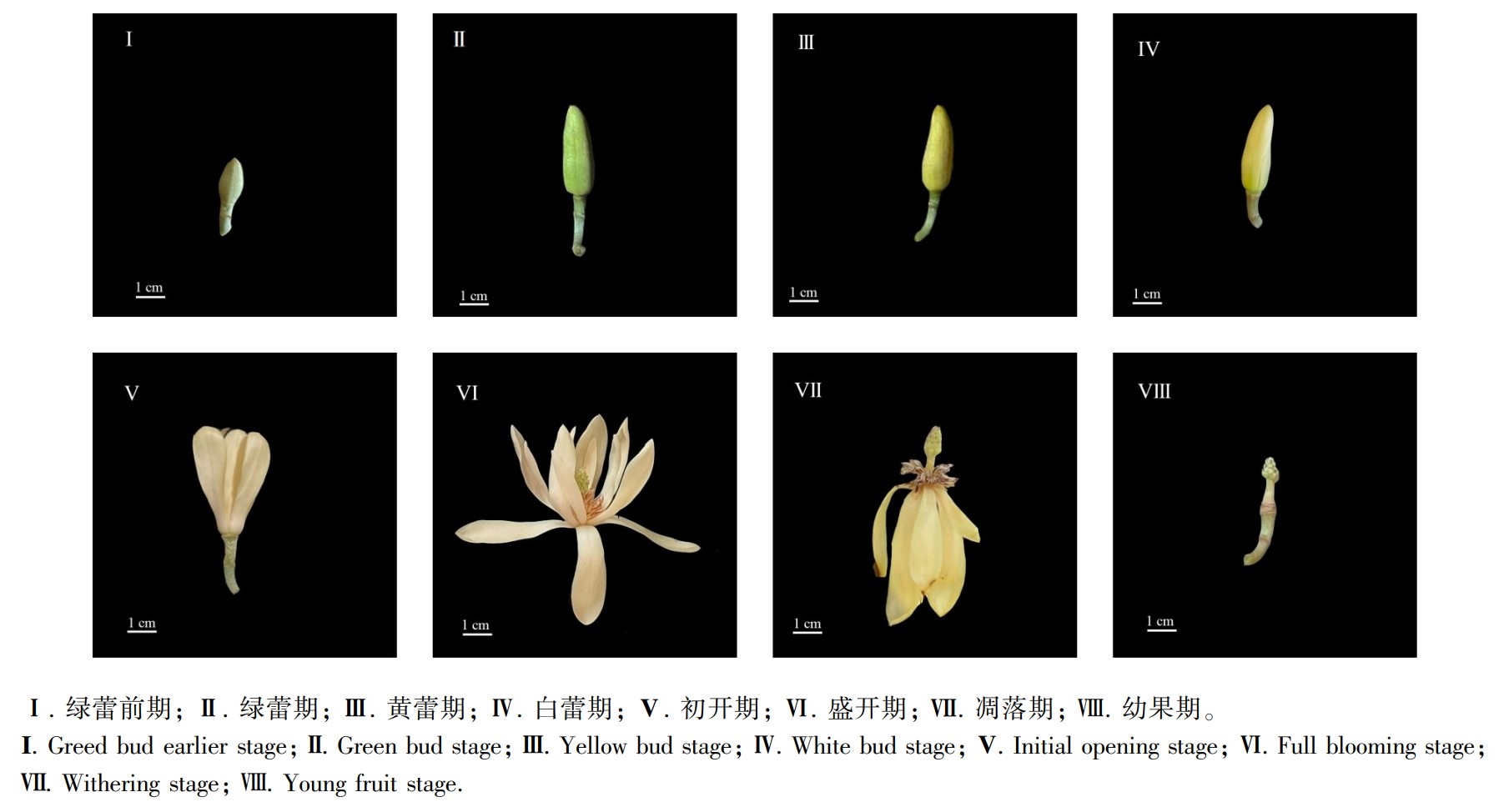
根据花蕾发育的外部形态,将诗琳通含笑从幼蕾至幼果过程可分成8个阶段,即Ⅰ为绿蕾前期,Ⅱ为绿蕾期,Ⅲ为黄蕾期,Ⅳ为白蕾期,Ⅴ为初开期,Ⅵ为盛开期,Ⅶ为凋落期,Ⅷ为幼果期(图3)。
图
3
诗琳通含笑的不同开花阶段
Fig.
3
Different flowering stages of Michelia sirindhorniae
2.1.4 开花动态
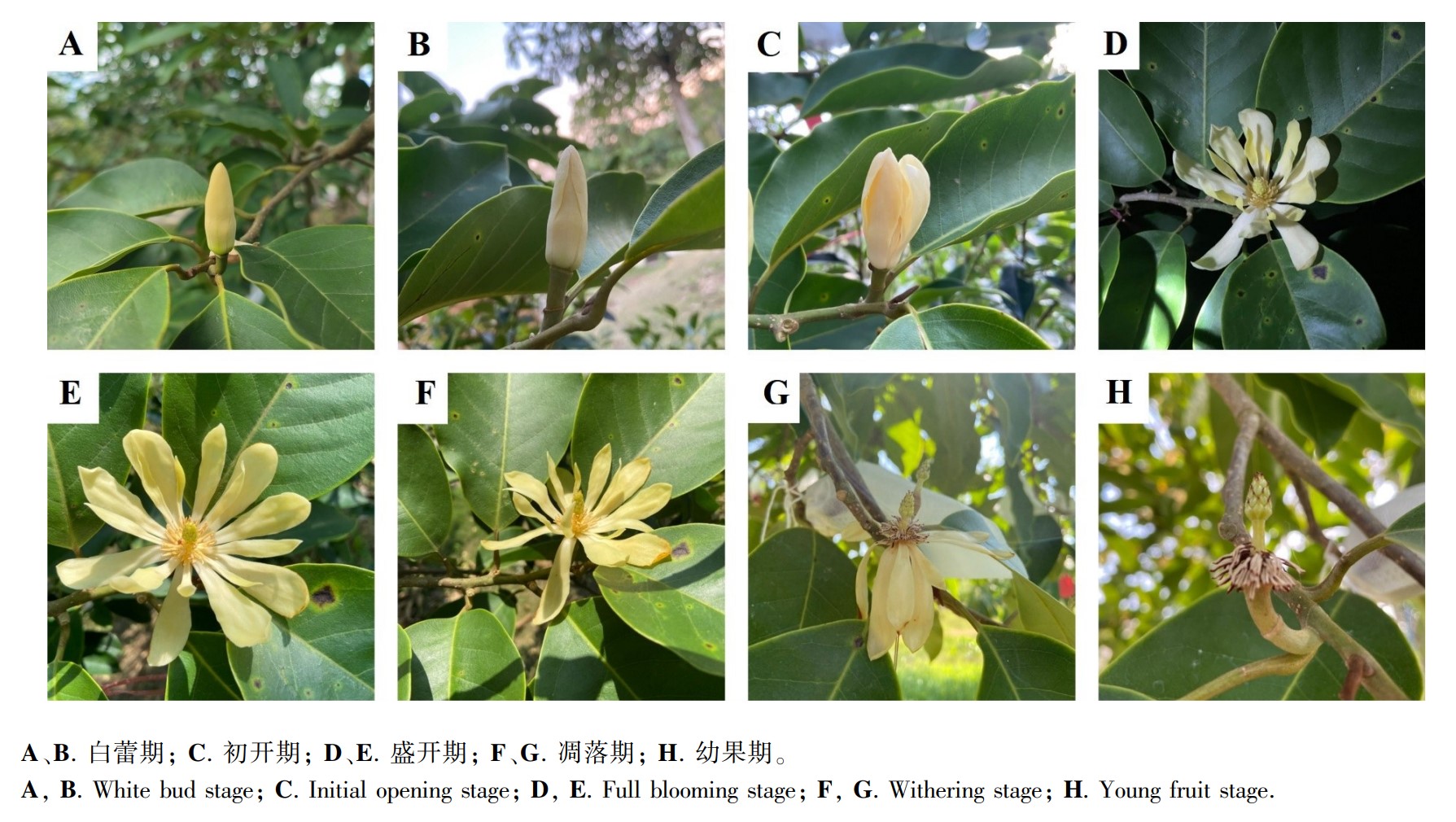
诗琳通含笑3层佛焰苞状苞片全部掉落后,进入白蕾期(Ⅳ时期),此时3轮花被片紧闭,外轮花被片呈乳白色,基部黄绿色(图4:A);当天花被片基部绿色逐渐褪去(图4:B),外轮花被片上部逐渐开始松动,不再互相紧贴。次日清晨5:00—7:00,进入初开期(Ⅴ时期),外轮花被片张开角度至15°~30°(图4:C)。此状态维持24 h后,即第3天清晨5:00—7:00左右整株处于初开期的花蕾会集中开放,进入盛开期(Ⅵ时期),同时雄蕊群松散,花药开裂散出花粉(图4:D);第3天上午9:00花被片完全打开,花药干缩(图4:E);中午11:00最外层花被片边缘变为焦黄色,进入凋落期(Ⅶ时期),并逐渐萎蔫(图4:F)。第4天花被片均下垂,花药褐化,随后花被片开始掉落(图4:G)。第6天,花被片与花药掉落进入幼果期(Ⅷ时期)(图4:H)。
图
4
诗琳通含笑单花开放动态
Fig.
4
Flowering dynamics of Michelia sirindhorniae
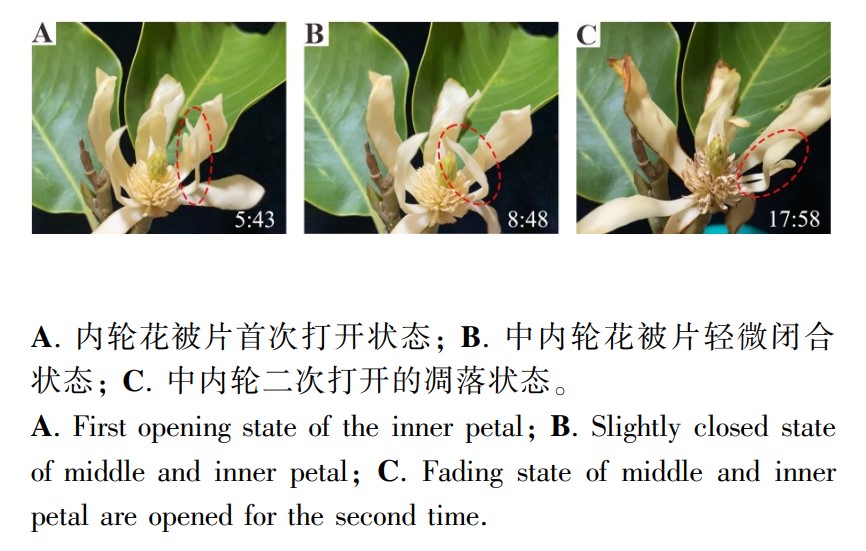
诗琳通含笑花被片从初开到盛开阶段,中内轮花被片有一个幅度较小的先合拢再打开的二次开合行为,闭合行为大致从上午6:00持续到9:00,约3 h,具体表现为中内轮花被片先随外轮花被片同时打开(图5:A),后在上午6:00至9:00逐渐闭合(图5:B),9:00后又缓慢打开至最大角度(图5:C)。
图
5
花被片二次开合过程
Fig.
5
Secondary opening and closing of petal
2.1.5 晴雨天气开花行为差异
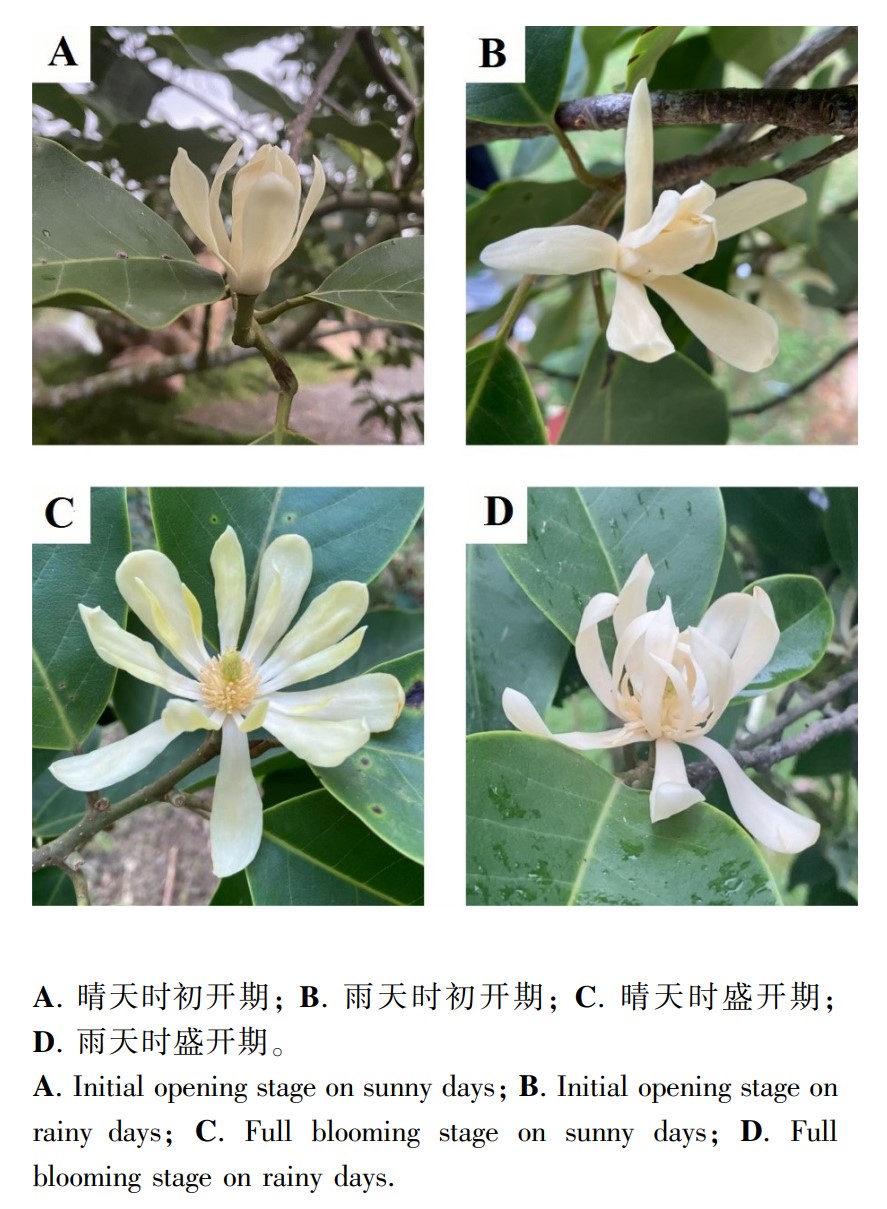
诗琳通含笑初开期和盛开期花被片的伸展方向会因开花时的天气不同而变化。晴天时,初开期外轮花被片向上呈杯状(图6:A);盛开期所有花被片斜上或平展呈盏状或碟状(图6:C)。雨天时,初开期外轮花被片斜上或平展呈杯碟状(图6:B);盛开期外轮花被片平展,中内轮花被片全部内弯呈球形(图6:D)。
图
6
诗琳通含笑花被片在不同天气下的不同姿态
Fig.
6
Different postures of Michelia sirindhorniae petals in different weather conditions
2.2 小孢子发育败育
石蜡切片结果表明,诗琳通含笑四分体时期败育严重,观察的526个花药囊切片中,85.55%四分体失去正常的形态(图7:A),8.17%为空花药囊,绒毡层开始解体,无法为小孢子的后续发育提供养分(图7:B)。单核靠边期的小孢子也部分发生皱缩出现败育,统计的142个花药囊中有29.51%小孢子变形(图7:C)。小孢子发育过程中的严重败育导致花粉产量极低,杂交育种时,很难收到花粉。
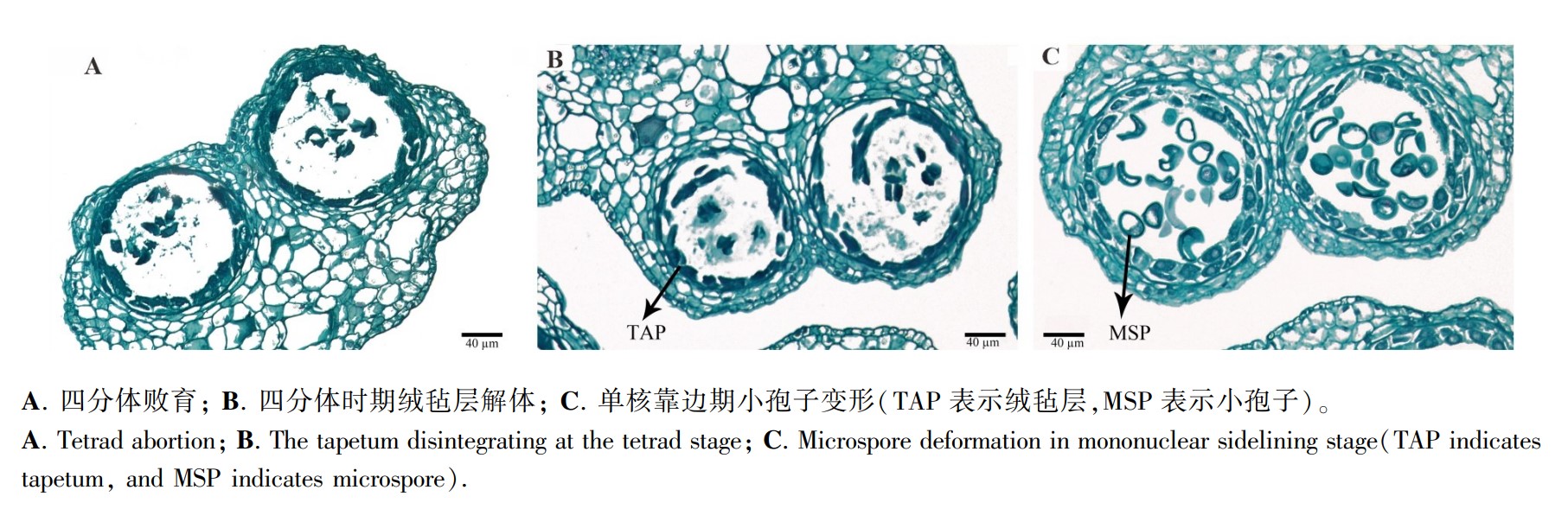
图
7
诗琳通含笑不同发育期的花粉囊
Fig.
7
Pollen sacs of Michelia sirindhorniae at different stages of development
2.3 花粉活性及柱头可授性
2.3.1 不同开花阶段的花粉活性
诗琳通含笑仅在盛开期才能收到花粉,散粉时间较短且集中。于白蕾期套袋,在盛开期自然散粉时立刻收集花粉,通过MTT染色法测定花粉活力为63.29%;离体培养萌发测定花粉活力为65.30%。具体萌发结果见图8。
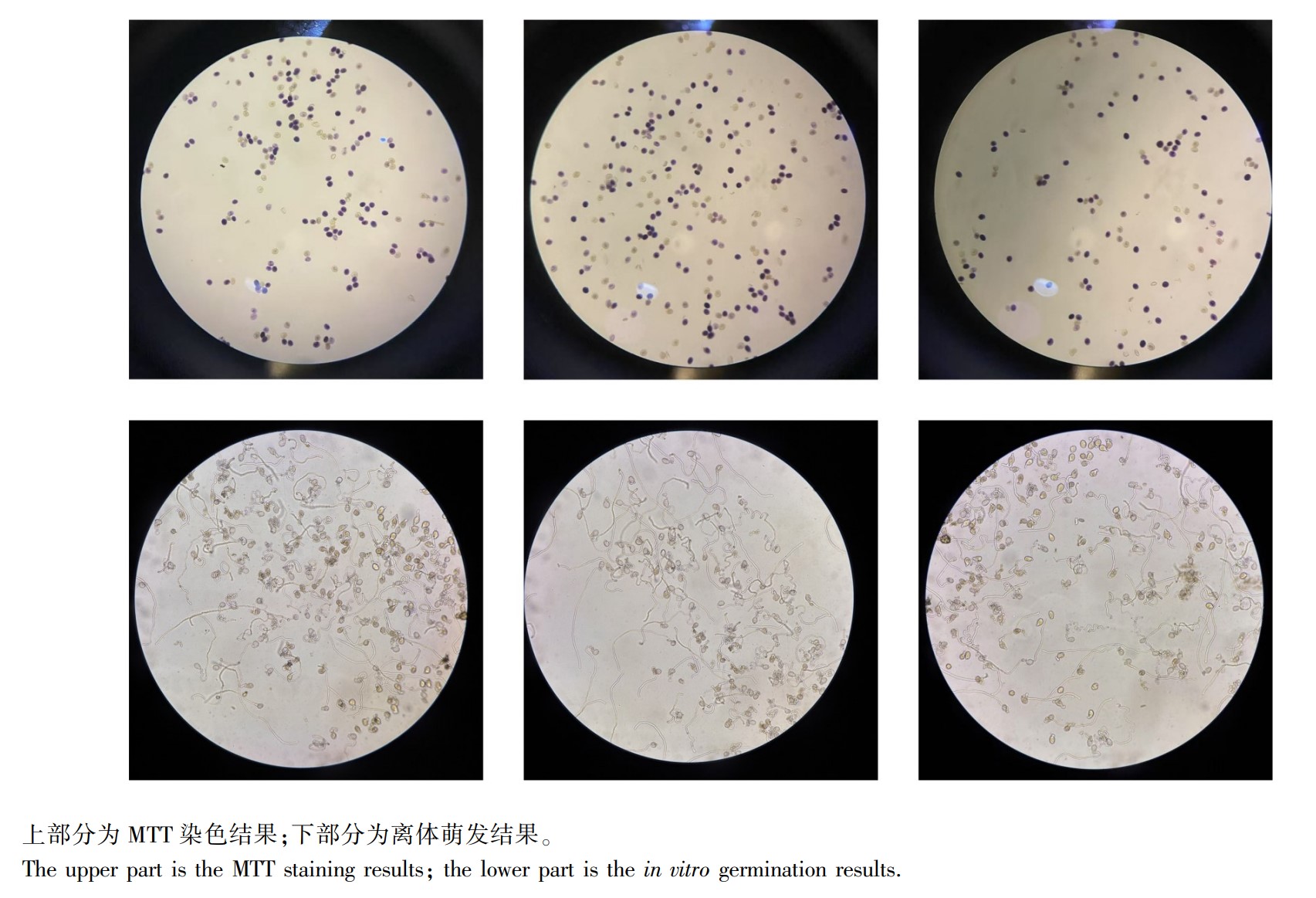
图
8
诗琳通含笑花粉活性测定
Fig.
8
Determination of pollen activity of Michelia sirindhorniae
2.3.2 不同开花阶段的柱头可授性
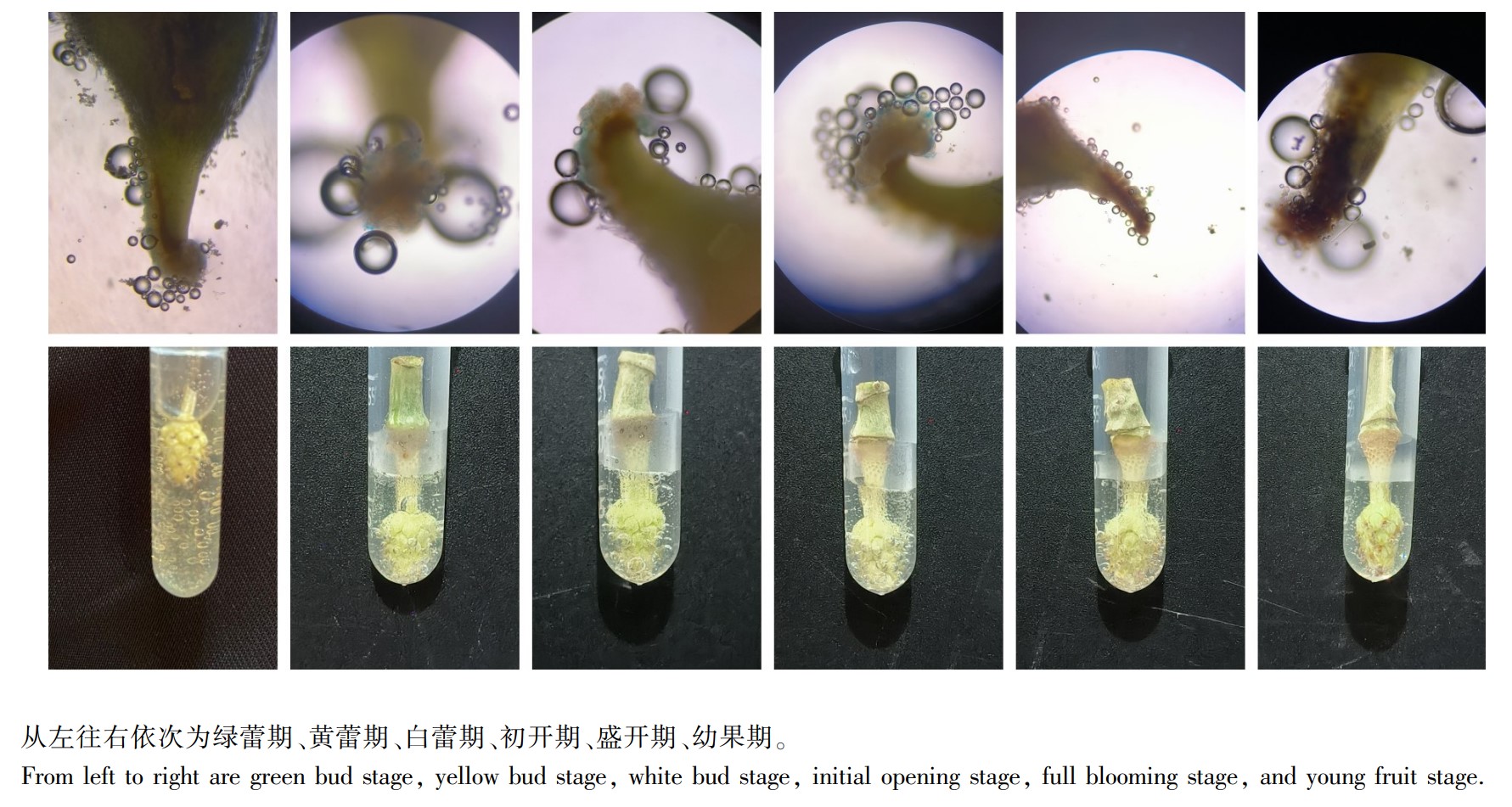
在绿蕾期、黄蕾期时,雄蕊呈黄绿色,紧贴雌蕊群柄,花药未开裂,柱头紧贴雌蕊群(图9:A、B),联苯胺-过氧化氢反应和人工授粉结果表明,在绿蕾期和黄蕾期的柱头已经具备活性;1~2 d后进入白蕾期,此时记作开花进程第1天,雄蕊状态与黄蕾期相同,但柱头开始向外反卷(图9:C),联苯胺-过氧化氢反应显示柱头可授性增强,人工授粉结果表明此时期授粉效果最佳;第2天进入初开期,雄蕊呈黄色(图9:D),联苯胺-过氧化氢反应显示柱头活性达到最强,但人工授粉没有获得同步的结果;第3天盛开期,雄蕊群松散并散粉,但此时柱头已褐化(图9:E),联苯胺-过氧化氢反应测定和人工授粉结果均表明柱头已失去活性;幼果期,雄蕊完全脱落(图9:F)。
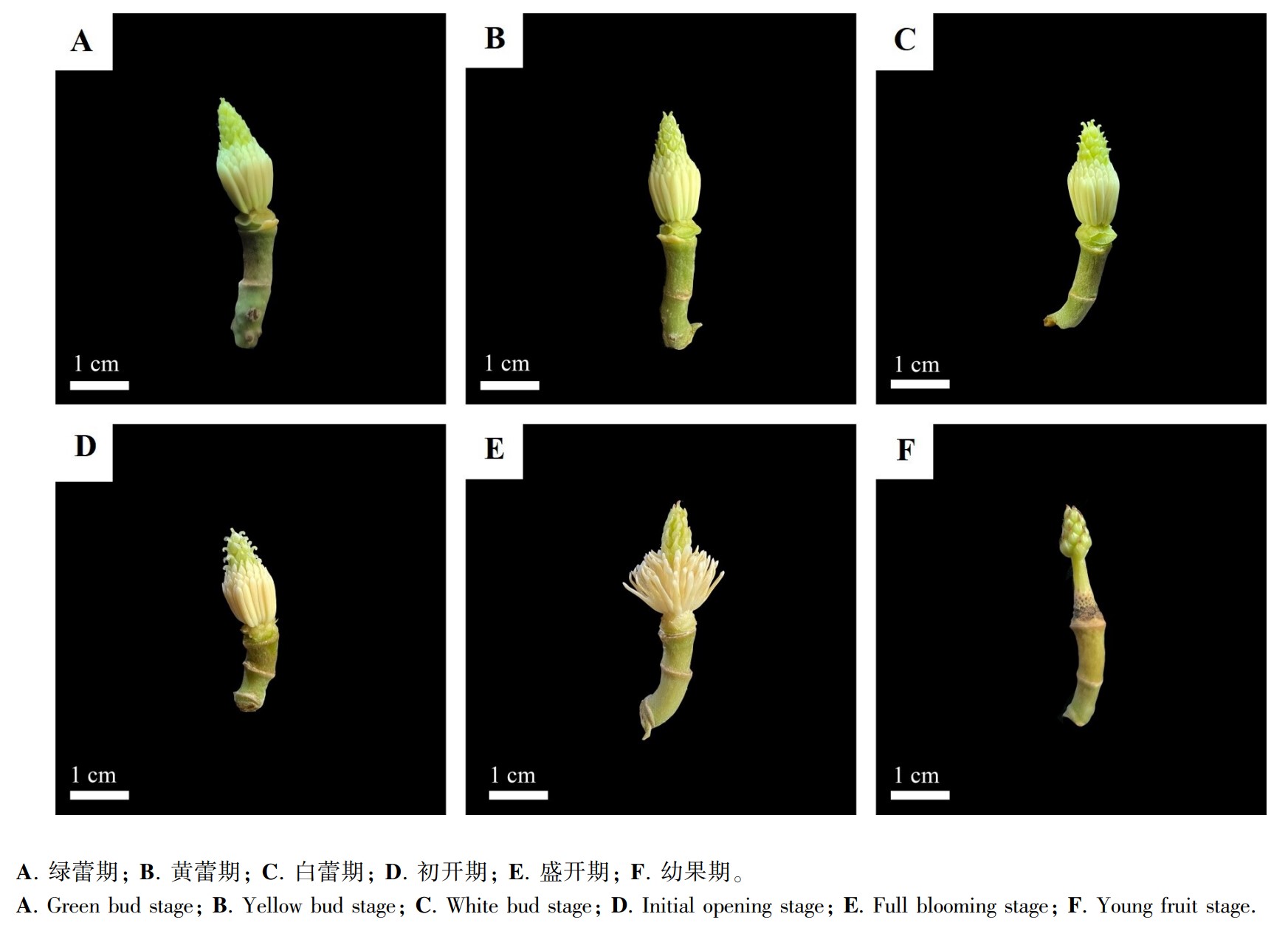
图
9
诗琳通含笑不同开花时期雌雄蕊的形态
Fig.
9
Morphology of pistils and stamens of Michelia sirindhorniae at different flowering stages
人工授粉结果表明,诗琳通含笑从绿蕾期到初开期均具可授性,最强阶段为白蕾期。盛开期花药开裂散粉时,柱头已无活性,雌雄蕊成熟阶段完全无重叠期(表3、图10)。
表
3
不同开花时期诗琳通含笑雌雄蕊特征及柱头可授性测定
Table
3
Pistil and stamen characteristics and stigma acceptability determinations of Michelia sirindhorniae at different flowering stages
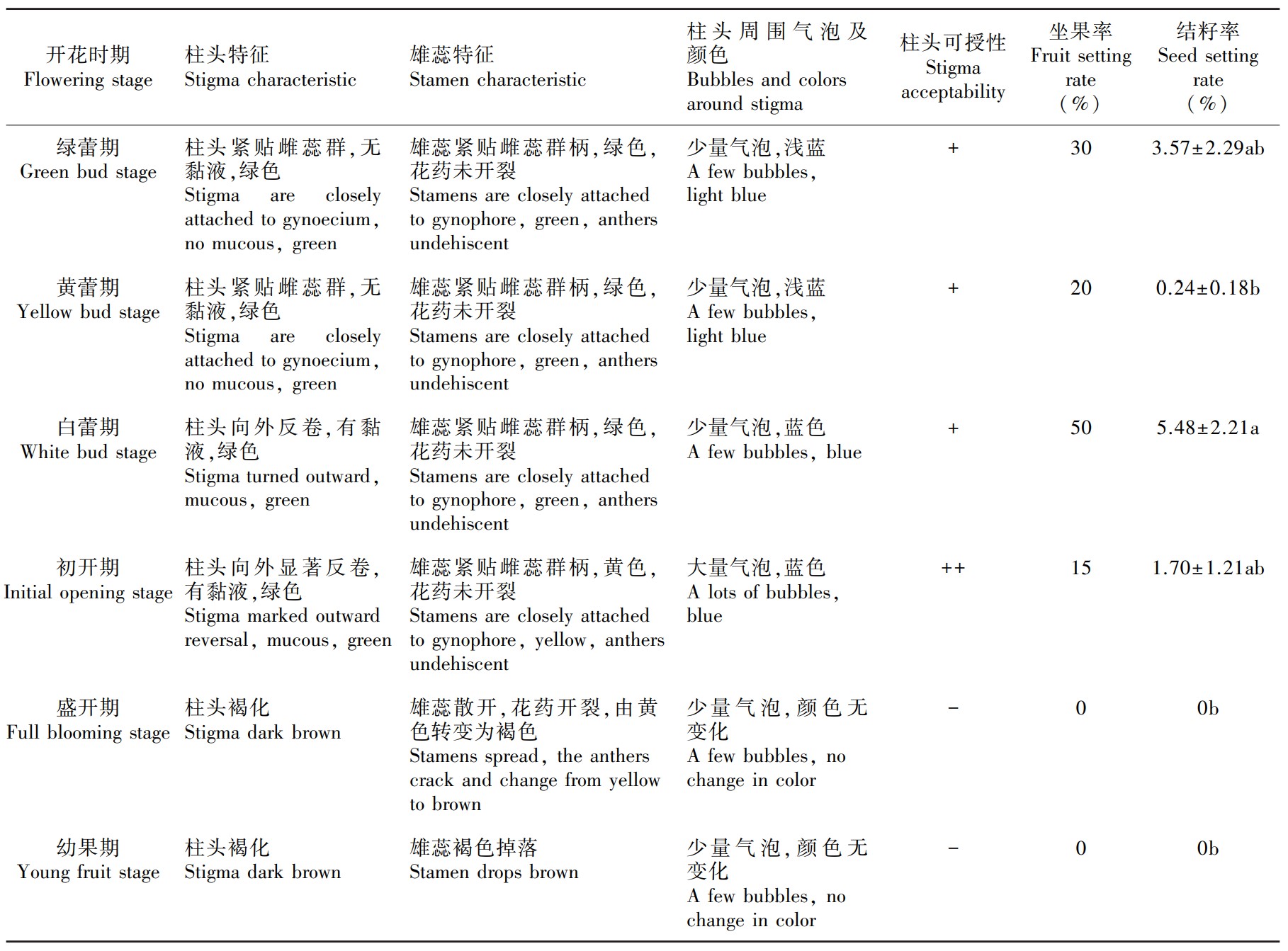
注:同列数据后不同字母表示差异显著(P<0.05),下同。++表示柱头可授性强;+表示柱头具有可授性;-表示无柱头具有可授性。
Note: Different letters in the same column indicate significant differences(P<0.05), the same below.++ indicates strong stigma acceptability;+ indicates the stigma is available;-indicates that no stigma is available.
图
10
不同开花时期诗琳通含笑柱头可授性
Fig.
10
Stigma acceptability of Michelia sirindhorniae at different flowering stages
2.4 访花昆虫
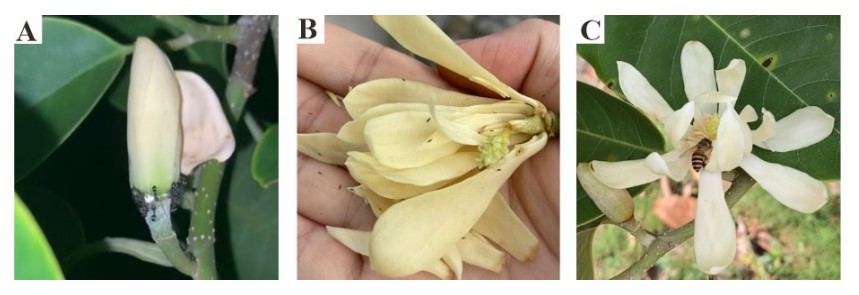
栽培圃地中诗琳通含笑的访花者有黑蚂蚁(Polyrhachis dives)、蓟马(Thysanoptera sp.)、意大利蜜蜂(Apis mellifera ligustica)等昆虫,它们在诗琳通含笑的不同开花阶段访花。白蕾期花基部会分泌少量蜜露,吸引蚂蚁前来取食(图11:A)。初开期,蓟马率先进入花内,大多停留在花被片基部及雄蕊群处,在次日盛开期(5:00—7:00)伴随着花被片开放逐渐离开(图11:B)。意大利蜜蜂在盛开期(6:00—9:00)进行访花行为,此时为访花高峰期,蜜蜂从花被片的侧面进入,收集花粉,阴天或雨天未见蜜蜂访花(图11:C),连续观测该时段蜜蜂对诗琳通含笑访花频率为每分钟1~3朵,单花停留的时间一般为5~28 s。在访花昆虫中,黑蚂蚁和蓟马身上未观察到花粉,意大利蜜蜂身上则携带有大量花粉。观察黑蚂蚁和蓟马停留过的花朵柱头,并未发现花粉,而蜜蜂停留过的花朵柱头上均有大量花粉。对被各访花昆虫光顾的幼果套袋跟踪观察,均无结实。在观察的3 900朵花中仅有2个自然结实。综上认为,在此栽培地无诗琳通含笑的有效传粉者。
图
11
栽培地诗琳通含笑访花昆虫
Fig.
11
Flower-visiting insects of Michelia sirindhorniae
2.5 繁育系统
统计了同株同花、同株异花、异株异花、属内种间、自然传粉和无融合生殖结实情况(表4)。人工控制授粉结果表明,诗琳通含笑不存在无融合生殖,自交完全不亲和,异株异花授粉平均坐果率为21.67%,但平均结籽率仅为2.87%。与含笑属部分种类有生理隔离,与木兰科其他属的属间杂交不亲和。
表4 控制授粉结果
诗琳通含笑单花花粉量为1.66×10⁵粒,具24个心皮,平均每心皮具胚珠7个,P/O比为900.47,依据Cruden(1977)的标准,诗琳通含笑繁育系统为兼性异交类型。根据Dafni(1992)的标准,诗琳通含笑的杂交指数OCI=5,繁育系统为异交,需传粉媒介。Cruden法计算的繁育系统结果与人工授粉结果不完全一致,P/O比显示部分自交亲和,但人工授粉表明诗琳通含笑自交完全不亲和。
3 讨论与结论
3.1 木兰科植物的开花特性
濒危木兰科植物的开花特性直接影响其种群延续及迁地保护成效(徐建恩等,2022)。天香木兰园的诗琳通含笑花期集中在4—5月,与华南植物园的诗琳通含笑以及原生种记录(Nooteboom & Chalermglin, 2000)的开花物候相对一致。这种集中的花期有助于植物在特定时间段内最大化吸引传粉者,从而提高繁殖成功率。部分热带分布的木兰科种类,如香港木兰(Lirianthe championii)、夜香木兰(L. coco)、毛桃木莲(Manglietia ventii),会选择在傍晚或者晚上开花(王亚玲,2006;潮薇,2023),而诗琳通含笑开花时间则集中在清晨5:00—7:00。这种避开日间高温的开花行为是热带植物应对高温高湿环境形成的繁殖适应机制,而这种开花时间上的差异可能是不同物种长期进化适应不同生态位和传粉策略的结果(陈心胜,2008)。
诗琳通含笑花被片在阴雨天气的不同伸展姿态,与醉香含笑、广玉兰、圆叶玉兰(Oyama sinensis)等的开花表现相似。这种行为可避免雨水对柱头的冲刷,保证花粉在柱头上顺利萌发(孟希等,2011;李慧敏,2017;粟莉圆,2021),在适应环境变化方面展示独特优势。同时所有植株花朵开放节律的高度一致,也容易在盛花期吸引更多昆虫访花,有利于自然结实。
3.2 专性异交的生态优势与迁地保护的挑战
与石碌含笑、华木莲(Manglietia decidua)、桂南木莲(M. conifera)以及天女木兰(Oyama sieboldii)的繁育系统相同,诗琳通含笑为专性异交类型(付潘文,2019;罗峰,2019;莫丽文等,2024a)。诗琳通含笑不仅雌雄异位、完全异熟,而且自交完全不亲和,最大程度地避免了柱头接收自身花粉。植物演化出雌雄异熟(时间隔离)和雌雄异位(空间隔离)的繁殖策略,本质上是为降低自交、促进异交,进而维护遗传多样性。自交消耗的能量与资源可能挤占异交机会,雌雄功能期错开能最大化繁殖收益,从而实现资源分配的优化,避免自身花粉对异交的干扰(Cardoso et al., 2018)。但是,部分濒危木兰科植物的自交不亲和性导致完全无法自花结实,使其在迁地保护中面临严峻挑战。由于圃地引种的个体多源自少数母株(甚至单一无性系),并且其后代遗传背景高度同质化,导致人工授粉时有效花粉源稀缺,加上适合的传粉者缺失,因此造成结实率低下,严重制约了回归引种与种群重建工作的开展。
3.3 访花昆虫传粉有效性分析
有效传粉媒介的缺乏是导致木兰科植物结实率低的重要原因之一(王亚玲,2006)。木兰科植物的柱头通常在花被片完全开放前已具可授性,并在开花后逐渐失活,这要求传粉昆虫必须在开花前就进入花内完成传粉(龚洵等,1998;莫丽文等,2024a)。然而,蜜蜂无法在诗琳通含笑花被片张开前实现访花,而花被片开放后柱头又已完全失去活性。张哲等(2022)也认为蜜蜂只能在紫花含笑花朵开放雄蕊散粉的雄性期进行访花,不是紫花含笑的有效传粉昆虫。在圃地,诗琳通含笑柱头活性最强时仅有蓟马访花。蓟马藏匿于未开放的诗琳通含笑花内,清晨花开散粉时离开。此时蓟马应该有机会携带花粉进入下一朵处于初开期的花内,然而未在访花蓟马身上观察到花粉,被访花朵也无结实。推测栽培地A株和B株间12 m的距离已超过蓟马的活动范围,其取食活动仅在同株进行,无法提供异株间有效传粉。因此,可在雌性阶段进入花内,以及具备较长距离的株间活动能力,都是有效传粉昆虫必备的特质。
3.4 诗琳通含笑花而不实的原因
栽培地的气候环境与诗琳通含笑的原生境相似且开花物候基本一致,排除了迁地引种过程中环境变化对其生殖发育的潜在影响。深入研究发现,诗琳通含笑在小孢子发育阶段出现了明显的败育现象,导致花粉量显著减少,从而影响其结实。同样地,广西含笑(Michelia guangxiensis)、香港木兰等在小孢子发育过程出现不同程度败育现象影响了自然结实率(刘坤良等,2013;付琳等,2015)。诗琳通含笑的人工异交授粉平均结籽率仅为2.87%,明显低于同属石碌含笑的22.93%(莫丽文等,2024a),其胚囊发育显然存在着严重的败育。此外,严格自交不亲和的特性使诗琳通含笑对传粉昆虫的短期活动范围有较高要求。景宁玉兰和峨眉拟单性木兰等植物也因传粉过程受到限制,导致种群繁衍和生存受到威胁(余道平等,2019;徐建恩等,2022)。
综上所述,迁地条件下,诗琳通含笑因缺乏有效传粉昆虫访花,小孢子和胚囊败育严重,导致其结籽率极低。在保护实践中,可通过对不同实生个体进行人工辅助授粉来提高结籽率,实现种群数量的稳步增加。