


摘要
为研究不同种源珙桐(Davidia involucrata)根际和根内微生物群落特征及功能规律,该研究以珙桐根际土壤和根部组织为研究材料,通过16S rRNA基因和ITS序列扩增子测序技术,对其群落组成、多样性、与理化因子的相关性及共现网络进行了分析且对其功能进行了预测。结果表明:(1)两个种源根际和根内微生物群落之间α多样性差异不显著,但β多样性存在显著性差异。(2)两个种源珙桐根际和根内优势细菌为变形菌门、酸杆菌门和放线菌门,而真菌则以子囊菌门与担子菌门为主;属分类水平则表现出特异性富集。(3)共现网络分析揭示了珙桐根际与根内细菌互作复杂度更高,其网络平均度及模块化等网络拓扑指数均高于真菌,揭示了真菌群落更高的保守性。(4) LEfSe分析表明,存在39个细菌分类单元和30个真菌分类单元且种源间具有显著性差异。(5)理化因子与微生物群落相关性显示,仅土壤有机碳与根际土壤细菌优势群落呈显著正相关,土壤速效钾与根内真菌群落呈显著正相关,其他理化因子与微生物群落无显著相关性。(6)功能预测表明,根际和根内优势细菌主要参与新陈代谢等功能,真菌则以腐生营养型为主。两个种源根际细菌群落在次生代谢物的合成、转录,以及折叠、分选和降解等11种功能均存在显著性差异,根际真菌仅地衣共生真菌功能存在显著性差异。综上认为,种源可影响微生物的组成与互作,并塑造功能差异化,这些差异可能影响珙桐的生态适应性,因此该研究结果可为濒危植物珙桐的迁地保护提供微生物组层面的理论支撑。
Abstract
To investigate the characteristics and functional patterns of rhizosphere and root endophytic microbial communities in different provenances of Davidia involucrata, this study took rhizosphere soil and root tissues as research materials, systematically examined community composition, diversity, physicochemical factor correlations, co-occurrence networks, and curried out the function prediction through 16S rRNA gene and ITS sequence amplicon sequencing technology. The results were as follows: (1) No significant α diversity differences were observed, but distinct β diversity patterns existed between provenances across compartments. (2) The dominant bacterial phyla included Proteobacteria, Acidobacteriota, and Actinobacteriota, while the dominant fungal phyla were Ascomycota and Basidiomycota; genus-level analysis revealed provenance-specific enrichment patterns. (3) Co-occurrence network analysis revealed bacterial communities exhibited greater interaction complexity compared to fungi, as evidenced by a higher average degree and modularity in network topology, reflecting the greater ecological conservatism of fungal communities. (4) LEfSe analysis identified 39 bacterial and 30 fungal taxa that demonstrated significant provenance-driven differentiation. (5) Physicochemical factor and microbial community correlation analysis indicated that soil organic carbon significantly positively correlated with the dominant bacterial communities in rhizosphere soil, while soil available potassium was significantly positively correlated with endophytic fungal communities within roots, with no other physicochemical factor and microbial community correlations observed. (6) Functional prediction indicated that dominant bacteria in the rhizosphere and roots endosphere primarily engage in functions such as metabolism, while fungi were predominantly saprotrophic. The rhizosphere bacterial communities from the two provenances exhibited significant differences in 11 functions, including the biosynthesis of other secondary metabolites, transcription, folding, sorting and degradation. For rhizosphere fungi, only the function of lichen symbiotic fungi showed significant differences. In conclusion, provenance can affect the composition and interactions of microorganisms, and shape differentiated functions which may influence the ecological adaptability of D. involucrata, therefore, the findings of this study can provide theoretical support at the microbiome level for the ex-situ conservation of the endangered plant D. involucrata.
珙桐(Davidia involucrata),隶属于珙桐科(Davidiaceae),珙桐属(Davidia),是第三纪古热带植物区系的孑遗物种,天然分布于湖北、湖南、四川、重庆、贵州、云南、陕西和甘肃等地,主要集中在海拔600~3 200 m的山地生境,呈现间断性零星分布(黎云样,2003)。珙桐迁地保育主要依赖种子萌发和扦插繁殖,而引种环境适应性问题成为关键制约因素(张清华等,2000)。目前,关于珙桐的研究主要集中在群落分布(张燕等,2024;杨永军等,2024)、繁育技术体系(董嘉明,2024)、形态特征解剖(张家勋等,1994)及生理遗传特性(关萍等,2015;令狐高曼等,2024)等方面,关于植物种源对微生物组影响的研究仍是空白。
植物根际与内生微生物群落在植物健康与适应性中扮演着至关重要的角色。植物根际微生物作为植物与土壤的生物媒介,参与养分循环、抑制病原菌的生长及增强植物抗逆性(Philippot et al., 2009; Ling et al., 2022)。植物内生菌则是定殖于植物组织内部,通过与宿主互惠共生,促进植物生长(Benson & Silvester, 1993; Luo et al., 2011; Khan et al., 2012; Hamilton &Bauerle, 2012)。因此,解析植物微生物组成与功能是理解其环境适应机制的关键。近年来,组学技术的革新为濒危植物的微生物群落解析提供了新视角。阿拉坦存布尔等(2024)通过研究进一步明确了濒危药用植物掌裂兰根部内生和根际真菌群落组成。有研究表明,濒危植物大别山五针松根际微生物与根内生菌在菌群丰富度、群落结构组成及功能多样性上均存在差异(石水琴等,2022;项小燕等,2025)。此外,Yang Y Z等(2024)对青海云杉、白桦、油茶3种林木微生物组学的研究进一步阐释了土壤理化因子在微生物群落组装中的驱动作用。孙晓等(2020)研究发现,锁阳土壤微生物的新陈代谢功能可在贫瘠的沙漠环境下为植物提供营养,并在干旱胁迫下促进植物生长。王香生等(2023)研究表明,小麦红花间作可显著提高根际细菌养分循环相关功能,显著提高根际丛枝菌根功能基因的相对丰度,降低了植物病原菌类功能基因的相对丰度。然而,针对珙桐微生物组的研究相对匮乏,目前主要是不同区域根际微生物组成差异分析(程立君等,2019)和海拔梯度对根际细菌群落的影响解析(Jin et al., 2024),而在种源水平上对根际微生物及内生菌的组成和功能的综合分析仍然欠缺。
珙桐因生境破碎化而导致其种群正面临严峻的生存压力。在迁地保护中,不同种源植株对新环境的适应能力可能存在差异,而根际和根内微生物作为重要的调节因子,其作用机制尚未阐明。为提高迁地保护的成效,本研究选择迁入保护林中神农架与五峰后河两个种源的珙桐为对象,通过比较分析其根际与内生微生物群落的结构及功能分化,旨在解析种源特性对微生物群落的影响,揭示微生物组驱动下的环境适应策略,并为珙桐种质资源的保育提供微生物学依据。
1 材料与方法
1.1 样品采集
采样地位于湖北省宜昌市夷陵区三峡植物园(110°20′30″E、30°23′30″N,海拔140 m)。选择濒危植物保护园区猕猴桃湾园区(湖北神农架徐家庄林场种源,树龄13 a,编号M)和小岗园区(湖北宜昌五峰后河国家级自然保护区种源,树龄15 a,编号N),两园区直线距离约110 m,海拔差约15 m,园区内造林坡度小于5°。
分别在每个园区按五点取样选择5个4 m × 4 m样地,在每个样地中选择一株健康的珙桐,按照东南西北4个方位,清除地表覆盖物后,于10~40 cm深度收集根际土壤,并采集部分健康根系(Wang et al., 2022)。将4个方位样本充分混匀,并去除杂质,使用冰盒保存带回实验室。共得到10份根际土壤样本和10份根部组织样本。将土样分成两部分,一部分土壤于-80 ℃冰箱保存,用于高通量测序;另一部分土壤样品用于土壤理化指标的测定。植物根系经过表面处理后用于高通量测序。
1.2 土壤理化性质测定
土壤理化性质分析参考《土壤分析技术规范》(第2版)(杜森和高祥照,2006)。土壤pH值,采用电极法测定;土壤有机碳(soil organic carbon, SOC),采用重铬酸钾氧化-外加热法测定;土壤全氮(total nitrogen, TN),采用凯氏法测定;土壤有效磷(available phosphorus, AP),采用碳酸氢钠/氟化钠盐酸浸提,钼锑抗比色法测定;土壤速效钾(available potassium, AK),采用冷硝酸浸提-火焰光度法测定。
1.3 DNA提取、PCR扩增及测序
采用OMEGA Soil DNA Kit(D5635-02, Omega Bio-Tek, USA)提取根际土壤及根系组织基因组DNA。使用0.8%琼脂糖凝胶电泳判断分子大小,并利用Nanodrop NC2000检测DNA质量和浓度。使用引物338F/806R,对细菌16S rRNA基因V3-V4区进行扩增(Huws et al., 2007)。使用引物ITS5F/ITS1R对真菌ITS1区扩增(孟兆云等,2023)。PCR产物经Quant-iT PicoGreen dsDNA Assay Kit(Invitrogen, Carlsbad, CA, USA)定量后按需混样。使用 TruSeq Nano DNA LT Library Prep Kit 建库,质量合格后在 Illumina NovaSeq6000(PE250双端测序)平台测序。本研究所有样品委托上海派森诺生物科技股份有限公司完成测序。原始数据已上传至NCBI网站SRA数据库,项目编号为PRJNA1225425。
1.4 数据处理
使用QIIME2(Bolyen et al., 2019)对原始序列进行预处理(Martin, 2011),经DADA2(Callahan et al., 2016)质控后以100%相似度生成特征性序列ASVs(amplicon sequence variants)及丰度矩阵。基于Silva数据库(Quast et al., 2012)和Unite数据库(Nilsson et al., 2019)分别对细菌和真菌ASV进行物种注释,过滤丰度低于 0.001%的稀有ASV。分别计算α多样性指数(包括Chao 1指数、Shannon指数、Pielou’s evenness指数)并可视化。基于Bray-Curitis距离进行β多样性主坐标分析(PCoA)(Ramette, 2007; Liu et al., 2021),通过PERMANOVA检验组间群落结构差异显著性。利用LEfSe(LDA Effect Size)识别组间差异分类单元(Segata et al., 2011)。用Mantel 检验分析微生物群落与环境因子相关性。基于Spearman相关性(|ρ|>0.8,P<0.001)构建微生物共现网络,使用Gephi可视化网络拓扑特征。使用PICRUSt2对细菌群落功能进行预测(Douglas et al., 2020),以及FUNGuild对真菌群落功能进行预测(Nguyen et al., 2016)。
2 结果与分析
2.1 土壤理化分析
表1显示,神农架种源(M)珙桐生长土壤的pH值、有机碳(SOC)、总氮(TN)、有效磷(AP)均高于后河种源(N),仅速效钾(AK)相反。经过差异显著性分析可知,所有指标均无显著性差异,表明两地生长环境差异不明显。
表
1
珙桐迁入林土壤理化性质
Table
1
Physical and chemical properties of soil in Davidia involucrata transplanted forest

注:数值=平均值±标准偏差。同列中不同小写字母表示样地间指标的显著性差异(P<0.05)。[M]. 神农架种源; [N]. 后河种源。下同。
Note: Values=. Different lowercase letters in the same column indicate significant differences among the indicators in the plots(P<0.05). [M]. Shennongjia provenance; [N]. Houhe provenance. The same below.
2.2 珙桐根际微生物和根内生菌物种组成分析
对根际土壤样品和根系组织分别进行16S rRNA基因和ITS测序,去除singleton后,10份土壤样品共得到700 557条16S rRNA序列和1 077 584条ITS序列,10份根系样品共得到596 744条16S rRNA序列和1 188 740条ITS序列。基于100%相似度进行聚类,共得到20 381个细菌ASV和3 635个真菌ASV。物种注释结果显示,细菌ASV归属于43门129纲306目493科957属1 596种;真菌ASV归属于11门46纲115目270科535属765种。
如图1所示,真菌和细菌稀释曲线逐渐趋于平稳,表明测序深度合理,可真实反映珙桐根际与根内的微生物群落特征。
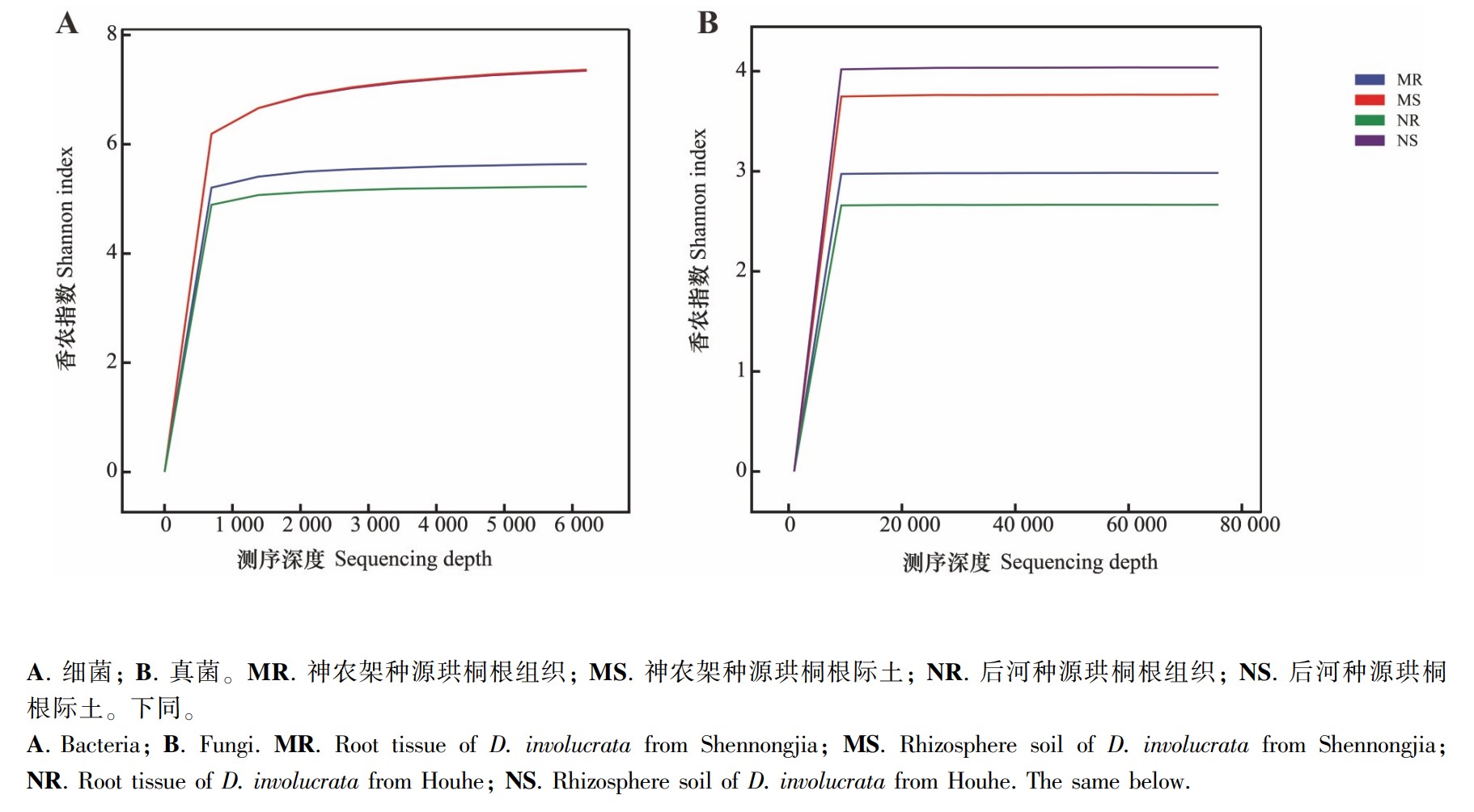
图
1
珙桐微生物群落稀释曲线
Fig.
1
Dilution curves of microbial communities of Davidia involucrata
细菌群落组成如图2:A、C所示,在门分类水平上,土壤样本中以变形菌门(Proteobacteria)、酸杆菌门(Acidobacteriota)、放线菌门(Actinobacteriota)为主,根系组织中以变形菌门、放线菌门、粘球菌门(Myxococcota)为主;在属水平上,土壤优势菌属为甲烷氧化菌门罗库菌属(Rokubacteriales)、酸杆菌目未分类菌属(Unclassified_o_Vicinamibacterale)、变形菌门SC-I-84等,根系组织中主要为慢生根瘤菌属(Bradyrhizobium)、分枝杆菌属(Mycobacterium)、游动放线菌属(Actinoplanes)等。
真菌群落组成如图2:B、D所示,在门分类水平上,土壤和根系中均以子囊菌门(Ascomycota)、担子菌门(Basidiomycota)为主;在属水平上,土壤优势真菌属为圆孢霉属(Staphylotrichum)、粗糙孔菌属(Trechispora)、未分类真菌属(Unclassified_d_Fungi)等,根系中则以树状孢属(Dendrosporium)、葡萄座腔菌属(Botryosphaeria)、未分类真菌属等为主。
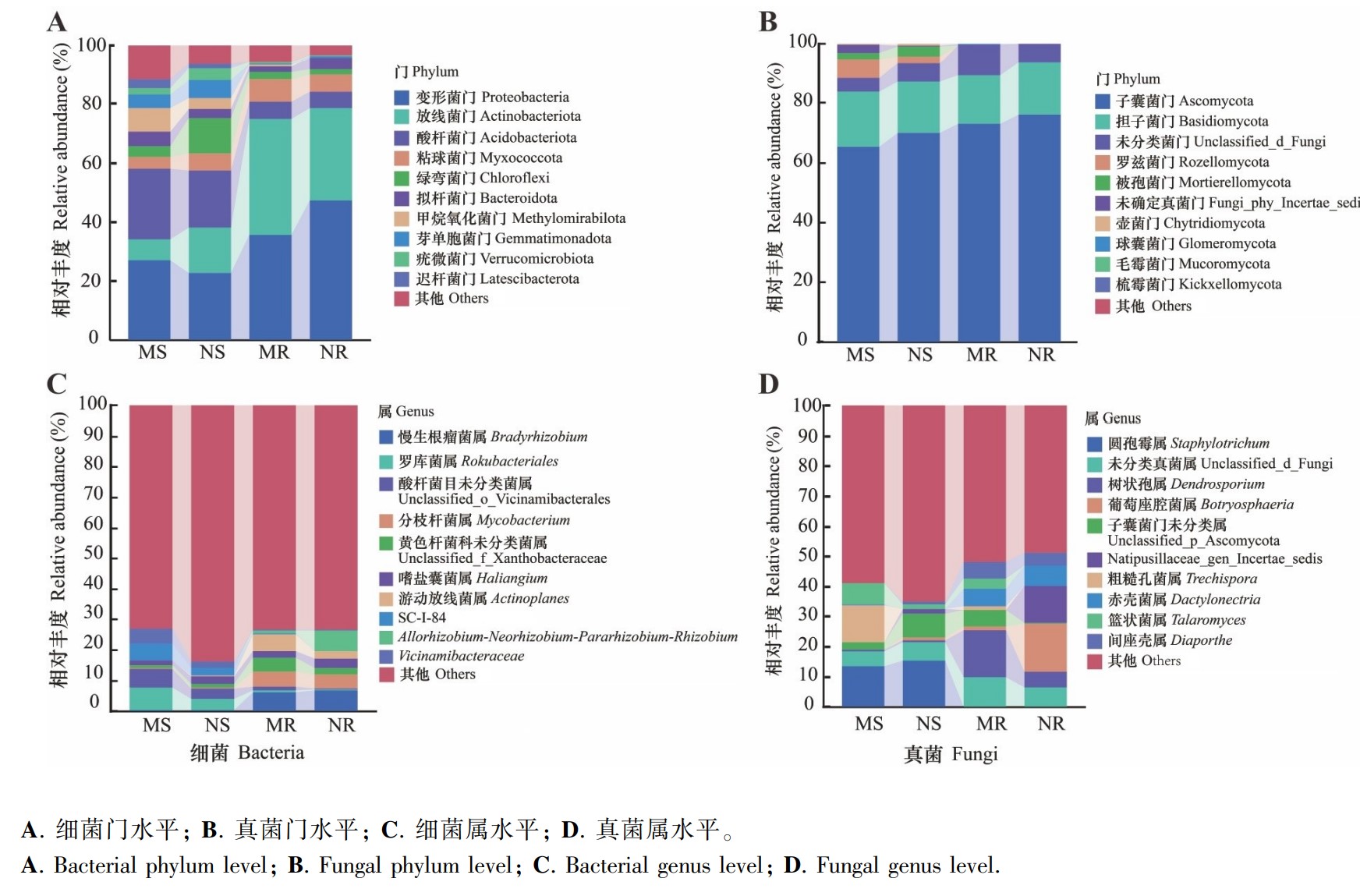
图
2
珙桐微生物群落组成
Fig.
2
Microbial community composition of Davidia involucrata
2.3 珙桐根际微生物和根内生菌群落多样性分析
α多样性分析(图3:A、C)表明,珙桐根际微生物群落Chao 1指数、Shannon指数、Pielou’s evenness指数均高于根内生菌,表明其物种数、群落丰富度和均匀度均高于根内生菌。神农架种源珙桐根际细菌群落Pielou’s evenness指数显著高于根内生细菌群落(P<0.05),说明根际细菌均匀度高于根内生细菌;Chao 1指数、Shannon指数高于根内生细菌群落,但差异不显著(P>0.05)。后河种源珙桐根际微生物群落Chao 1指数、Shannon指数、Pielou’s evenness指数均显著高于根内生菌(P<0.05),说明后河种源珙桐根际细菌和真菌群落丰富度和均匀度均高于根内生菌。两个种源珙桐根际和根内微生物群落多样性基本一致,种源间未表现出显著性差异。
基于Bray-Curtis距离,对ASVs进行PCoA分析,结果如图3:B、D所示。细菌群落PCoA1和PCoA2的总解释度为35.7%,真菌群落PCoA1和PCoA2总解释度为25.9%。Adonis组间差异显著性分析显示,基于不同部位分组和不同种源分组,微生物群落结构均具有显著性差异,但基于不同部位分组组间差异显著性(细菌P=0.001,真菌P=0.001)高于基于不同种源分组(细菌P=0.002,真菌P=0.001)。
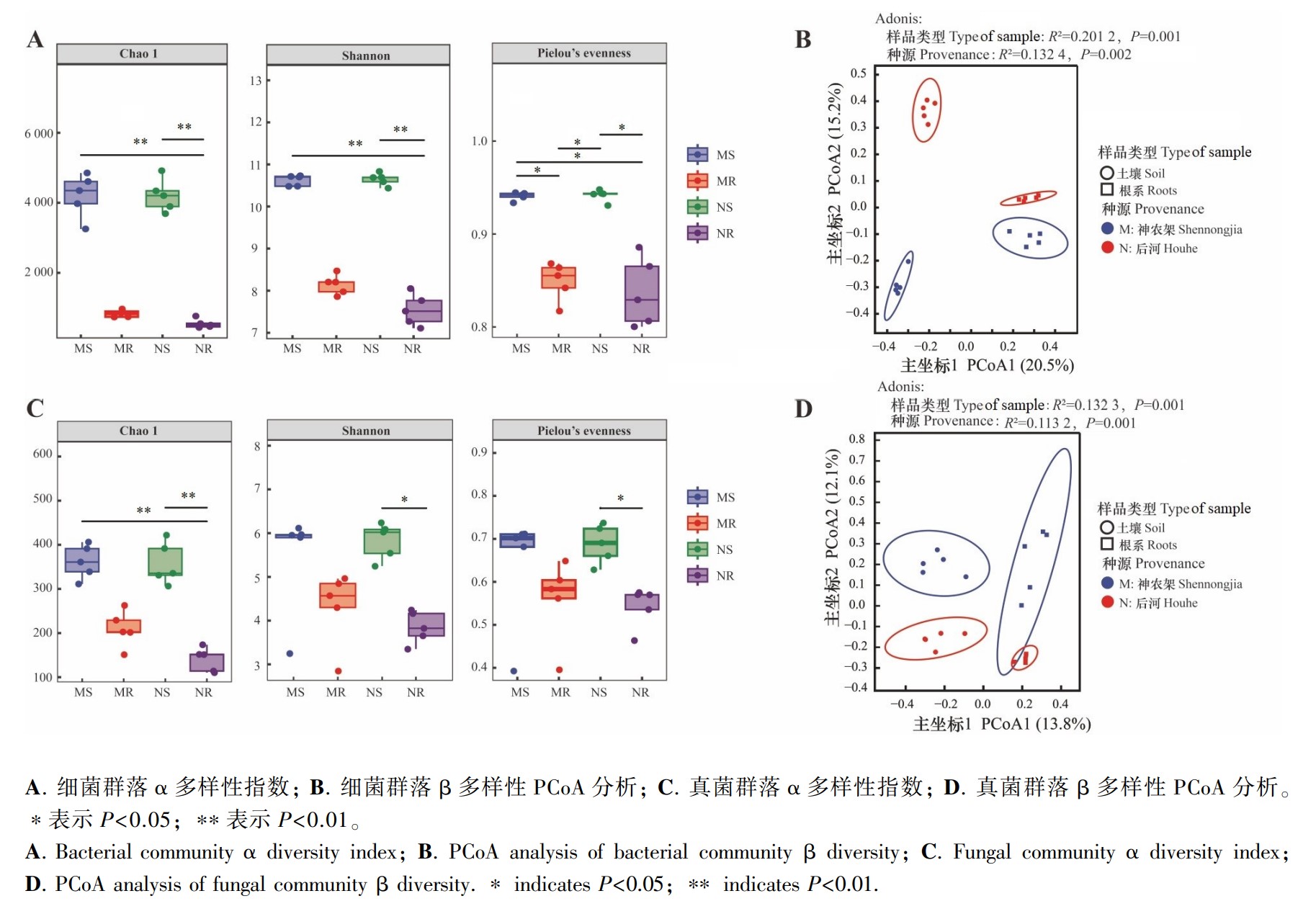
图
3
珙桐根际微生物和根内生菌α多样性指数和β多样性PCoA分析
Fig.
3
α diversity indices and β diversity PCoA analysis of rhizosphere microbial and root endophytes in Davidia involucrata
2.4 珙桐微生物群落标志物种分析
通过LEfSe分析(LDA>4,P<0.05),得到不同种源珙桐根际和根内微生物群落标志性物种。由图4可知,共发现39个细菌标志分类单元,其中神农架种源和后河种源珙桐根际土壤中分别有19个和8个,神农架种源和后河种源珙桐根内生菌中分别有7个和5个,主要类群包括甲烷氧化菌目(Methylomirabilia)、芽单胞菌门(Gemmatimonadota)、小单孢菌目(Micromonosporales)和链霉菌属(Streptomyces)等;共发现30个真菌标志分类单元,其中神农架种源和后河种源珙桐根际土壤中分别为15个和7个,根内生菌中分别为1个和7个,主要类群包括刺孢菌科(Hydnodontaceae)、银耳纲(Tremellomycetes)、间座壳科(Diaporthaceae)和葡萄座腔菌属(Botrvosphaeria)等。
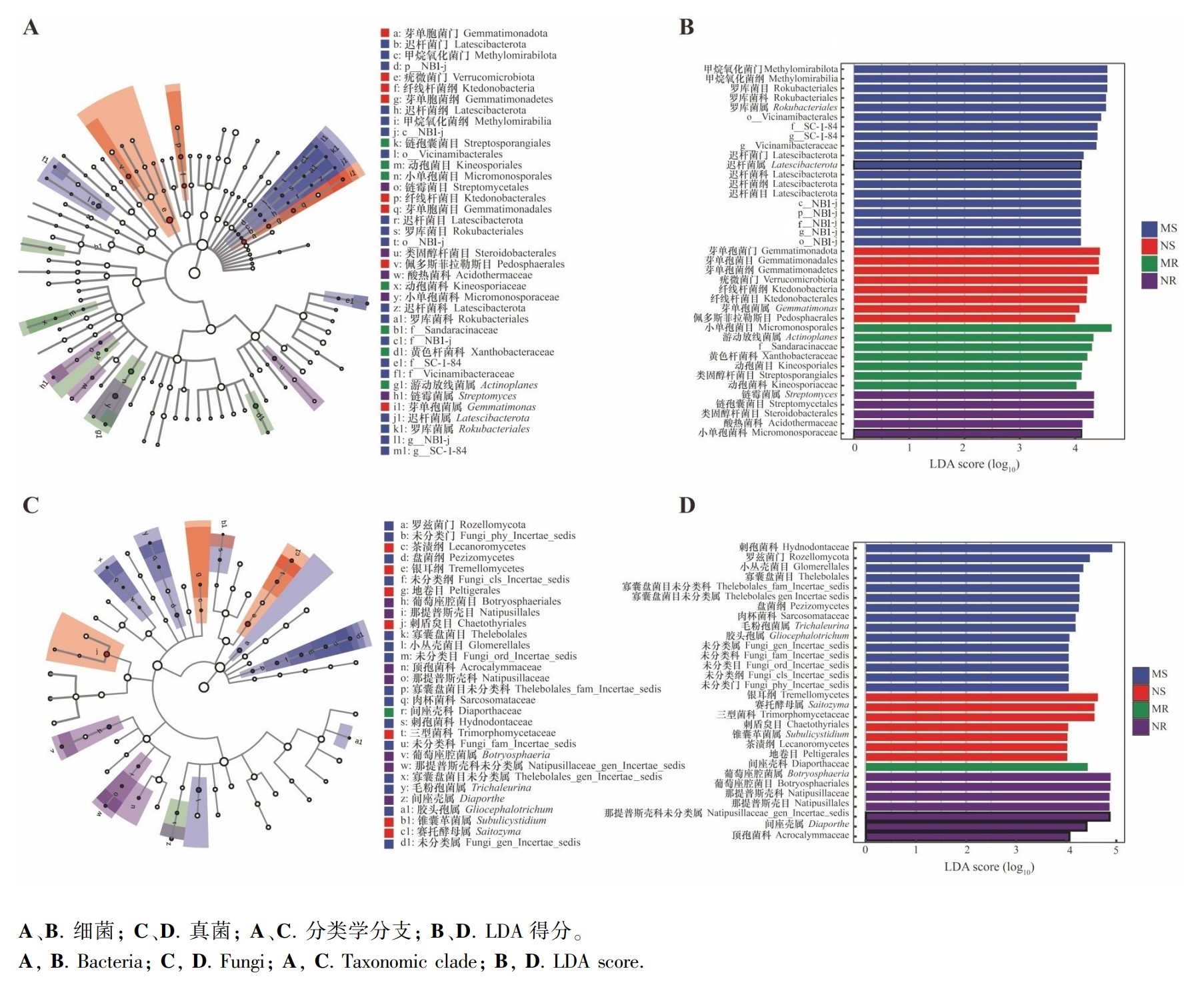
图
4
不同种源珙桐组间差异物种LEfSe分析
Fig.
4
LEfSe analysis of different species between groups of different provenances in Davidia involucrata
2.5 珙桐微生物群落与环境因子之间的关系
基于真菌和细菌门分类水平优势种群,通过Mantel检验分析其与环境因子的Spearman相关性。结果如图5所示,对于细菌群落,仅土壤有机碳与根际优势细菌门呈显著正相关(P<0.05),土壤酸碱度、总氮、有效磷和速效钾与根际和根内优势细菌均无显著相关性(P>0.05);对于真菌群落,仅土壤速效钾与根内优势真菌呈显著正相关(P<0.05),土壤酸碱度、总氮、土壤有机碳和有效磷与根际和根内优势真菌均无显著相关性(P>0.05)。环境因子间相关性分析显示,除速效钾与其他环境因子间呈负相关以外,其他环境因子间均为正相关,其中有机碳与总氮之间呈极显著相关。
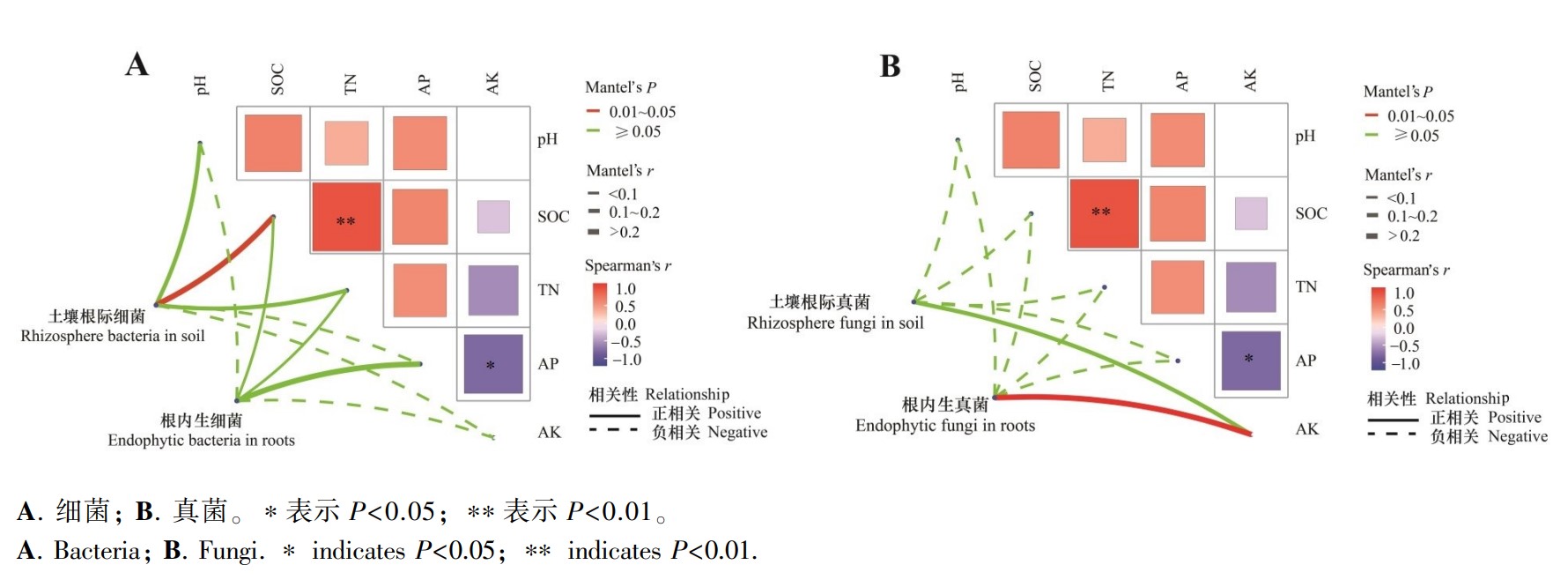
图
5
理化因子与珙桐根际和根内微生物群落相关性
Fig.
5
Correlation between physicochemical factors and microbial communities in the rhizosphere and roots of Davidia involucrata
2.6 珙桐根际微生物和根内生菌的共现网络分析
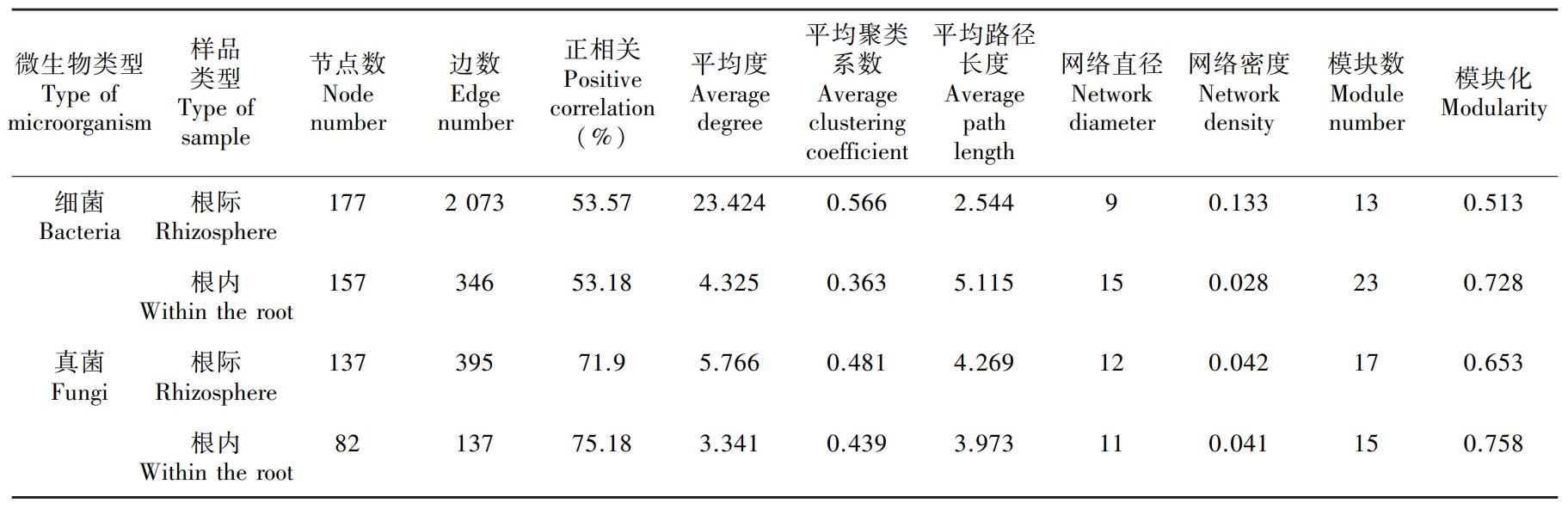
基于根际和根内丰度前200的属水平细菌和真菌构建共现网络,具体如图6所示。由表2可知,根际土壤微生物共现网络节点数与边数(根际细菌为177/2 073,根内生细菌为157/346,根际真菌为137/395,根内生真菌为82/137)、平均度(根际细菌为23.424,根内生细菌为4.325,根际真菌为5.766,根内生真菌为3.341)均高于根内微生物,表明根际微生物共现网络复杂程度更高。此外,微生物间互作以正相关为主且真菌群落间正相关比例高于细菌群落。
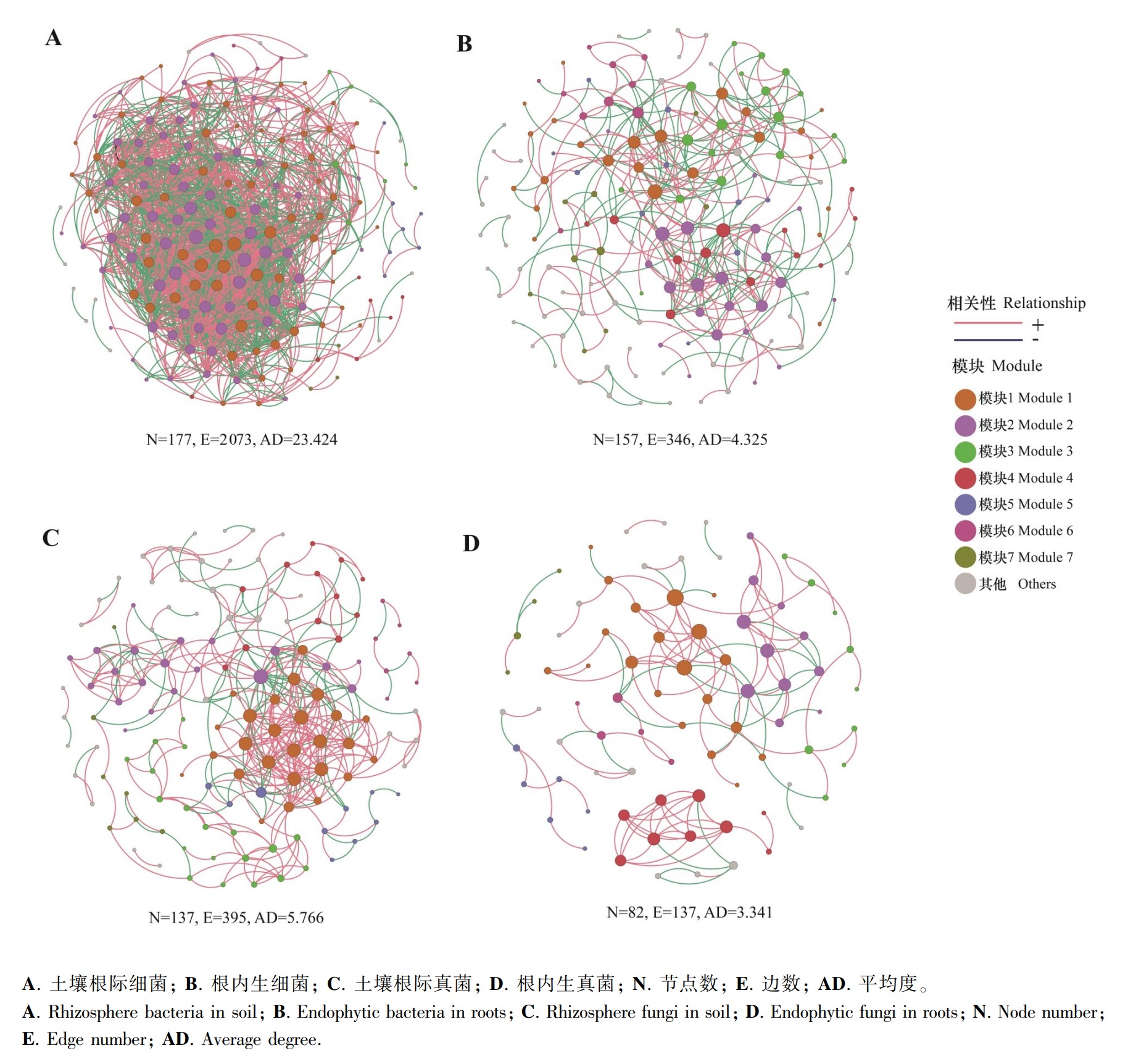
图
6
珙桐根际和根内微生物共现网络分析
Fig.
6
Co-occurrence network analysis of microorganisms in the rhizosphere and roots of Davidia involucrata
表
2
珙桐微生物共现网络拓扑参数
Table
2
Topological parameters of the microbial co-occurrence network of Davidia involucrata
2.7 珙桐根际微生物和根内生菌的功能预测
使用PICRUSt2功能预测显示(图7:A),在一级功能层上共有6个代谢通路,分别为新陈代谢、环境信息处理、人类疾病、细胞过程、遗传信息处理及有机系统。其中,新陈代谢在根际和根内生细菌群落功能的相对丰度均占80%以上,其次是遗传信息处理、环境信息处理、有机系统等。选择相对丰度占比前20的二级功能绘制热图,并进行差异显著性分析,结果(图7:B)表明不同种源珙桐根际细菌群落在次生代谢物的合成,转录,折叠、分选和降解,翻译,核苷酸代谢,细胞生长与死亡,细胞活动性,碳水化合物代谢,异源物质的生物降解与代谢,脂代谢,运输与分解代谢均存在显著性差异(P<0.05);不同种源珙桐根内生细菌群落功能均无显著性差异(P>0.05)。
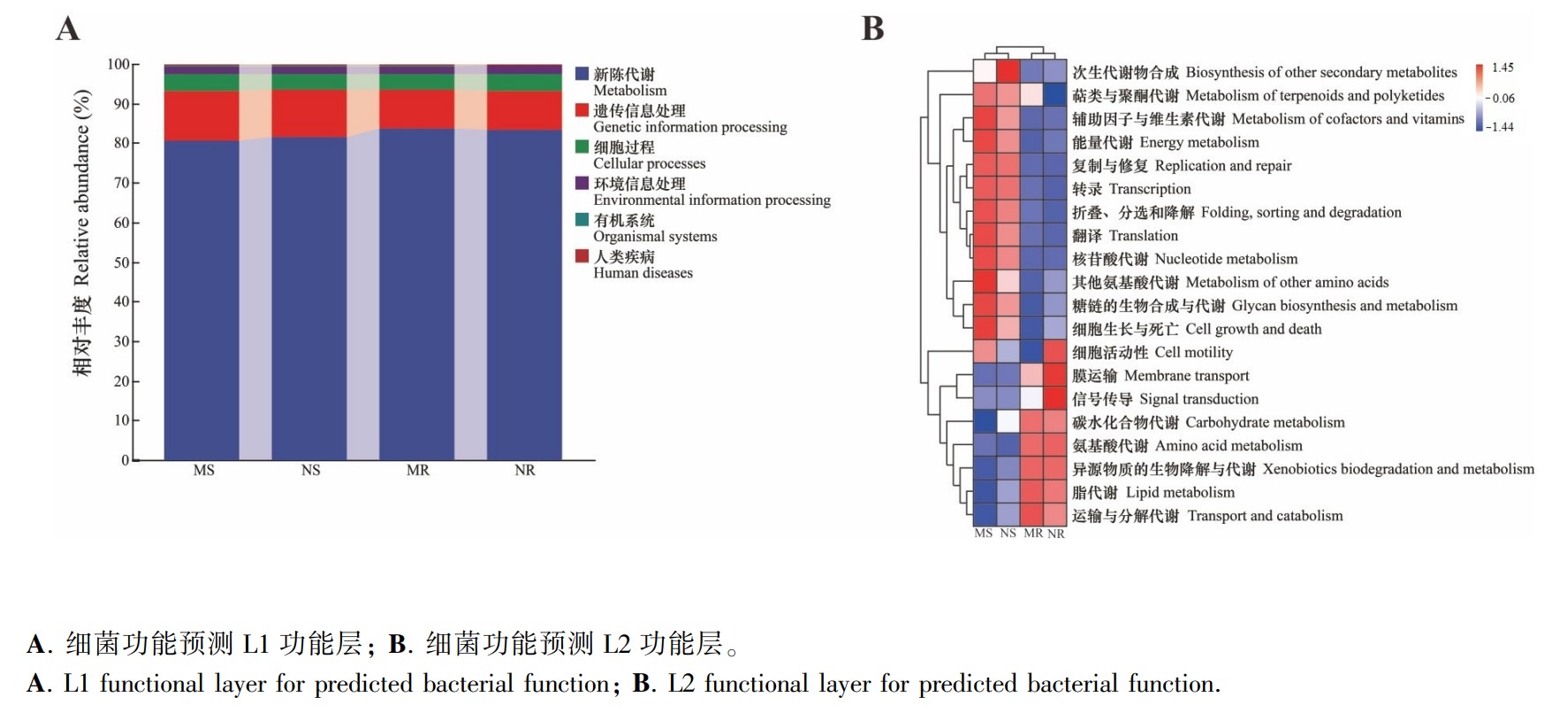
图
7
细菌群落基于KEGG功能预测
Fig.
7
Functional prediction of bacterial communities based on KEGG
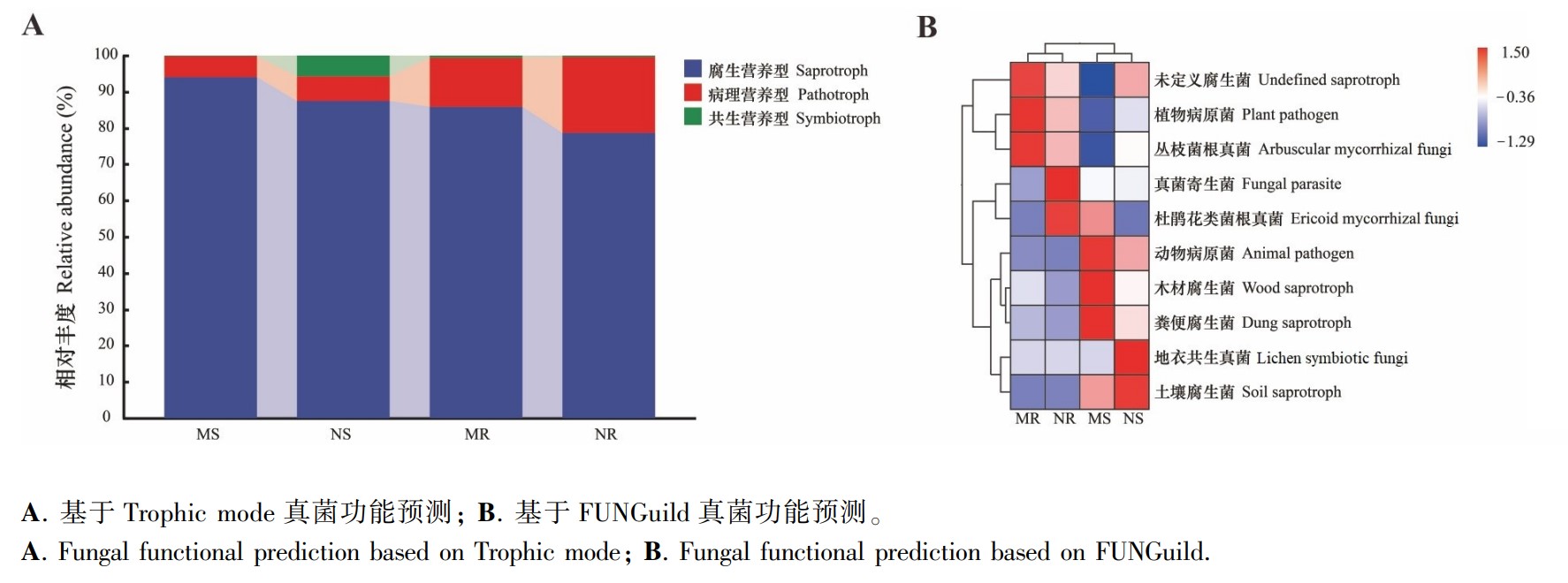
使用FUNGuild对真菌群落进行功能预测表明,主要分为腐生营养型、病理营养型、共生营养型3大类,其中腐生营养型平均相对丰度在80.0%以上(图8:A)。选择相对丰度占比前10的功能(占比99.0%以上)绘制热图(图8:B),并进行差异显著性分析,结果表明不同种源根际真菌群落主要功能仅地衣共生真菌存在显著性差异(P<0.05);根内生真菌群落主要功能均无显著性差异(P>0.05)。
图
8
真菌群落基于FUNGuild功能预测
Fig.
8
Functional prediction of fungal communities based on FUNGuild
3 讨论
植物微生物群落多样性与植物种类(Yang Y Z et al., 2024)、海拔高度(Jin et al., 2024)、生长环境(Yang X W et al., 2024)等多种因素相关。尽管本研究中两个引种保护地环境因子不存在显著性差异,但是根际与根内微生物的β多样性仍存在显著性差异。不同种源珙桐根际与根内微生物具有门水平组成保守性(变形菌门、放线菌门、酸杆菌门为细菌优势类群;子囊菌门、担子菌门占真菌总丰度80%以上),与Jin等(2024)报道的珙桐根际优势细菌基本一致,但在属水平呈现显著特异性分化,与Yang Y Z等(2024)和Yang X W(2024)等研究一致。这一现象表明,植物种源可能通过调控根系分泌物组成,进而选择性招募微生物类群。通过研究优势群落与环境因子相关性显示,有机碳与根际细菌群落呈显著正相关,速效钾与根内生真菌群落呈显著正相关。其中,碳源可能与群落构建相关,内生菌可能通过钾离子通道调控参与植物渗透胁迫响应,这一发现与陆玉芳和施卫民(2020)发现的种源-微生物-土壤的反馈与负反馈机制一致,表明种源可通过调控分泌物化学组成驱动微生物群落改变。
为进一步明确具有显著性差异的微生物类群,通过LEfSe分析确定了39个细菌和30个真菌差异分类单元,其功能特征呈现显著的生态位分化。其中,根际富集细菌罗库菌属和芽单胞菌属分别通过甲烷氧化和有机质矿化,参与碳循环(He et al., 2015; Becraft et al., 2017; Venkatachalam et al., 2024);而内生细菌游动放线菌属和链霉菌属分别承担抗菌物质的生成(Hirsch & Valdés 2010; 孔璐琦等,2023)和抗生素的合成功能(Vurukonda et al., 2018),协助宿主抵御病原入侵。根际和根内富集真菌,如胶头孢属、间座壳属、葡萄座腔菌属,主要参与物质代谢和生态循环(Slippers & Wingfield, 2007; Hilário & Gonçalves, 2023)。
功能预测进一步印证了种源导致的生态适应性。本研究结果显示,珙桐根际和根内生细菌功能主要为新陈代谢,真菌功能则以腐生营养型为主。通过差异性分析表明,细菌群落二级功能,如碳水化合物代谢等11种功能存在显著性差异,这可能与珙桐根际分泌物和生长代谢密切相关;根际真菌群落在地衣共生菌方面存在显著性差异,表明不同种源珙桐可能通过招募特定菌根真菌来适应迁入地生态位。有研究表明,放线菌门、变形菌门和酸杆菌门与碳氮循环存在紧密的关系,因此在生态系统中相对丰度较高,从而形成了以新陈代谢为主要功能的格局(Leff et al., 2015; Dai et al., 2018)。子囊菌为寡养营养型,可以分解不稳定碳源,释放营养物质,为植物和微生物提供营养,是分解有机基质的优势真菌门,可以在外界压力环境中有效利用资源(Chen et al., 2017),担子菌则可以分解植物残体中复杂的化合物,释放营养促进碳和有机物循环(Guo et al., 2018),以上均与腐生营养型功能特点相关。这表明种源差异不仅改变了微生物的组成,而且还改变了其主要功能和代谢活动。后续可结合宏基因组测序技术和代谢组学,进一步解析不同种源珙桐根际和根内微生物的碳、氮循环等功能基因丰度差异,明确种源导致的群落组成和功能差异的相关代谢物。
微生物群落的共现网络分析进一步支持了功能分化的结果。本研究表明,根际微生物共现网络复杂程度均高于根内,这与Guseva等(2022)提出的“环境影响微生物互作强度”观点一致。根际作为土壤与根系相互作用的界面,其动态变化的环境可能促进了更复杂、更具竞争性的微生物互作关系(Ling et al., 2022)。细菌群落共现网络中正相关比率低于真菌群落,这表明细菌群落之间的相互作用更为复杂且存在更多的资源竞争与拮抗作用,这与其在功能预测中呈现多种代谢功能结果相符;而真菌群落的保守性则更高,可能反映了其在分解复杂有机物、共生或腐生营养策略上相对稳定的生态功能(Feng et al., 2017)。
4 结论
本研究系统解析了不同种源珙桐根际与根内微生物群落的组成及功能特征,主要结论如下:(1)种源特性显著影响了珙桐根际与根内特定微生物类群。微生物多样性分析显示,两种源根际和根内微生物群落之间α多样性差异不显著,但β多样性存在显著性差异。在门分类水平上微生物组成呈现保守性(细菌优势类群为变形菌门、放线菌门、酸杆菌门;真菌优势类群为子囊菌门和担子菌门),属分类水平则表现出特异性富集特征。共现网络分析表明,根际和根内细菌群落间相互作用明显强于真菌,真菌群落则表现出更高的保守性。LEfSe分析表明,共存在39个细菌分类单元和30个真菌分类单元且种源间具有显著性差异。(2)功能预测发现,根际和根内优势细菌主要参与新陈代谢等功能,真菌则以腐生营养型为主。微生物群落组成不同导致其功能强度呈现一定差异,根际细菌群落在次生代谢物的合成、转录及折叠、分选和降解等11种功能均存在显著性差异,根际真菌仅地衣共生真菌功能存在显著性差异,表明不同种源珙桐可通过选择性招募特定根际微生物来适应环境。然而,本文仅对珙桐根际和根内微生物群落功能作了初步探索,为了进一步研究相关功能对应的微生物类群,后续可结合宏基因组技术和代谢组学进一步研究。