


摘要
苯丙氨酸解氨酶(PAL)在植物生长发育和果实成熟中发挥重要作用。为探究猕猴桃AcPAL家族成员特征及其在果实成熟过程中的表达特性,该文从全基因组水平鉴定AcPAL成员并分析不同成员的序列特征、编码蛋白特性、启动子顺式元件、基因结构及系统进化关系,应用实时荧光定量PCR(qRT-PCR)研究它们在不同组织和果实成熟过程中的表达模式。结果表明:(1)共鉴定到7个猕猴桃PAL基因,分别命名为AcPAL1-AcPAL7。AcPAL家族基因编码蛋白含706~722个氨基酸,均为稳定的酸性蛋白。它们具有植物PAL家族的保守结构域(PLN02457)和活性中心基序(GTITASGDLVPLSYIA)。(2)染色体定位和共线性结果表明,1个串联重复和10次片段重复事件是驱动AcPAL家族成员扩张的主要因素。(3)系统进化树结果表明,AcPAL家族成员均聚在双子叶植物分支,与茶树CsPAL的亲缘关系近。(4)AcPAL家族基因启动子存在多种光响应、胁迫响应、激素响应和生长发育调控元件。(5)qRT-PCR结果表明,不同AcPAL成员在猕猴桃根、茎、叶、花和果实中差异性表达,其中4个成员(AcPAL2、AcPAL3、AcPAL4和AcPAL5)在果实采后成熟阶段显著上调表达,与PAL酶活性的显著升高一致,并受脱落酸(ABA)诱导表达。该研究结果为进一步探究AcPAL在猕猴桃果实采后品质形成中的功能提供了候选基因和理论依据。
Abstract
Phenylalanine ammonia-lyase (PAL) plays an important role in plant growth and development as well as fruit ripening. To investigate the characteristics of the AcPAL gene family in kiwifruit (Actinidia chinensis) and their expression profiles during fruit ripening, a genome-wide identification of AcPAL genes was performed, followed by analyses of their sequence characteristics, encoded protein properties, promoter cis-acting elements, gene structures, and phylogenetic relationships. Quantitative real-time PCR (qRT-PCR) was employed to detect the expression patterns of these genes in different tissues and during fruit ripening. The results were as follows: (1)A total of seven kiwifruit AcPAL genes were identified and designated as AcPAL1-AcPAL7, respectively. The proteins encoded by the AcPAL family genes consisted of 706-722 amino acids, and all of them were stable acidic proteins. These proteins possess the conserved domain (PLN02457) and active site motif (GTITASGDLVPLSYIA). (2)Chromosomal localization and collinearity analyses revealed that one tandem duplication event and ten segmental duplication events were the major driving forces for the expansion of the AcPAL family members. (3)Phylogenetic tree analysis indicated that all AcPAL family members clustered within the dicotyledon clade and showed a close genetic relationship with CsPAL proteins from Camellia sinensis. (4)The promoters of AcPAL family genes contained various cis-acting elements involved in light response, stress response, hormone response, as well as growth and development regulation. (5)qRT-PCR results showed that different AcPAL members exhibited differential expression patterns in roots, stems, leaves, flowers and fruits of kiwifruit. Notably, four members (AcPAL2, AcPAL3, AcPAL4 and AcPAL5) were significantly up-regulated during postharvest fruit ripening. This expression pattern was consistent with the marked increase in PAL enzyme activity, and their expression was induced by abscisic acid (ABA). These findings provide candidate genes and a theoretical basis for further investigation into the functions of AcPAL genes in the formation of postharvest fruit quality in kiwifruit.
猕猴桃是20世纪80年代发展起来的新兴水果作物,其果实富含抗坏血酸、酚类等多种生物活性物质,深受消费者喜爱(Yu et al., 2020; Zhu et al., 2022)。猕猴桃果实在发育成熟过程涉及大量酚类等次生代谢物质的生成与转化(黄春辉等,2019)。有研究表明,次生代谢产物的积累与代谢对猕猴桃果实品质形成具有重要影响(Yu et al., 2020; Wang et al., 2022)。苯丙烷代谢通路是植物产生次生代谢产物的主要途径之一。苯丙氨酸解氨酶(phenylalanine ammonia-lyase, PAL)是该通路的起始酶与限速酶,能够催化L-苯丙氨酸生成反式肉桂酸,进而形成黄酮类、木质素、酚苷等多种苯丙烷类化合物,在植物的生长发育及果实成熟中发挥重要作用(Shahidi et al., 2024; An et al., 2025)。
苯丙氨酸解氨酶广泛存在于植物、藻类、真菌及酵母中。植物苯丙氨酸解氨酶由多基因家族编码,目前已陆续从海南粗榧(He et al., 2020)、香蕉(杨会晓等,2019)、水稻(Yu et al., 2018)、拟南芥(Cochrane et al., 2004)、山核桃(刘晨等,2025)和大豆(Rizwan et al., 2025)等多种裸子植物、单子叶植物与双子叶植物中鉴定得到。植物PAL家族的成员数量因物种而异,如拟南芥含有4个AtPALs(Cochrane et al., 2004),水稻和陆地棉中则分别含有9 个O𝑠PAL𝑠(Gho et al., 2020)和12个GhPALs(李雨哲等,2021)。诸多研究表明,PAL基因参与植物的生长发育及果实成熟等生物学过程。美洲南瓜PAL基因在自交授粉20 d后的有壳品种中表达上调,而在露仁品种中表达下调,其在不同品种中的差异表达影响种皮发育,进而形成有壳或露仁性状(刘佳等,2014);蜜柚果实发育过程中CmPAL3的表达量与木质素含量显著相关(黄汉唐等,2020);香蕉MaPAL4在果实后熟过程中特异性上调表达(杨会晓等,2019);软枣猕猴桃PAL基因(TRINITY_DN6191_c0-g1)在果实发育过程中上调表达,与花色苷积累趋势一致(Niu et al., 2022);毛花猕猴桃果实PAL基因(DTZ79_15g06470)的表达量则与多酚类物质(4-咖啡酰奎宁酸和山奈酚-3-O-葡萄糖苷)的积累高度相关(Jia et al., 2022)。作者课题组前期在脱落酸(abscisic acid, ABA)促进猕猴桃果实采后成熟的转录组研究中发现,部分PAL基因呈现显著差异表达,推测PAL家族基因参与猕猴桃果实成熟过程(Chen et al., 2021)。此外,PAL基因的转录水平与其启动子区的顺式作用元件密切相关(Li et al., 2019)。目前,虽已有猕猴桃部分PAL基因表达量的相关报道,但其家族成员的系统特征,以及该家族在不同组织、果实发育及成熟进程中的表达谱与调控特征仍不明确。因此,系统解析猕猴桃PAL家族基因的序列特征与表达调控模式,对揭示猕猴桃果实成熟及品质形成的分子机制和筛选关键功能基因具有重要理论意义。
本研究基于‘Red5’猕猴桃基因组数据,从全基因组水平鉴定AcPAL家族成员,采用𝑞RT-PCR技术检测其在不同组织部位、果实成熟过程及ABA处理后的表达水平,拟探讨以下问题:(1)猕猴桃AcPAL家族成员的序列特征、编码蛋白特性、启动子区的响应元件、共线性模式、基因组外显子与内含子组成及系统进化特征等;(2)AcPAL家族成员在不同组织、果实成熟过程及ABA处理后的表达模式。本研究旨在为后续深入探究AcPAL基因在猕猴桃果实成熟中的生物学功能奠定基础。
1 材料与方法
1.1 猕猴桃AcPAL家族基因的筛选与鉴定
以植物苯丙氨酸解氨酶基因的保守结构域(Pfam编号PF00221)为种子序列,利用HMMER程序在已公布的‘Red5’猕猴桃(Actinidia chinensis ‘Red5’)基因组中进行检索(Pilkington et al., 2018),设置e-value阈值<1×10-5,获得候选序列。将候选序列分别提交至BLASTp数据库(https://blast.ncbi.nlm.nih.gov/)和CD-Search数据库(https://www.ncbi.nlm.nih.gov/cdd),进行植物PAL序列同源性比对与保守结构域分析,剔除结构域缺失或不完整的冗余序列,最终确定AcPAL家族成员。
采用ProtParam(https://web.expasy.org/protparam/)分析AcPAL家族基因编码蛋白的分子量和等电点等理化特性;通过数据库ProtComp v9.0(http://www.softberry.com/berry.phtml? topic=protcomppl&group=programs&subgroup=proloc)预测AcPAL家族成员的亚细胞定位。
1.2 AcPAL家族基因的染色体定位和共线性分析
从猕猴桃基因组注释文件中提取AcPAL家族基因的染色体位置信息,并利用TBtools软件的Gene Location Visualize程序进行可视化。从Ensembl Plants数据库下载茶树、水稻和玉米的基因组数据,从TAIR数据库下载拟南芥的基因组数据。利用TBtools的One-Step MCScanX工具完成种内和种间的共线性分析,并采用Simple Ka/Ks Calculator计算共线性基因对的非同义替换率/同义替换率(K𝑎/K𝑠)比值。
1.3 AcPAL家族基因的系统进化树
从Ensembl Plants数据库下载水稻、玉米、拟南芥、毛果杨和茶树的PAL蛋白序列,将其与猕猴桃AcPAL蛋白序列一同在Clustal X软件中进行多序列比对,再应用MEGA X软件的邻接法(neighbor joining)构建分子系统进化树。
1.4 AcPAL家族的保守结构域与基因结构
将AcPAL家族编码的氨基酸序列分别提交到MEME(https://meme-suite.org/meme/)和CD-Search数据库(https://www.ncbi.nlm.nih.gov/cdd),开展保守基序与保守结构域分析;将AcPAL家族基因的基因组序列及CDS序列提交至GSDS 2.0平台(http://gsds.gao-lab.org/),完成基因内含子-外显子结构的可视化分析。
1.5 AcPAL家族启动子的顺式作用元件分析
提取AcPAL基因起始密码子上游2 000 bp的启动子序列,提交至PlantCARE数据库(http://bioinformatics.psb.ugent.be/webtools/plantcare/html/),分析其顺式作用元件的类型、数量及分布特征。
1.6 AcPAL家族基因的表达分析
以福建省农业科学院果树研究所基地的‘米良1号’猕猴桃(Actinidia chinensis var. deliciosa ‘Miliang-1’)为试材,分别采集根、茎、叶、花瓣、幼果果肉(授粉后16 d)及硬熟期果肉(授粉后160 d),经液氮速冻后置于-80 ℃保存,用于AcPAL基因的组织表达特性分析。
将硬熟期果实[可溶性固形物含量(6.83±0.33)%、果肉硬度(15.89±0.91)N]置于25 ℃贮藏,分别在果实软化中期[可溶性固形物含量(15.05±0.40)%、果肉硬度(7.52±0.46)N]和软化末期[可溶性固形物含量(17.41±0.38)%、果肉硬度(1.12±0.21)N]取果肉冻存,用于果实成熟软化过程中AcPAL基因表达及PAL酶活性分析,所有处理均设3次重复。
果实采后ABA处理0 d和7 d的转录组数据(PRJNA639739)下载自NCBI的SRA数据库(http://www.ncbi.nlm.nih.gov/sra/)。选取大小均一的硬熟期果实,采用50 mg·L-1 ABA溶液浸润2 min后贮藏于25 ℃,分别于1、3、5、7、9 d时取果肉冻存,以蒸馏水浸润并在25 ℃贮藏相同时间的果肉作为对照,所有处理均重复3次,用于验证ABA处理下AcPAL基因在果实成熟软化过程中的表达特征。
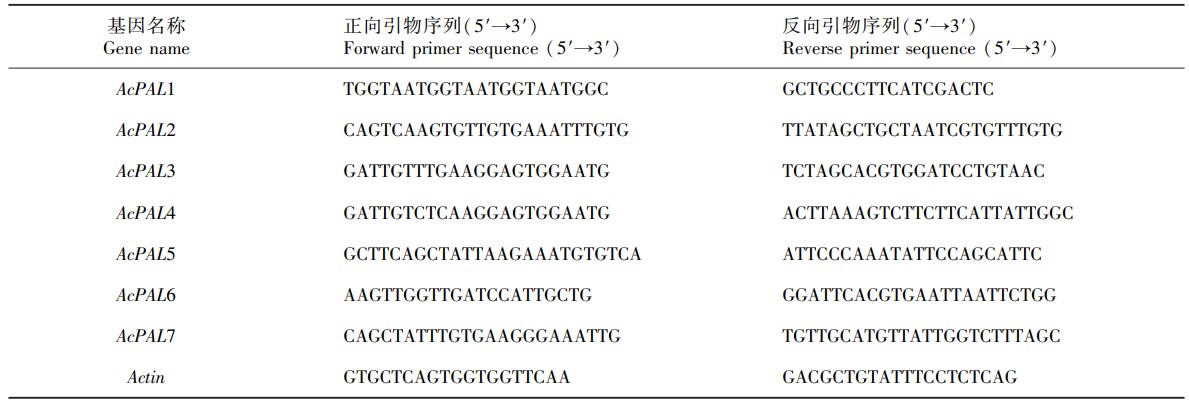
根据AcPAL家族基因的序列特征,在DNAMAN软件上设计定量PCR引物,引物信息见表1。采用RNAprep Pure Plant Plus Kit(Tiangen)提取猕猴桃总RNA。以TransScript® One-Step gDNA Removal and cDNA Synthesis SuperMix(TransGen)反转录的cDNA为模板,Actin为内参基因,参照TransStart® Top Green qPCR SuperMix(TransGen)操作指南配置反应液进行qRT-PCR分析。Eppendorf荧光定量PCR仪的扩增程序包括1个预变性(94 ℃ 30 s)、40个循环扩增(94 ℃ 5 s、60 ℃ 15 s、72 ℃ 10 s)和1个熔解反应(94 ℃ 15 s、60 ℃ 15 s、94 ℃ 15 s)。通过2-ΔΔCt计算,获得AcPAL基因的相对表达量。
表
1
实时荧光定量PCR(qRT-PCR)分析引物
Table
1
Primers used for quantitative real-time PCR (qRT-PCR)analysis
1.7 苯丙氨酸解氨酶活性测定
参照苯丙氨酸解氨酶(PAL)试剂盒(PAL-1-Y,苏州科铭生物技术有限公司)说明书,依据PAL催化L-苯丙氨酸生成的裂解产物(反式肉桂酸)在290 nm波长处具有最大吸收峰的原理,通过测定各样品在该波长下的吸光值,计算PAL酶活性。
2 结果与分析
2.1 猕猴桃AcPAL家族基因的鉴定
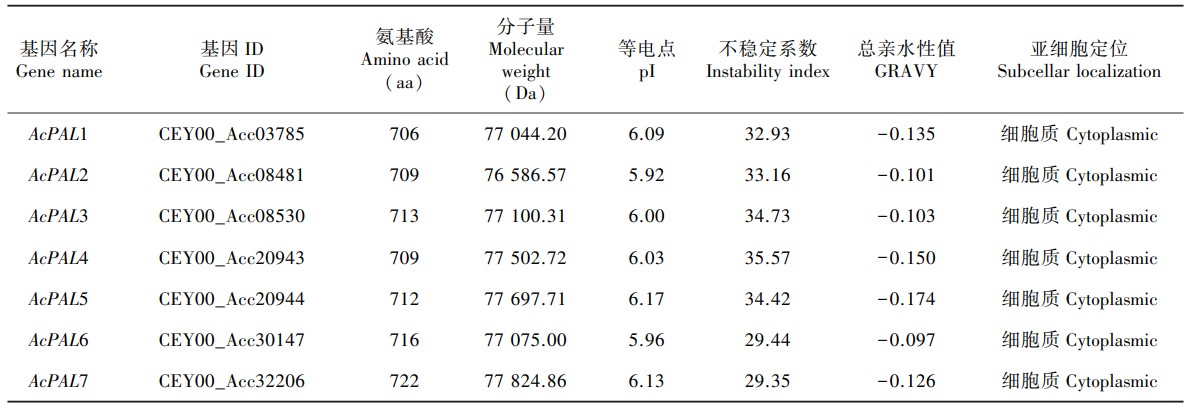
经HMMER检索及BLASTp同源性分析,剔除结构域缺失及冗余序列后,从猕猴桃基因组中共鉴定出7条AcPAL基因。根据其在染色体上的位置顺序,依次命名为AcPAL1-AcPAL7(表2)。理化性质分析结果表明,AcPAL家族编码的蛋白长度均大于700 aa,其中AcPAL1最短(706 aa),AcPAL7最长(722 aa);分子量范围为76 586.57(AcPAL2)~77 824.86 Da(AcPAL7);理论等电点为5.92~6.17,均小于7,表明所有AcPAL蛋白均为酸性蛋白;不稳定系数为29.35(AcPAL7)~35.57(AcPAL4),均低于40,说明其均属于稳定蛋白;总亲水性值在-0.097(AcPAL6)至-0.174(AcPAL5)之间,说明AcPAL蛋白均具亲水性。亚细胞定位预测结果显示7个AcPAL蛋白均定位于细胞质中。
2.2 AcPAL家族基因的染色体定位与共线性模式
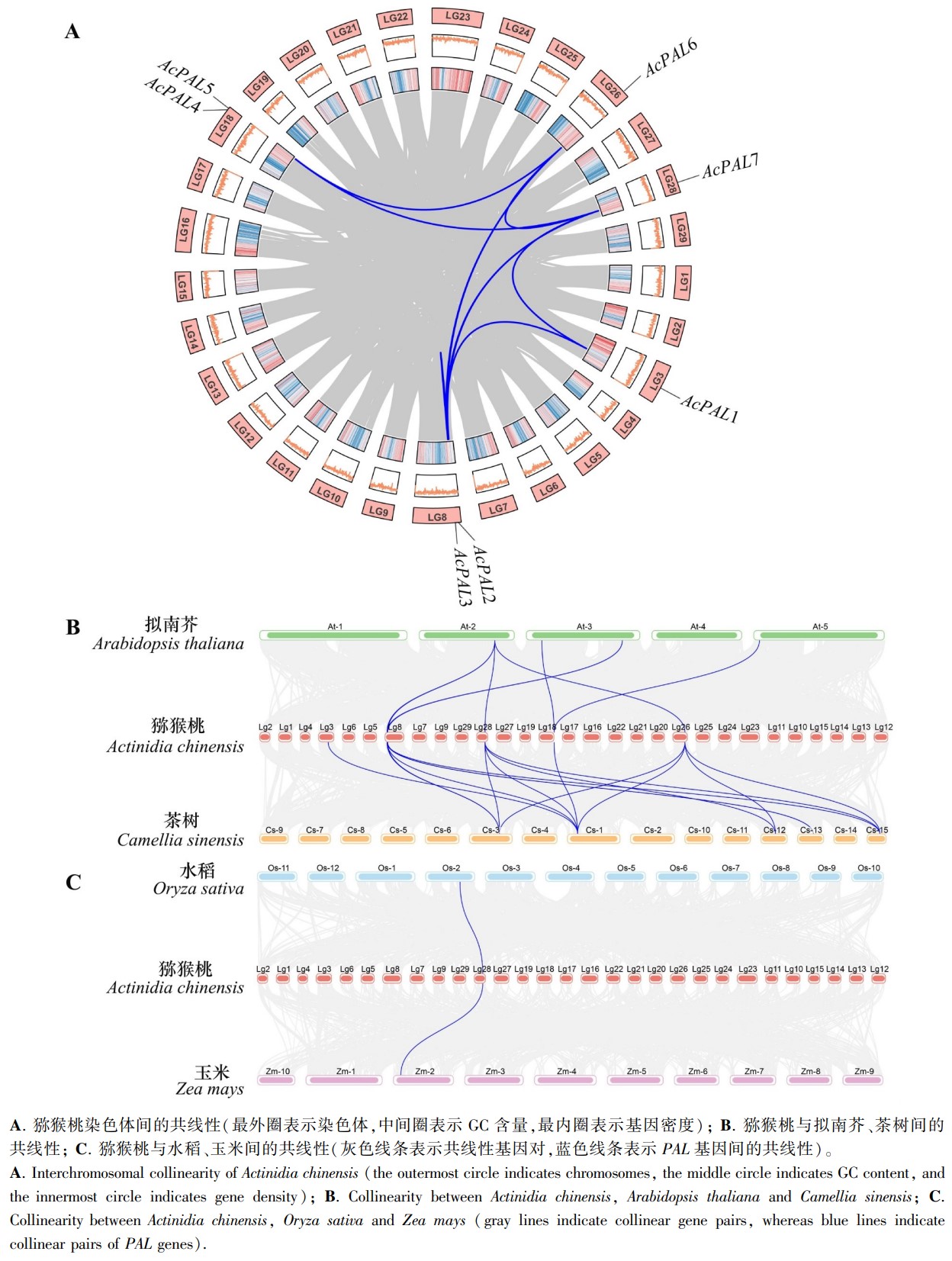
染色体定位结果如图1所示,7个AcPAL基因不均匀分布于猕猴桃的5条染色体上,其中LG8和LG18染色体各含有2个成员,LG3、LG26、LG28染色体各含有1个成员。值得注意的是,AcPAL4和AcPAL5均定位在LG18染色体上且具有相同的转录方向;它们的基因间隔区仅跨越3 637 bp且该区域未发现其他功能基因,同时它们在核苷酸和氨基酸水平的序列相似性分别高达95.65%和94.66%,表明AcPAL4和AcPAL5起源于串联重复事件。此外,基因密度分析显示,AcPAL基因主要分布于基因密度相对较高的基因组区域。
种内共线性结果显示,AcPAL家族内存在10对共线性基因对,单个成员可与多个其他成员形成共线性基因对,如AcPAL1与AcPAL2、AcPAL1与AcPAL7、AcPAL2与AcPAL3、AcPAL2与AcPAL6、AcPAL2与AcPAL7等(图1:A),说明片段重复事件是推动AcPAL家族基因数量扩张的重要因素。为评估选择压力,计算了每对共线性基因的非同义替换率(K𝑎)和同义替换率(K𝑠),结果表明10对共线性AcPAL基因对的K𝑎/K𝑠比值为0.048~0.138,均小于1,说明A𝑐PAL𝑠家族基因经历了纯化选择。
表
2
AcPAL基因编码蛋白的基本理化特性
Table
2
Basic physical and chemical characteristics of proteins encoded by AcPAL genes
此外,为鉴定AcPAL家族的直系同源基因,分析并绘制了猕猴桃与两种双子叶植物(拟南芥、茶树)及两种单子叶植物(水稻、玉米)的种间同源图谱。结果(图1:B、C)表明,猕猴桃AcPAL家族基因与其他双子叶植物的PAL基因存在显著的共线性关系。其中,AcPAL家族与茶树CsPAL家族的共线性基因对数量最多(16对),与拟南芥AtPAL家族的共线性基因对为8对。相比之下,猕猴桃AcPAL家族与单子叶植物PAL基因的共线性关系较弱,与水稻OsPAL、玉米ZmPAL家族的共线性基因对均仅为1对。
2.3 AcPAL家族基因的系统进化
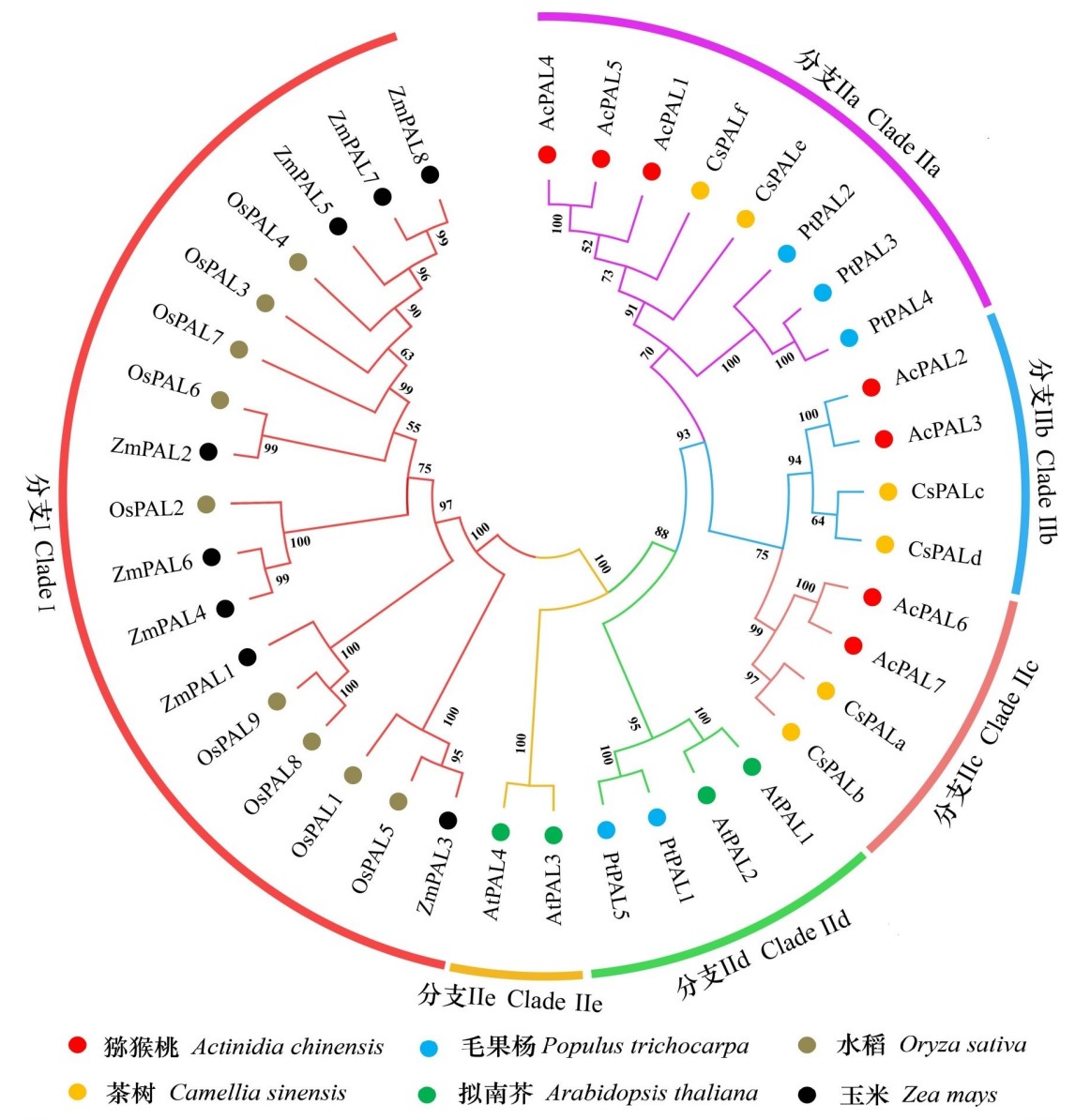
为了评估系统进化关系,利用猕猴桃与水稻、玉米、拟南芥、毛果杨及茶树的PAL蛋白序列比对数据集,构建种间系统发育树,结果如图2所示,所有植物PAL蛋白聚类形成2大分支,即单子植物分支(分支I)和双子叶植物分支(分支II),表明植物PAL家族基因随物种进化而出现分歧。双子叶植物分支进一步聚类为5个小分支(分支IIa-分支IIe),7个猕猴桃AcPAL成员分别聚类于分支IIa、分支IIb和分支IIc且与茶树CsPAL成员的亲缘关系最近。此外,AcPAL成员呈现出物种特异性聚类,如分支IIa的AcPAL1、AcPAL4和AcPAL5,分支IIb的 AcPAL2和AcPAL3,以及分支IIc的AcPAL6和AcPAL7,这与同一物种特异性分支内的AcPAL成员具有更高序列相似性的结果相符。
2.4 AcPAL家族基因的结构域与外显子和内含子组成
种内系统发育分析结果显示,7个AcPAL基因被分为3个主要分支(图3:A),该结果与种间系统发育树的聚类趋势一致。采用MEME工具从AcPAL家族中鉴定到12个保守基序且7个AcPAL基因编码蛋白的基序排列顺序与数量完全一致(图3:B)。保守结构域分析结果(图3:C)表明,所有AcPAL基因均含有完整的PLN02457结构域,提示其均具备PAL蛋白的核心功能特征。氨基酸序列的同源比对结果如图4所示,猕猴桃AcPAL蛋白之间,以及AcPAL蛋白与其他物种PAL蛋白之间均具有高度的氨基酸序列保守性,并且所有AcPAL蛋白均含有PAL活性中心基序,即GTITASGDLVPLSYIA,该基序是催化L-苯丙氨酸转化为反式肉桂酸的关键结构。此外,AcPAL蛋白中还存在保守的FL(苯丙氨酸-亮氨酸)二肽,该FL残基在调控PAL酶的底物特异性中起关键作用;同时,AcPAL蛋白还包含植物PAL家族保守的催化活性位点GLALVNG、NDN及HNQD。上述结构特征表明,7个AcPAL蛋白均具有保守的催化活性,为其行使苯丙氨酸解氨酶功能提供了结构基础。
图
1
猕猴桃 AcPAL 家族基因的染色体定位和共线性模式
Fig.
1
Chromosomal localization and collinearity patterns of kiwifruit AcPAL family genes
图
2
猕猴桃 AcPALs 与其他植物 PALs 的系统进化树
Fig.
2
Phylogenetic tree of kiwifruit AcPALs and other plant PALs
基因结构分析结果(图3:D)表明,7个AcPAL基因均由2个外显子和1个内含子组成且内含子均在GT-AG处剪切;外显子长度具有高保守性,其中第1外显子长度为371~419 bp,第2外显子长度除AcPAL2为1 738 bp以外,其余6个成员均为1 750 bp;与外显子不同,内含子长度在家族成员间差异显著,最短为568 bp,最长可达2 377 bp。
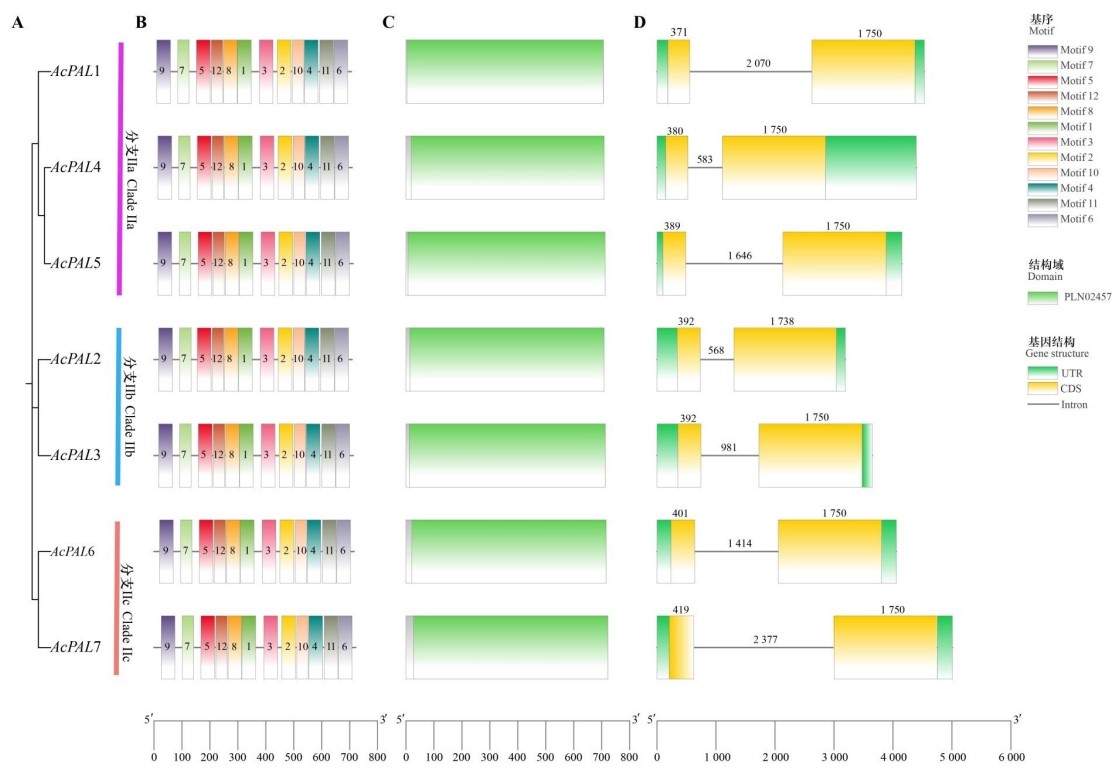
图
3
AcPAL家族基因的种内进化树(A)、保守基序(B)、结构域(C)和基因结构(D)
Fig.
3
Intraspecific evolutionary tree (A), conserved motif (B), domain (C), and gene structure (D) of AcPAL family genes
2.5 AcPAL家族基因的启动子顺式作用元件
为进一步分析猕猴桃AcPAL家族基因的转录调控特征,对AcPAL基因启动子区的顺式响应元件进行了分析。结果(图5)表明,7个AcPAL基因的启动子区均包含核心启动子元件TATA box和CAAT-box,说明它们均具有启动子功能。
在AcPAL家族启动子区共检测到238个已知功能的顺式作用元件,按功能分为4类,即光响应元件、胁迫响应元件、激素响应元件及生长发育相关元件(图5)。其中,光响应元件在启动子区的分布数量最多,每个AcPAL家族成员均含有7~14个且以G-box为主要类型。胁迫响应元件共鉴定出9种,主要响应干旱(MBS)、低温(LTR)、防御与胁迫(TC-rich repeats)、伤口(WUN-motif)、厌氧诱导(ARE)及缺氧特异性诱导(GC-motif)等。除AcPAL1以外,其余6个AcPAL的启动子均含有1~6个响应厌氧诱导元件(ARE)。此外,还在AcPAL启动子区检测到10种激素响应元件,分别响应脱落酸(ABRE)、赤霉素(TATC-box、GARE-motif和P-box)、茉莉酸甲酯(CGTCA-motif和TGACG-motif)、水杨酸(TCA-element)、乙烯(ERE)及生长素(TGA-element和AuxRR-core)。除AcPAL3以外,其余6个AcPAL启动子均含有2~6个脱落酸响应元件(ABRE),推测它们参与脱落酸介导的生理生化过程。生长和发育相关元件共发现8种,主要参与昼夜节律调节、细胞周期调控、分生组织表达及木质素合成等过程。其中,6个AcPAL启动子区均含有至少1个木质素合成必需元件(AC-I或AC-II),这与PAL作为苯丙烷代谢通路的关键酶相符。这表明AcPAL家族基因可能广泛参与猕猴桃对各种环境胁迫的响应及激素信号调控过程,为其多功能性提供了转录调控层面的支撑。
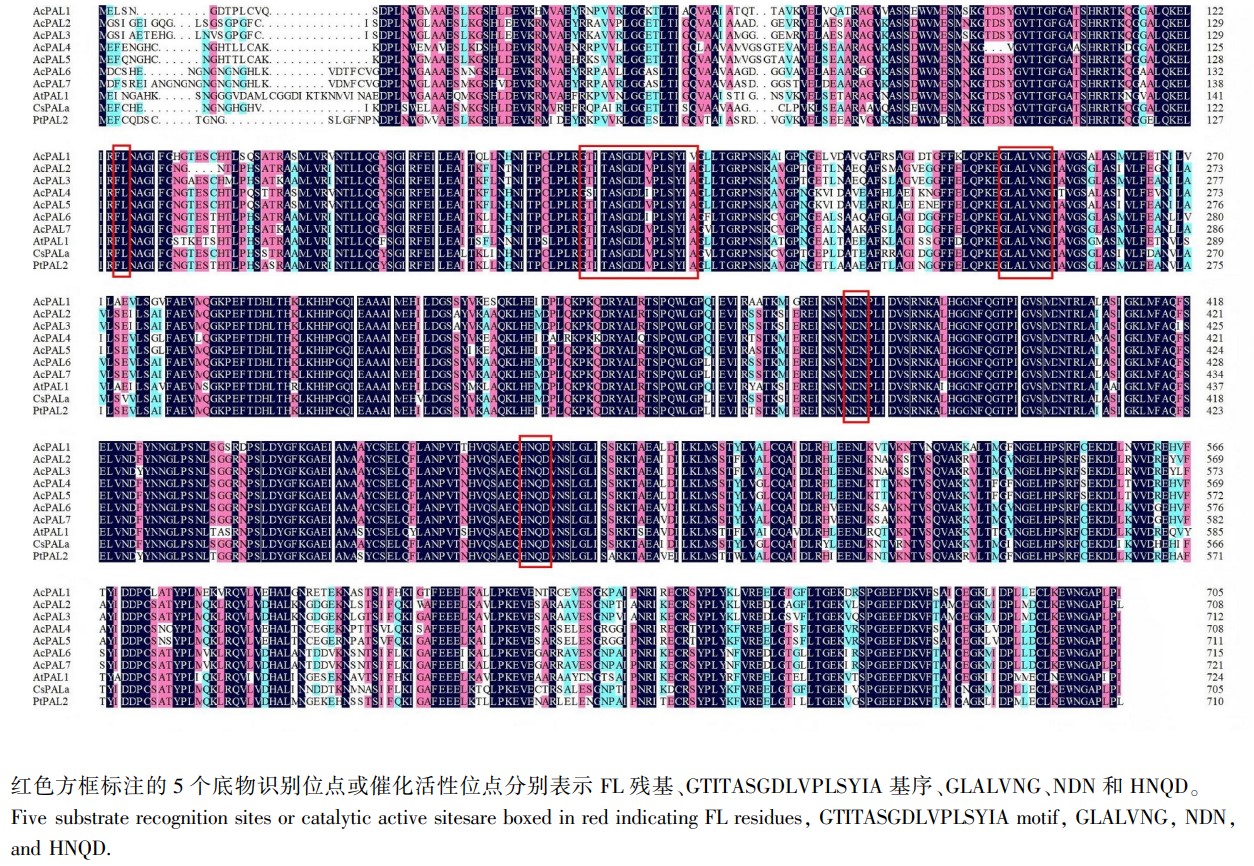
图
4
AcPAL家族与其他植物PALs氨基酸序列的同源比对
Fig.
4
Homology comparison of the amino acid sequences between AcPAL family and other plant PALs
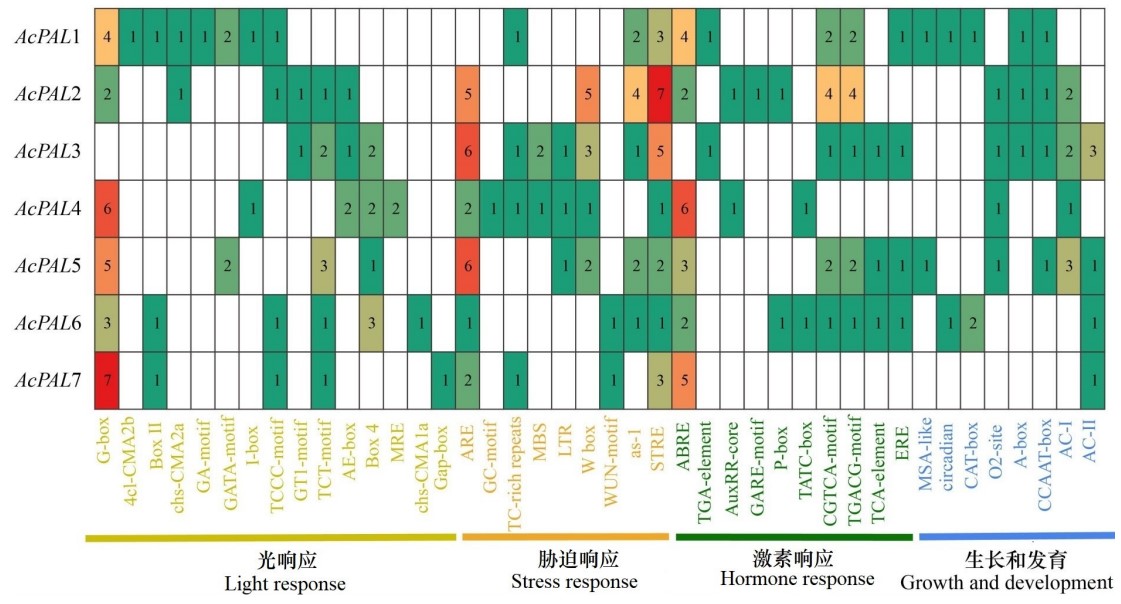
图
5
AcPAL家族启动子的顺式作用元件
Fig.
5
The cis-acting elements present in AcPAL family promoters
2.6 AcPAL家族基因在猕猴桃不同组织部位和果实成熟过程中的表达分析
通过qRT-PCR检测猕猴桃AcPAL家族基因在根、茎、叶、花瓣、幼果(花后16 d)、硬熟期果实(花后160 d)、软化中期果实及软化末期果实中的相对表达量。结果如图6所示,AcPAL家族不同成员的表达模式差异明显。其中,3个成员(AcPAL1、AcPAL6和AcPAL7)仅在营养器官及幼果中表达,即根、茎、叶、花瓣和幼果(花后16 d)中可检测到其表达,而在果实硬熟期及后熟过程均不表达,并且表达模式存在差异性,AcPAL6和AcPAL7在叶片的表达量最高,AcPAL1在茎的表达量最高。另外4个成员(AcPAL2、AcPAL3、AcPAL4和AcPAL5)在根、茎、叶、花瓣和幼果(花后16 d)中的表达量均高于硬熟期果实,而随着果实成熟软化,其表达量呈显著上调趋势,该表达模式与果实成熟软化期间PAL酶活性的显著上调趋势一致(图6),推测这4个AcPAL成员可能在猕猴桃果实成熟过程发挥作用。
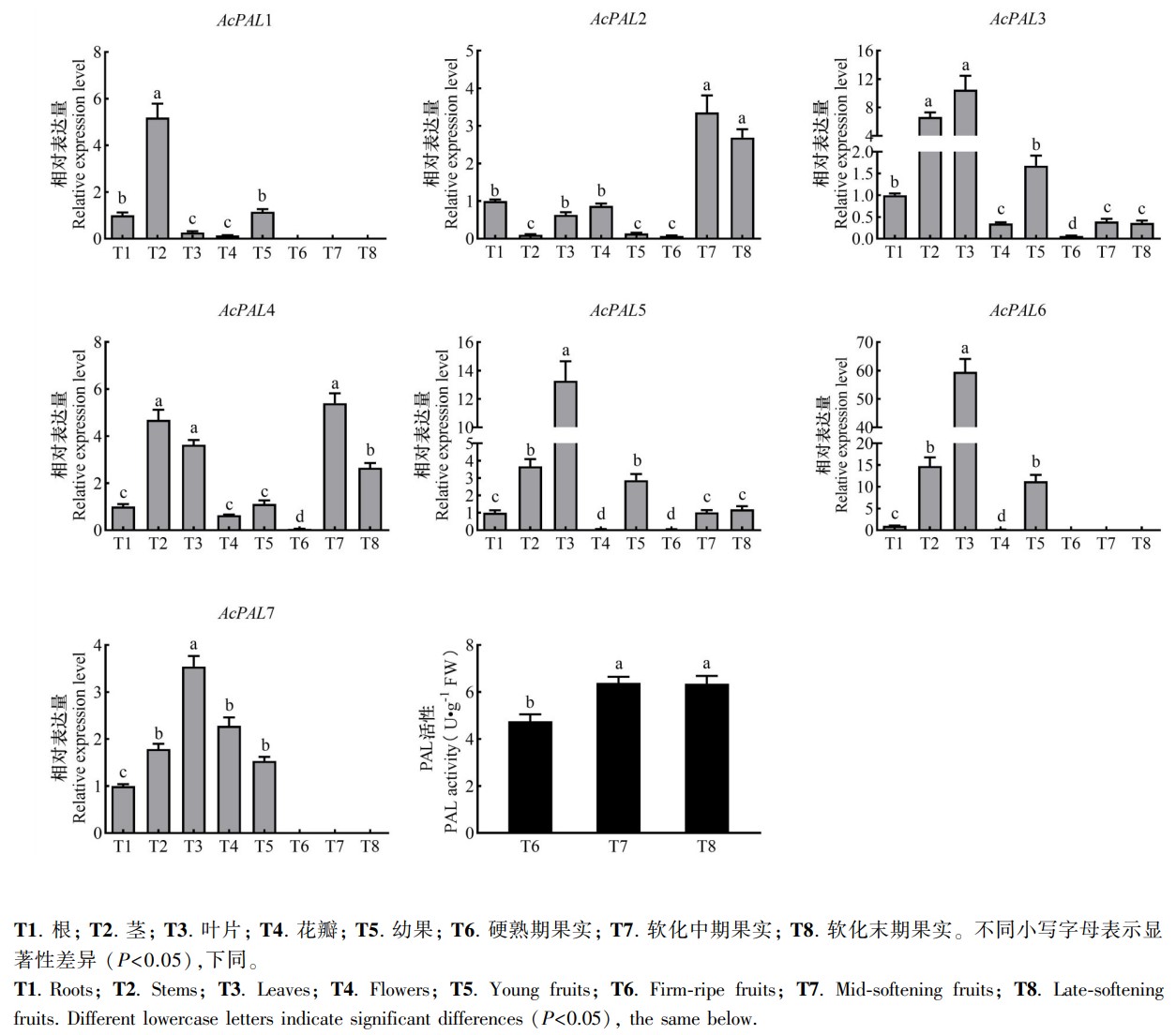
图
6
猕猴桃AcPAL家族基因的表达模式及PAL酶活性
Fig.
6
Expression patterns and PAL activities of kiwifruit AcPAL family genes
2.7 AcPAL家族基因在ABA处理后果实成熟过程的转录特征
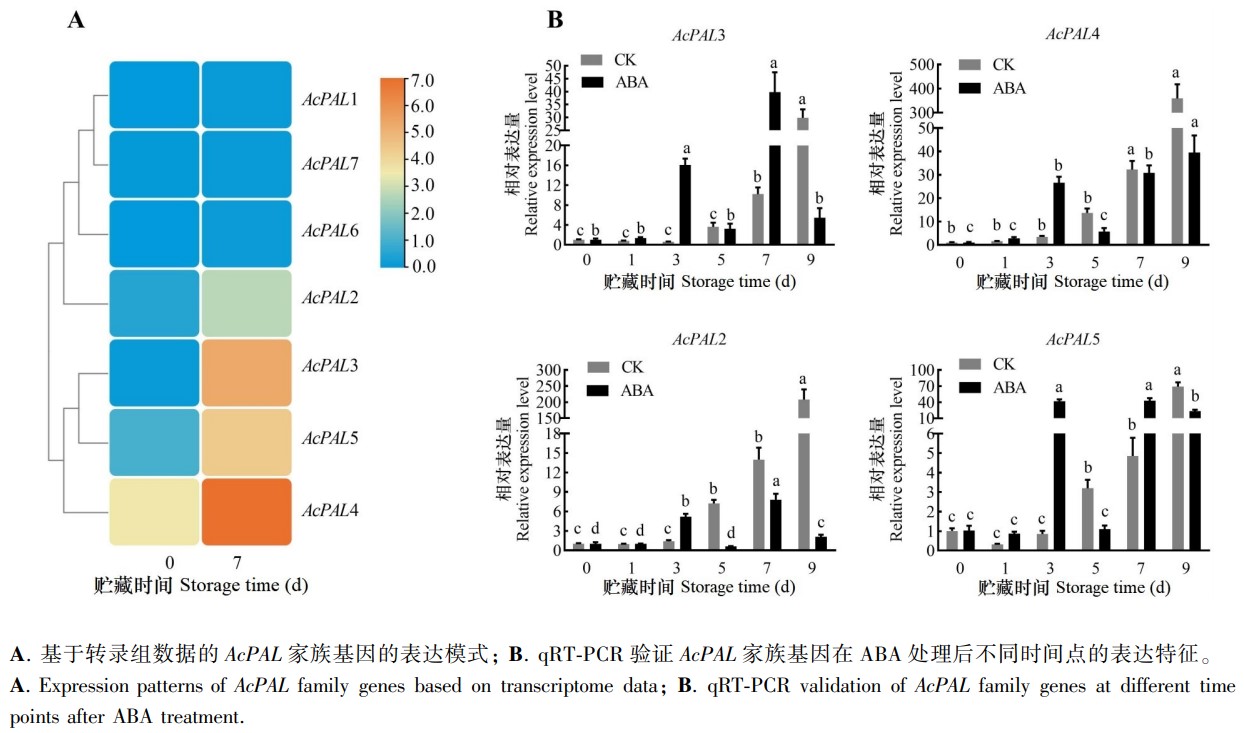
脱落酸处理显著促进猕猴桃果实采后的成熟进程,并影响果实品质(兰德国等,2023)。ABA处理果实的转录组分析结果(图7:A)表明,AcPAL家族基因的转录模式主要聚为2类。第1类包含4个成员(AcPAL1、AcPAL2、AcPAL6和AcPAL7),其中仅AcPAL2在ABA处理后呈轻微上调表达,其余3个成员在ABA处理前后均未检测到表达;第2类包含3个成员(AcPAL3、AcPAL4和AcPAL5),这3个成员在ABA处理后均呈现显著上调表达趋势。
进一步通过qRT-PCR验证这4个猕猴桃AcPAL成员(AcPAL2、AcPAL3、AcPAL4和AcPAL5)在ABA处理后的表达模式。结果如图7:B所示,在果实贮藏第3天时,ABA处理组中这4个AcPAL基因的表达量均显著高于对照组;而对照组中,这4个基因的上调表达直至贮藏第5天才被检测到。这表明AcPAL2、AcPAL3、AcPAL4和AcPAL5的表达均受ABA诱导,推测它们可能参与ABA介导的猕猴桃果实成熟过程。
图
7
ABA处理后猕猴桃AcPAL家族基因的表达模式
Fig.
7
Expression patterns of kiwifruit AcPAL family genes after ABA treatment
3 讨论与结论
本研究共鉴定到7个猕猴桃AcPAL基因,其数量介于拟南芥(4个)和水稻(9个)之间。物种间PAL家族成员数量的差异,与其经历的全基因组加倍、染色体重组、基因片段复制与丢失等事件密切相关(Li et al., 2019; 李雨哲等,2021)。染色体定位、共线性及系统进化树结果共同表明,基因串联重复与片段复制是驱动猕猴桃AcPAL家族数量扩张的主要因素。猕猴桃AcPAL家族编码的蛋白不仅基序的排列顺序和数量高度一致,还含有相同的保守结构域(PLN02457),这一特征在山核桃CcPAL家族蛋白中同样存在(刘晨等,2025)。而且,AcPAL家族蛋白均含有酶活性中心序列GTITASGDLVPLSYIA,其中ASG(即丙氨酸-丝氨酸-甘氨酸,Ala-Ser-Gly)三联体可经自动内部环化脱水形成亚甲基咪唑酮亲电基团,进而作为PAL的重要辅因子发挥作用(Song & Wang, 2009)。综上表明,所获得的7个AcPAL成员均具备行使植物苯丙氨酸解氨酶的基本功能。此外,利用AcPAL与其他植物PAL蛋白构建的系统进化树聚类结果与植物的种属分类特征一致,说明植物PAL基因随物种演化而进化。其中,7个猕猴桃AcPAL成员分别与茶树的CsPAL家族成员聚在3个小分支(分支IIa、IIb和IIc),提示二者具有较近的亲缘关系。这一结果也进一步验证了Wei等(2018)的研究结论,即猕猴桃与茶树起源于约8 000万年前的共同原始祖先。多数被子植物的PAL基因含有2个外显子和1个内含子,如拟南芥AtPAL1和AtPAL2及紫花苜蓿PAL基因等;仅有少数PAL基因不含或含有1个以上内含子。猕猴桃AcPAL家族基因均具有2个外显子和1个内含子且第1个外显子长度为371~419 bp,第2外显子长度为1 738~1 750 bp,这与郝向阳等(2018)在14种被子植物PAL基因结构中的研究结果相似,表明PAL基因在物种内及物种间的长度差异由内含子长度决定。虽然猕猴桃AcPAL家族的结构域与基因结构在进化上较为保守,但其启动子区的顺式作用元件存在明显差异,推测不同AcPAL成员的表达模式与生物学功能存在分化。
已有研究表明,植物PAL家族不同成员在各组织器官的转录水平差异明显。非洲菊GjPAL1在叶片大量表达,GjPAL2、GjPAL3和GjPAL4则在根部的转录水平较高(郝向阳等,2021);半夏PtPAL基因在叶中高表达,其次为块茎和根,在花中的表达最弱(何潇等,2021);茉莉花JsPAL基因在花蕾和花瓣的表达水平最高,其次为叶片和茎部,在根部的表达水平最低(孙君等,2020)。本研究发现,猕猴桃AcPAL家族的7个成员同样存在时空表达差异,如AcPAL1主要在茎中表达,而AcPAL2则在果实成熟后期高表达。植物PAL的组织器官特异性表达与其功能密切相关。剑麻PAL1和PAL2基因在叶片发育过程中的转录模式与PAL酶活性在纤维形成过程的变化模式一致,说明这2个基因与木质素合成密切相关(黄兴等,2021);JsPAL在茉莉花开放前期高表达,与香气形成相关(孙君等,2020);猕猴桃的根、茎、叶含有丰富的酚类和黄酮类物质且这些物质参与植株的生长发育过程(Mao et al., 2024)。PAL是连接初级代谢与苯丙烷通路,进而调控酚类和黄酮类等次生代谢物质合成的关键限速酶。猕猴桃AcPAL家族中共有4个成员(AcPAL3、AcPAL5、AcPAL6和AcPAL7)在叶片高表达,1个成员(AcPAL1)在茎部高转录,推测它们分别在叶片和茎部的次生代谢合成中发挥重要作用,但其具体分工及参与合成的活性物质仍待进一步研究。
猕猴桃果实的生长发育与采后成熟是食用品质形成的重要阶段,涉及多种初级及次生代谢物质的生成与转化(Commisso et al., 2019;Nie et al., 2020)。苹果(张丽之等,2018)和琯溪蜜柚(黄汉唐等,2020)的PAL基因均参与果实的生长发育进程,香蕉MaPAL4则在果实后熟过程特异性上调表达(杨会晓等,2019)。本研究中,猕猴桃AcPAL家族7个成员在幼果期均有表达,但在果实发育成熟时(即硬熟期)的表达量明显下调,其中3个成员(AcPAL1、AcPAL6和AcPAL7)甚至不表达,这与黄春辉等(2019)的研究结果相符,即猕猴桃果实中类黄酮和酚类物质含量随果实发育呈由高到低的变化趋势。孙兴盛等(2021)对软枣猕猴桃采后后熟过程总酚与类黄酮含量变化的研究表明,果实后熟期间的总酚含量呈上升趋势,类黄酮含量则先升后降,并在后熟中后期达到峰值。本研究同样发现,4个AcPAL基因(AcPAL2、AcPAL3、AcPAL4和AcPAL5)在果实后熟过程中显著上调表达且与PAL酶活性的显著升高趋势一致,推测这4个成员可能参与猕猴桃果实后熟过程中酚类等次生代谢物质合成,但其具体作用机制仍待深入研究。
植物PAL基因的转录受脱落酸等外源激素调控。丹参幼苗SmPAL1基因在ABA处理后的表达水平升高了10倍(Song & Wang, 2009)。类似地,本研究通过qRT-PCR检测到4个AcPAL基因(AcPAL2、AcPAL3、AcPAL4和AcPAL5)在ABA处理后7 d的表达量显著高于0 d的表达量,这与前期转录组数据结果(Chen et al., 2021)一致。AcPAL基因的ABA诱导表达特性,可能与其启动子区富含ABRE元件有关。进一步比较发现,这4个AcPAL基因在ABA处理后第3天即开始显著上调表达,较对照组(CK)提前了2~4 d。该表达模式与兰德国等(2023)报道的结果相吻合,即ABA处理可使猕猴桃果实呼吸峰、物质转化等进程提前,加速果实后熟。据此推测,采后ABA处理可能通过诱导AcPAL等基因提前表达,加快果实酚类等代谢物的合成与转化,进而促进果实后熟品质(酚类、抗氧化能力、香气等)形成。然而,AcPAL基因在果实后熟过程中的具体生物学功能,仍需借助过表达、基因敲除等手段进行多维度验证。
综上所述,本研究共鉴定出猕猴桃AcPAL家族7个成员,分布于5条染色体上;其编码蛋白均具有保守的PAL基序与结构域,能行使苯丙氨酸解氨酶的基本功能。串联重复和片段重复驱动了AcPAL家族成员的数量扩张。AcPAL家族启动子区共含有238个已知功能的顺式作用元件,分别参与光响应、生物和非生物胁迫响应、激素信号及生长发育调控等过程。AcPAL家族基因的表达具有组织差异性,其中4个成员在果实采后成熟过程中上调表达且受脱落酸诱导表达。本研究结果为深入解析AcPAL基因在果实发育成熟中的功能提供了候选基因与理论基础。