


摘要
需冷量是促使猕猴桃花芽分化的关键因素,冬季低温积累不足会导致花芽发育异常,进而影响翌年产量,确定猕猴桃栽培品种的需冷量是目前待解决的问题。该文以中华猕猴桃品种‘仲和红阳’为试验材料,使用人工气候室设置5个时段(2、4、6、8、10 d)的4 ℃低温处理,模拟自然环境的冷积温模式,通过各处理组和对照组的开花及挂果情况来分析不同冷积温对猕猴桃生长发育的影响。结果表明:(1)不同时长的低温处理对‘仲和红阳’植株的开花结果有明显影响,其在4 ℃下处理6 d是最适宜的冷处理时长,开花数量为49朵,人工授粉之后挂果数量为17个,均显著高于其他组。(2)第2年对冷处理后的‘仲和红阳’植株进行追踪观察,发现仍可以正常开花且4 ℃下处理6 d的植株开花数量同样显著高于其他组且保留了冷处理效应。‘仲和红阳’猕猴桃的最低需冷量为576 h,在广东省的适宜种植区域为梅州、河源、韶关、清远和云浮5个城市。综上认为,‘仲和红阳’的需冷量较低,可以在华南地区推广种植。
Abstract
The chilling requirement (CR) is a critical factor promoting flower bud differentiation in kiwifruit (Actinidia spp.). Insufficient accumulation of low temperatures in winter leads to abnormal flower bud development, which in turn impairs the yield in the following year. Determining the CR of the Actinidia chinensis cv. ‘Zhonghe Hongyang’ remains an unresolved issue to date.In this study, potted seedlings of the ‘Zhonghe Hongyang’ were used as experimental materials. To determine the CR of this cultivar, the seedlings were exposed to cold treatments of different durations under controlled artificial low-temperature conditions. Meanwhile, the flowering performance of the kiwifruit plants in the second year after cold treatment was monitored to verify the existence of “chilling treatment memory”. An artificial climate chamber was employed to simulate the cold accumulation pattern in natural environments. Specifically, five cold treatment groups were set at 4 ℃ low temperature for durations of 2, 4, 6, 8, 10 d, respectively; a control group was established concurrently. The effects of different cold accumulation levels on the growth and development of kiwifruit were analyzed based on the flowering and fruiting parameters. The results were as follows: (1) Different durations of cold treatment had a significant effect on the flowering and fruiting of ‘Zhonghe Hongyang’ plants. The optimal cold treatment duration was 6 d at 4 ℃, under which the plants produced 49 flowers and set 17 fruits, significantly more than those in other treatment groups. (2) Follow-up observations in the second year showed that the cold-treated plants could flower normally. Among these, the group treated at 4 ℃ for 6 d still exhibited significantly better flowering performance than other groups, and achieved normal fruit set after artificial pollination. The minimum CR of ‘Zhonghe Hongyang’ when cultivated in Guangdong Province was 576 h, and the plants could retain the cold treatment memory in the second year. Based on the CR results and the influence of terrain conditions, the suitable planting areas for this cultivar in Guangdong are Meizhou, Heyuan, Shaoguan, Qingyuan, and Yunfu. In conclusion, the ‘Zhonghe Hongyang’ variety has a low CR and is suitable for cultivation in South China.
猕猴桃为猕猴桃科(Actinidiaceae)猕猴桃属(Actinidia Lindl.)多年生落叶藤本植物,是20世纪由野生到商业化栽培驯化最成功的果树之一,栽培至今已有一百余年(孙雷明和方金豹,2020)。猕猴桃因具有较高的营养和经济价值而使人们对猕猴桃的需求和品质要求日益增多。‘仲和红阳’中华猕猴桃品种是以‘和平红阳’果枝辐射诱变处理和大密度高位嫁接,筛选大果突变体扩繁而成,于2015年获广东省新品种认定(粤登果2015002),是中国第一个辐射诱变育成的猕猴桃品种。该品种为中熟品种,其单果重90~110 g,果实圆柱形兼倒卵形,果顶和果基内凹,果肉黄绿色红心,多汁香甜,品质优良,目前是广东省猕猴桃主推品种,种植面积近2 000 hm2,并于2020年首次出口阿联酋。
需冷量(chilling requirement,CR)又称需寒量、低温需求量或需寒积温,指植物打破自然休眠对低温需求的有效小时数,该参数被认为是植物打破冬季休眠重要的影响因子之一(高健洲等,2018;王海波等,2019)。对于猕猴桃这类落叶果树而言,需冷量在成花诱导及花期调控过程中发挥至关重要的作用,只有积累到一定的需冷量才能打破位于一年生枝叶腋中自然休眠的混合芽使其正常萌发并形成花芽(姜卫兵等,2003;庄维兵等,2012;Hartmann et al.,2024)。需冷量不足时,即使遇到适宜的生长条件,也会造成猕猴桃植株的营养生长和开花异常(Richardson et al.,1974;Wall et al.,2008)。
近年来,对需冷量的研究多集中在桃、梨、杏、牡丹、蜡梅等植物上(王英珍等,2020;闫闪闪等,2022;张敏等,2023;张钰晗等,2023;李海炎等,2024)。对猕猴桃的需冷量研究虽起步较早,但不同品种的需冷量差异显著,分析各地区主推品种的需冷量,有助于各猕猴桃品种的商业化栽培及应用(赵婷婷,2016;Wang et al.,2017;石广丽等,2018;常婧等,2021;张钰晗等,2023)。杨义伶等(2010)使用0~7.2 ℃模型对4个中华猕猴桃品种的需冷量进行了评估,其范围为600~888 h;赵婷婷(2016)认为0~7.2 ℃模型没有考虑到高温对于冷量积累的负效应,使用犹他模型把不同温度范围划分为不同的效应值,以估算的效应值来衡量果树的需冷量积累,并测算了9个猕猴桃品种的需冷量,其范围为213~1 009 h;石广丽等(2018)通过0~7.2 ℃模型测定出43个软枣猕猴桃的需冷量范围为551~1 056 h;常婧等(2021)同样通过0~7.2 ℃模型,测得7个丹东地区软枣猕猴桃的需冷量范围为552~888 h。由此可知,不同猕猴桃品种之间的需冷量存在显著性差异。
本研究基于人工低温诱导的方法,以中华猕猴桃‘仲和红阳’为试验材料,通过连续2年的开花及坐果数据统计分析,对‘仲和红阳’需冷量进行测定,以期为扩大该品种的栽培范围提供理论参考,为该品种在广东及周边地区的推广应用提供科学依据。
1 材料与方法
1.1 试验材料
以2017年盆栽于仲恺农业工程学院白云校区何鸿燊实验楼B栋(广东广州,113.45°E、23.38°N)的2年生‘仲和红阳’嫁接苗为对象,砧木为‘米良1号’美味猕猴桃。所选18棵植株长势一致、生长健壮、无病虫害,冷处理前后的水肥一体化管理措施均保持一致。
1.2 猕猴桃冷处理
以每3株‘仲和红阳’为一组,于2021年1月18—28日在人工气候室(自建,40 m2,室内控温在4 ℃,温度控制仪为浙江余姚市明兴制冷配件厂生产的XMK-7型,温度精度为0.1 ℃)进行为期2、4、6、8、10 d的冷处理;同时以露天种植区放置的3盆为对照,即冷处理0 d。每个处理3个重复。具体操作如下:开启人工气候室,将目标温度设置为4 ℃;待温度降至4 ℃时,将15株盆栽苗转移到人工气候室。每隔2 d随机取出3盆并编号,再放回楼顶与对照组一起管理,共重复5次。观察记录开花数量,当第一个花芽萌发时,表明猕猴桃已经开始进入开花期;开花后对其进行人工授粉,花粉来源为‘和雄1号’(中华猕猴桃授粉品种),观察猕猴桃坐果情况。第二年(2022年)对18株‘仲和红阳’盆栽苗不进行冷处理,让其在露天种植区自然生长,继续统计其开花和挂果情况。
1.3 分析方法
1.3.1 7.2 ℃模型
以Weinberger(1950)最早提出的需冷量估算模型——7.2 ℃低温模型作为计算依据。该模型是以秋季日平均气温稳定通过7.2 ℃的日期为有效低温累积的起点,累计≤7.2 ℃的低温累积小时数作为需冷量的计算基础(赵昶灵等,2000;赵海亮等,2007),认为植物在自然休眠期内经历7.2 ℃以下的低温累积小时数,即为该植物的需冷量。
1.3.2 0~7.2 ℃模型0~7.2 ℃模型认为植物在自然休眠期内,经历0~7.2 ℃(不包括0 ℃)的低温累积小时数,即为该植物的需冷量(赵海亮等,2007)。该模型的有效低温累积起点与7.2 ℃模型相同,即秋季日平均气温稳定低于7.2 ℃的日期。其计算公式如下:
式中:𝑇代表每小时的平均温度,如果在0~7.2 ℃,用“1”表示,否则用“0”来表示;𝐶𝐻代表从休眠开始至结束的总需冷量,单位为h。
1.3.3 犹他模型
犹他模型是Richardson等在1974年提出为桃树设计的需冷量模型,至今仍被广泛用于猕猴桃的冷害估算(Hartmann et al.,2024)。相比“7.2 ℃模型”和“0~7.2 ℃模型”,犹他模型考虑了不同有效温度变化对需冷量的影响,确认影响需冷量的最佳温度为2.4~9.1 ℃,0 ℃以下和12.5 ℃以上减效,超过16 ℃则起负作用(赵海亮等,2007)。以秋季负累积低温达到最大值时的日期为有效低温的起点(冷温单位≥0时的日期),不同温度范围的加权效应值不同,单位为h,计算公式如下:
式中:Utaht表示休眠结束时低温单位积累值;tu表示每1 h的有效低温量;𝑡表示每1 h记录的气温。
1.3.4 数据统计与分析
采用Excel软件进行数据整理,采用SPSS软件进行统计分析。
2 结果与分析
2.1 ‘仲和红阳’猕猴桃开花数量
经过冷处理后的‘仲和红阳’在自然条件下,随着气温的逐渐升高,花芽逐渐解除休眠状态,开始进入生殖生长阶段。经过冷处理的‘仲和红阳’当年开花时间为2021年3月8日到19日(日均温24 ℃),持续时间为12 d。第二年的开花时间为2022 年3月30日到4月13日(日均温26 ℃),持续时间为14 d。‘仲和红阳’两年的花期相差较大,可能是因为温度的影响为可逆,2021年的冷处理效应经过2022年的夏季后,作用减弱,导致其花期推迟。
由图1和图2可知,经过不同时长冷处理的‘仲和红阳’植株,第一年在自然环境下的开花情况呈现出明显的差异且变化趋势并不一致,与其冷处理时间紧密相关。未经过冷处理的对照组开花数少,甚至没有开花现象。冷处理6 d和8 d的开花数量较多,其他处理组开花数量远小于这两组。第二年不同处理组的植株出现开花情况,也出现与冷处理时间紧密相关的差异。冷处理6 d和8 d的植株开花数量较多,其他处理组的开花数量远小于这两组,但却大于第一年的开花数量。这表明‘仲和红阳’冷处理6 d为最佳且存在一定程度的冷处理记忆。
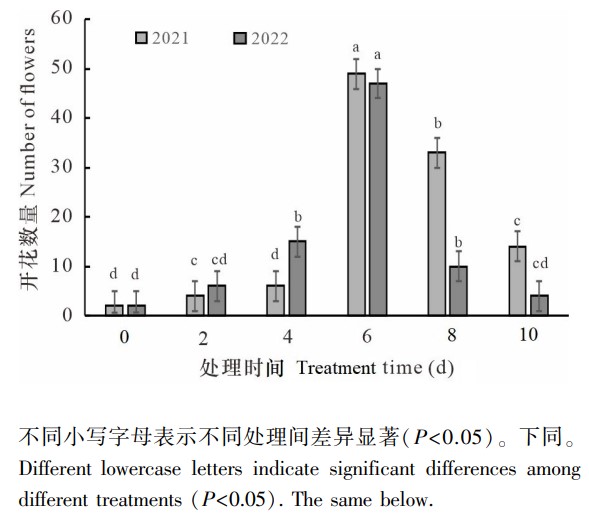
图
1
‘仲和红阳’猕猴桃开花数量
Fig.
1
Number of flowers of ‘Zhonghe Hongyang’ kiwifruit
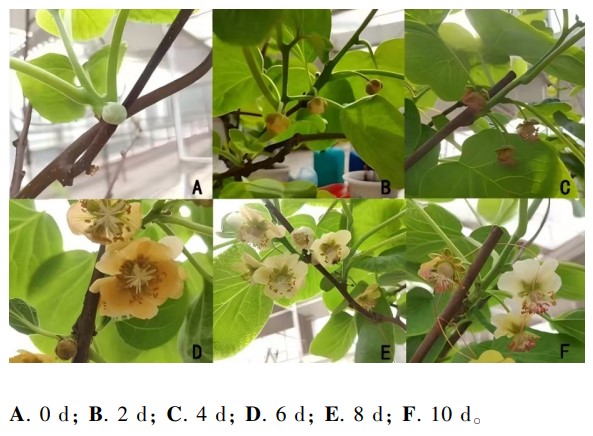
图
2
‘仲和红阳’猕猴桃开花情况
Fig.
2
Flowering status of ‘Zhonghe Hongyang’ kiwifruit
2.2 ‘仲和红阳’猕猴桃挂果数量
授粉完成后,每隔7 d对猕猴桃植株的挂果情况进行统计并记录,直到果实成熟。由图 3和图4可知,2021年经过冷处理的‘仲和红阳’挂果数为55个,最终采摘到44个成熟果。其中,冷处理6 d的挂果数最多,其他处理组的数量远小于这组,与开花情况一致。
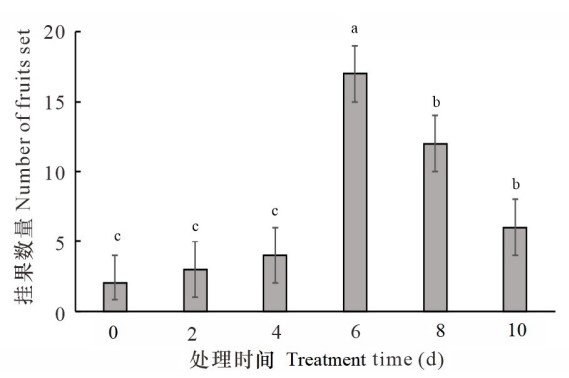
图
3
‘仲和红阳’猕猴桃挂果数量
Fig.
3
Number of fruits set ‘Zhonghe Hongyang’ kiwifruit
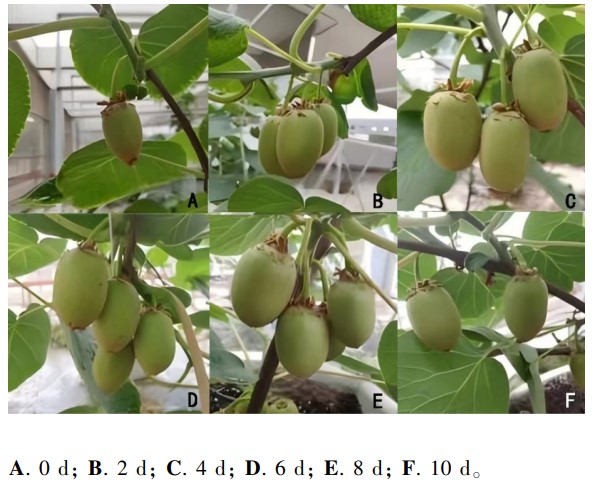
图
4
‘仲和红阳’猕猴桃挂果情况
Fig.
4
Fruiting status of ‘Zhonghe Hongyang’ kiwifruit
2.3 ‘仲和红阳’猕猴桃需冷量
根据开花数、挂果数及第二年未冷处理的开花数,可以得到最适合‘仲和红阳’品种生长繁殖的冷处理时长为6 d,即144 h。将数据代入0~7.2 ℃模型和犹他模型公式,可得:
综合表明,‘仲和红阳’猕猴桃开花结果的需冷量为576 h。
2.4 ‘仲和红阳’猕猴桃适栽范围
通过广东天气网(https://www.gdweathers.com/)查询粤北6个城市冬季日平均气温,统计低于7.2 ℃的持续时间。由表1可知,梅州、河源、韶关和云浮4个城市在2020—2024 年的4个冬季中,低温时长全部大于等于576 h且平均低温时长远高于576 h。这说明这些区域冬季低温积累稳定且充足,能保障 “仲和红阳” 的休眠正常解除,满足生长结果的基础条件。清远虽在2022—2023年低温时长(480 h)略低于576 h,但其余3个冬季均达标且平均低温时长达936 h,整体低温积累仍能稳定满足需冷量需求,仅个别年份需注意增加辅助措施(如设施保温),不影响规模化推广。肇庆在4个冬季中仅2个年份达标且平均低温时长(480 h)低于576 h,低温积累不足的年份占一半,易因需冷量不足导致生长异常,不具备规模化推广的气象条件。初步推断梅州、河源、韶关、清远和云浮的冬季低温时长在统计周期内稳定且满足“仲和红阳”576 h的需冷量要求,是该品种的适宜规模化推广区域。
表
1
2020—2024年广东省6个城市的低温时长
Table
1
Low temperature duration in six cities of Guangdong Province from 2020 to 2024

3 讨论
本研究在人工低温条件下确定‘仲和红阳’花芽萌发的最适时间,再以7.2 ℃模型、0~7.2 ℃模型和犹他模型为依据估算其需冷量(Sharma et al.,2022),发现3个模型估算的需冷量结果一致,均为 576 h。与杨义伶等(2010)对其他中华猕猴桃品种的研究结果相比,‘仲和红阳’的需冷量较低,更适合在广东省乃至华南地区推广种植。‘仲和红阳’是辐射诱变后在广东省河源市经大龄砧木高位嫁接扩繁,最终筛选大果枝条选育而成的新品种,其较低的需冷量可能与辐射导致的遗传变异相关。El Oualkadi等(2019)使用低剂量𝛾射线辐射草莓品种“Fortuna”匍匐茎,得到的“Fortuna”突变体存在需冷量变低的植株,需冷量从常规品种的600 h降至500 h以下,适配温带和亚热带冬季较短低温区域。李树举等(2010)发现满天红品种经 40Gy60Co 𝛾射线辐照后,产生了迟花变异体(代号 0801),其花期为3月底,而满天红对照品种(CK2)的花期为3月中旬,变异体花期明显推迟,体现了辐射诱变具有影响物候期的作用。这可作为判断需冷量是否满足的重要间接指标。
Sherman和Lyrene(2002)利用高需冷量品种与低需冷量品种杂交,对得到的植株进行连续多代筛选,获得蓝莓、桃、梨和杏等低需冷量品种。王力荣等(2022)针对南方丘陵山区冬季低温不足的特点,通过杂交育种和多代适应性筛选,培育出 “需冷量很低、开花坐果早”的“早醒”桃品种,解决了高需冷量桃品种“休眠不足、萌芽不整齐、坐果率低”的问题。这说明‘仲和红阳’的低需冷量也可能是在诱变处理后的扩繁过程中受到人工选择使其适应了当地的气候环境,与辐射诱变共同作用的结果。
本研究中对‘仲和红阳’需冷量的测定一方面是基于盆栽的植株活体,另一方面是在人工控制的低温气候室进行,这有别于以往文献中使用无根插条作为试验对象。完整植株的使用可以更客观地估算出自然环境下‘仲和红阳’对低温累积的响应,从而获得更准确的需冷量测定结果(闫闪闪等,2022;张钰晗等,2023),为植物需冷量的测定方法提供了新的研究思路。同时,本研究还证明了‘仲和红阳’可以保持前一年的冷处理记忆,在第二年依然维持开花,有助于适应偶发的暖冬事件。但是,其冷处理记忆能保持的时长,记忆维持的遗传基础等问题则需进一步深入研究(阮长海,2014;杨盛等,2017)。此外,本研究所用‘仲和红阳’嫁接苗,其砧木为‘米良1号’美味猕猴桃。不同果树砧木品种具有不同的遗传背景,这决定了不同品种的砧木在需冷量上存在显著的差异(张浩天等,2025)。对于不同的砧木影响红阳接穗的花芽分化机制,后续可增加砧木种类、扩大盆栽数量并进行多年验证,以获得更为精确的数据,为‘仲和红阳’的花期精准控制提供科学依据。
在种植‘仲和红阳’时,一方面需关注当地气象部门发布的冬季气温预报,预测发生暖冬概率,提前预警冷量不足的风险;另一方面还需收集当地近10~20年冬季(12月至翌年2月)气象数据,计算平均有效冷量,预判其冷量是否达标。例如,遇需冷量不足的情况,可考虑在地表覆盖秸秆、稻壳等有机物,既能降低土壤温度,又能保持水分,间接辅助冷量的积累。同时,应减少氮肥施用,增施磷钾肥,保留中果枝和短果枝,减少徒长枝,降低树体养分消耗,以促进花芽分化。
综上所述,‘仲和红阳’属于低需冷量的中华猕猴桃品种,在猕猴桃产业发展中具有多方面优势,尤其在气候变暖、传统种植区域减少及市场需求多样化的背景下其价值更为突出。‘仲和红阳’的低需冷量可以适配南亚热带的气候条件,无需人工破眠(如喷洒赤霉素),技术门槛降低(张俊民等,2002;阮长海,2014)。在后续的研究与生产过程中,还能积极探索通过温度(Linsley & Allan,1987)、激素(孙培琪等,2011)、光照(李冬梅,2012)等环境因子的调控来进一步缩短该品种的需冷量,扩大华南地区猕猴桃产业规模(呼凤兰和杜俊杰,2006;Cooke et al.,2012;金亚征等,2013;付立中等,2014;Zhao et al.,2017)。
4 结论
在4 ℃条件下,经过6 d冷处理的中华猕猴桃品种‘仲和红阳’能够更好地破除休眠,完成花芽发育,开花数量达到峰值并且挂果数量最多;6 d是最佳的冷处理时长,估算其最低需冷量为576 h。并且,经过1次冷处理的‘仲和红阳’植株,在第2年不再冷处理的情况下,依然能保持冷处理记忆,促使其花芽正常开花繁殖。此外,综合‘仲和红阳’的需冷量及广东北部6个城市的气候条件,推断‘仲和红阳’新品种可以在梅州、河源、韶关、清远和云浮规模化种植。