


摘要
由丁香假单胞菌猕猴桃致病变种引发的猕猴桃细菌性溃疡病是一种毁灭性病害。相较于化学防治手段,利用微生物进行病害防治具有环境相容性高、可持续性强和不易使病原菌产生抗药性等显著优势。通过文献梳理,该文系统概述了猕猴桃细菌性溃疡病的病害特点、致病菌与传播途径、微生物生防菌的主要类群、核心生防机制,以及微生物在该病生物防治中的实际应用情况,旨在为猕猴桃细菌性溃疡病的可持续生物防控提供理论支撑与实践指导。结果表明:(1)生防微生物种类丰富。对猕猴桃细菌性溃疡病具有防控效果的微生物主要包括细菌、放线菌、真菌和噬菌体四大类。其中,细菌中的芽孢杆菌属与假单胞菌属以及放线菌中的链霉菌属应用最为广泛,防效显著。(2)生防机制有直接作用和间接作用两条路径。直接作用包括分泌抗菌肽、抗生素等抑菌物质以溶解病原菌细胞壁,通过营养竞争、空间占位以阻断病原菌的侵染位点,以及借助寄生作用直接破坏病原菌的菌体结构;间接作用核心在于诱导寄主植物产生系统抗性,从而增强其对猕猴桃细菌性溃疡病的抵御能力。多数高效生防菌株兼具这两种作用机制,其防效优于单一作用机制的菌株。(3)同一研究中,复合微生物菌剂的防治效果与稳定性通常优于单一微生物。不同菌株间协同作用,不仅能拓宽抗菌谱,还能提升菌株在植株体表的定殖率与抗逆性。综上,该文明确指出了当前猕猴桃细菌性溃疡病生物防控领域存在的核心问题,并提出了具有针对性的建议。
Abstract
Kiwifruit bacterial canker (KBC), caused by Pseudomonas syringae pv. actinidiae, is a devastating disease. Compared with chemical control methods, microbial-based disease control offers significant advantages, including exceptional environmental compatibility, robust sustainability, and a reduced likelihood of developing pathogen resistance. Through literature review, this article systematically summarizes the disease characteristics, pathogenic bacterium, and transmission routes, as well as the main microorganism species used in biological control, core biocontrol mechanisms, and practical applications of microorganisms in the biocontrol of KBC. The aim of this study is to provide theoretical support and practical guidance for the sustainable biocontrol of KBC. The results are as follows: (1) Biocontrol microorganisms are highly diverse. The microorganisms with control effects on KBC mainly included four categories: bacteria, actinomycetes, fungi, and bacteriophages. Among these, Bacillus and Pseudomonas (bacteria) and Streptomyces (actinomycetes) are the most widely used and exhibit significant efficacy. (2) The biocontrol mechanisms involve both direct and indirect pathways. Direct mechanisms include the secretion of antimicrobial peptides, antibiotics and other antimicrobial substances to dissolve pathogenic bacterial cell walls, blocking infection sites through nutritional competition and spatial occupation, as well as direct disruption of pathogen structure via parasitism; indirect mechanisms primarily involve the induction of systemic resistance in host plants to enhance resistance to KBC. Most highly effective biocontrol strains employ both mechanisms, demonstrating superior efficacy compared with strains relying on a single mechanism. (3) In the same study, the control efficacy and stability of composite microbial agents are generally superior to those of single microorganisms. The synergistic effects among different strains not only broaden the antimicrobial spectrum but also enhance the colonization rate and stress tolerance of the strains on plant surfaces. In summary, this article clearly identifies the core issues in the current field of KBC biocontrol and puts forward targeted recommendations.
猕猴桃(Actinidia Lindl.)富含多种维生素和矿物质,被誉为“水果之王”(Han et al., 2023)。其因营养丰富且兼具保健功能与药用价值,深受消费者喜爱(Deng et al., 2023)。中国是世界上主要的猕猴桃生产国与销售国,其种植面积与产量均居世界首位。根据中国园艺学会猕猴桃分会统计,截至2024年8月,中国猕猴桃种植总面积达29.2万hm2,其中结果面积约19.9万hm2,占总种植面积的68%;从全国产量来看,2023年累计产量为382.6万t(李大卫等,2024)。自2013年以来,随着国家一系列惠农政策的相继实施,我国猕猴桃产业逐步迈向规模化、标准化发展阶段,并实现了快速成长。目前,中国贫困地区的猕猴桃栽培面积占全国总栽培面积的46.4%,猕猴桃种植业已成为助力国家精准扶贫、推进乡村振兴与促进生态文明建设的重要产业之一(李大卫等,2024)。然而,由丁香假单胞菌猕猴桃致病变种(𝑃seudomonas syringae pv. actinidiae, Psa)引起的猕猴桃细菌性溃疡病(kiwifruit bacterial canker, KBC)是一种在全球各猕猴桃种植区均有发生的毁灭性病害(Vanneste, 2012)。该病具有暴发性强、传播速度快、难以预防和控制等特点,对猕猴桃产量和品质有重大影响(Zhao et al., 2023)。
目前,生产上对KBC的防治以预防为主,包括使用春雷霉素、四霉素和中生菌素等农用抗生素(Wang et al., 2021; 李晨等,2024)。但是,这些药剂的长期使用不仅会导致抗药性菌株的出现和抗生素的残留等问题,而且也不利于猕猴桃产业的绿色健康发展(Massart et al., 2015)。利用天然存在的微生物及其代谢产物防治植物病害,不仅具有环境相容性高、可持续性强、不易使病原菌产生抗药性等优点,部分微生物及其代谢产物还兼具促进植物生长和改善土壤生态环境的功能,近年来逐渐成为病害防治领域的研究热点(El-Saadony et al., 2022)。
综合现有研究进展来看,利用微生物防治KBC的研究整体处于实验室或温室验证向田间应用的过渡阶段,部分有益微生物已在田间推广应用并取得了一定成效(Santos et al., 2024)。然而,研究与应用具有明显的地域性特征,虽在实验室中展现出优异的防治效果,但田间应用稳定性欠佳,因此尚未实现大规模产业化替代化学防治。基于此,本文围绕KBC生防微生物的资源类型、作用机制及防控效果开展了系统性研究,针对当前领域存在的问题进行了分析并提出针对性建议,旨在为研发安全、绿色、环保的生物防治制剂提供优质种质资源,明确不同生防菌的作用机制与适用场景,为KBC的绿色生物防控提供理论支撑与实践指导,助力猕猴桃产业实现可持续健康发展。
1 猕猴桃以及猕猴桃细菌性溃疡病
1.1 猕猴桃
猕猴桃属于猕猴桃科多年生大型落叶藤本植物,其果肉鲜嫩多汁、口感适口,富含维生素C、多种不饱和脂肪酸、矿质元素等营养成分,以及蒽醌类、黄酮类、酚类、香豆素类、三萜类等有效成分,具有抗炎、抗过敏、抗癌、抗溃疡等药理特性,因此兼具营养价值与药用价值(冯勇,2021)。自20世纪70年代起,猕猴桃开始在全球范围内广泛种植,现已成为一种重要的经济作物。目前,中国、意大利和新西兰是猕猴桃的主要生产国(李大卫等,2024)。
1.2 猕猴桃细菌性溃疡病
KBC是猕猴桃生产中危害最为严重的毁灭性病害。1984年,日本首次从美味猕猴桃(Actinidia deliciosa)中分离出KBC的病原体Psa。此后,该病原体陆续在意大利、葡萄牙、新西兰、韩国、中国等国家被发现。该病害由变形菌门(Proteobacteria)假单胞菌属(Pseudomonas)丁香假单胞菌猕猴桃致病变种(Psa)引起(Vanneste, 2017)。Psa是一种革兰氏阴性需氧杆菌,具有极性鞭毛,对温度的适应性广泛,可在4~20 ℃的环境中生长(Donati et al., 2014)。Psa在10~20 ℃的温度范围内侵袭性更强,其最适生长温度为(15 ± 3)℃(Pereira et al., 2021)。
KBC通常在冬末春初与秋季发病,主要危害猕猴桃果树的叶片、枝干以及果实(钟彩虹等,2020;秦虎强等,2020)。KBC典型症状如下:(1)芽变为棕色,叶子上出现不规则棕色斑点,病斑呈暗褐色,叶片随之发黄;(2)受感染的树枝会渗出乳白色或红色的细菌黏液;(3)花朵不能正常开放,花梗、花蕾和花瓣均会褐变(Renzi et al., 2012;刘露,2023)。KBC的危害部位广泛,影响周期长、流行频率高、防控难度大,严重制约猕猴桃产业的高质量和高效率发展。
Psa主要的传播途径如下:(1)花粉传播。受感染的雄花能够在自然条件下将Psa传播给健康植株(Lopes et al., 2020),而随意使用未经检测或质量不合格的带菌花粉进行人工授粉,同样会造成Psa的传播。(2)昆虫传播。蜜蜂是Psa的传播媒介之一,它们会采集受Psa感染的花粉,再将这些带菌花粉从花朵传播到不同的猕猴桃植株上(Donati et al., 2018)。(3)人工操作及操作设备传播。感病果园与健康果园之间人员频繁往来,在果园内进行农事操作时未做好消毒或隔离措施,易导致溃疡病传播(钟彩虹等,2020)。(4)受感染猕猴桃苗木售卖传播。种植户在已知或未知感染的情况下,对种苗进行大量繁育并售卖,加大了带菌植株在种植地的广泛传播(Pereira et al., 2021)。
2 生防微生物的类群
当前,已经从环境中分离得到的针对KBC的生防微生物主要涵盖细菌、放线菌、真菌和噬菌体等类群。
2.1 生防细菌
细菌凭借种类丰富、繁殖速率快、代谢途径复杂多样、代谢产物种类繁多且对致病菌作用方式多样以及生活周期短等优势,在自然生物防治进程与人为生物防治实践中占据关键地位(Ali et al., 2022)。据报道,对Psa具有拮抗作用的细菌主要包括芽孢杆菌属(Bacillus)、假单胞菌属(Pseudomonas)、不动杆菌属(Acinetobacter)、黄杆菌属(Flavobacterium)、赖氨酸芽孢杆菌属(Lysinibacillus)、泛菌属(Pantoea)、类芽孢杆菌属(Paenibacillus)、乳酸菌属(Lactobacillus)等,这些均是具有生物防治潜力的类群(Daranas et al., 2019;Yan et al., 2023; 黄丽丽等,2023;Fu et al., 2024;Shao et al., 2024)。其中,芽孢杆菌属和假单胞菌属是防治KBC最为广泛的细菌类群。在芽孢杆菌属中,枯草芽孢杆菌(Bacillus subtilis)、贝莱斯芽孢杆菌(B. velezensis)、蜡样芽孢杆菌(B. cereus)和巨大芽孢杆菌(B. megaterium)等生防菌,对Psa具有显著的抑制作用和良好的防治效果(李娟,2010;邵宝林等,2015;朱海云等,2021;Wang B C et al., 2023)。在假单胞菌属中,嗜根假单胞菌(Pseudomonas rhizophila)、食苯假单胞菌(P. benzenivorans)对Psa具有较好的预防效果(杨若兰,2022;黄静等,2025;Tian et al., 2025b)。此外,乳酸菌中的植物乳杆菌也被视作极具潜力的一类细菌(Daranas et al., 2019)。
2.2 生防放线菌
生防放线菌是一类可产生丰富活性次生代谢产物的微生物,其代谢产物具有高效杀菌作用。目前已有报道显示,对Psa具有拮抗作用的放线菌类群包括链霉菌属(Streptomyces)、糖霉菌属(Glycomyces)、原小单胞菌属(Promicromonospora)、拟诺卡氏菌属(Nocardiopsis)等(Kim et al., 2019;关鹏等,2024)。其中,链霉菌属是在KBC防治方面应用最广泛、资源最丰富的类群(朱海云等,2016;田雪莲等,2017;刘巍等,2023)。
2.3 生防真菌
国内外针对不同植物生防真菌的研究已较为丰富,但聚焦于猕猴桃的相关研究却相对匮乏,特别是针对KBC的研究更是寥寥无几(Guzmán-Guzmán et al., 2023)。对Psa有抑菌活性的生防真菌大多是内生菌,已见报道的包括木霉属(Trichoderma)、黑孢霉属(Nigrospora sp.)、三线镰孢菌(Fusarium tricinctum)、链格孢菌(Alternaria alternata var. alternata)和孢子副空球菌(Paraphaosphaeria sporulosa)等(Yan et al., 2013; Hill et al., 2015; Chen et al., 2022; Ma et al., 2023; 李晨,2025)。
2.4 生防噬菌体
噬菌体是一类专门侵染特定细菌的病毒,它们对特定细菌种类或菌株有着极强的靶向性,能够附着于目标细菌表面,将自身DNA注入细菌体内,随后在宿主体内完成自我复制,最终致使细菌细胞裂解死亡。基于噬菌体的特异性与环境安全性,其可作为生物防治剂用于防治KBC。目前,从Psa生存环境中分离获得的噬菌体主要包括肌尾病毒科(Myoviridae)、长尾病毒科(Siphoviridae)、短尾病毒科(Podoviridae)和囊状病毒科(Cystoviridae)。其中,各科的代表性菌株包括PHB09(肌尾病毒科)、PKb2b(长尾病毒科)、PHB10b(长尾病毒科)、PPPL-1(短尾病毒科)、PKb5a和PHR10a(囊状病毒科)等(Liu et al., 2021; Song et al., 2021; Bai et al., 2022; PH et al., 2025)。
3 生防微生物的生防机制
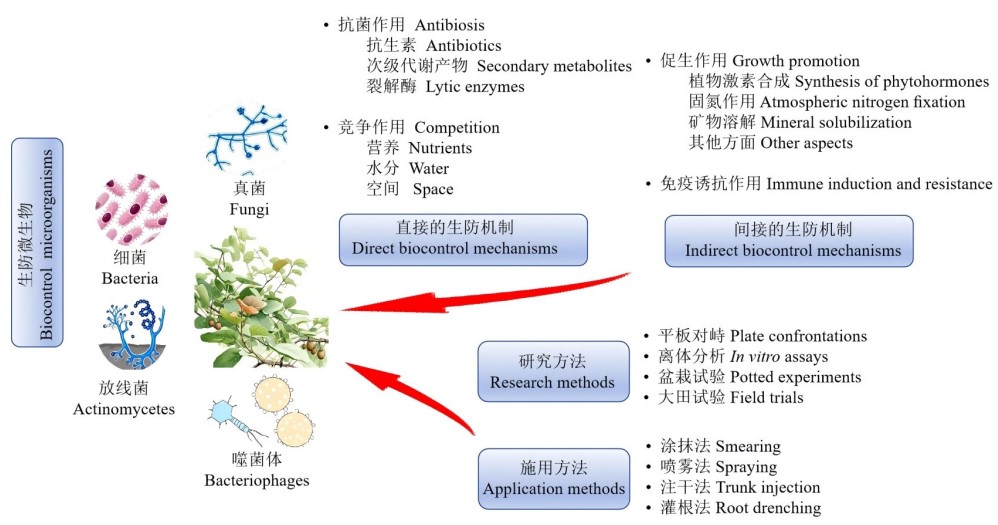
生防微生物的生防机制包括抗菌作用、竞争作用、免疫诱抗作用和促进植物生长等方面(Hill et al., 2015)。生防菌可通过单一或多种机制与病原菌发生直接或间接的相互作用,从而有效抑制或减轻植物病害(图1)。
图
1
KBC生防微生物的类群、生防机制、研究方法及施用方法
Fig.
1
Biocontrol microorganism species, biocontrol mechanisms, research methods, and application methods of KBC
3.1 抗菌作用
某些微生物能够产生脂肽、细菌素、抗生素、生物表面活性剂、细胞壁降解酶或微生物挥发性化合物等特定代谢产物,或合成和分泌生物碱类、萜类、酚类等具有抗菌活性的物质,通过直接抑制致病菌的生长、繁殖或代谢活性来发挥抗菌作用。分离自健康的猕猴桃根际的多粘类芽孢杆菌(Paenibacillus polymyxa YLC1)对KBC有防效的生物活性成分为多粘菌素B1(Wang H et al., 2023)。从黄瓜叶片中分离得到的内生菌薰衣草链霉菌(Streptomyces lavendulae gCLA4),其发酵滤液中的链丝菌素F成分,可与Psa的FtsZ靶点结合并发挥作用,从而抑制Psa的细胞分裂(刘巍等,2023;Wang et al., 2024)。皱纹假单胞菌(Pseudomonas corrugata XL17)产生2,4-二乙酰基福林糖醇和脂肽,对KBC具有防治作用(Ali et al., 2022)。分离自野生中药牛蒡茎部的子囊链霉菌变种(Streptomyces sporovirgulis var. arctium TGNBSA5),其发酵滤液对Psa具有抑菌活性,主要活性成分为苯甲醇(黄以超,2012)。从猕猴桃内生真菌Bipolaris sp.分离得到的萜类化合物4(bipolarisorokin M)和化合物5(bipolarisorokin N)对Psa有抗菌活性,最小抑菌浓度(minimum inhibitory concentration, MIC)分别为32 μg·mL-1和64 μg·mL-1(Yu et al., 2022)。
3.2 竞争作用
通常情况下,生防菌可通过分泌抗生素或抗细菌代谢物干扰病原菌的毒力,同时占据病原菌在植物上的侵染位点,并在感染部位定殖存活。借助更高效的营养吸收系统,生防菌能与病原菌争夺水分、氨基酸、碳水化合物、维生素、无机盐及铁元素等营养物质和生存空间,进而抑制病原菌的生长繁殖(Abd El-Mageed et al., 2020)。黄杆菌(Flavobacterium F55)能快速利用‘海沃德’根分泌物促进自身生长,从而增强抗Psa的能力(Zheng et al., 2024)。
3.3 免疫诱抗作用
生防菌的部分种类可通过诱导植物内源抗性信号通路,增强宿主防御机制并引发系统性抗性,触发多种生化与分子层面的防御反应,从而间接提升植物对病原菌的抵御能力。接种贝莱斯芽孢杆菌(Bacillus velezensis WL-23)可诱导猕猴桃植株产生系统性抗性,植株体内超氧化物歧化酶、过氧化氢酶、多酚氧化酶和苯丙氨酸解氨酶的活性显著上升,同时水杨酸含量也呈上升趋势(Wang B C et al., 2023)。在田间试验中,从猕猴桃枝条分离的贝莱斯芽孢杆菌(B. velezensis JIN4),对猕猴桃表现出有效的定殖效果,可提高猕猴桃叶片中过氧化氢含量和过氧化氢酶活性,进而增强猕猴桃植株对Psa的抵抗力(Zhao et al., 2024)。猕猴桃根际来源的嗜根假单胞菌(Pseudomonas rhizophilaZ98)会促使猕猴桃中防御相关基因AcBSL1、AcJAR4、AcEIN3、AcERF2和AcTGA9的表达增强,从而激活植物的免疫反应(Tian et al., 2025b)。植物内生真菌链格孢菌(Alternaria alternata var. alternata)的发酵浸膏可诱导猕猴桃产生免疫应答反应,包括活性氧迸发与胼胝质沉积,并能提升植株体内过氧化氢酶和过氧化物酶的活性(李晨,2025)。
3.4 促进植物生长
某些微生物,尤其是植物根际促生菌,能够在寄主植物体内定殖,并通过直接和间接的机制促进植物生长(El-Saadony et al., 2022)。直接促生机制包括产生吲哚乙酸、乙烯、茉莉酸、赤霉素和细胞分裂素等植物激素,溶解磷酸盐,固定氮素,以及通过产铁载体促进铁的吸收等。间接效应则包括抗生素的产生、营养竞争、寄生作用、病原体毒素抑制以及诱导抗性等(Elnahal et al., 2022)。接种贝莱斯芽孢杆菌(Bacillus velezensis WL-23)不仅增加了猕猴桃体内吲哚乙酸、赤霉素3和细胞分裂素的含量,还提高了芽孢杆菌属(Bacillus)、慢生根瘤菌属(Bradyrhizobium)、罗丹杆菌属(Rhodanobacter)及木霉属(Trichoderma)等有益微生物的相对丰度,从而促进幼苗的生长(Wang B C et al., 2023)。在实验室条件下,贝莱斯芽孢杆菌(Bacillus velezensisJIN4)菌株表现出固氮和解磷能力,同时具备促进植物生长的特性(Zhao et al., 2024)。皱纹假单胞菌(Pseudomonas corrugata XL17)产生的吲哚乙酸和ACC脱氨酶,可能参与植物的促生长过程(Ali et al., 2022)。Streptomyces sp. W3SF9和Streptomyces racemochromogenesW1SF4在纤维素分解、几丁质分解、蛋白分解和铁载体生成方面表现出色,具备促进植物生长的能力(Kim et al., 2019)。
4 微生物生防菌在KBC防治中的应用
随着中国及部分欧美国家先后禁止将链霉素用于KBC的防治,采用生防菌剂等绿色防控手段已成为预防该病害的首要选择。
4.1 单一微生物在KBC防治中的应用
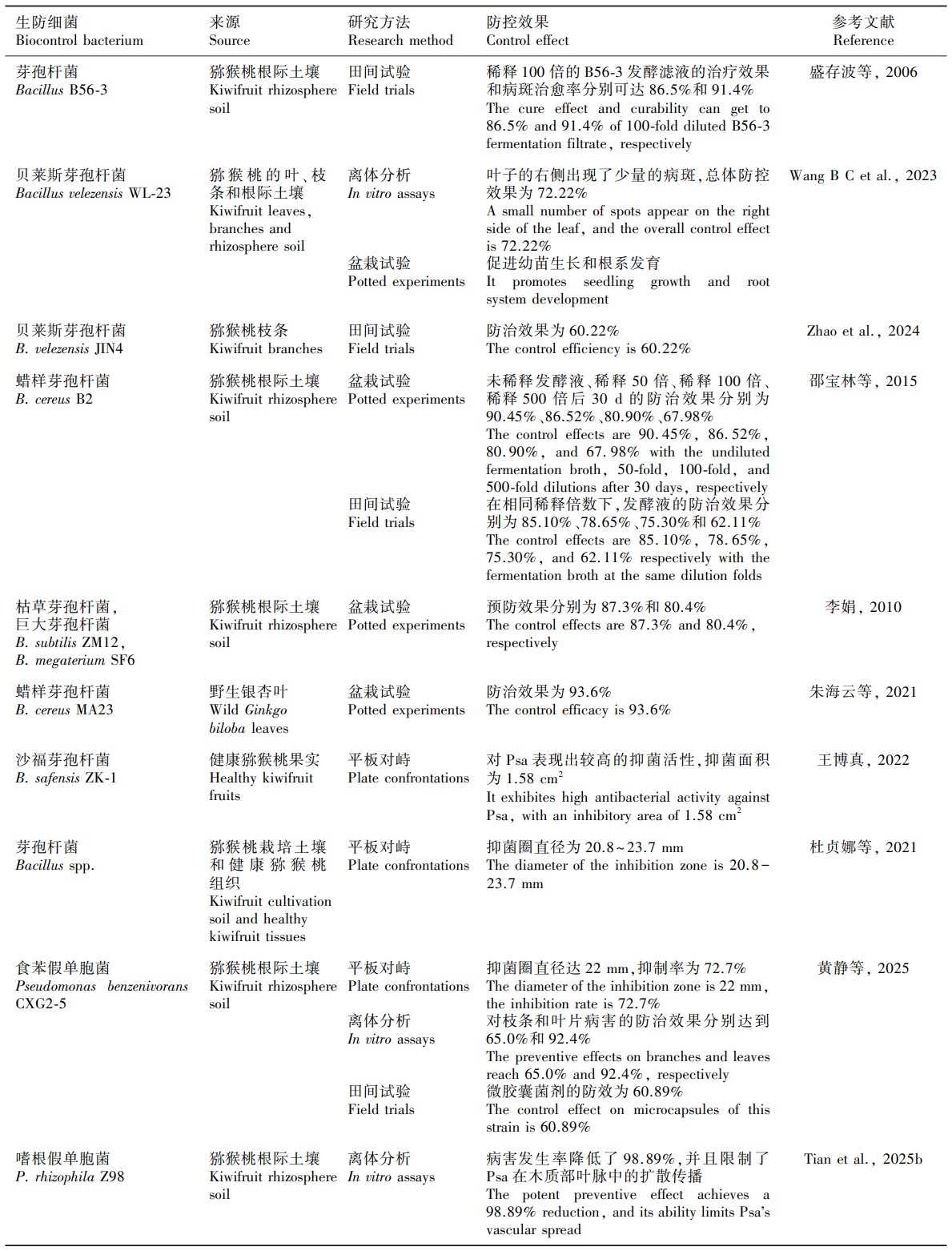
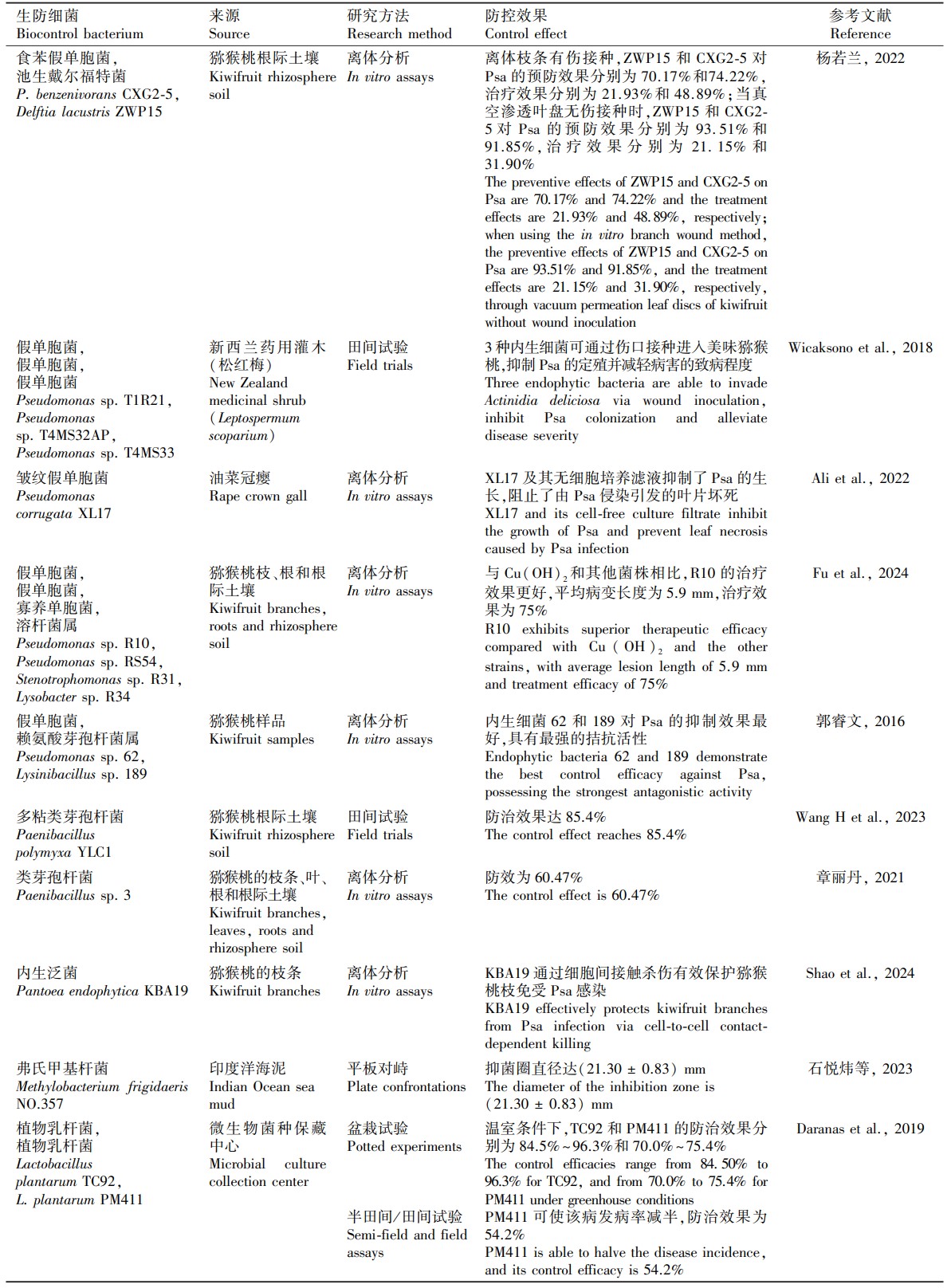
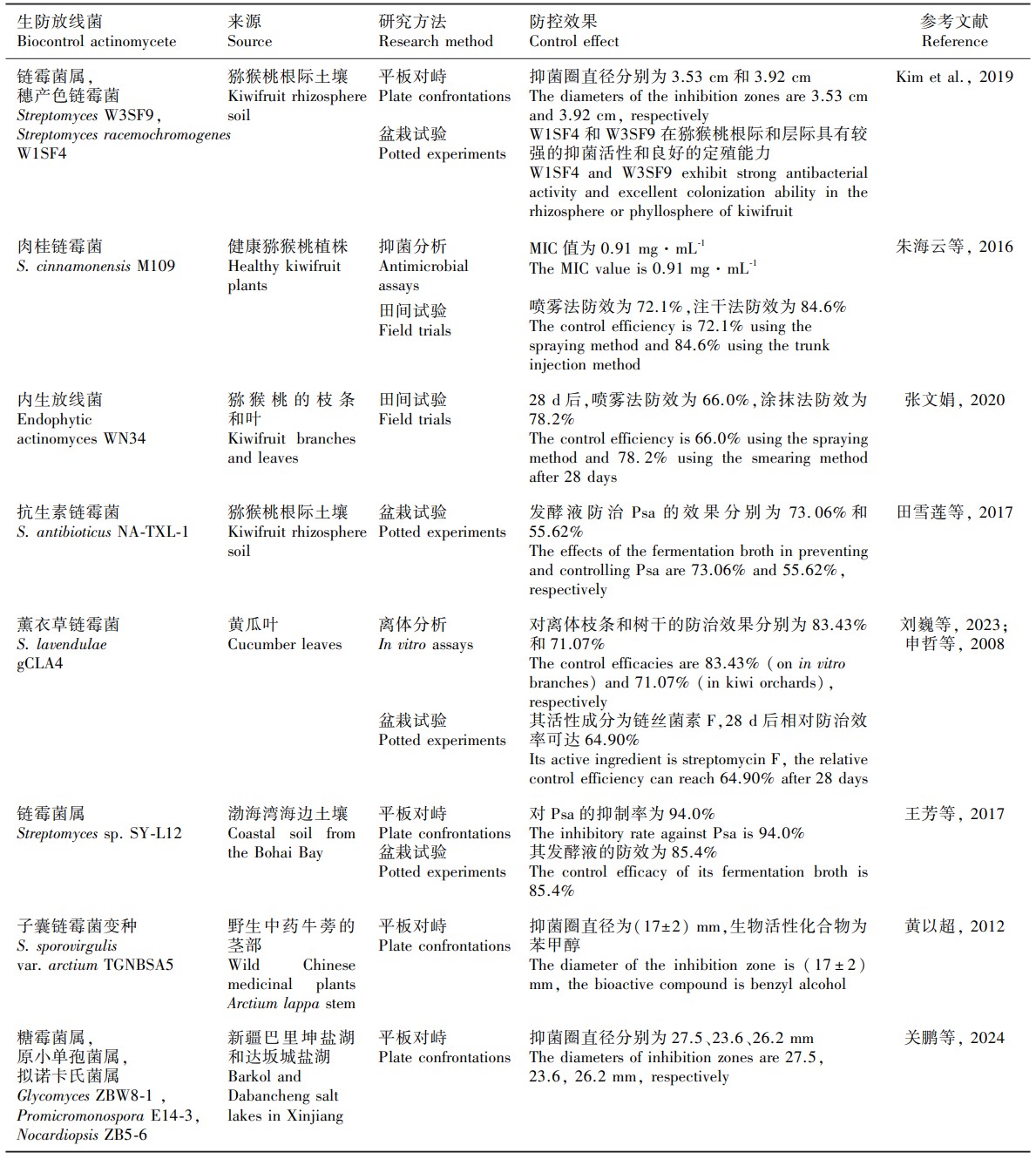
在KBC的生物防治研究与应用中,单一微生物的利用较为广泛,其中以芽孢杆菌属细菌和链霉菌属放线菌为主(表1,表2)。
表
1
单一生防细菌在KBC防治中的应用
Table
1
Application of single biocontrol bacterium strains for the prevention and control of KBC
续表 1
表
2
单一生防放线菌在 KBC 防治中的应用
Table
2
Application of single biocontrol actinomycete strains for the prevention and control of KBC
4.1.1 单一生防细菌
在盆栽和大田试验中,应用效果较为理想的是从猕猴桃生境中分离的芽孢杆菌属细菌和假单胞菌属细菌。盛存波等(2006)从猕猴桃根际土壤分离到的芽孢杆菌(Bacillus B56-3)菌株,通过田间试验采用喷雾和病斑刮除涂抹相结合方式,使用稀释100倍的发酵滤液对KBC的治疗效果和病斑治愈率分别达86.5%和91.4%。Zhao等(2024)从猕猴桃枝条分离得到的贝莱斯芽孢杆菌(Bacillus velezensisJIN4)菌株,田间试验结果表明该菌对猕猴桃的定殖效果显著,不仅能提高植物的抗氧化酶活性,还可诱导猕猴桃植株产生抗性,对KBC防治效果为60.22%。邵宝林等(2015)从猕猴桃根际土壤中分离得到的蜡样芽孢杆菌(B. cereus B2),通过盆栽试验,采用B2发酵原液、50倍、100倍和500倍发酵稀释液对染病的猕猴桃枝条进行喷雾处理,30 d后的防治效果分别为90.45%、86.52%、80.90%和67.98%;在田间试验中,不同稀释倍数的B2发酵液对Psa的防治效果分别为85.10%、78.65%、75.30%和62.11%。李娟(2010)从猕猴桃根际土壤中分离得到的枯草芽孢杆菌(B. subtilis ZM12)和巨大芽孢杆菌(B. megaterium SF6),在盆栽试验中对Psa的预防效果分别为87.3%和80.4%。黄静等(2025)从猕猴桃根际土壤中分离得到的食苯假单胞菌(Pseudomonas benzenivorans CXG2-5)菌株,在离体枝条和叶片上对KBC的预防效果分别为65.0%和92.4%,该菌株的微胶囊菌剂在田间的防治效果为60.89%,略低于20%春雷霉素,高于枯草芽孢杆菌可湿性粉剂。Wang H等(2023)从猕猴桃根际土壤分离得到多粘类芽孢杆菌(Paenibacillus polymyxa YLC1),田间试验结果显示,3倍稀释的YLC1发酵液对溃疡病菌具有较好的抑菌效果,抑菌防效达85.4%。
除猕猴桃生境细菌外,自然环境中其他细菌对Psa也展现出良好的防治效果。朱海云等(2021)从野生银杏叶中分离得到蜡样芽孢杆菌(Bacillus cereus MA23),盆栽试验结果显示内生菌MA23发酵上清液对KBC的防治效果达93.6%;Wicaksono等(2018)从新西兰的一种药用灌木松红梅(Leptospermum scoparium)中分离的内生细菌假单胞菌(Pseudomonas sp. T1R21、T4MS32AP和T4MS33)可通过伤口接种进入美味猕猴桃体内,抑制Psa的定殖,进而减轻病害的致病程度。
4.1.2 单一生防放线菌
链霉菌属放线菌及其代谢产物在控制KBC中展现出巨大的潜力(表2)。朱海云等(2016)从健康猕猴桃植株中分离得到肉桂链霉菌(Streptomyces cinnamonensis M109),在采用喷雾法时田间防效为72.1%,在采用注干法时田间防效为84.6%;张文娟(2020)从猕猴桃植株的枝条和叶片组织中分离得到内生放线菌WN34,并采用喷雾与涂抹两种方法开展田间试验,结果显示该菌株发酵液粗提活性物在施药28 d后,对KBC的防治效果分别为66.0%和78.2%;田雪莲等(2017)从猕猴桃根际土壤中分离得到抗生素链霉菌(𝑆. antibioticus NA-TXL-1),经预防法和治疗法的盆栽试验验证,该菌株发酵原液对Psa的预防效果和治疗效果分别为73.06%和55.62%。
申哲等(2008)从黄瓜叶片中分离得到薰衣草链霉菌(S. lavendulae gCLA4),经室内离体枝条及田间树干喷施试验,该菌株发酵液对KBC的防治效果分别为83.43%和71.07%;刘巍等(2023)证实了gCLA4发酵滤液对Psa具有拮抗活性,田间防治效果为64.90%;王芳等(2017)从渤海湾海边土壤分离获得的链霉菌属Streptomyces sp. SY-L12,其培养24 h的发酵液原液对病原菌的生长抑制率达94.0%,培养8~9 d的发酵产物对KBC的盆栽防效为85.4%,优于Cu(OH)2对照药剂;关鹏等(2024)从新疆巴里坤盐湖和达坂城盐湖分离获得的糖霉菌属Glycomyces ZBW8-1、原小单孢菌属Promicromonospora E14-3和拟诺卡氏菌属Nocardiopsis ZB5-6菌株对Psa的抑菌圈直径分别为27.5、23.6、26.2 mm。从极端环境中分离出的抗Psa菌株,不仅丰富了生防菌株的多样性,还展现出优异的抑菌能力,有望成为防治KBC的优良菌剂。
4.1.3 单一生防真菌
目前,单一生防真菌在KBC防治中的应用实例较为有限,所分离的菌株主要来源于植物内生真菌。Yan等(2013)从猕猴桃植株叶片和枝条中分离的内生真菌黑孢霉属Nigrospora sp. J2对Psa具有稳定的拮抗活性,抑菌圈直径为14 mm。从海棠树树皮组织中分离的链格孢菌(Alternaria alternata var. alternata),其发酵浸膏对猕猴桃离体叶片和枝条的防治效果分别为85.36%和48.06%(李晨,2025)。Ma等(2023)从猕猴桃植株中分离的三线镰孢菌(Fusarium tricinctum)对Psa体外抑制率为59.5%,从该菌分离的咪唑生物碱,可通过破坏细菌细胞壁结构发挥抗菌活性,其MIC为25~50 μg·mL-1。从猕猴桃内生真菌孢子副空球菌(Paraphaosphaeria sporulosa)中获得的异苯并呋喃酮和异香豆素,具有抗Psa活性,MIC在25~100 μg·mL-1之间(Chen et al., 2022)。猕猴桃内生真菌Bipolaris sp.含有萜类(包括倍半萜类、酯萜类和类似物)和克山酮类,对Psa具有抗菌活性(Yu et al., 2021, 2022)。
众所周知,内生真菌是生物活性物质的重要来源(Yan et al., 2013)。尽管目前针对Psa生防真菌的研究主要集中在平板抑菌试验以及体外离体枝条或叶片基础研究层面,但随着对真菌代谢产物挖掘工作的不断推进,其代谢产物作为潜在抗Psa药物的价值逐渐凸显,越来越多的真菌有望成为防治KBC的有效生物防治菌株。
4.1.4 生防噬菌体
噬菌体是一类能特异性感染目标细菌的病毒,凭借其宿主范围的高度特异性,近年来被视作细菌性病原体的潜在生物防治剂。目前,Psa噬菌体已成功从全球不同生态位中分离得到,在KBC的生物防控领域初步展现出应用成效。Park等(2018)和Song等(2021)研究的短尾病毒科PPPL-1噬菌体对KBC的多数菌株具有显著抑制作用,其对KBC的防控效果与链霉素和土霉素相当,并且能够成功杀死对链霉素具有抗药性的Psa细菌分离株,该病毒在40 ℃、pH 3~11以及365 nm紫外光照射下均能保持稳定。Frampton等(2014)从新西兰果园中分离鉴定的噬菌体φPsa316对KBC具有较强的防控能力,并且抗噬菌体细菌的出现概率为1.20 × 10⁻³。商业化的噬菌体φ6能感染Psa CRA-FRU 12.54和Psa CRA-FRU 14.10菌株,当感染复数(multiplicity of infection,MOI)为1或100时,均可有效灭活上述致病菌株(Pinheiro et al., 2019, 2020)。Liu等(2021)从中国猕猴桃果园土壤中分离出一株新型噬菌体PHB09,该噬菌体潜伏期短、裂解量大且在较宽的pH值和温度范围内具有良好的稳定性。PHB09能裂解多种Ⅲ型Psa菌株(包括BJ530、BJ9和BST)及Ⅱ型Psa菌株,是一种具有特异性灭活作用的生物防治剂。Yu等(2016)从韩国猕猴桃果园土壤中分离得到的肌病毒科噬菌体KHUφ44,对14株Psa均有较好的抑制作用。噬菌体的体外裂解活性可维持至80 h,在50 ℃、pH 11和UV-B光条件下保持稳定。上述这些噬菌体绝大多数分离自Psa侵染猕猴桃的生境,不仅对Psa具有特异性,还能耐受多种环境因素,在KBC的防治中具有潜在应用前景。
上述微生物均对Psa具有显著的抑制效果,其中部分菌株在田间试验中表现出优异的生防成效,其高效生防能力与以下几个因素密切相关。
(1)生防菌的来源。筛选自猕猴桃生态圈(包括根际土壤、枝叶等部位)的绝大多数生防菌,其生防效果显著优于非生境来源的菌株。这可能是因为这类生防菌与猕猴桃植株长期共进化,从而具备了更强的宿主适配性、定殖能力以及生态位竞争力。猕猴桃抗性品种‘皖金’根际富集的假单胞菌、溶杆菌能高效定殖(Zheng et al., 2024);猕猴桃枝条分离的内生泛菌(Pantoea endophytica KBA19)可通过T6SS直接接触并精准杀灭Psa(Shao et al., 2024);分离自‘海沃德’根际土壤的黄杆菌(Flavobacterium F55)可高效利用根系特有代谢物促进自身快速增殖,进而增强对Psa的抑菌能力(Zheng et al., 2024);分离自抗性品种‘万金’根际的假单胞菌(Stenotrophomonas sp.),能够主动招募并协同猕猴桃核心有益菌群,形成功能互补的生防菌群,进而显著提升整体防治效果(Fu et al., 2024)。分离自湖南省的贝莱斯芽孢杆菌(Bacillus velezensis JIN4)菌株对当地气候和土壤环境的适应能力更强,有助于占领猕猴桃根间或体内的生态位,从而增强对KBC的抑制作用(Zhao et al., 2024)。链霉菌属Streptomyces W3SF9和穗产色链霉菌(S. racemochromogenesW1SF4)在猕猴桃幼苗的根和叶上均表现出较强的定殖能力(Kim et al., 2019)。
(2)猕猴桃品种。生防菌在抗病品种上防治效果更稳更高,在高感品种上效果波动大、易被突破。美味猕猴桃‘海沃德’为抗病品种,中华猕猴桃‘红阳’为高感品种,Flavobacterium F55在‘海沃德’上防效达88.2%,在‘红阳’上仅为45.7%。抗病品种根际天然富集如黄杆菌、芽孢杆菌等更多生防菌(Zheng et al., 2024)。‘皖金’为抗病品种,‘东红’为感病品种,从‘皖金’根际或根内分离的溶杆菌属Lysobacter sp. R34和假单胞菌(Pseudomonas sp. R10)在本抗性品种上的定殖率与防治效果均显著高于感病品种‘东红’(Zheng et al., 2024)。
(3)生防菌施用方法。目前,针对猕猴桃病灶部位,主要采用喷雾法、注干法、涂抹法以及灌根法等方式进行处理(图1)。同一种生防菌,不同处理方式对Psa生防效果存在显著性差异,每种方法都有各自的优势。张文娟(2020)通过田间试验对比了喷雾法与涂抹法两种施药方式,结果显示涂抹法的防效(78.2%)显著优于喷雾法(66.0%)。涂抹法可以使菌剂直接接触病灶,局部浓度高,定殖快,既能快速抑制病情的发展,又可有效避免外界气候条件的干扰。朱海云等(2016)通过田间试验对比了喷雾法和注干法两种施药方式,结果显示注干法的防效(84.6%)优于喷雾法(72.1%)。嗜根假单胞菌(Pseudomonas rhizophila)注干法防效达98.89%(Tian et al., 2025b)。注干法使生防菌可以直达维管束、阻断Psa在木质部传导,持效期长。采用喷雾法时,蜡样芽孢杆菌(Bacillus cereus B2)发酵原液的防效超90%(邵宝林等,2015)。采用灌根方式施用B. amyloliquefaciens subsp. plantarum D747菌株,能有效降低Psa在中华猕猴桃上诱发的叶斑病严重程度(Biondi et al., 2022)。灌根施用Flavobacterium F55,可抑制‘红阳’猕猴桃地上部分Psa的繁殖(Zheng et al., 2024)。灌根法能使菌株在猕猴桃根际定殖,进而诱导植株产生系统抗性,实现跨生态位对地上部分的保护。
(4)KBC的发病程度。KBC的田间发病情况是影响生防菌应用效果的关键因子。当病情指数低、病原菌基数小、树体健康度高时,生防菌能借助生态位竞争、拮抗作用及诱导宿主抗病性等机制,实现对病害的高效防控;而当病情严重、病灶深入木质部、树体免疫系统受损时,生防菌则难以定殖并发挥作用。在猕猴桃开花初期施用Flavobacterium F55菌株,其对KBC的防治效果可达84.4%,显著优于化学药剂春雷霉素69.0%的防效(Zheng et al., 2024)。离体枝条有伤接种池生戴尔福特菌(Delftia lacustris ZWP15)和食苯假单胞菌(Pseudomonas benzenivorans CXG2-5)对Psa的预防效果分别为70.17%和74.22%,治疗效果分别为21.93%和48.89%(杨若兰,2022)。从实例中可以看出,生防菌的防效与KBC的发病程度呈显著负相关。
4.2 复配微生物生防菌在KBC防治中的应用
大多数生物防治研究主要围绕单一菌株的分离、筛选与应用展开,但在大田生产实践中,单一成分的生防菌剂常面临防效不稳定、抑菌谱较窄等问题(Massart et al., 2015)。多株生防菌经科学复配后,可通过多种生防机制协同作用,更高效地实现病害防控,同时还能促进植物产量与品质的提升,降低成本、提高效益。
4.2.1 生防微生物的复配方式
为了开发防效高、稳定性好的复合菌剂,深入研究生防菌的作用机制至关重要。复配前,首先考量菌株间的互作关系,筛选相容性良好且能产生协同增效作用的菌株开展复配;其次应结合菌株的生物学特性、生长速度及作用机制,依据最终应用目标进行科学配制,从而获得高效的复配组合。
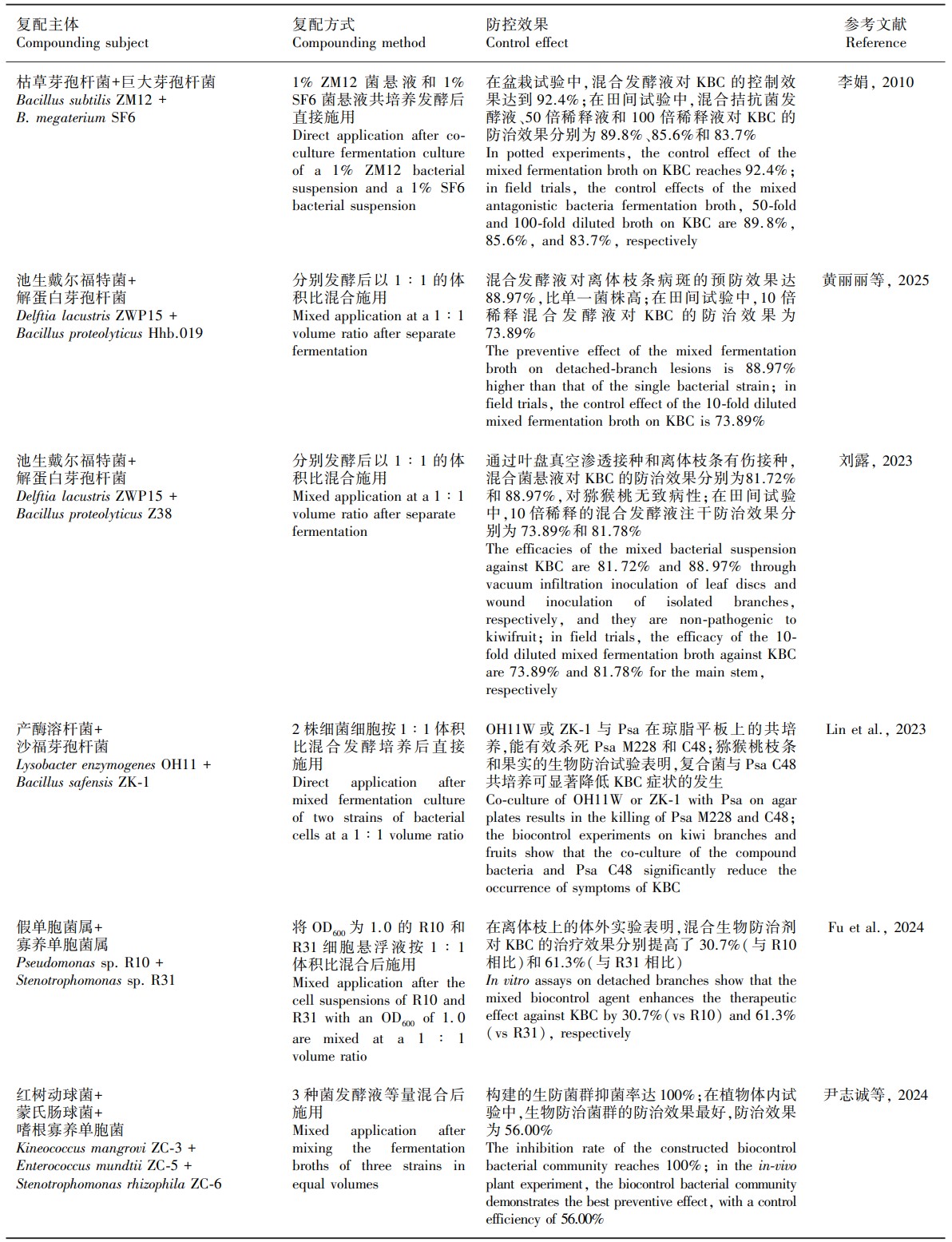
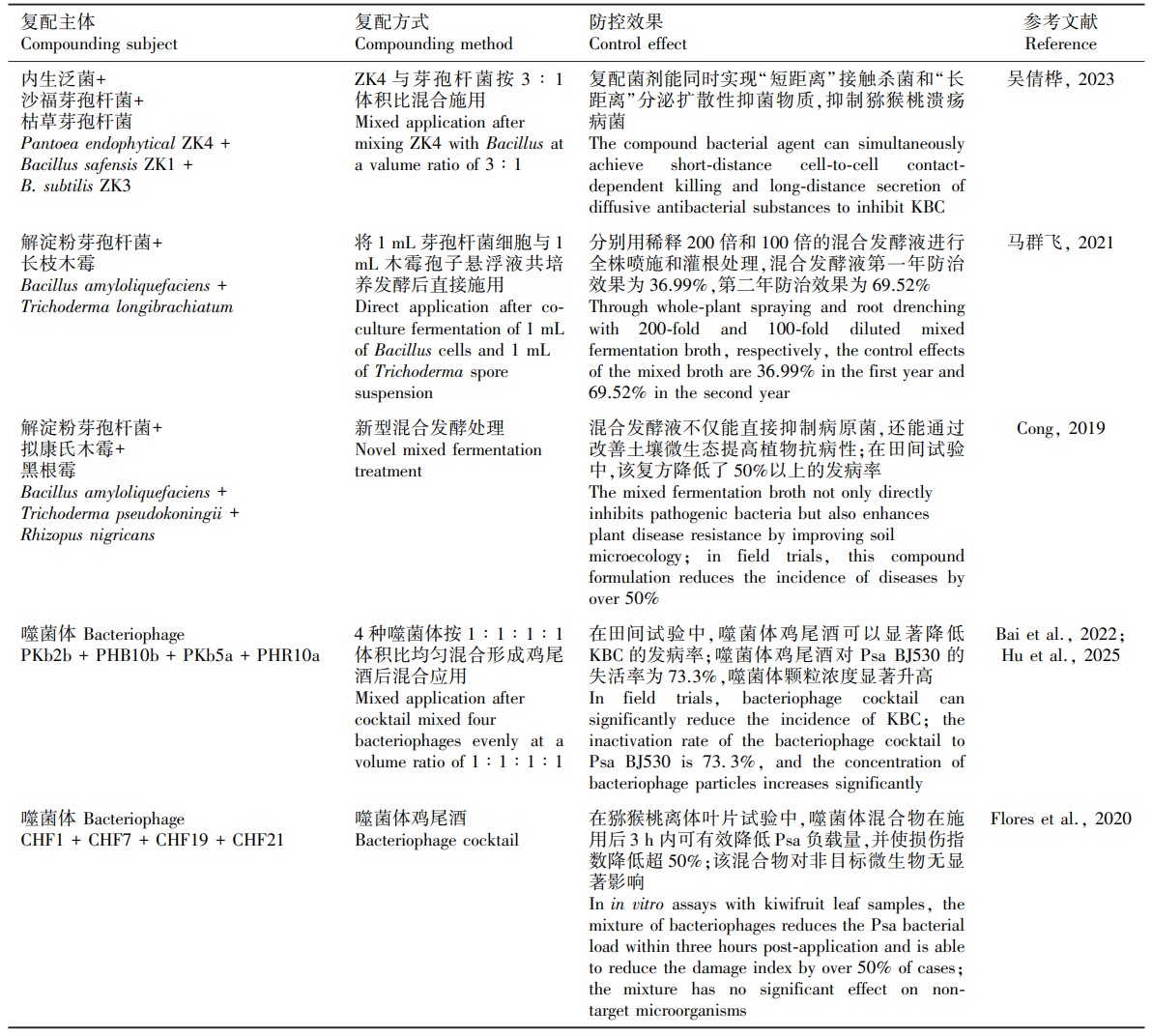
生防菌的复配方式可分为复配主体和施用方式两类。复配主体根据菌群的组成成分可划分为五类,即细菌生防菌群、放线菌生防菌群、真菌生防菌群、混合生防菌群(如细菌和放线菌的复配、细菌和真菌的复配或者放线菌和真菌复配等)以及噬菌体鸡尾酒(王卫雄等,2020)。根据菌群数量,可将菌株进行两两复配,也可进行多株菌复配。其施用方式主要分为两种:一种是各菌株单独发酵后再混合施用,另一种是将菌株混合发酵后直接施用(付博等,2020)(表3)。
表
3
复配微生物在KBC防治中的应用
Table
3
Application of mixed microorganisms for the prevention and control of KBC
续表 3
4.2.2 复配微生物生防菌在KBC防治中的应用
属内菌株复配与属间菌株复配是微生物协同防治植物病害的两种重要策略,二者在亲缘关系、生理特性以及生防效果上各具优势。在实际的生防应用研究中,由同属或不同属的两种或多种细菌构建的细菌生防菌群,在KBC的防治领域应用较为广泛。
(1)属内两株细菌复配
李娟(2010)对芽孢杆菌属内的枯草芽孢杆菌(Bacillus subtilis ZM12)和巨大芽孢杆菌(B. megateriumSF6)两种细菌,采用等体积的接种方式进行发酵培养后施用。盆栽试验结果表明,该混合发酵液对KBC的防治效果高达92.4%,优于ZM12(87.3%)与SSF6(80.4%)的单菌处理效果;田间试验结果表明,复合拮抗菌剂原液、50倍和100倍稀释发酵液对KBC的防治效果分别为89.8%、85.6%和83.7%。由于属内菌株生理代谢特征与生态位较为相似,菌株间不易产生拮抗;不同芽孢杆菌可在产酶、解磷、固氮、促生、抗病、抗逆等方面形成功能互补与效果叠加,进而增强环境耐受能力与定殖能力,使复配体系稳定性更高,最终对KBC的抑制效果更为显著。
(2)属间两株细菌复配
黄丽丽等(2025)对不同属的池生戴尔福特菌(Delftia lacustris ZWP15)和解蛋白芽孢杆菌(Bacillus proteolyticus Hhb.019)两种细菌分别进行单独发酵,将二者发酵液按1∶1体积比组合后制得的菌剂,对离体枝条病斑的预防效果达88.97%,该效果优于单一菌种的防效;此外,经10倍稀释复配生防菌剂的发酵液对KBC的田间防效为73.89%。刘露(2023)对不同属的两种细菌池生戴尔福特菌(Delftia lacustris ZWP15)和解蛋白芽孢杆菌(Bacillus proteolyticusZ38)分别进行单独发酵,将二者发酵液按1∶1体积比混合后施用。通过室内叶盘真空渗透接种和离体枝条有伤接种试验验证其对KBC的预防效果分别为81.72%和88.97%且对猕猴桃无致病作用。田间试验结果表明,稀释10倍的混合发酵液对该病的整体防治效果为73.89%,对主干的防治效果则为81.78%。Lin等(2023)将Lysobacter enzymogenes OH11和Bacillus safensis ZK-1的细胞以1∶1的体积比在混合菌落的琼脂板上共培养,能有效杀死Psa M228和Psa C48;猕猴桃枝条和果实生防试验显示复配菌与Psa C48共培养显著减少了细菌性溃疡病症状的发生。Fu等(2024)将光密度 600 nm(optical density at 600 nm, OD600)为1.00的Pseudomonas sp. R10和Stenotrophomonas sp. R31的细胞悬液按1∶1体积比混合后,离体枝条抑菌试验结果表明,混合生防菌剂对KBC的防治效果,相较于R10和R13单剂处理分别提高了30.7%和61.3%。尹志诚等(2024)对不同属的红树动球菌(Kineococcus mangrovi ZC-3)、蒙氏肠球菌(Enterococcus mundtii ZC-5)和嗜根寡养单胞菌(Stenotrophomonas rhizophila ZC-6)3种细菌分别进行单独发酵,将发酵菌液等体积混合后施用。离体共培养结果表明,该复配菌对KBC的抑制率达100%;活体试验结果显示,由这3株菌联合构建的生防菌群防治效果最佳,为56.00%,经其处理的猕猴桃植株不仅叶片病斑数量少、面积小,而且植株长势与健康状况未受影响。吴倩桦(2023)将发酵后的内生泛菌(Pantoea endophytical ZK4)分别与沙福芽孢杆菌(Bacillus safensis ZK1)和枯草芽孢杆菌(B. subtilis ZK3)按照3∶1体积比混合,所制备的复配菌剂可同时通过“短距离”接触杀菌和“长距离”分泌扩散性抑菌物质两种方式,抑制KBC病原菌。
细菌和真菌组合形成的混合菌群在KBC的生物防治中也有少量的相关报道。马群飞(2021)将1 mL解淀粉芽孢杆菌(B. amyloliquefaciens)细菌悬液和1 mL长枝木霉(Trichoderma longibrachiatum)真菌孢子悬液发酵共培养后,采用200倍和100倍稀释的混合发酵液进行整株喷施和灌根联合处理。结果显示,第一年和第二年的防治效果分别为36.99%和69.52%。Cong(2019)将解淀粉芽孢杆菌(Bacillus amyloliquefaciens)、拟康氏木霉(Rhizopus nigricans)和真菌黑根霉(Trichoderma pseudokoningii)进行复配,所得混合菌剂不仅直接抑制病原菌,还通过改善土壤微生态增强植株抗病性;田间试验结果显示,该复配菌剂使KBC的病害发生率降低了50.00%以上。
以噬菌体混合制成的“鸡尾酒”制剂,在KBC的生物防治中同样取得了一定成效。Bai等(2022)和Hu等(2025)从猕猴桃生长环境中分离得到长尾病毒科成员PKb2b、PHB10b以及囊状病毒科成员PKb5a、PHR10a,体外试验显示,这4株噬菌体混合物对Psa BJ530的失活率为73.3%且噬菌体颗粒浓度随之显著升高;体内试验表明,该噬菌体混合物可有效抑制Psa的增长。此外,这4株噬菌体在溃疡病发病期的自然温度、pH值及UV-B条件下,其活性总体保持稳定。Flores等(2020)从猕猴桃果园的土壤样品中筛选出4株噬菌体CHF1、CHF7、CHF19和CHF21,其混合制剂在使用3 h内可显著降低Psa菌量,使病害损伤指数降低超50%,且对非靶标微生物无显著影响。将噬菌体置于与猕猴桃生产相关的条件下,所有噬菌体均保持了良好的活性。从上述实例可见,在同一研究中,复配菌株的防治效果显著优于单一菌株,其复配理论指导基础如下:(1)生防机制差异显著,功能互补性更强。复配后能通过多靶点、多机制协同作用防控病害。(2)生态位互补,定殖范围更广。不同属微生物在植株根表、叶表及体内的定殖部位与偏好存在差异,能够全方位占据生态位,减少内部竞争,提高整体定殖稳定性。(3)环境适应范围更广,田间稳定性更高。不同属菌株对温度、湿度、土壤及pH值的耐受范围差异较大,复配后整体抗逆性得以提升,在复杂田间环境中防效更稳定。(4)复配菌株可互相促进生长、互相保护,进而形成稳定的功能微生物群落。复配的优势并非一定优于最强单株,而是通过生态位互补、机制协同、环境适应性,提升生防效果的稳定性和持久性(王卫雄等,2020)。
5 总结与展望
5.1 总结
本文围绕KBC的微生物生防展开综述,系统梳理了生防菌的种类、作用机制以及其在该病生物防治中的应用现状。与传统化学防治相比,采用微生物生防策略不仅环境友好,而且还能有效延缓病原菌抗药性的产生与发展,提升果实品质,契合猕猴桃产业绿色可持续发展的需求。众多生防微生物的发掘与深入研究,不仅为KBC生防菌剂的研发提供了安全高效的菌株资源及配套应用技术,而且还为猕猴桃产业的健康可持续发展提供了坚实支撑。基于对现有研究结果和理论知识的理解与分析,今后KBC的微生物防治研究与应用需重点关注以下几点。
5.1.1 加快筛选高效防控Psa的生防菌资源
综合数据可见,兼具优良田间防效与强环境适应性的Psa生防菌资源仍相对匮乏。真正应用于田间试验且防效在85%以上的生防菌株仅有少数,例如芽孢杆菌(Bacillus B56-3)、蜡样芽孢杆菌(Bacillus cereus B2)、多粘类芽孢杆菌(Paenibacillus polymyxa YLC1)和肉桂链霉菌(Streptomyces cinnamonensis M109)(盛存波等,2006;邵宝林等,2015; 朱海云等,2016;Wang H et al., 2023)。贝莱斯芽孢杆菌(Bacillus velezensis JIN4)和食苯假单胞菌(Pseudomonas benzenivorans CXG2-5)等菌株虽已在田间推广应用,但对Psa的防控效果仅维持在60%左右(Zhao et al., 2024; 黄静等,2025)。尽管国内外已针对Psa生防菌开展了大量筛选工作,但其研究方法大多局限于平板抑菌、枝条或叶片的离体分析以及盆栽试验等层面。虽然部分菌株在离体分析与盆栽试验中表现出理想防治效果,但尚未真正应用于田间试验。综上可见,猕猴桃自身微生态(根际、内生、叶际)是筛选高效且适配性强的Psa生防菌的理想来源。同时,借助植物与微生物的互作机制,可从猕猴桃生境中快速分离出高效的生防微生物(李青等,2026)。
5.1.2 加强Psa生防菌防控的广域性研究
多数菌株仅在特定品种、特定环境有效,广域应用潜力未被充分挖掘。多粘类芽孢杆菌(Paenibacillus polymyxa YLC1)不仅对Psa具有高效生防作用,还对多种植物病原细菌展现出广谱抑制活性,但其生防效果目前仅在‘红阳’猕猴桃上得到验证(Wang H et al., 2023)。Flavobacterium F55已在陕西省内3个不同试验区完成防效验证,然而该菌株的防控研究目前仅局限于‘红阳’猕猴桃(Zheng et al., 2024)。食苯假单胞菌(Pseudomonas benzenivorans CXG2-5)对Psa具有良好防治效果,不过其应用测试目前仅覆盖湖南部分产区(黄静等,2025)。多数已分离的生防菌均缺乏对其广域应用潜力的系统评价,难以满足不同生态区猕猴桃产业的绿色防控需求。建议首先在猕猴桃主产区挖掘本土多功能优势菌株,其对本地环境、Psa种群的适配性更强,更易实现大面积应用。其次,靶向筛选对多种Psa菌株均有强拮抗的生防菌。最后,加大某种生防菌剂的研发,实行跨区域田间适应性验证。
5.1.3 开展生物防控机制的系统性研究
生防菌、病原菌与宿主植物间的互作是一个涵盖分子信号传导、代谢调控与微生态平衡的复杂网络系统,并且这一互作过程受微环境的影响极为显著,实验室模拟条件难以精准复刻田间复杂的微环境,制约着人们对其深层机制的探究。近期,西北农林科技大学果树病害综合防治研究团队阐明了维管组织介导的Psa系统性传导是溃疡病呈现“一病多症”及“发病快、死树急”的内在机制,为Psa的精准防控找到了关键的突破口(Tian et al., 2025a)。猕猴桃根际来源的嗜根假单胞菌(Pseudomonas rhizophila Z98)能抑制Psa在木质部叶脉中的扩散传播,生防效果达98.89%(Tian et al., 2025b)。李青等(2026)发现了“溃疡病菌入侵-猕猴桃有益菌定向富集”的动态互作网络,为植物-微生物联合抗病理论体系的发展提供理论依据。研究者可依托微生物-植物互作机制,深度解析生防菌的防治机理,通过人为构建特定微生物菌群,有效提升其适配性与定殖能力,进而增强植物的抗病能力。
5.1.4 加快可推广应用微生物菌剂研制进程
尽管部分生防菌在小范围田间试验中对KBC展现出显著的防治效果,但其菌剂研发与产业化进程仍较为缓慢。菌剂研发受到菌株稳定性、环境适应性、作用机制、生产及制剂技术、登记流程与成本控制等多重因素的制约,因此应该优先研发能直接应用于田间的简易剂型,简化繁琐的施用流程。首先,可湿性粉剂成本低廉、易于储存,适用于叶面喷雾且适配无人机施药;悬浮剂分散性佳、附着力强,适合枝干涂抹与灌根作业;颗粒剂缓释性能优异,适用于根际施用,可与有机肥、生物炭混合使用,适配“水肥菌一体化”技术。其次,筛选玉米粉、豆粕、麸皮等农业废弃物作为发酵原料,优化发酵工艺参数,提高菌株增殖效率,缩短发酵时间,降低发酵成本,实现“低成本、高产出”的目标。最后,联合当地农业技术推广中心、猕猴桃产业协会以及龙头企业,开展菌剂示范推广工作,建设核心示范园,让种植户直观看到防控效果。目前,Wang等(2022)基于植物病原菌富集原理构建的生防菌靶向分离技术体系,成功分离出能有效抑制溃疡病菌的沙福芽孢杆菌(Bacillus safensis),并依托该菌株研发出低毒高效的“中科生防药剂”,且已在湖北省多地开展田间防效验证,这使得该药剂有望在实际生产中推广应用。
5.2 展望
5.2.1 合成生物学改造生防菌
借助CRISPR-Cas9等高效基因编辑技术,定向优化KBC生防菌的核心功能模块。(1)通过过表达冷休克蛋白基因(Csp家族)及渗透调节相关基因,显著增强菌株在极端环境中的存活能力与定殖效率。(2)通过强启动子改造、沉默冗余代谢基因等手段,定向重构抗菌代谢物合成途径,或异源表达Psa特异性裂解基因,显著提升其抑菌活性与靶向性。(3)导入植物维管束亲和基因并优化鞭毛基因,增强菌株在猕猴桃木质部的趋化运动能力;强化生物膜合成基因簇,促使工程菌在伤口、导管口稳定占位,进而阻断Psa的入侵通道。(4)构建“Psa感应-智能杀伤-自身调控”一体化回路,让KBC工程菌株可精准识别Psa并按需启动抑菌功能,减少对果园土著微生物群的干扰;同时结合营养缺陷型底盘改造,提升工程菌株的环境安全性,为其田间规模化应用筑牢基础。
5.2.2 基于微生物组的病害预警与精准防控
基于微生物组学技术,解析猕猴桃溃疡病健康植株与发病植株根际、叶际及枝干维管内生菌群结构差异,筛选病害特异性微生物标记物,进而构建潜伏侵染阶段的早期微生态预警模型;同时通过定向修复核心抗病有益菌群、组装合成功能菌群、优化栽培管理以调控果园微生态,构建从早期风险预警到菌群精准重塑的一体化绿色防控体系。
5.2.3 生防菌与智慧农业的融合应用
借助在线监测设备,对果园环境、Psa菌量及KBC生防菌的定殖动态进行实时监测,通过完善大数据分析模型,进一步推动智能装备与KBC生防菌施用的深度适配;研发适用于猕猴桃枝干维管系统的精准注射设备、无人机变量施药系统等智能装备,以实现KBC生防菌的定向递送与定量施用,有效提升其施用效率与防治效果;同时结合“水肥菌一体化”智慧灌溉技术,促进KBC生防菌应用与栽培管理的协同融合。