


摘要
为明确水分条件与猕猴桃溃疡病菌(Psa)感染的关联机制,该研究以高感病的‘红阳’猕猴桃为材料,设置空气相对湿度(60%±2%)的亏缺组和(90%±2%)的高湿组,采用菌落计数、荧光观察和扫描电镜等方法,探究适度水分亏缺处理对溃疡病的影响及机理。结果表明:(1)提前水分亏缺处理的植株初始过氧化氢酶(CAT)、超氧化物歧化酶(SOD)、谷胱甘肽还原酶(GR)和苯丙氨酸解氨酶(PAL)的酶活性更高,气孔开度更低,接菌12 天后叶片病原菌数量仅约为高湿组的1/5。(2)高湿组带病植株转入水分亏缺环境处理7天后叶片荧光出现弥散现象,处理12 天时病原菌消亡率高达99.38%,并且该处理可有效诱导叶片水势降低、气孔关闭以及抗氧化酶系统活性显著上升。综上,水分亏缺处理可通过降低叶片水势、促使气孔关闭减少病原菌入侵,同时调控抗氧化酶活性增强植株抗性,不仅能抑制Psa的侵染与增殖,还能杀灭植株组织内已定殖的病原菌。该研究证实适度水分亏缺处理可有效防控猕猴桃细菌性溃疡病,丰富“水分-植物-病原体”互作体系的研究内容,为猕猴桃细菌性溃疡病的防控提供了新的思路与理论参考,也为控雨栽培等田间水分调控措施的推广应用奠定了理论基础。
Abstract
To clarify the correlation mechanism between moisture conditions and Pseudomonas syringae pv. actinidiae (Psa) infection in kiwifruit, this study used the highly susceptible cultivar ‘Hongyang’ under two relative humidity treatments: 60%±2% (water deficit group) and 90%±2% (high humidity group). Colony counting, fluorescence observation, and scanning electron microscopy were employed to investigate the effects and mechanisms of moderate water deficit treatment on bacterial canker. The results were as follows: (1) Plants under early water deficit treatment exhibited higher initial enzyme activities of catalase (CAT), superoxide dismutase (SOD), glutathione reductase (GR) and phenylalanine ammonia-lyase (PAL), lower stomatal aperture, and had only about 1/5 of the pathogen load in leaves compared to the high humidity group after 12 days inoculation. (2) When infected plants from the high humidity group were transferred to water deficit conditions, leaf fluorescence showed diffuse patterns after 7 days, and pathogen mortality reached 99.38% after 12 days of treatment; this treatment effectively induced a decrease in leaf water potential, stomatal closure, and significantly enhanced antioxidant enzyme activities. In conclusion, water deficit reduces pathogen invasion by decreasing leaf water potential and promoting stomatal closure, while enhancing plant resistance through antioxidant enzyme regulation, not only inhibiting Psa infection and proliferation, but also eliminating established pathogens. This study confirms that moderate water deficit effectively controls kiwifruit bacterial canker, enriches the “water-plant-pathogen” interaction framework. It provides new ideas and theoretical references for the prevention and control of bacterial canker in kiwifruit, and also lays a theoretical foundation for the popularization of field water management strategies such as rain-sheltered cultivation.
猕猴桃原产于中国,目前中国种植面积和产量均居于世界首位(Liu et al., 2017)。由丁香假单胞菌猕猴桃致病变种( Pseudomonas syringae pv. actinidiae,Psa)引起的猕猴桃溃疡病严重危害着猕猴桃产业的发展(Cellini et al., 2021)。该病具有高隐蔽性、高暴发性、高传染性和高毁灭性等特点(Donati et al., 2018),一旦发生难以治愈。该病自1989年在日本被首次报道(Serizawa et al., 1989)以来,已在全球主要猕猴桃产区蔓延,造成严重的产量和经济损失(Ferrante & Scortichini, 2009; Kim et al., 2016; McCann et al., 2017)。我国于1985年在湖南省东山峰农场首次发现该病,随后又在多个省份暴发。2018年,该病在福建省福安市暴发,导致果园株发病率在70%以上,超过15 hm2果园被毁,造成了严重的经济损失(Dai et al., 2019)。随着猕猴桃产业面积的扩大,溃疡病防控形势日益严峻。
植物常同时面临生物胁迫和非生物胁迫的双重作用。非生物胁迫通过影响植物代谢、细胞活性、信号转导以及转录调控等途径调控植物-病原体互作(Suzuki et al., 2014; Pandey & Senthil-Kumar, 2017; Zarattini et al., 2021)。在诸多组合中,干旱胁迫对植物病原体互作的影响研究较为深入,其效应取决于胁迫严重程度、发生时间以及植物发育阶段,可能产生不利或有利影响。适度干旱胁迫可通过调控活性氧(reactive oxygen species, ROS)产生、激活防御相关基因表达等方式增强植物对病原菌的抗性。Gupta等(2016)研究表明,适度土壤水分亏缺可降低拟南芥ROS产生和细胞死亡,诱导AtPR5、AtLEA4等抗性基因上调,提高对Pseudomonas syringae pv. tomato DC3000的抗性。干旱适应还可诱导本生烟中ROS产生,提高对Sclerotinia sclerotiorum和Pseudomonas syringae pv. tabaci的耐受性(Ramegowda et al., 2013)。但是,严重干旱可通过抑制关键免疫因子的表达来削弱植物防御(Choudhary & Senthil-Kumar, 2024)。
现有研究表明,温度是影响溃疡病发生的关键因子,而雨水主要作为病原菌的传播载体。但在实际生产中发现,在干旱胁迫下感病叶片会产生大块的与通常的多角形叶溃疡症状不一样的坏死性病斑(Mauri et al., 2016)。Froud等(2015)在探究热处理杀死猕猴桃花粉中所携带的溃疡病菌时发现,在相同温度和持续时间条件下,相对湿度越低,致死效率越高。可见水分可能不仅起到传播载体的作用,还可通过增加组织含水量,作为直接影响因子作用于猕猴桃对溃疡病菌的耐受性和发病过程,因此通过水分调控适度降低植株组织含水量,或许能预防和抑制溃疡病的发生。目前,我国部分猕猴桃主产区已逐步推广控雨栽培实践,通过人为调控田间水分条件,减少溃疡病等病害的发生,但相关调控措施缺乏明确的理论支撑,亟需从基础研究层面明确水分条件与Psa感染的关联机制。
综上所述,结合国内部分地区猕猴桃控雨栽培的生产实践,为给该栽培模式下的溃疡病防控提供理论依据,本研究以高感溃疡病的‘红阳’猕猴桃为材料,通过模拟春季田间不同湿度条件,探讨水分亏缺能否通过调节叶片水势与气孔运动在物理层面阻断Psa的侵染与增殖,以及对于已感染Psa的植株,水分亏缺能否激活宿主防御系统诱导其清除已定殖的病原菌。通过解析上述问题,本研究旨在揭示水分亏缺抑制猕猴桃溃疡病的生理机制,为控雨栽培等田间水分管理措施的应用提供理论支撑。
1 材料与方法
1.1 仪器和材料
MICROFGE20R高速冷冻离心机(美国贝克曼库尔特公司)、RDN-560-4人工气候箱(中国宁波东南仪器有限公司)、SQ810C自动高压蒸汽灭菌锅(中国重庆雅玛拓科技有限公司)、HS-1800H-U超净工作台(中国苏州安泰空气技术有限公司)、LAMBDA 365紫外/可见分光光度计(美国PerkinElmer公司)、卡尔·蔡司EVO18扫描电镜(德国卡尔·蔡司集团)。植物材料选择对溃疡病高感的‘红阳’猕猴桃,保存于广西植物研究所(桂林市)猕猴桃品种资源圃。本实验使用的溃疡病菌株分离于广西,经全基因组测序,证明其属于高致病力的 Biovar 3型菌株,对猕猴桃具有高致病力(Gao et al., 2025)。
1.2 实验方法
1.2.1 叶片接菌与培养
选择生长一致且未感染Psa的‘红阳’两年生植株,于2022年4月转移至人工气候箱中。控制营养钵内土壤含水量在(35%左右)正常略偏低水平(崔致学等,1988),以消除土壤水分差异对试验的干扰,使植株叶片水分状况主要由空气湿度调控。培养条件设置如下:光照强度3 300 lx,温度15 ℃。由于猕猴桃生长与结果的最适空气湿度为75%~85%(Cui et al., 2002),因此本实验设置2个空气湿度处理:
亏缺组(water deficit group, WDG):空气相对湿度(60%±2%);
高湿组(high humidity group, HHG):空气相对湿度(90%±2%)。
两组植株均在对应条件下预培养7 天,每个处理设置3 个重复。使用 Scholander便携式压力室(PMS仪器公司,Corvallis,美国)对叶片进行水势测量。将携带绿色荧光蛋白标记的病原菌Psa-GFPuv于25 ℃培养48 h后,用无菌水制备浓度为1×10⁶ CFU·mL-1的悬浮液。选取各处理植株完全展开的健康新生叶片,在正反两面均匀喷施菌悬液至叶片表面完全湿润,随后转回原湿度条件下继续培养12 天。
为进一步探究水分状况对已发病植株的调控效应,将高湿组(HHG)培养12天后的植株转移至空气相对湿度60%±2%条件下继续培养12天,设为高湿转亏缺组(high humidity to water deficit group, HTW),每组3 次生物学重复。
1.2.2 各组接菌前后‘红阳’叶片中Psa增殖情况
(1)利用GFP绿色荧光蛋白标记研究不同湿度条件下Psa增殖和消亡的规律:高湿组和亏缺组分别于接种Psa前后不同时间(0、1、3、7、12 d)采集叶片。高湿转亏缺组于1、3、7、12 d采集叶片置于UVP EC3 凝胶成像系统(美国 UVP 公司)下365 nm波长处观察荧光变化。
(2)采集的叶片先用75%乙醇进行表面消毒,以杀灭叶片表面病原菌及杂菌,随后采用稀释涂布平板法,对组织内定殖的Psa进行菌落计数。
1.2.3 各组‘红阳’接菌前后气孔开度测定及形态观察
高湿组和亏缺组分别于接种Psa前后不同时间(0、1、3、7、12 d)采集叶片。高湿转亏缺组于1、3、7、12 d采集叶片。取不同时间的叶片材料,在同一位置(避开叶脉)剪取3 mm×3 mm叶片组织,放入FAA固定液中固定,于电镜平台制样,用离子溅射仪镀金。采用卡尔·蔡司EVO18扫描电镜对叶片背面气孔进行观察并拍照(500×、1 000×)。采用ImageJ 软件对气孔开张度进行统计,每个样品统计50个以上气孔。
1.2.4 各组‘红阳’不同时期叶片CAT、SOD、POD、GR和PAL的酶活性测定
高湿组和亏缺组分别于接种Psa前后不同时间(0、1、3、7、12 d)采集叶片。高湿转亏缺组于0、1、3、7、12 d采集叶片,置于-80 ℃冰箱中保存。取0.5 g冷冻样品,迅速加入5 mL含1 mmol·L-1抗坏血酸和0.5%(m/V)聚乙烯吡咯烷酮的100 mmol·L-1磷酸钠缓冲液(pH=7.0)中,冰上匀浆5 min。匀浆液随后以8 000×g离心15 min,收集上清液。分别使用苏州科铭生物技术有限公司生产的过氧化氢酶(catalase,CAT)测试盒(FY2,紫外分光光度法)、超氧化物歧化酶(superoxide dismutase,SOD)测试盒(GY1,可见分光光度法)、过氧化物酶(peroxidase,POD)测试盒(FY3,可见分光光度法)、谷胱甘肽还原酶(glutathione reductase,GR)测试盒(A062,紫外比色法)和苯丙氨酸解氨酶(phenylalanine ammonia-lyase,PAL)测试盒(PAL-2-Y,可见分光光度法)测定CAT、SOD、POD、GR和PAL的酶活性。
1.2.5数据处理
采用Origin 2019作图。两组计量数据比较采用Student’𝑠 𝑡检验统计学分析,𝑃<0.05表示差异具有统计学意义。
2 结果与分析
2.1 水分亏缺对叶片水势及Psa增殖的影响
亏缺组叶片水势在整个时期均显著低于高湿组(𝑃<0.05),呈持续下降趋势;高湿组接菌后7 天内水势降低,之后回升(图1:A)。接菌1 天时两组病原菌数量无显著性差异,接菌3 天后高湿组显著高于亏缺组(𝑃<0.05)。接菌12 天时,高湿组叶片中病原菌密度高达4.47×10⁵ CFU·cm-2,而亏缺组仅为8.70×10⁴ CFU·cm-2(约为高湿组1/5)(图1:B),并且荧光分布明显少于高湿组(图1:C),表明水分亏缺可有效抑制Psa的侵染及增殖。
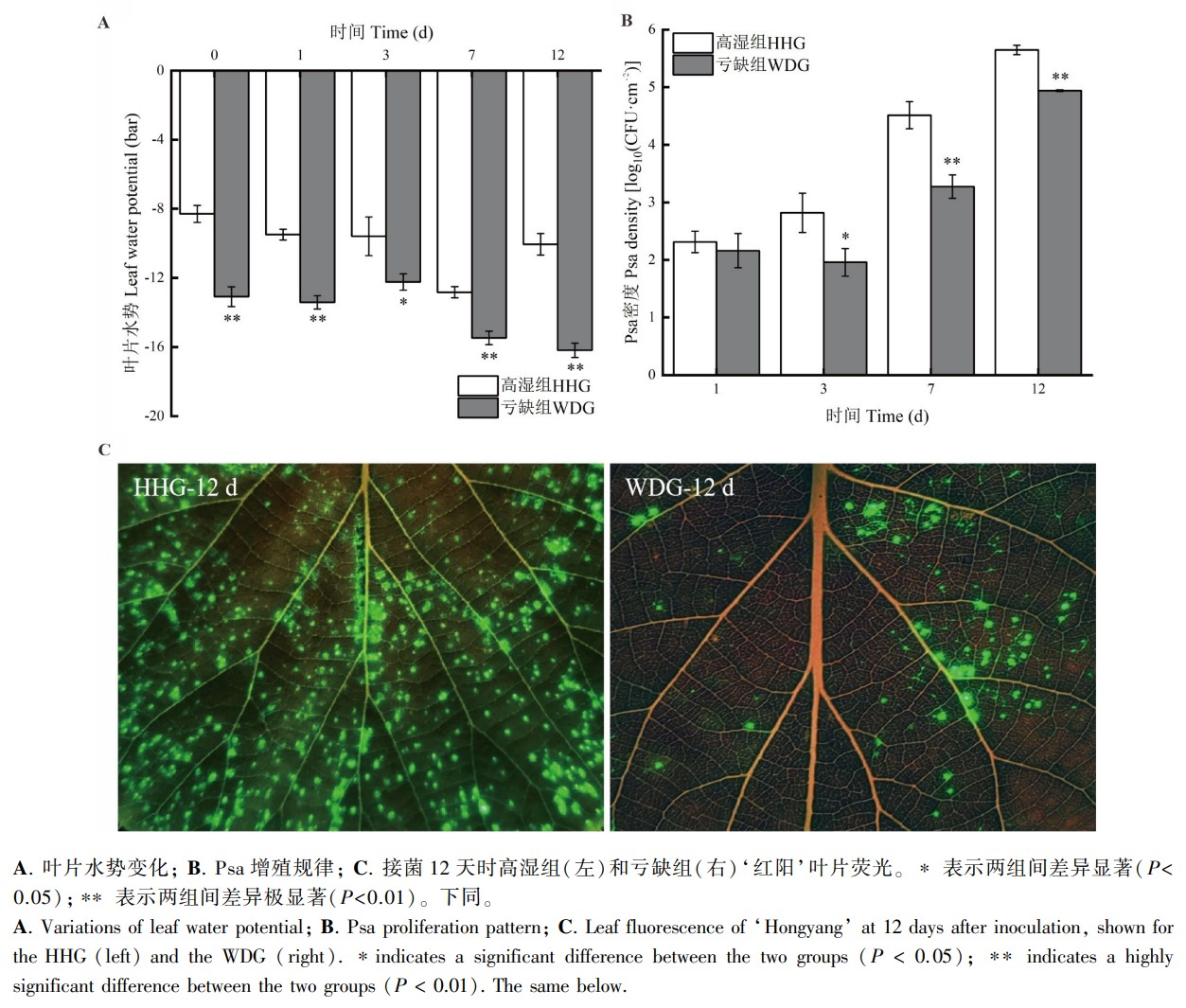
图
1
高湿组与亏缺组‘红阳’接种Psa后叶片水势变化及Psa增殖规律
Fig.
1
Variations of leaf water potential and Psa proliferation pattern in ‘Hongyang’ after Psa inoculation between the HHG and WDG
2.2 水分亏缺对气孔开度的影响
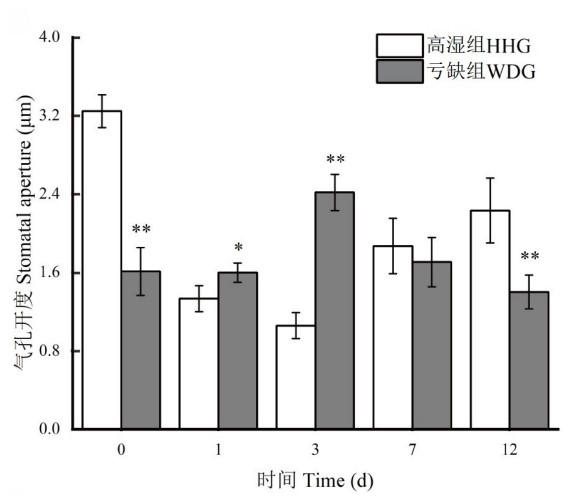
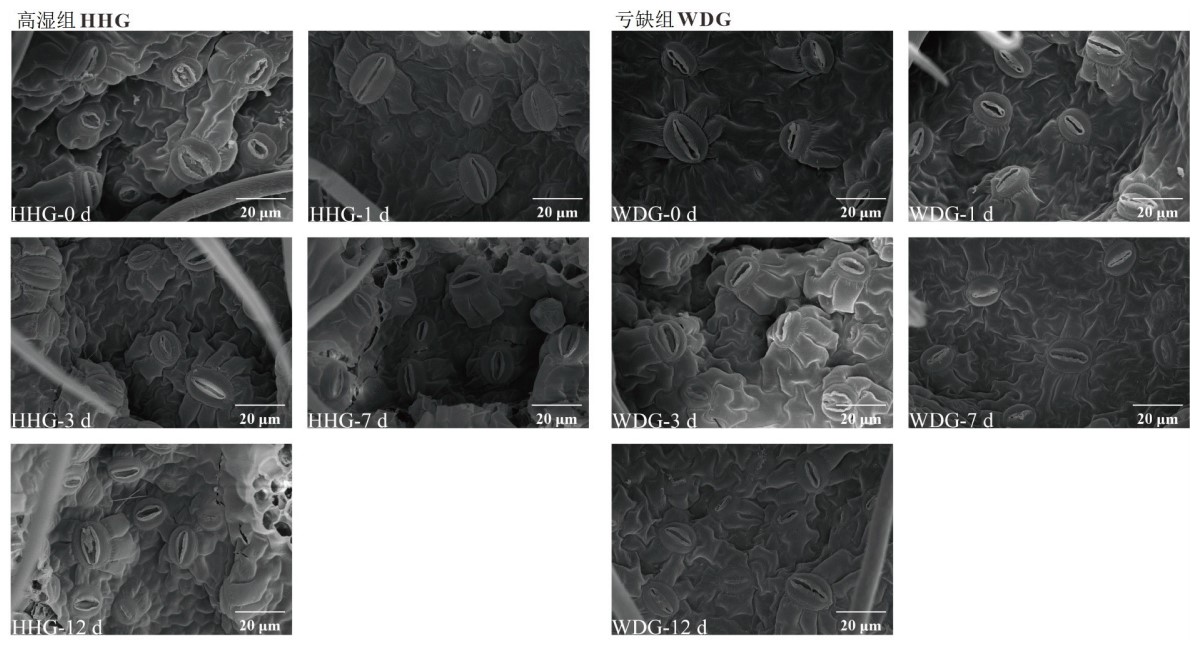
接菌前亏缺组气孔开度(1.61 μm)显著低于高湿组(3.25 μm)。接菌后高湿组气孔开度先降后升,第12 天时为2.23 μm;亏缺组气孔开度先因接菌补水短暂增大(第3 天达峰值),后持续降低,第12 天时仅为1.40 μm(图2,图3)。这表明水分亏缺可通过诱导气孔关闭阻止病原菌入侵。
图
2
高湿组与亏缺组‘红阳’接菌前后叶片气孔开度变化
Fig.
2
Variations of leaf stomatal aperture of ‘Hongyang’ leaves before and after Psa inoculation between the HHG and WDG
图
3
高湿组与亏缺组‘红阳’接菌前后叶片气孔形态变化
Fig.
3
Variations of leaf stomatal morphology of ‘Hongyang’ leaves before and after Psa inoculation between the HHG and WDG
2.3 水分亏缺对抗氧化酶活性的影响
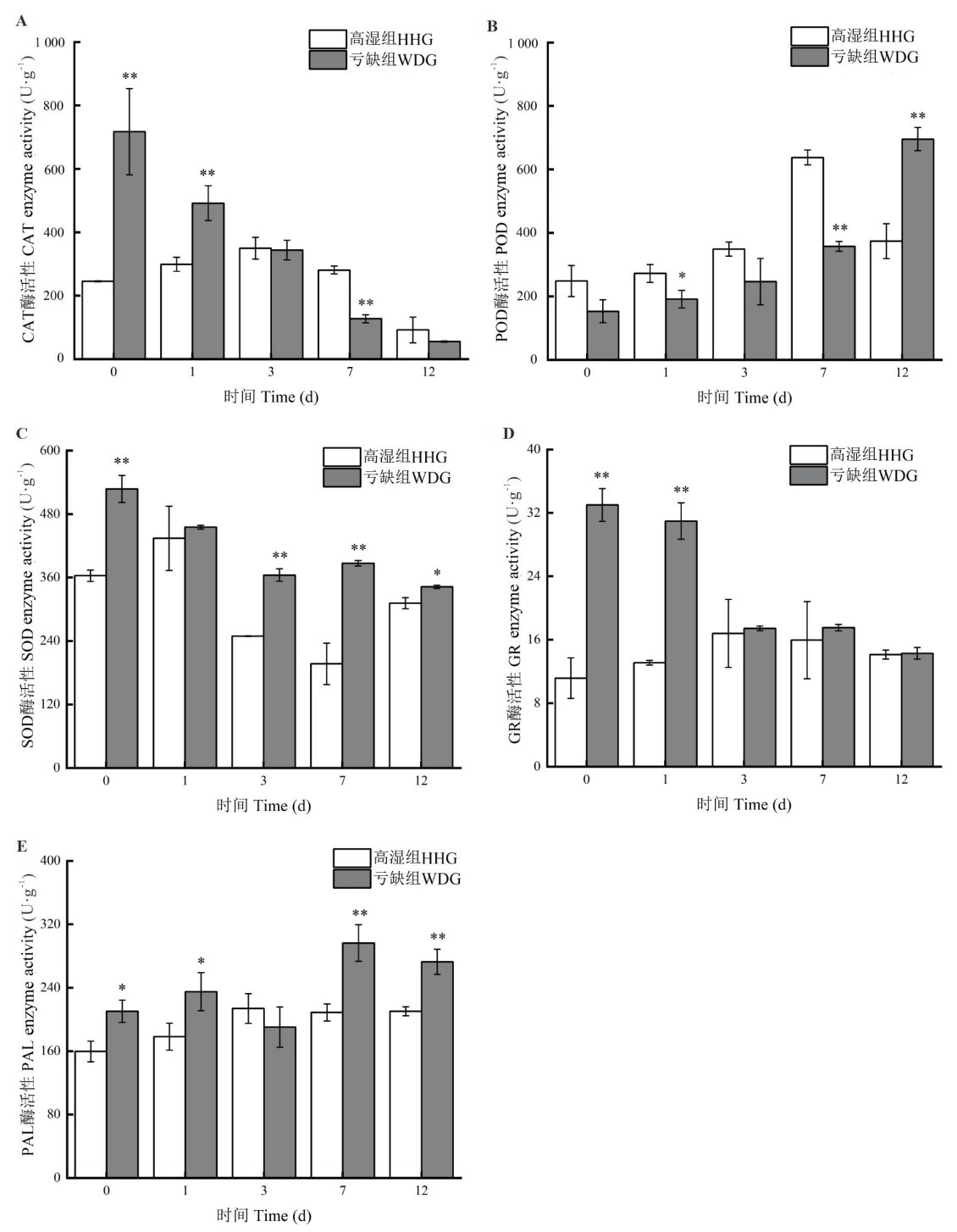
高湿组与亏缺组‘红阳’植株接种Psa后其叶片CAT酶活性变化趋势差异较大(图4:A),在接菌前亏缺组CAT酶活性显著高于高湿组(𝑃<0.01),但接菌后亏缺组CAT酶活性呈下降趋势,而高湿组CAT酶活性在前3 天呈上升趋势,第3天时达到峰值,随后降低,当接菌第7 天时亏缺组CAT酶活性显著低于高湿组(𝑃<0.01),第12 天时两组CAT酶活性无显著性差异(𝑃>0.05)。高湿组POD酶活性变化与CAT酶活性变化趋势相近,前7天呈上升趋势,在第7天时达到峰值,随后下降,而亏缺组在整个培养周期中均稳步上升,在接菌后前7 天均低于高湿组,而在第12 天时显著高于高湿组(𝑃<0.01)(图4:B)。亏缺组‘红阳’叶片中SOD酶活性在整个培养周期中呈下降趋势,且亏缺组SOD酶活性均高于高湿组,而高湿组SOD酶活性变化并无明显趋势(图4:C)。亏缺组初始GR酶活性显著高于高湿组(𝑃<0.01),但接菌后其GR酶呈下降趋势,而高湿组在前7 天均呈上升趋势,在第7天时达到峰值,随后酶活性下降(图4:D)。除接菌后第3 天外,其余时期亏缺组PAL酶活性均高于高湿组,总体而言,两组PAL酶活性均呈上升趋势(图4:E)。这表明前期水分亏缺诱导了较高的抗氧化酶活性,使植株具备更强的抗性基础。
图
4
高湿组与亏缺组‘红阳’接种Psa后叶片CAT、SOD、POD、GR和PAL的酶活性响应Psa侵染的变化
Fig.
4
Variations of CAT, SOD, POD, GR and PAL enzyme activities of‘Hongyang’ leaves in response to Psa infection
2.4 水分亏缺诱导的叶片水势下降与病原菌消亡
转入亏缺环境后,叶片水势持续降低,3 天后较转移前存在极显著性差异(𝑃<0.01)(图5:A)。伴随水势下降,病原菌密度显著降低,12 天时降至2 764.9 CFU·cm-2,消亡率达99.38%(图5:B)。荧光观察显示,当培养时间达到7 天时,叶片中荧光已出现减弱的迹象,此时叶脉中荧光分布较多,非叶脉部分大部分呈现弥散性荧光,但仍然存在非弥散性荧光。当培养时间达到第12 天时,荧光强度明显降低且荧光呈弥散性(图5:C)。可见适度水分亏缺不仅能抑制Psa的增殖,而且能有效地诱导宿主杀灭体内的病原菌。
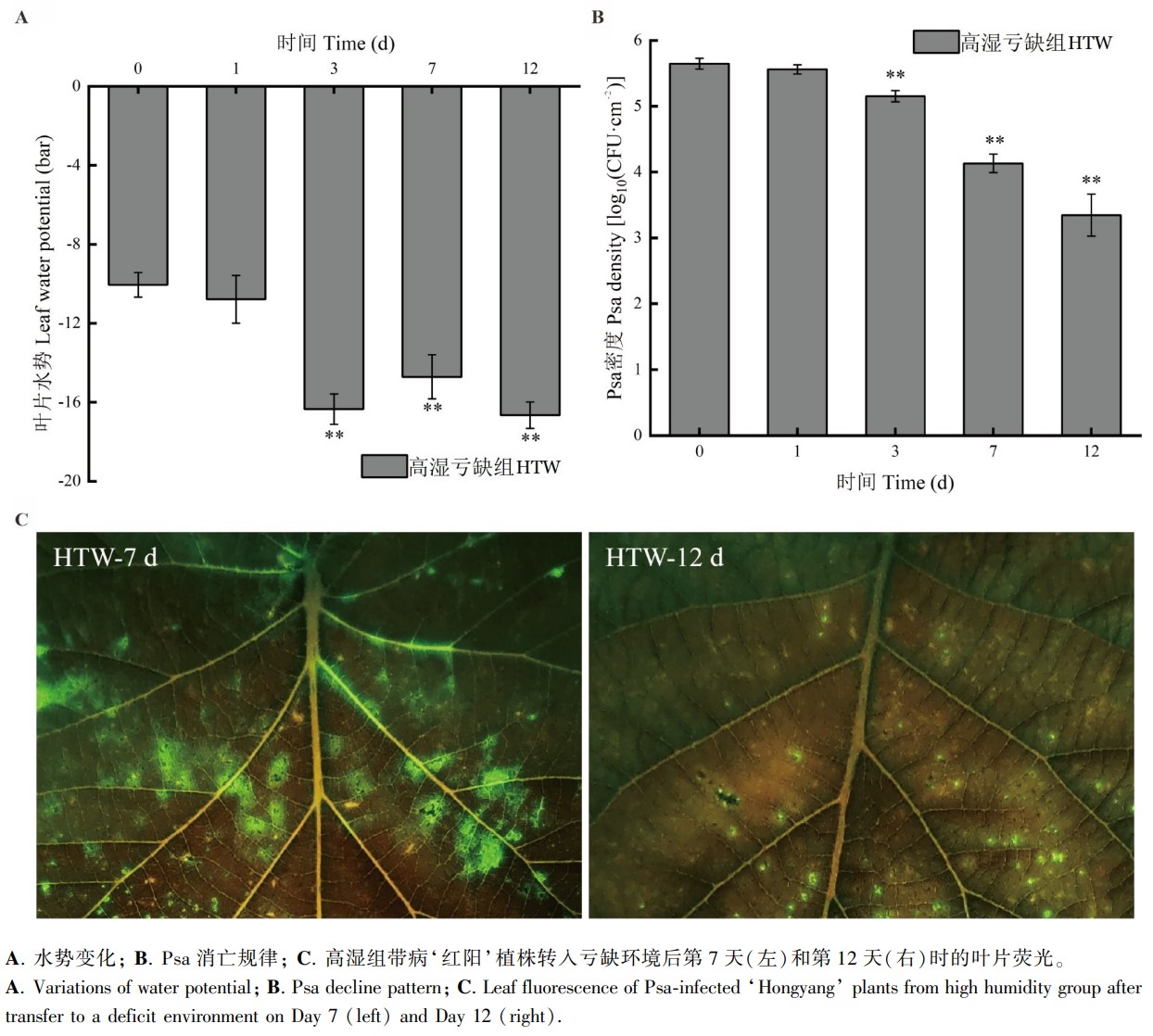
图
5
高湿组带病‘红阳’植株转入亏缺环境后叶片水势变化及Psa消亡规律
Fig.
5
Variations of leaf water potential and Psa decline pattern in Psa-infected ‘Hongyang’ plants from high humidity group after transfer to a deficit environment
2.5 高湿组带病‘红阳’植株转入亏缺环境中后气孔开度及形态变化
高湿组植株转入亏缺环境中后其气孔开度显著降低,转入亏缺环境前气孔开度为2.23 μm,而在亏缺环境中连续培养12 天后气孔开度降至0.87 μm(图6:A)。在转入亏缺处理前视野中未见完全关闭的气孔,而转入亏缺环境中培养后,视野中处于完全关闭状态的气孔所占比率持续上升,当连续培养至12 天时,视野中几乎未见处于开放状态的气孔(图6:B)。可见后期的水分亏缺处理可再次诱导带病植株气孔关闭以阻止后续病原菌入侵及组织内水分的散失。
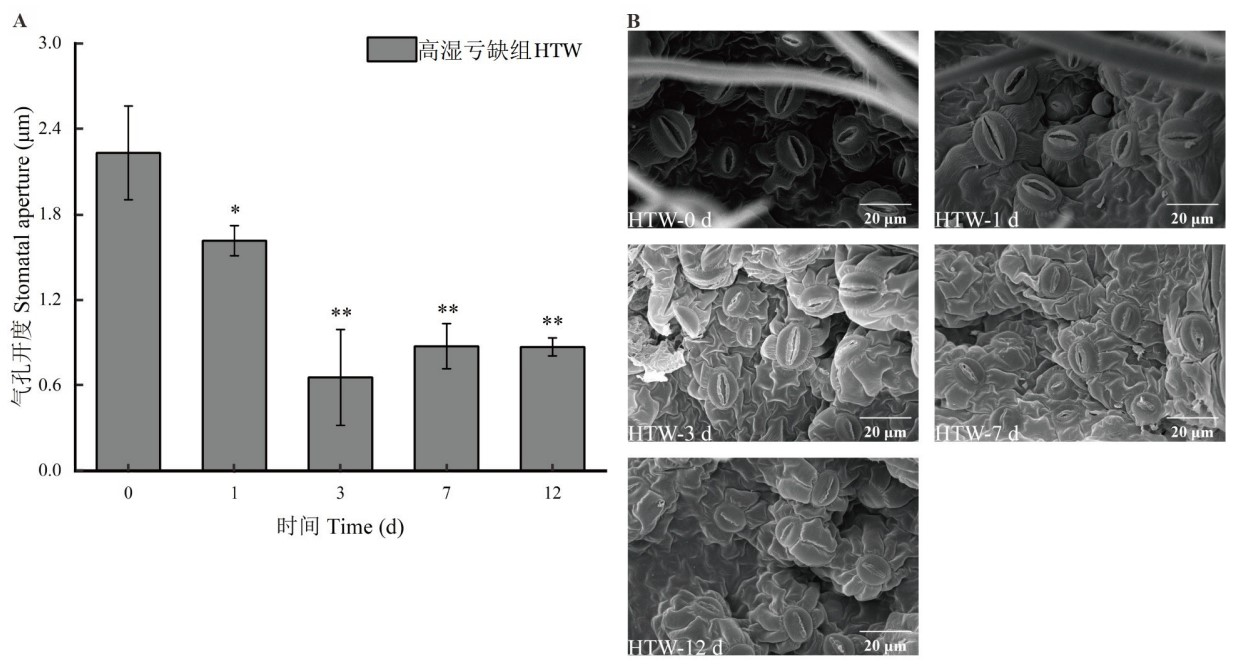
图
6
高湿组带病‘红阳’植株转入亏缺环境后叶片气孔开度和气孔形态变化
Fig.
6
Variations of leaf stomatal aperture and stomatal morphology in Psa infected ‘Hongyang’ plants from the high humidity group after transfer to a deficit environment
2.6 高湿组带病‘红阳’植株转入亏缺环境中后叶片CAT、SOD、POD、GR和PAL酶活性变化
如图7:A所示,将高湿组带病植株转入亏缺环境中后,叶片CAT酶活性在培养前1 天时稍有下降,随后呈上升趋势,当培养到第7 天时出现极显著上升(𝑃<0.01),第12 天时酶活性达到峰值。POD、GR和PAL的酶活性在整个培养周期中均呈上升趋势,但培养1 天时GR酶活性就已出现极显著性差异(𝑃<0.01),而PAL酶活性则在第3 天时出现显著性差异(𝑃<0.05), POD酶活性也在第7天时出现极显著上升(𝑃<0.01)(图7:B、D、E)。SOD酶活性在转移后的前7 天内均呈上升趋势,第7 天时达到峰值,随后下降。这表明亏缺处理可激活带病植株抗氧化酶防御系统。
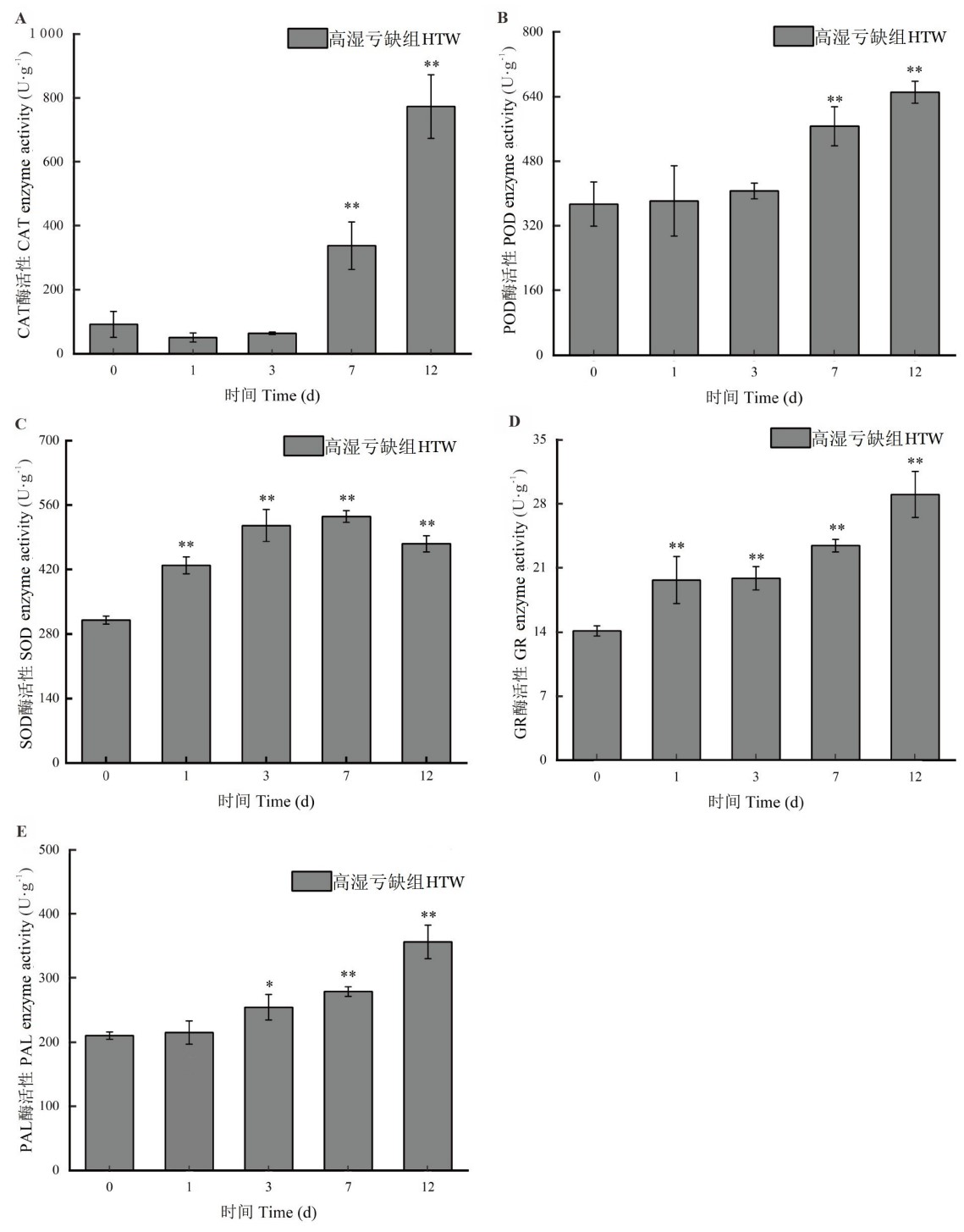
图
7
高湿组带病‘红阳’植株转入亏缺环境后叶片CAT、SOD、POD、GR和PAL的酶活性变化
Fig.
7
Variations of CAT, SOD, POD, GR and PAL enzyme activities in Psa-infected ‘Hongyang’ plants from high humidity group after transfer to a deficit environment
3 讨论与结论
在植物-水分-病原体互作过程中,病原菌成功侵染的前提是在宿主组织内建立适宜的水合微环境。Xin等(2016)提出,病原菌通过效应子诱导宿主质外体水分积累,形成“水性外质体”(aqueous apoplast),为自身增殖提供必要条件。本研究中,高湿组叶片水势在接菌前期下降、后期回升,可能与Psa侵染后诱导质外体水分积累有关;而亏缺组叶片水势持续处于较低水平且显著低于高湿组,这种持续的水分亏缺状态可能直接抑制了水性质外体的形成,从而限制了Psa的侵染与增殖。Aung等(2018)的研究进一步证实,宿主水势降低会诱导病原菌合成渗透调节物质以维持形态,但同时也抑制了病原菌的活性。本研究中,亏缺组接菌12天时病原菌数量仅约为高湿组的1/5,这一结果提示,持续的水分亏缺状态可能通过抑制水性质外体形成或影响病原菌活性,从而限制了Psa的侵染与增殖。
气孔是Psa入侵的主要通道。其开闭状态受水分胁迫与病原菌侵染的双重调控。在水分亏缺条件下,植物会通过ABA信号通路诱导气孔的适应性关闭(Cutler et al., 2010),而气孔关闭直接阻断了Psa通过气孔进入叶肉组织的通道,削弱了病原菌建立侵染位点的能力(Melotto et al., 2006; Froud et al., 2018)。本研究中水分亏缺处理显著降低了‘红阳’猕猴桃叶片气孔开度,这一变化有利于阻断Psa通过气孔进入叶肉组织的通道,从而抑制病原菌的入侵。然而,成功入侵的Psa可通过释放茉莉酸甲酯类似物抑制植物内源激素水杨酸(salicylic acid)的合成并引起气孔的重新开放以促进后续病原菌的侵染(Cellini et al., 2021)。这在本研究中得到了验证,即高湿组在感染病原菌后,气孔开度在感染前期呈下降趋势,而在第3 天后,叶片气孔开度又增大。然而,亏缺组中并未出现气孔的重新开放,说明水分亏缺诱导的气孔关闭效应强于Psa效应子诱导的重新开放,从而持续阻断病原菌入侵通道。
本研究中,接菌前水分亏缺处理组中,‘红阳’CAT、SOD、GR和PAL的酶活性均显著高于高湿组,表明适度水分亏缺诱导了植株抗氧化防御能力的提升。抗氧化系统的激活一方面可有效地清除由水分亏缺处理和病原菌侵染诱发的过量ROS积累,维持细胞氧化还原稳态(Torres, 2010);另一方面,ROS作为信号分子在低浓度时可激活防御基因表达,而抗氧化酶对ROS水平的精细调控则有助于平衡防御响应与细胞损伤之间的关系(Mittler et al., 2011)。更为重要的是,抗氧化系统与超敏反应(hypersensitive response,HR)密切相关——适度的ROS爆发可触发感染部位细胞程序性死亡,形成物理屏障以限制病原菌扩散,而抗氧化酶的同步激活则可防止ROS过度积累而对周边健康组织造成损伤(Mittler et al., 2011; Nunes da Silva et al., 2020)。上述机制在本研究中得到印证,即高湿组带病植株转入亏缺环境后,5种抗氧化酶活性均显著上调,同时伴随病原菌大量消亡,提示抗氧化系统的激活可能参与了宿主对已定殖Psa的清除过程。推测适度水分亏缺通过诱导抗氧化酶活性上升,增强了植株对ROS的精细调控能力,在促进超敏反应发生的同时保护周边组织,从而协同实现对已定殖病原菌的有效清除。此外,PAL和POD是植物木质素合成的关键酶和限速酶(Vanholme et al., 2010; Liu et al., 2018),二者活性上升可能促进木质素沉积;而植物细胞壁次生木质化及导管处木质素沉积,在防止病原菌扩散和水分调控中发挥重要作用(Emonet & Hay, 2022; Zhang et al., 2023)。这进一步印证了亏缺处理的防御调控作用,补充了互作体系下的酶活性调控机制研究。
本研究结果显示,预先的水分亏缺处理可有效抑制猕猴桃溃疡病致病菌的入侵,对已感病植株的水分亏缺处理可有效诱导宿主内病原菌的消亡,但其具体机制仍需进一步研究。需要注意的是,本研究目前主要基于实验室条件探讨水分亏缺对Psa入侵方式的影响,或通过调控植物自身代谢机理间接作用于Psa入侵过程,该理论在实际产业应用中,还需考虑多种环境因素的综合作用。例如,实际生产中采用的控雨栽培模式,会使猕猴桃植株地上部分的光照、温度、湿度条件与地下部分的土壤理化性质、微生物群落结构发生显著改变,与实验室可控环境存在较大差异。因此,适度水分亏缺理论要真正应用于猕猴桃实际生产,还需更科学地揭示Psa感染猕猴桃过程中的水分控制途径,明确水分调控与其他环境因素(如土壤肥力、田间温湿度、微生物互作等)的协同作用机制,阐明各因素共同影响猕猴桃抗溃疡病能力的综合原因。综上所述,水分亏缺理论在猕猴桃实际生产过程中具备较大的应用潜力,可为搭建避雨棚等栽培措施防控和治愈猕猴桃细菌性溃疡病提供理论基础,但后续仍需开展更多田间试验与多因素协同研究,推动该理论的产业化落地。
本研究证实,适度水分亏缺对猕猴桃细菌性溃疡病兼具预防与治疗双重效应。在预防层面,亏缺处理通过降低叶片水势、诱导气孔关闭阻断Psa入侵通道,同时上调CAT、SOD、GR、PAL等抗氧化酶活性,使植株具备更强的抗性基础,接菌后病原菌增殖被显著抑制。在治疗层面,将已感病植株转入亏缺环境后,叶片水势持续下降,气孔进一步关闭,抗氧化酶系统被显著激活,可有效诱导宿主清除已定殖的病原菌。综上,适度水分亏缺是防控猕猴桃溃疡病的有效策略,本研究为控雨栽培等田间水分调控措施提供了理论依据。