


摘要
兰科植物生长发育与根际土壤及根内微生物密切相关,解析其微生物群落特征,对指导人工繁育、野外保护和潜在功能微生物资源挖掘具有重要意义。该研究以神农架地区的野生绿花杓兰(Cypripedium henryi)和扇脉杓兰(C. japonicum)为对象,采用高通量测序技术,分析其花期和果期根际土壤及根内真菌、细菌群落的组成、多样性及潜在功能。结果表明:(1)两种杓兰根际土壤与根内共检出真菌14门、细菌38门,真菌优势门为子囊菌门(Ascomycota)、担子菌门(Basidiomycota)和被孢霉门(Mortierellomycota),细菌优势门为变形菌门(Proteobacteria)、酸杆菌门(Acidobacteriota)和放线菌门(Actinobacteria)。(2)根际土壤真菌和细菌群落的丰富度及均匀度整体高于根内,其中根际土壤真菌丰富度由花期至果期显著升高,而根内细菌丰富度显著下降。(3)生态位对两种杓兰根际土壤与根内微生物群落结构差异具有较高解释度,对真菌和细菌群落变异的解释度分别为19.49%和60.20%。(4)发育阶段影响部分微生物类群的丰度变化及群落功能分化,从花期到果期,根际土壤真菌和根内细菌分别有13个属和20个属的相对丰度发生显著变化。(5)根际土壤与根内真菌群落功能组成差异明显,而细菌群落功能谱相对稳定,根际土壤微生物互作中竞争与协同并存,根内群落则以正相关关系为主。该文初步阐明了神农架两种杓兰根际土壤和根内真菌、细菌群落的组成特征及其与生态位、发育阶段和宿主种类的关系,结果可为杓兰属植物共生微生物筛选、人工繁育及种群保护提供基础数据参考。
Abstract
The growth and development of orchids are closely associated with microorganisms in rhizosphere soil and root endosphere. Characterizing orchid-associated microbial communities is of great significance for guiding artificial propagation, field conservation, and the exploration of potential functional microbial resources. To clarify the microbial community characteristics of endangered Cypripedium species in Shennongjia, wild Cypripedium henryi and C. japonicum were used as experimental materials. High-throughput sequencing was used to analyze the composition, diversity, and potential functions of fungal and bacterial communities in rhizosphere soil and root endosphere at the flowering and fruiting stages. The results were as follows: (1) A total of 14 fungal phyla and 38 bacterial phyla were detected in rhizosphere soil and root endosphere of the two Cypripedium species. The dominant fungal phyla were Ascomycota, Basidiomycota, and Mortierellomycota, and the dominant bacterial phyla were Proteobacteria, Acidobacteriota, and Actinobacteria. (2) The richness and evenness of fungal and bacterial communities in rhizosphere soil were generally higher than those in root endosphere. Fungal richness in rhizosphere soil increased significantly from the flowering stage to the fruiting stage, whereas bacterial richness in root endosphere decreased significantly. (3) Ecological niche explained a relatively high proportion of the differences in microbial community structure between rhizosphere soil and root endosphere of the two Cypripedium species, accounting for 19.49% and 60.20% of the variation in fungal and bacterial communities, respectively. (4) Developmental stage affected the abundance changes of some microbial taxa and differentiation of community functions. From the flowering stage to the fruiting stage, the relative abundance of 13 fungal genera in rhizosphere soil and 20 bacterial genera in root endosphere changed significantly. (5) The functional composition of fungal communities differed markedly between rhizosphere soil and root endosphere, whereas the functional profiles of bacterial communities were relatively stable. Competitive and cooperative interactions coexisted in rhizosphere soil microbial communities, whereas positive correlations dominated in root-endosphere microbial communities. This study preliminarily clarifies the composition characteristics of fungal and bacterial communities in rhizosphere soil and root endosphere of two Cypripedium species in Shennongjia, as well as their associations with ecological niche, developmental stage, and host species. These findings provide foundational data for screening symbiotic microorganisms, artificial propagation, and population conservation of Cypripedium plants.
兰科(Orchidaceae)物种多样性丰富,全球约有750属28 000种(Chase et al., 2015),我国约有200属1 800种(张成等,2025)。杓兰属(Cypripedium)是兰科中兼具观赏和药用价值的重要类群,除离萼杓兰外,该属其余物种均被列为国家二级及以上保护植物(国家林业和草原局农业农村部,2021)。目前,杓兰属植物相关研究大多集中于传粉生物学(代彩琴,2025)、分布格局预测(吴艳,2022)、生境适宜性与引种回归(Rusconi et al., 2023)以及胚发育和离体繁育(Perner et al., 2022; Kaur, 2023)等方面。兰科植物种子微小且缺乏胚乳,自然萌发率极低,其种子萌发、原球茎形成及幼苗建成等过程通常需要特定菌根真菌参与(Smith & Read, 2008;Genre et al., 2020;Těšitelová et al., 2022;Yang et al., 2024;Yu et al., 2026)。因此,解析兰科植物相关微生物群落的组成及变化规律,对于认识其生长发育和环境适应的微生态过程具有重要意义。
植物根系微生物是连接植物与土壤环境的重要生物因子,根际土壤和根内组织的微生物可参与宿主营养获取和生长调控等过程(Park et al., 2023; Luo et al., 2025)。近年来,包括玉米、黑枸杞、木麻黄、大豆等植物根系微生物的研究已从单纯的群落组成分析,逐渐拓展到生态位分化、宿主筛选及发育阶段动态变化等方面(Xiong et al., 2021; Li et al., 2022; Lin et al., 2022; Wang et al., 2024),这些研究表明,生态位、宿主种类和发育阶段是影响植物根系微生物群落的重要因素。目前,关于杓兰属植物宿主与根际及根内微生物关系的系统研究仍较有限。周珊(2020)对扇脉杓兰(Cypripedium japonicum)根内和根际真菌多样性进行了分析,但不同宿主种类、生态位及发育阶段下微生物群落的变化规律仍有待进一步明确。
神农架地处北半球中纬度生物多样性热点地区,兰科植物资源丰富,其中杓兰属多达10种(张成等,2025)。绿花杓兰(C. henryi)和扇脉杓兰野外种群数量有限,生境易受扰动,其保护与人工繁育亟需根系相关微生物数据支撑。因此,本研究以神农架地区的绿花杓兰和扇脉杓兰为研究对象,采用高通量测序技术,分析两种杓兰在不同发育阶段(花期、果期)与生态位(根际、根内)的真菌及细菌群落特征,探讨两种杓兰根际土壤与根内真菌、细菌群落是否随生态位和发育阶段发生分化,并筛选与宿主种类、生态位或发育阶段相关的优势类群及潜在功能类群,以期为濒危杓兰属植物的保护与人工繁育提供微生物组学依据。
1 材料与方法
1.1 样品采集及处理
于2025年4月(花期)和7月(果期)在湖北神农架官门山景区(110.386°E、31.443°N,海拔约1 200 m)同一地点采样。在每个采样时期,均仅于该地点分别选取长势一致的绿花杓兰和扇脉杓兰各1株进行采样。本研究涉及的两种杓兰采样,已取得神农架国家公园管理局审批许可。根据Ge 等(2021)的方法,用无菌毛刷收集紧贴根表2 mm以内的根际土壤,剪取幼嫩根段(长约3 cm),用无菌水冲洗以去除表面浮土及杂质。本研究共设置8个样品组,每组采集3份平行样品,共24份。各组平行样品均取自相应物种在对应时期的同一植株,样品编号依据物种、发育阶段、植物组织或土壤,即CH(绿花杓兰)、CJ(扇脉杓兰),b(花期)、f(果期),r(根系)、s(根际土壤),组合成共8个组(具体编号及信息见表1),如CHfr表示绿花杓兰果期的根系样品。
1.2 总DNA抽提及高通量测序
根样品先经无菌水冲洗3 min后,用体积分数75%乙醇浸泡1 min,再用有效氯质量分数2%次氯酸钠溶液浸泡3 min,接着用体积分数75%乙醇浸泡1 min,最后用无菌水冲洗30 s(Ren et al., 2019)。取最终洗液涂布于PDA和LB平板,28 ℃培养48 h,检测表面消毒是否彻底。使用磁珠法DNA提取试剂盒(上海美吉逾华生物医药科技有限公司)抽提根际土壤和根样品的总DNA。利用NanoDrop 2000检测DNA浓度与纯度,并通过1%琼脂糖凝胶电泳检测DNA质量。
采用引物ITS1F/ITS2R扩增真菌ITS1区(White et al., 1990)。PCR反应体系20 μL:2×Pro Taq 10 μL,正、反向引物(5 μmol·L-1)各0.8 μL,DNA模板(10 ng·μL-1)1 μL,用无菌蒸馏水补足至20 μL。反应程序为95 ℃预变性3 min,35个循环(95 ℃变性30 s, 55 ℃退火30 s, 72 ℃延伸45 s),72 ℃终延伸10 min。细菌16S rRNA基因V3-V4区采用引物338F/806R扩增(Klindworth et al., 2013)。PCR反应体系同上。反应程序如下:95 ℃预变性3 min;29个循环(95 ℃变性30 s, 53 ℃退火30 s, 72 ℃延伸45 s);72 ℃终延伸10 min。PCR产物经2%琼脂糖凝胶电泳检测并纯化,送上海美吉生物医药科技有限公司于Illumina Nextseq 2000平台进行双端测序。原始数据已上传至NCBI SRA数据库(https://www.ncbi.nlm.nih.gov/sra),登录号为PRJNA1394500。
1.3 数据处理与分析
利用fastp(Chen et al., 2018)对原始数据进行质控:去除接头序列;以滑动窗口法(window size=10 bp)切除平均质量Q<20的碱基;去除含N碱基的reads;保留长度≥50 bp的高质量序列。使用FLASH(Magocˇ & Salzberg, 2011)进行双端序列拼接:最小重叠长度10 bp,重叠区最大错配率0.2。利用UPARSE软件(Stackebrandt & Goebel, 1994;Edgar, 2013),按97%相似度对序列进行操作分类单元(operational taxonomic unit, OTU)聚类。微生物群落Alpha多样性选用Ace指数衡量丰富度,Pielou_e指数反映均匀度,Coverage指数反映覆盖率。Beta多样性基于Bray-Curtis距离进行非度量多维尺度分析(non-metric multidimensional scaling,NMDS),并通过置换多元方差分析(permutational multivariate analysis of variance,PERMANOVA)检验显著性水平(置换次数为999)。群落组成分析选用抽平后的OTU表,绘制门水平柱状图(合并丰度<10),基于Venn图中各组特有的OTU绘制门水平趋势表、属水平Heatmap图(分类水平总丰度前25的物种)。采用FUNGuild预测真菌群落功能(Nguyen et al., 2016),利用PICRUSt2结合KEGG数据库(https://www.genome.jp/kegg/)预测细菌群落的代谢功能(Koner et al., 2021)。使用Spearman相关性分析(|𝑟|≥0.8,𝑃<0.05)构建微生物单因素相关性网络及物种间的相互关系(Xiao et al., 2016)。
2 结果与分析
2.1 两种杓兰根际土壤及根内微生物群落多样性分析
Alpha多样性分析表明,绿花杓兰和扇脉杓兰根际土壤真菌Ace指数平均值分别从花期的618.76和494.64显著上升到果期的1 393.76和1 116.28,均显著高于根内(69.69~120.24),而二者的根内真菌Ace指数变化不显著(表1)。绿花杓兰和扇脉杓兰根际土壤细菌Ace指数从花期到果期变化不显著(平均值3 966.83~4 368.83),显著高于根内(平均值402.94~1 955.30),而根内细菌的Ace指数平均值从花期的1 955.30和1 269.62显著下降到果期的949.50和402.94。绿花杓兰花期和果期的根内细菌丰富度分别为1 955.30±419.68和949.50±190.84,显著高于扇脉杓兰的1 269.62±350.44和402.94±62.55(表2)。
表
1
基于OTU水平分析两种杓兰根际土壤及根内真菌的Alpha多样性
Table
1
Alpha diversity of fungi in the rhizosphere soil and root endosphere of two Cypripedium species based on OTU level
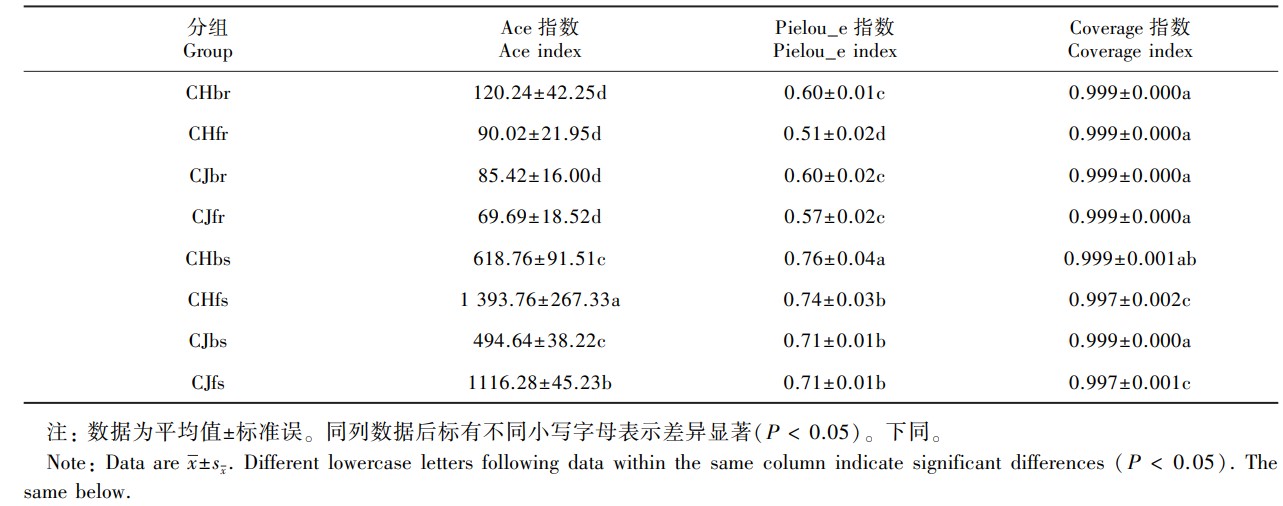
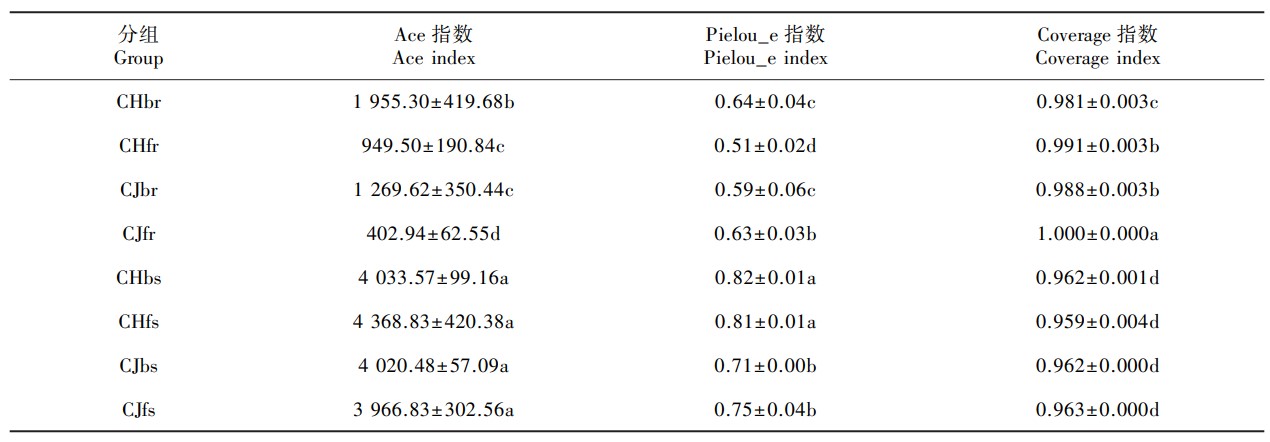
表2 基于OTU水平分析两种杓兰根际土壤及根内细菌的Alpha多样性
两种杓兰根际土壤微生物群落的Pielou_e指数均高于根内,其中根际真菌(0.71~0.76)和细菌(0.71~0.82)分别高于根内真菌(0.51~0.60)和细菌(0.51~0.64),表明根际土壤微生物群落组成较根内更为均匀(表1,表2)。
两种杓兰根际土壤及根内真菌群落的Coverage指数均大于0.99,细菌群落的Coverage指数均大于0.95,说明测序结果能全面真实地反映样品微生物的群落组成(表1,表2)。
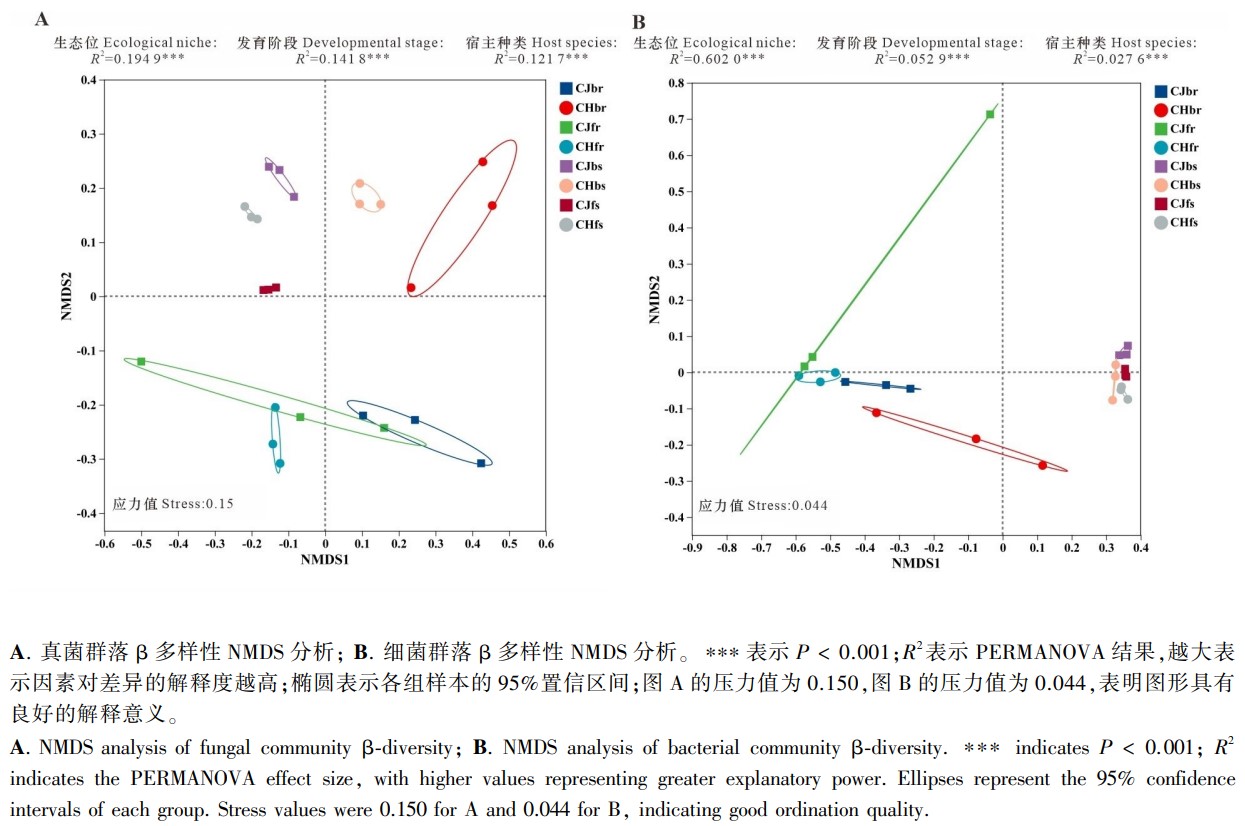
基于Bray-Curtis距离对两种杓兰根际土壤及根内微生物群落进行非度量多维尺度(NMDS)排序并结合置换多元方差(PERMANOVA)分析,结果(图1)显示,两种杓兰的两个发育阶段,其根际土壤和根内的真菌、细菌群落结构有显著性差异。生态位是两种杓兰微生物群落变异的最主要的解释因子(真菌R2=0.194 9,𝑃< 0.001;细菌R2=0.602 0,𝑃< 0.001),植物发育阶段和植物种类对真菌群落的解释力较高,而对细菌群落的解释力较低。
图
1
两种杓兰根际土壤及根内微生物群落NMDS分析结合PERMANOVA分析
Fig.
1
NMDS analysis of microbial communities in the rhizosphere soil and root endosphere of two Cypripedium species combined with PERMANOVA analysis
2.2 两种杓兰根际土壤及根内微生物群落结构比较
2.2.1 两种杓兰根际土壤及根内微生物群落结构
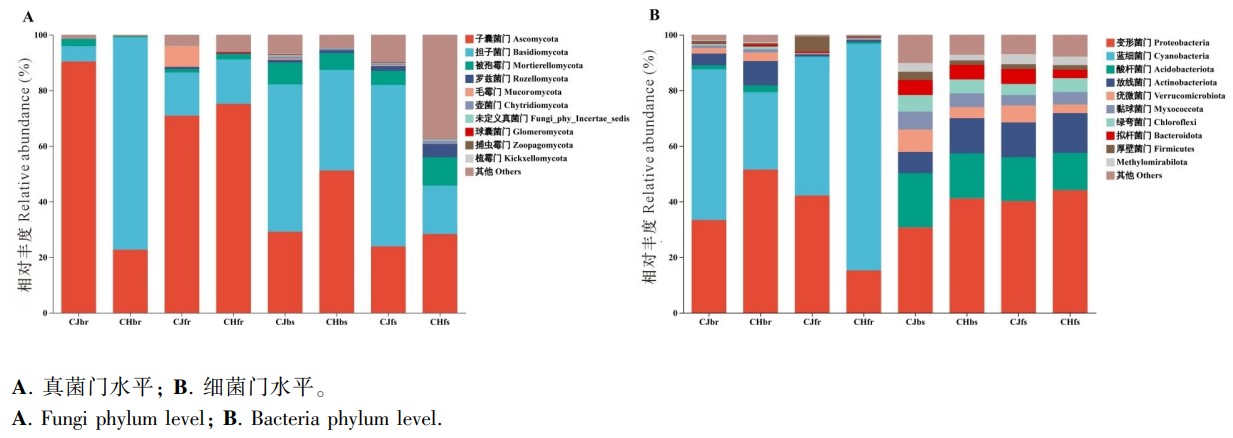
两种杓兰的根际土壤与根内真菌分布于14门,以子囊菌门、担子菌门和被孢霉门为优势门。根际土壤真菌以3个优势门为主,CHbs和CHfs的占比分别为93.40%和55.94%,CJbs和CJfs的占比分别为90.03%和87.04%;根内真菌以子囊菌门和担子菌门为主,CHbr和CHfr的占比分别为99.13%和91.13%,CJbr和CJfr的占比分别为95.92%和86.41%(图2:A)。
两种杓兰的根际土壤与根内细菌分布于38门,优势菌门为变形菌门、酸杆菌门、放线菌门与蓝细菌门。根际细菌以变形菌门、酸杆菌门、放线菌门为主,CHbs和CHfs占比分别为69.90%和71.76%、CJbs和CJfs占比分别为57.72%和68.43%;根内细菌以变形菌门和蓝细菌门为主,CHbr和CHfr占比分别是79.37%和96.82%,CJbr和CJfr占比分别是87.59%和92.12%(图2:B)。
图
2
两种杓兰根际土壤及根内微生物群落组成
Fig.
2
Composition of microbial communities in the rhizosphere soil and root endosphere of two Cypripedium species
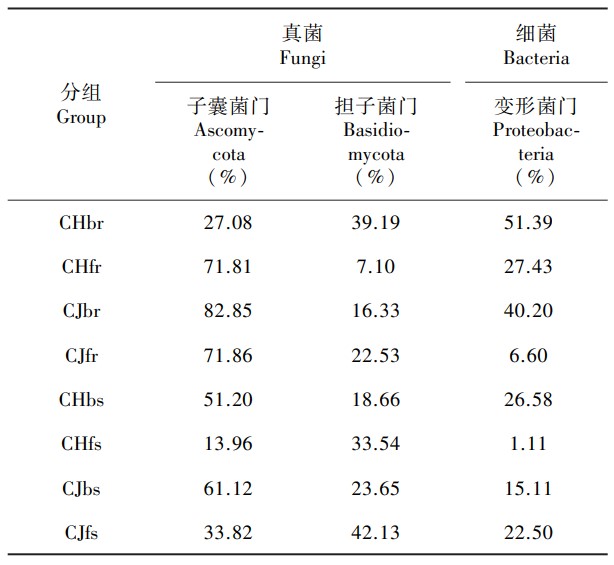
Venn分析表明,8个样品组的真菌OTU总计2 758个,其中共有的OTU仅11个,而8个样品组细菌共有的OTU为204个,OTU总计5 165个。真菌和细菌群落结构随发育阶段及植物种类发生变化(表3),从花期到果期,两种杓兰根际土壤真菌群落中子囊菌门相对丰度均下降,担子菌门均上升,并且扇脉杓兰无论花期还是果期,其根际土壤的子囊菌门与担子菌门占比均高于绿花杓兰;而根内真菌群落的变化则表现出种间差异。细菌群落从花期到果期,两种杓兰根际土壤中变形菌门相对丰度均呈上升趋势,而根内则均呈下降趋势,并且无论花期还是果期,绿花杓兰根际土壤和根内变形菌门的相对丰度均高于扇脉杓兰。
表
3
基于Venn分析的两种杓兰根际土壤及根内优势真菌和细菌门水平的相对丰度
Table
3
Relative abundance of dominant fungal and bacterial phyla in the rhizosphere soil and root endosphere of two Cypripedium species based on Venn analysis
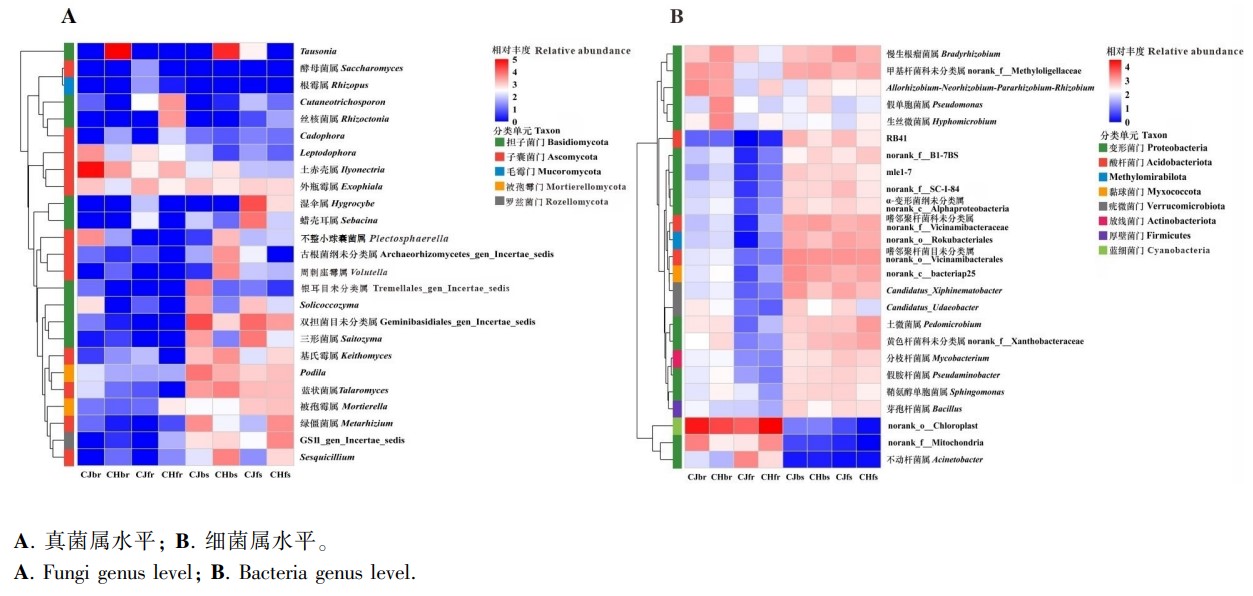
2.2.2 两种杓兰根际土壤及根内微生物属水平差异两种杓兰根际土壤与根内微生物群落具有较高的多样性,共检出真菌805属、细菌729属。从花期到果期,两种杓兰根际土壤真菌与根内细菌群落结构发生显著变化。其中,根际土壤中13个真菌属的相对丰度呈动态变化:丰度上升的有7个属,分别为如担子菌门湿伞属(H𝑦groc𝑦be)等5个属,子囊菌门1个属Cadophora,被孢霉门1个属被孢霉属(Mortierella);丰度下降的有6个属,分别为子囊菌门土赤壳属(Ilyonectria)等4个属,担子菌门1个属银耳目未分类属(Tremellales_gen_Incertae_sedis),被孢霉门1个属Podila(图3:A)。根内细菌20个属的丰度发生改变,仅变形菌门中不动杆菌属(Acinetobacter)的丰度上升,其余19个属丰度均下降,包括变形菌门中慢生根瘤菌属(Bradyrhizobium)等12个属,酸杆菌门中RB41等3个属,疣微菌门2个属Candidatus_Udaeobacter、Candidatus_Xiphinematobacter,厚壁菌门中芽孢杆菌属(Bacillus),Methylomirabilota门中norank_o__Rokubacteriales(图3:B)。
图
3
两种杓兰的根际土壤及根内微生物群落热图
Fig.
3
Heatmap of microbial communities in the rhizosphere soil and root endosphere of Cypripedium
两种杓兰的微生物群落结构存在差异,根际土壤真菌中,扇脉杓兰8个属[Cadophora、外瓶霉属(Exophiala)、Leptodophora、三形菌属(Saitozyma)、蜡壳耳属(Sebacina)、Solicoccozyma、双担菌目未分类属(Geminibasidiales_gen_Incertae_sedis)及银耳目未分类属(Tremellales_gen_Incertae_sedis)]的丰度(0.55~3.96)高于绿花杓兰(0.48~3.47),而绿花杓兰仅3个属[基氏霉属(Keithomyces)、不整小球囊菌属(Plectosphaerella)、Sesquicillium]的丰度(1.91~3.47)高于扇脉杓兰(0.55~2.88)。根内细菌中,绿花杓兰有10个属[土微菌属(Pedomicrobium)、生丝微菌属(Hyphomicrobium)、Candidatus_Xiphinematobacter、RB41、mle1-7、嗜邻聚杆菌目未分类属(norank_o__Vicinamibacterales)、嗜邻聚杆菌科未分类属(norank_f__Vicinamibacteraceae)、norank_o__Rokubacteriales、黄色杆菌科未分类属(norank_f__Xanthobacteraceae)及α-变形菌纲未分类属(norank_c__Alphaproteobacteria)]的丰度(0.31~3.20)较高,扇脉杓兰则仅4个属[不动杆菌属(Acinetobacter)、芽孢杆菌属(Bacillus)、Candidatus_Udaeobacter及甲基杆菌科未分类属(norank_f__Methyloligellaceae)]的丰度(0.01~2.39)更高,表明扇脉杓兰根际土壤真菌群落更具多样性,而绿花杓兰根内细菌群落更为丰富。
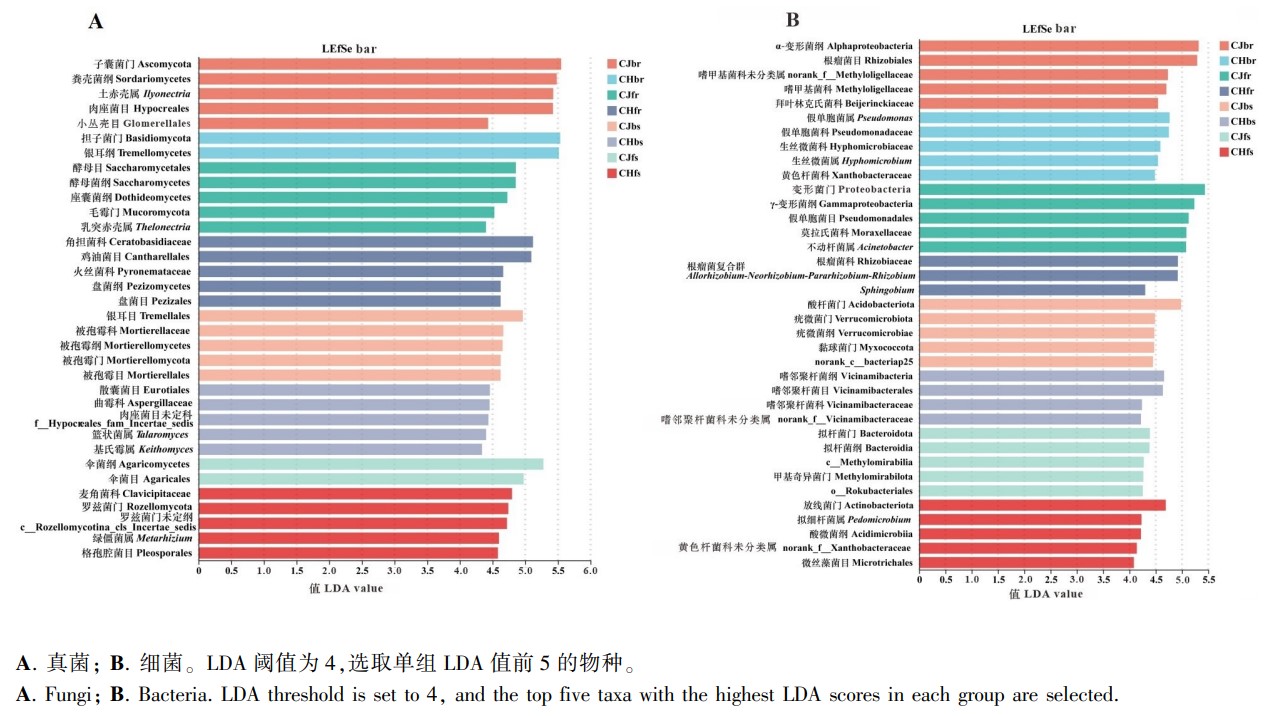
LEfSe多级物种差异判别分析表明,LDA阈值为4时,选取前5的差异标志类群,这些标志类群提示该物种可能在环境变化过程中起到关键作用。两种杓兰的根际土壤和根内真菌共有37个差异标志类群(图4:A)。各组在最低分类水平上的差异标志类群组成存在差异,如花期根际土壤的差异标志类群,扇脉杓兰是被孢霉科(Mortierellaceae),绿花杓兰是蓝状菌属(Talaromyces)和基氏霉属(Keithomyces),而在根内,扇脉杓兰是土赤壳属(Ilyonectria),绿花杓兰是银耳纲(Tremellomycetes);果期根际土壤的差异标志类群,扇脉杓兰是伞菌纲(Agaricomycetes),绿花杓兰是绿僵菌属(Metarhizium),在根内,扇脉杓兰是乳突赤壳属(Thelonectria),绿花杓兰是角担菌科(Ceratobasidiaceae)和火丝菌科(Pyronemataceae)。
图
4
两种杓兰根际土壤及根内微生物群落 LDA 判别结果
Fig.
4
LDA discrimination results for microbial communities in the rhizosphere soil and root endosphere of two Cypripedium species
在LDA阈值为4时,两种杓兰根际土壤细菌共有19个差异标志类群,根内细菌共有18个差异标志类群,各组在最低分类水平上的差异标志类群组成存在差异(图4:B)。花期根际土壤的差异标志类群中,扇脉杓兰是疣微菌纲(𝑉errucomicrobiae),绿花杓兰是嗜邻聚杆菌科(Vicinamibacteraceae),在根内,扇脉杓兰是嗜甲基菌科(Methyloligellaceae)和拜叶林克氏菌科(Beijerinckiaceae),绿花杓兰是假单胞菌属(Pseudomonas)和生丝微菌属(Hyphomicrobium);果期根际土壤的差异标志类群中,扇脉杓兰是Rokubacteriales,绿花杓兰是拟细杆菌属(Pedomicrobium),在根内,扇脉杓兰是不动杆菌属(Acinetobacter),绿花杓兰是Allorhizobium-Neorhizobium-Pararhizobium-Rhizobium和Sphingobium。
2.3 微生物群落功能分析
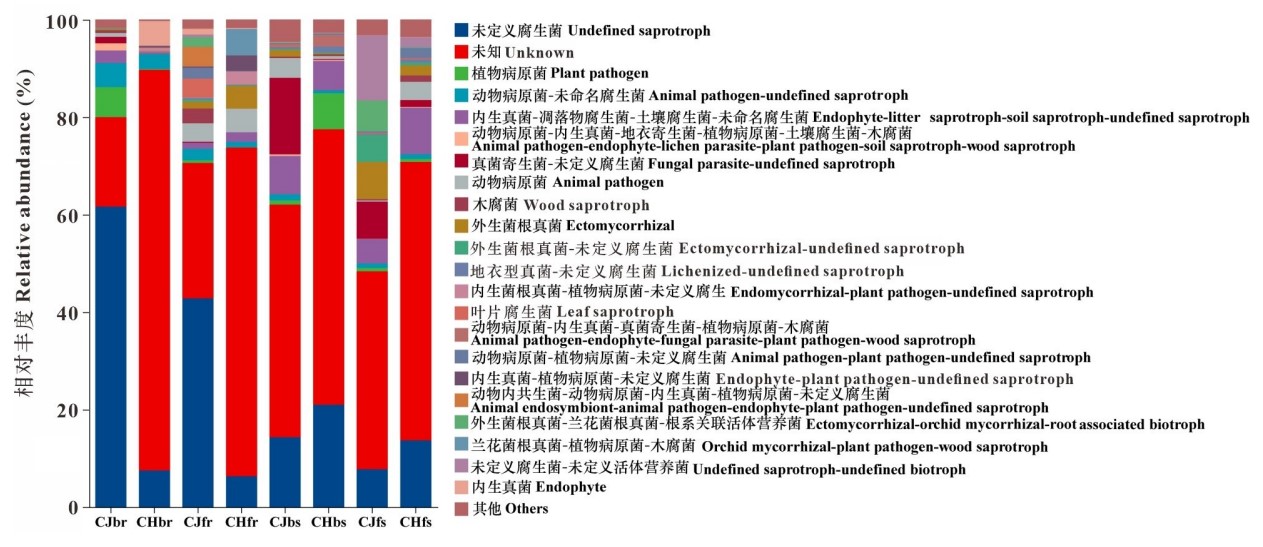
由图5可知,基于FUNGuild数据库对真菌OTUs进行功能注释,共得到21种功能类群,其中未知功能群(unknown)及未定义的腐生菌(Undefined saprotroph)在两种杓兰中占主导地位,相对丰度分别为18.04%~82.23%和6.42%~60.64%。
绿花杓兰和扇脉杓兰根际土壤及根内富集微生物群落的功能特征存在差异。绿花杓兰根内的内生菌根真菌-植物病原菌-未定义腐生菌的丰度(花期0.58%、果期2.75%)均高于扇脉杓兰(0.05%、0.11%),根际土壤的木腐菌(0.39%、1.23%)、地衣型真菌-未定义腐生菌(1.24%、0.58%)及动物病原菌-内生真菌-真菌寄生菌-植物病原菌-木腐菌(2.11%、0.17%)占比均高于扇脉杓兰(0.29%、0.27%)、(0.38%、0.16%)、(0.26%、0.03%),暗示绿花杓兰根际环境更倾向于木质素降解及多物种互作;扇脉杓兰表现出更高的病原菌负荷,其植物病原菌(6.08% vs 0.13%、0.53% vs 0.05%)、真菌寄生菌-未定义腐生菌(1.31% vs 0.03%、0.23% vs 0)及叶片腐生菌(0.20% vs 0.01%、3.81% vs 0)的丰度在花期和果期均高于绿花杓兰,扇脉杓兰根际土壤的真菌寄生菌-未定义腐生菌(15.00%、7.41%)和外生菌根真菌(1.26%、7.36%)均高于绿花杓兰(0.15%、1.32%)、(0.17%、2.01%)。结合热图结果,扇脉杓兰根际土壤中的蜡壳耳属(Sebacina)和Cadophora类群下包含较多外生菌根真菌成员,同时蜡壳耳属是兰科植物常见的共生真菌,表明其可能通过外生菌根网络拓展养分吸收范围。
图
5
基于 FUNGuild 的真菌功能预测
Fig.
5
Prediction of fungal functions based on FUNGuild
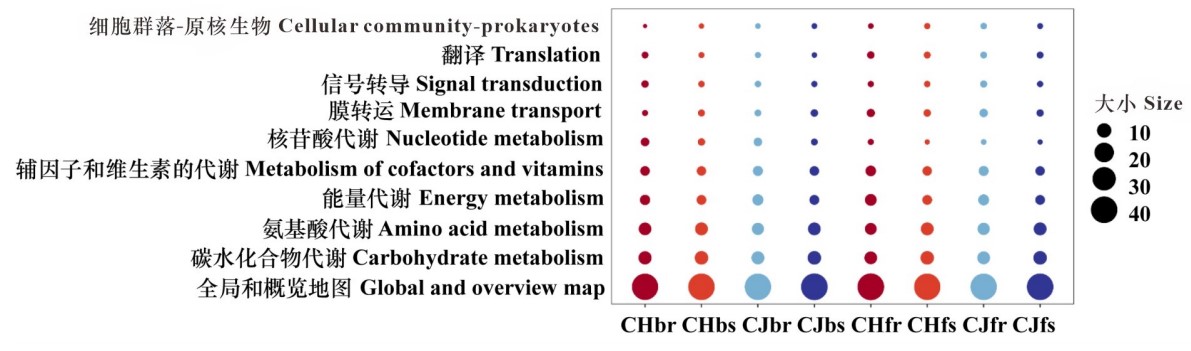
由图6可知,两种杓兰细菌功能结构相对稳定,其功能以代谢、环境信息处理、遗传信息处理及细胞过程为主,二级功能中,全局和概览地图(>39.0%)、碳水化合物代谢(7.5%)及氨基酸代谢(6.5%)为优势通路。
图
6
基于PICRUSt2的细菌群落功能预测
Fig.
6
Prediction of bacterial community function based on PICRUSt2
2.4 微生物群落网络互作分析
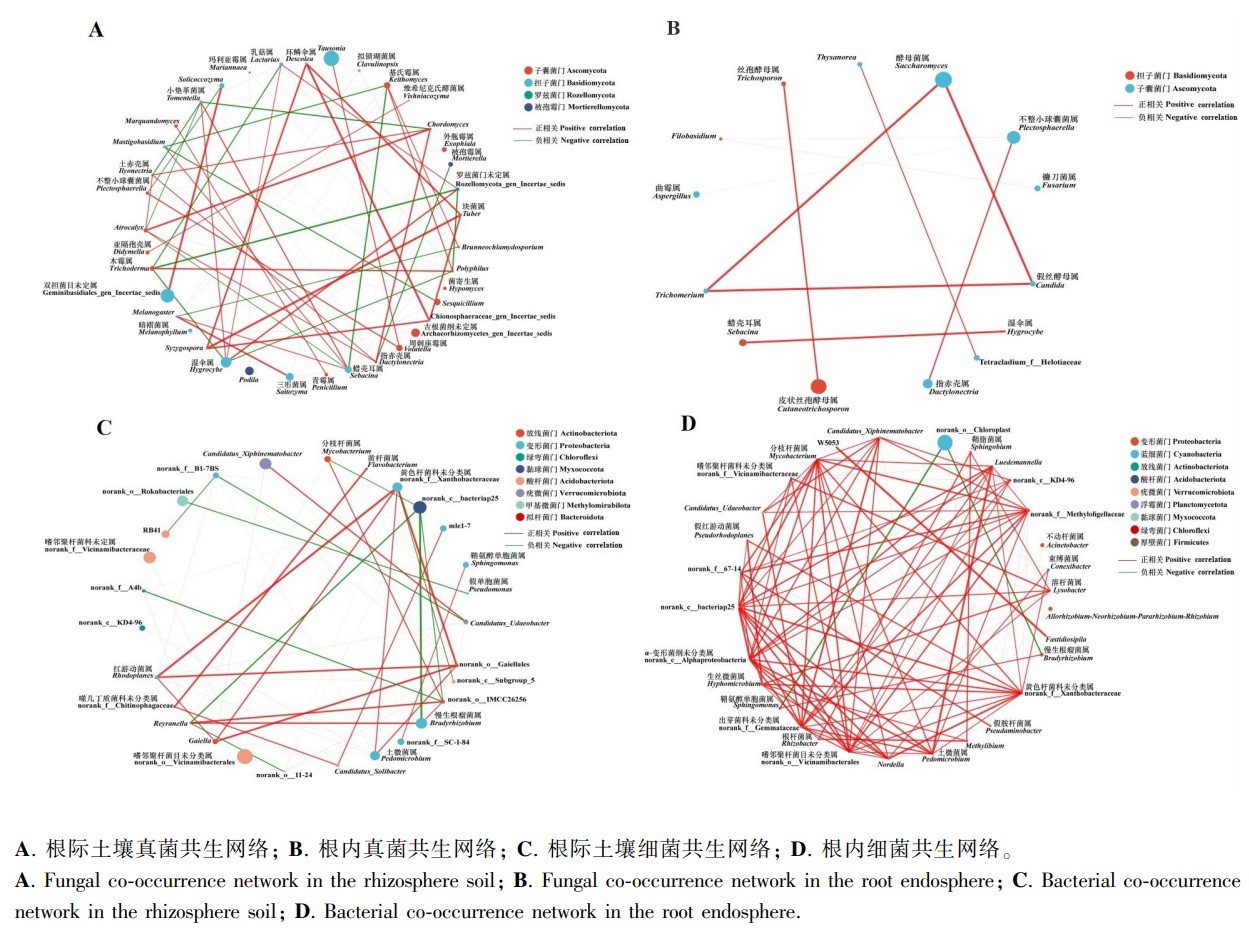
两种杓兰的根际土壤与根内真菌/细菌相对丰度前40的OTU网络拓扑分析结果显示,两种杓兰的根际土壤真菌群落正相关边占总边数的53.52%,如小垫革菌属(Tomentella)为关键节点,节点度为10,与蜡壳耳属(Sebacina)、Mastigobasidium等4个属呈正相关(图7:A),表明两种杓兰的根际土壤真菌间存在较强的生态位竞争或拮抗作用。根内真菌网络的正相关比例高达90%,呈现高度协作特征,如不整小球囊菌属(Plectosphaerella)为关键节点(节点度为3),与指赤壳属(Dactylonectria)和Filobasidium呈正相关(图7:B)。两种杓兰根际土壤细菌群落正相关占比为62%(图7:C),负相关占比为38%,竞争与协作并存,如假红游动菌属(Pseudorhodoplanes)为关键节点(节点度为7),与土微菌属(Pedomicrobium)、Gaiella等5个属呈正相关。根内细菌网络则表现出极强的正相关性(96.42%)(图7:D),负相关仅为3.58%,如土微菌属(Pedomicrobium)为超级节点(节点度为15),与分枝杆菌属(Mycobacterium)及Luedemannella等15属呈正相关。上述结果表明,根际土壤中竞争-协作平衡与根内高度协作的梯度变化,并非简单的对立关系,而是植物-微生物共生系统构建的连续动态过程,根际的竞争筛选确保群落的稳定性和功能韧性,根内的紧密协作则提高养分利用效率,二者共同塑造杓兰适应高海拔生境的微生物组架构。
图
7
两种杓兰根际土壤及根内微生物网络关系
Fig.
7
Microbial network relationships in the rhizosphere soil and root endosphere of two Cypripedium species
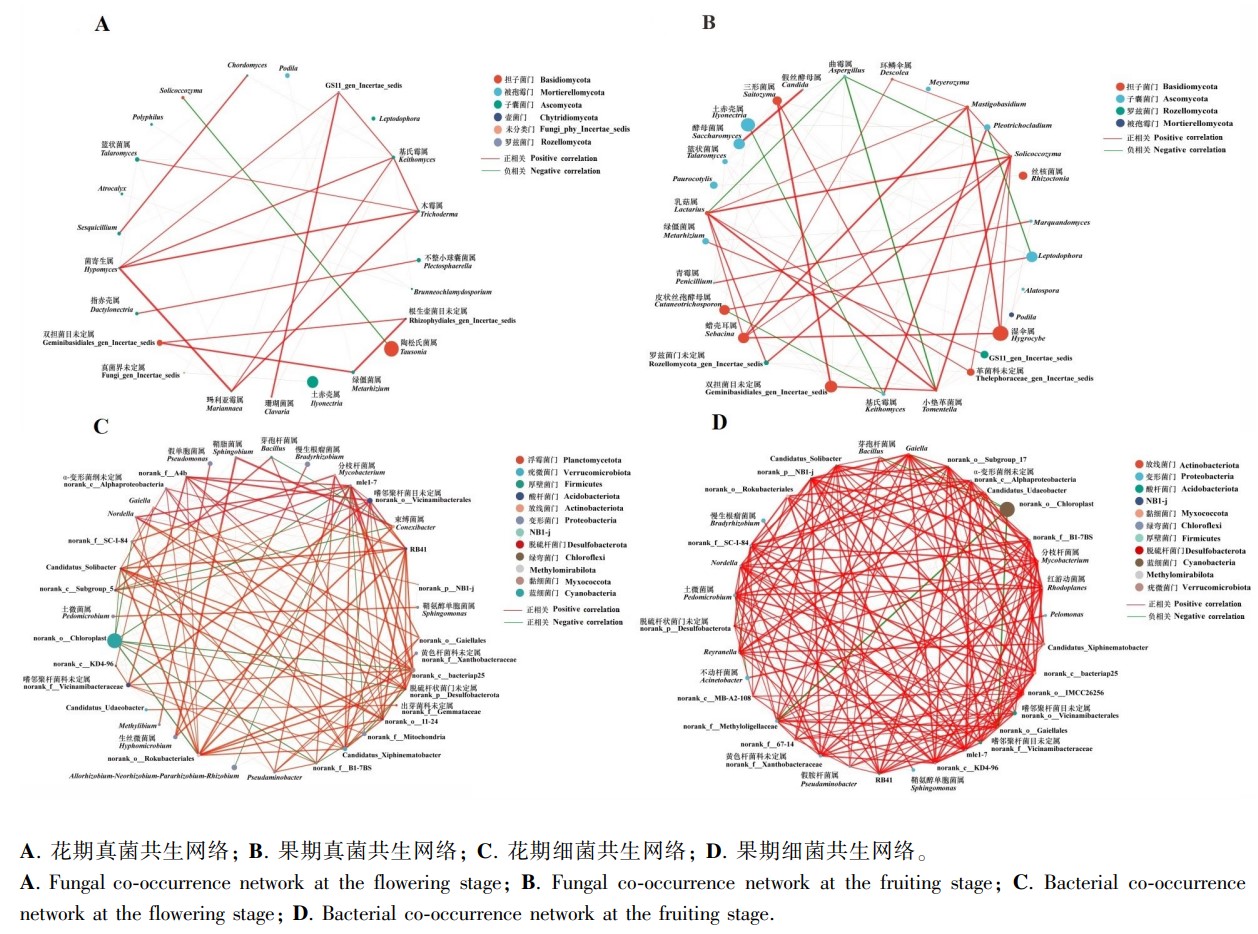
两种杓兰花期与果期的真菌/细菌相对丰度前40的OTU网络拓扑分析结果显示,在花期,两种杓兰的真菌群落网络关系中正相关边占总边数的90.32%(图8:A),表明群落内部以协同变化关系为主,属间联系较为紧密。其中,玛利亚霉属(Mariannaea)为关键节点,节点度为5,与蓝状菌属(Talaromyces)和木霉属(Trichoderma)等5个属呈显著正相关;两种杓兰的细菌群落网络中正相关边占总边数的80.24%(图8:C),说明细菌群落整体上同样以正相关为主。Nordella为关键节点,节点度为10,与Candidatus_Xiphinematobacter和Candidatus_Solibacter等多个属呈正相关。在果期,两种杓兰的真菌群落网络中正相关边占比下降至78.26%(图8:B),其中湿伞属(Hygrocybe)为关键节点,节点度为8,与蜡壳耳属(Sebacina)和Mastigobasidium等8个属呈显著正相关;两种杓兰的细菌群落网络中正相关边占比升至91.43%(图8:D),高于花期,这说明两种杓兰果期细菌群落内部的协同关联进一步增强。此阶段Gaiella为关键节点,节点度为11,与Nordella和mle1-7等多个属呈显著正相关。这表明两种杓兰根际微生物群落在生育时期转换过程中具有明显的阶段性动态变化,并且真菌与细菌可能在不同发育阶段发挥互补作用。
图
8
两种杓兰花期及果期微生物网络关系
Fig.
8
Microbial co-occurrence network relationships of two Cypripedium species during the flowering and fruiting stages
3 讨论
3.1 生态位差异是影响微生物群落分化的重要因素
植物根际土壤和根内组织是微生物定殖的重要生态位,二者在营养来源和环境开放程度等方面存在差异,因而影响杓兰的微生物群落组成,这与Cregger等(2018)的研究结果一致。Zhang等(2025)研究表明,与植物发育阶段或宿主物种类型相比,生态位空间差异是导致微生物群落结构分异的重要因素。本研究中,两种杓兰根际土壤中真菌与细菌的群落丰富度均显著高于根内环境,这在许多兰科植物中具有普遍性(周珊,2020;谭小明等,2023;Liu et al., 2024)。两种杓兰根际土壤中的真菌群落与根内相比,除子囊菌门和担子菌门均为优势菌门外,还显著富集被孢霉门。这可能是因为根际土壤中有机质及矿物养分含量更丰富,为腐生型真菌的定殖与繁衍提供了更适宜的生态条件(Ren et al., 2023;Zhu et al., 2024)。细菌群落方面,根际土壤主要以变形菌门、酸杆菌门、放线菌门为优势类群,而根内则以变形菌门和蓝细菌门为主。其中,酸杆菌门和放线菌门是土壤中参与有机质降解及次级代谢的重要类群,蓝细菌门在根内富集,则可能与其潜在的固氮功能有关,暗示它在兰科植物根内营养供给过程中可能发挥一定作用(Zhang et al., 2024; Shahrajabian & Sun, 2025)。
根际土壤作为一个相对开放的微生态系统,可以为微生物提供更多的资源和生态位(侯馨博等,2025)。相比之下,根内环境面临宿主植物组织屏障与免疫系统的双重筛选,仅允许部分适应性强的共生菌或内生功能群定殖(Lundberg et al., 2012)。这种由根际到根内的逐级筛选过程,可能是两种杓兰根际与根内微生物群落发生分化的重要原因。因此,根际土壤可能是杓兰相关微生物的重要来源,而根内群落则更多体现宿主筛选作用。这提示在杓兰人工繁育、迁地保护和野外回归过程中,不仅应关注植株本身,也应重视其根际微环境及潜在有益微生物资源。
3.2 发育阶段影响微生物群落的动态变化
植物不同发育阶段的营养需求与生理代谢状态,可能影响根际和根内微生物群落的变化(Dadi et al., 2025)。本研究选择花期和果期进行比较,是因为二者为杓兰生长发育中关键且野外易于准确识别的时期(Perner et al., 2022; Wang et al., 2025),结果显示,两种杓兰的微生物群落均表现出明显时期特征:从花期到果期,根际土壤真菌的Ace指数显著上升,而根内细菌丰富度显著下降,这反映了宿主植物在生长关键阶段的资源分配策略(Wang et al., 2024)。花期至果期是杓兰生长的重要时期,需要将大量的光合产物(碳源)向生殖器官(花、果实)转移,以支撑果实发育(Fan et al., 2025),杓兰可能通过改变根系分泌物,进而招募并富集一批具有较强有机质分解能力和养分转化潜力的腐生真菌,如本研究中丰度显著上升的被孢霉属等真菌。相反,根内细菌丰富度在果期显著下降,可能是宿主植物为了集中资源保果,通过加强免疫筛选淘汰了部分非核心内生菌,仅保留维持基本代谢的必需共生细菌群落(Jin et al., 2025)。因此,两种杓兰相关微生物群落在花期和果期间表现出一定的阶段性变化,说明发育阶段是影响其微生物群落结构的重要因素之一,但由于本研究未测定根系分泌物和功能验证,因此上述解释仍需后续实验进一步证实。
3.3 宿主物种与微生境共同影响微生物群落组装
尽管绿花杓兰和扇脉杓兰生长于同一地点的相近区域,且样株间距离较近,但二者相关微生物群落仍表现出一定差异,暗示除生态位和发育阶段外,宿主物种特性也可能参与了微生物组装过程。NMDS分析结果表明,生态位是驱动群落变异的首要因素,尤其对细菌群落的解释度更高,说明根际土壤与根内环境差异构成了两种杓兰微生物组装的基础框架。同时,结合热图和LDA判别分析,推测宿主自身特性可能也参与两种杓兰根际与根内特定微生物类群的筛选。例如,扇脉杓兰根际土壤中蜡壳耳属(Sebacina)及伞菌纲(Agaricomycetes)相关类群富集,提示其更易招募与菌根共生和养分获取有关的真菌成员(Li et al., 2021; Selosse et al., 2022),而绿花杓兰则在根内富集角担菌科(Ceratobasidiaceae),它属于兰科植物中较常见的菌根真菌类群,这提示绿花杓兰根内可能存在对特定菌根真菌类群的选择性富集(Zhao et al., 2024)。此外,绿花杓兰和扇脉杓兰根内分别富集假单胞菌属(Pseudomonas)和芽孢杆菌属(Bacillus),均属于潜在的促生细菌类群,表明这类细菌可促进原球茎生长、提升幼苗建成并增强病害抑制潜力(Guzmán-Guzmán & Santoyo, 2022; Tsotetsi et al., 2022)。因此,两种杓兰相关微生物群落可能受生态位、发育阶段和宿主特性的共同影响。这种协作性的招募机制可能是其适应局域生境并维持种群更新的重要基础(Calevo et al., 2021)。本研究获得的菌根真菌和潜在促生细菌类群,可作为后续功能微生物分离与评价的候选对象。需要指出的是,由于两种杓兰均为国家二级保护植物,野外种群稀少,采样许可严格,并且根际和根系采样对植株影响较大,本研究仅在每个时期的同一地点分别选取1株长势相近的绿花杓兰和扇脉杓兰进行采样,未设置不同植株间的生物学重复;尽管每组设置了3份技术重复,但结果仍主要反映所采个体的微生物群落特征,难以全面代表物种水平的群落组成。此外,高通量测序结果主要提供群落组成和功能线索,相关类群的生态功能仍需结合可培养微生物分离、共培养和回接实验进一步评价。未来应在保护许可前提下增加样本量,结合培养组学技术分离和筛选关键功能微生物,为杓兰属植物的保护和人工繁育提供菌种资源。
4 结论
综上所述,生态位差异是影响神农架地区两种濒危杓兰相关微生物群落分化的重要因素。与根内相比,根际土壤微生物群落具有较高多样性;根内微生物群落则表现出一定筛选特征,并富集部分可能与宿主生长和逆境适应相关的微生物类群。发育阶段变化也会影响两种杓兰根际和根内微生物群落组成,表明杓兰相关微生物群落受生态位、发育阶段和宿主种类共同影响。部分优势真菌和促生细菌类群可作为后续功能验证和微生物资源挖掘的候选对象,为濒危杓兰属植物人工繁育与保护提供参考。