


摘要
为探究珙桐(Davidia involucrata)幼苗生长所需氮(N)、磷(P)、钾(K)的最佳施肥量,该研究以1年生珙桐幼苗为对象,通过盆栽控制试验,以黄棕壤为基质,测定其基本理化指标,采用“3414”测土配方施肥法设置N、P、K三个因素,0、1、2、3四个水平共14个处理(T1-T14),测定各处理生长条件下幼苗与叶、根生态化学计量特征指标,统计分析各指标的处理间差异及其相关关系。结果表明:(1)各处理珙桐幼苗叶和根的C含量差异较小;N、P含量表现出显著性差异(P<0.05),分别与N、P施肥水平呈正相关。(2)T2(N0P2K2)下叶和根的C∶N、N∶P失衡,限制了珙桐幼苗生长;各处理下叶和根的N∶P处于4.86至13.65之间,均低于14,受到N的限制。(3)比叶重、总生物量、株高增长量、地径增长量均表现为T11(N3P2K2)最低,分别比T1(N0P0K0)低6.78%、32.88%、18.91%、6.82%,T13(N1P2K1)促生长效果最显著,分别比T1高12.39%、82.37%、201.75%、120.45%。(4)相关分析显示,比叶重与根的N含量、叶和根的N∶P呈显著正相关(P<0.05),总生物量与根的C含量呈显著正相关(P<0.05),生长特征与化学计量特征之间存在一定关联性。(5)多重比较结果显示,N对各生长特征及根的C、N含量和叶的N、P含量有显著影响(P<0.05),P对比叶重、株高增长量和地径增长量,以及叶和根的P含量有显著影响(P<0.05),K对比叶重、株高增长量、地径增长量有显著影响(P<0.05)。综上认为,盆栽珙桐幼苗应注重N、P、K的均衡施用,避免因N施加过量(7.95 g·plant-1)而造成抑制作用,T13(2.65 g N、1.00 g P2O5、1.50 g K2O)是珙桐幼苗生长的最佳施肥方案。该研究构建的珙桐幼苗精准施肥模式,为珙桐种群扩繁及自然回归提供了核心技术支撑,助力濒危物种资源保育。
Abstract
To explore the optimal fertilizing amount of nitrogen (N), phosphorus (P) and potassium (K) for the growth of Davidia involucrata seedlings, a pot control experiment was conducted with one-year-old seedlings as research object and yellow brown soil as the substrate whose basic physical and chemical properties were determined. The “3414” soil testing and formulated fertilization method was adopted to set three factors (N, P, K) with four levels (0, 1, 2, 3), with 14 treatments in all (T1-T14). The seedling growth and ecological stoichiometric characteristics of leaves and roots under different treatments were determined, and the inter-treatment differences and correlation relationships of each index were statistically analyzed. The results were as follows: (1) The carbon (C) content in leaves and roots of D. involucrata seedlings showed relatively small differences among all treatments. The N and P contents showed significant differences (P<0.05), and they were positively correlated with the application levels of N and P fertilizers, respectively. (2) The C∶N and N∶P in leaves and roots under T2 (N0P2K2) were unbalanced, which limited the growth of D. involucrata seedlings. The N∶P ratios in leaves and roots among all treatments ranged from 4.86 to 13.65, all lower than 14, indicating that the seedling growth was limited by N. (3) The leaf mass per area, total biomass, plant height increment and ground diameter increment were the lowest under T11 (N3P2K2), which were 6.78%, 32.88%, 18.91% and 6.82% lower than those under T1 (N0P0K0), respectively. T13 (N1P2K1) had the most significant growth-promoting effect, with the above indicators being 12.39%, 82.37%, 201.75% and 120.45% higher than those under T1, respectively. (4) Correlation analysis showed that leaf mass per area was significantly positively correlated with root N content and N∶P of leaves and roots (P<0.05), and total biomass was significantly positively correlated with root C content (P<0.05), indicating a certain correlation between growth traits and ecological stoichiometric characteristics. (5) Multiple comparison results showed that N had significant effects on all growth traits, as well as root C and N contents and leaf N and P contents (P<0.05). P had significant effects on leaf mass per area, plant height increment, ground diameter increment and P contents of leaves and roots (P<0.05). K had a significant effect on leaf mass per area, plant height increment and ground diameter increment (P<0.05). In conclusion, balanced application of N, P and K should be emphasized for potted D. involucrata seedlings, and excessive application of N fertilizer (7.95 g·plant-1) should be avoided due to its inhibitory effect on seedling growth. T13 (2.65 g N, 1.00 g P2O5, and 1.50 g K2O) is the optimal fertilization scheme for the growth of D. involucrata seedlings. The precise fertilization model constructed in this study provides core technical support for the population propagation and natural reintroduction of D. involucrata, and contributes to the conservation of this endangered species resource.
生态化学计量学是研究生物体内关键化学元素的比例关系及其在生态系统能量流动和物质循环中作用规律的一门学科,贯穿从基因到生态系统的多个研究维度,构建起不同生命层次间元素平衡的关联(Elser et al., 2000)。研究植物化学计量比特征能够反映植物养分限制状态,可为植株施肥提供均衡指示。Meunier等(2017)认为,生态化学计量学框架与基于性状的生态学相结合,有助于揭示养分元素与功能性状之间的相互作用,种内化学计量比特征的变异能体现植株对环境干扰的适应机制,种间变异可反映群落生态位分化程度,对于揭示植物自身养分分配规律及其对非生物环境的适应机制策略具有重要意义(Fervández-Martínez et al., 2021)。聚焦自然群落中植物生长的养分规律,借助生态化学计量方法,有助于明确养分元素比例对植物生长的调控机制(Ågren, 2008)。Cai等(2024)研究发现,植物通过调节自身不同器官的化学计量比特征增强环境适应能力,以应对火灾恢复过程。Zhang等(2020)研究发现,兼性附生植物可通过调节植株的养分含量及化学计量特征,以适应不同的黑土生境状况。碳(C,carbon)、氮(N,nitrogen)、磷(P,phosphorus)是植物生长的三大核心元素,对植物器官发育、体内养分循环以及对环境的适应发挥着重要意义(姚彩萍,2022;胡芳等,2025)。何茂松等(2019)研究发现,植物体内C、N、P化学计量比体现植物体内养分供需分配平衡,主要受到植株自身(如植物种类、不同发育阶段等)及外部非生物环境(如水、热、气、土、肥等)的影响。研究珙桐幼苗生态化学计量特征,有助于揭示其养分需求特征,进而制定高效的施肥方案。植物叶与根的生态化学计量特征均衡能优化光合产物分配与养分吸收,动态调整植株根冠比以适配环境养分供给,进而促进植物生长发育(Li et al., 2020)。本研究通过制定不同配方施肥处理,分析各处理间珙桐幼苗叶、根的生态化学计量特征差异,旨在为珙桐幼苗繁育提供高效的施肥模式。
施肥是林木繁育的核心措施之一,能够补充林木生长所需的关键养分,提高林木的生长速率(Ouimet & Moore, 2015; Kuzin & Solovchenko, 2021)。Liu等(2024)研究发现,合理施肥有助于促进无患子苗木生长,改善土壤肥力状况;Kantavichai等(2020)研究表明,合理的栽植密度和施肥量能显著提升花旗松林木质量。“3414”测土配方施肥法可以通过多元素梯度组合,根据物种种类及非生物环境状况提供“适应性施肥方案”,精准匹配植物养分需求特征,达到高效施肥的目的(Yang et al., 2020)。Yang等(2021)通过“3414”测土配方施肥法研究闽楠的养分需求特征,制定了闽楠幼苗生长的最佳施肥方案;赵铭等(2023)通过研究“3414”测土配方施肥法对杉木化学计量特征的影响,制定了杉木生长的最佳施肥模式。现阶段,关于珙桐幼苗对N、P、K养分需求的研究较少,研究偏单一,多元协同作用未明晰,缺乏细化参数,未形成系统的施肥模式。
珙桐(Davidia involucrata)是我国特有的濒危乔木,具有极高的观赏和科研价值,适宜在中性或微酸性的山地黄壤和黄棕壤中生长(孙杰等,2017),主要集中分布于四川、云南、贵州三省(陈梦娇等,2025)。珙桐生境较为狭窄,种子休眠时间较长(2~3年),加之历史上对珙桐的挖采和对其栖息地的严重破坏,野外现存数量极其稀少(詹施施,2022)。近年来,对于珙桐的研究主要集中在树种保护(Yang & Ji, 2017;Qian et al., 2018)、化学成分分析(Shimozu et al., 2017)、种子休眠机制研究(Deng et al., 2022)等方面,关于珙桐苗期生长对养分需求的研究较少,Liu等(2023)研究表明,施N肥能显著增强珙桐叶、根的功能性状;丁坤元(2015)研究发现,施用单一铵态氮对珙桐抗寒能力的提升并无显著作用。目前的研究尚未形成完整的珙桐施肥模式,1年生珙桐幼苗处于营养生长初始阶段,生长指标对养分干扰响应迅速,易量化分析施肥效果,此阶段是珙桐繁育的关键环节,聚焦该时期珙桐幼苗的需肥特征,直接影响后续的成苗率。
该研究以1年生珙桐幼苗为研究对象,采用单因素方差分析(one-way ANOVA)方法,分析N、P、K配方施肥对珙桐幼苗生长特征及其叶、根的生态化学计量特征的影响,拟探讨以下问题:(1)如何优化盆栽珙桐幼苗的最佳施肥模式;(2)N、P、K三因素对珙桐幼苗生长影响的主次效应如何;(3)如何确定珙桐幼苗生长所需的养分阈值。本研究结果有助于揭示珙桐幼苗叶与根的养分分配机制,阐明其对N、P、K的需求特征,为珙桐的保护繁育提供高效施肥方案。
1 材料与方法
1.1 研究地概况
试验地位于贵阳市云岩区的贵州省植物园(106°42′E,26°34′N),地处黔中丘原盆地,海拔1 210~1 411 m。该地属亚热带湿润温和型气候,年平均气温14.7 ℃,年均降水量约1 200 mm,年空气相对湿度80%以上,全年日照时数1 174 h,无霜期占全年的73.70%,立地条件较好(任启飞等,2016)。
1.2 试验材料
试验苗木为贵州省植物园培育的同种源且长势基本一致的1年生珙桐容器苗 [平均株高(51.34±4.44)cm,平均地径(8.07±0.84)mm]。选用黄棕壤作为栽培基质,测定其基本理化指标如下:pH值5.75±0.07,有机碳含量(7.63±0.64)g·kg-1,碱解氮含量(60.87±2.47)mg·kg-1,速效磷含量(18.71±1.70)mg·kg-1,速效钾含量(65.80±0.58)mg·kg-1。2025年3月初,通过DPS数据处理系统采用完全随机设计方案,按照每个处理20株苗分区放置于温室中,苗间距为50 cm,处理间距为150 cm。试验期间,温室内温度控制在23~28 ℃,湿度保持在60%。
1.3 施肥方法
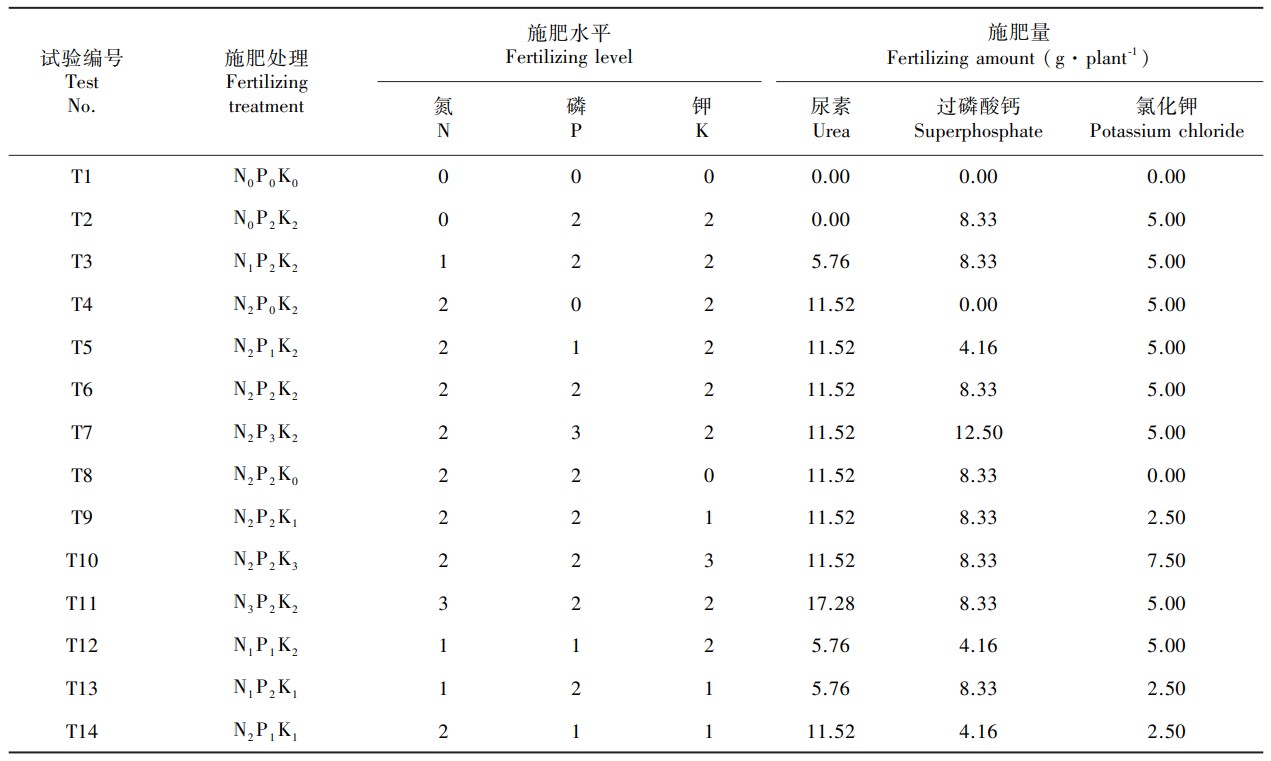
试验采用“3414”完全实施方案,设置N、P、K三个因素,0、1、2、3四个水平共14个处理,分别以T1-T14命名。N、P、K分别采用尿素(含N 46%)、过磷酸钙(含P2O5 12%)和氯化钾(含K2O 60%)。其中,施肥水平如下:N1、N2、N3分别为2.65、5.30、7.95 g·plant-1;P1、P2、P3分别为0.50、1.00、1.50 g·plant-1;K1、K2、K3分别为1.50、3.00、4.50 g·plant-1。施肥方式采用水肥浇施法,通过量筒将水肥溶液均匀施入。于2025年4月1日、5月1日、6月1日分3次施肥,同年7月底收获幼苗。综合参照珙桐原生地土壤养分含量(张珍明等,2016)、所选基质(黄棕壤)的基本理化指标及蓝果树施肥方案(罗婷等,2021),各施肥水平见表1。
表
1
珙桐幼苗各水平肥料施用量
Table
1
Fertilizer application rate for Davidia involucrata seedlings at different levels
1.4 指标测定
于试验开始前,将筛选分区后的珙桐幼苗每木检尺,记录各处理的原始株高与地径,试验结束后记录最终株高和地径,计算增长量。各处理随机选取3株幼苗,将根、茎、叶分别分装,置于烘箱中105 ℃杀青30 min后,于80 ℃烘干至恒重,称取生物量。各处理随机选取3片健康的成熟叶片,利用美国国立卫生研究院开发的开源程序Fiji-windows-x64计算叶面积,将叶片烘干至恒重后计算比叶重。采用锡舟包埋,元素分析仪(Unicube, Elementar, Germany)测定珙桐幼苗叶、根的全碳、全氮含量;采用硫酸-双氧水消解及钼锑抗吸光光度法(NY/T 2017—2011 植物中氮、磷、钾的测定)测定珙桐幼苗叶、根全磷含量。土壤基本理化指标测定参照《土壤农化分析》(鲍士旦,2000)。
1.5 数据分析
使用Microsoft Excel 2019和IBM SPSS Statistics 27软件对试验数据进行数理统计和初步分析,运用单因素方差分析检验不同配方施肥处理对珙桐幼苗生长特征及其根和叶的C、N、P含量及计量比的影响,采用最小差异显著法(least significant difference,LSD)对珙桐幼苗生长特征及其叶和根的养分含量进行多重比较分析,利用Origin 2024软件绘制不同处理的生态化学计量特征柱状图和相关性热图。
2 结果与分析
2.1 珙桐幼苗叶、根养分含量
由图1可知,不同配方施肥处理下珙桐幼苗根的C含量与T1差异较小,仅T11下的C含量显著低于T1(P<0.05);叶的C含量在T2、T14与T1下差异不显著(P>0.05),其余施肥处理显著高于T1(P<0.05)。各处理下叶、根N含量总体呈现出施高N>施中N>施低N>不施N的趋势,具体表现为T1和T2叶、根的N含量显著低于其他各配方施肥处理(P<0.05)。不同配方施肥处理下珙桐幼苗叶的P含量在T1下显著低于其余配方施肥处理(P<0.05),T7下P含量最高;根的P含量在T1和T4下差异不显著(P>0.05),其余处理下P含量显著高于T1(P<0.05),T7下最高。
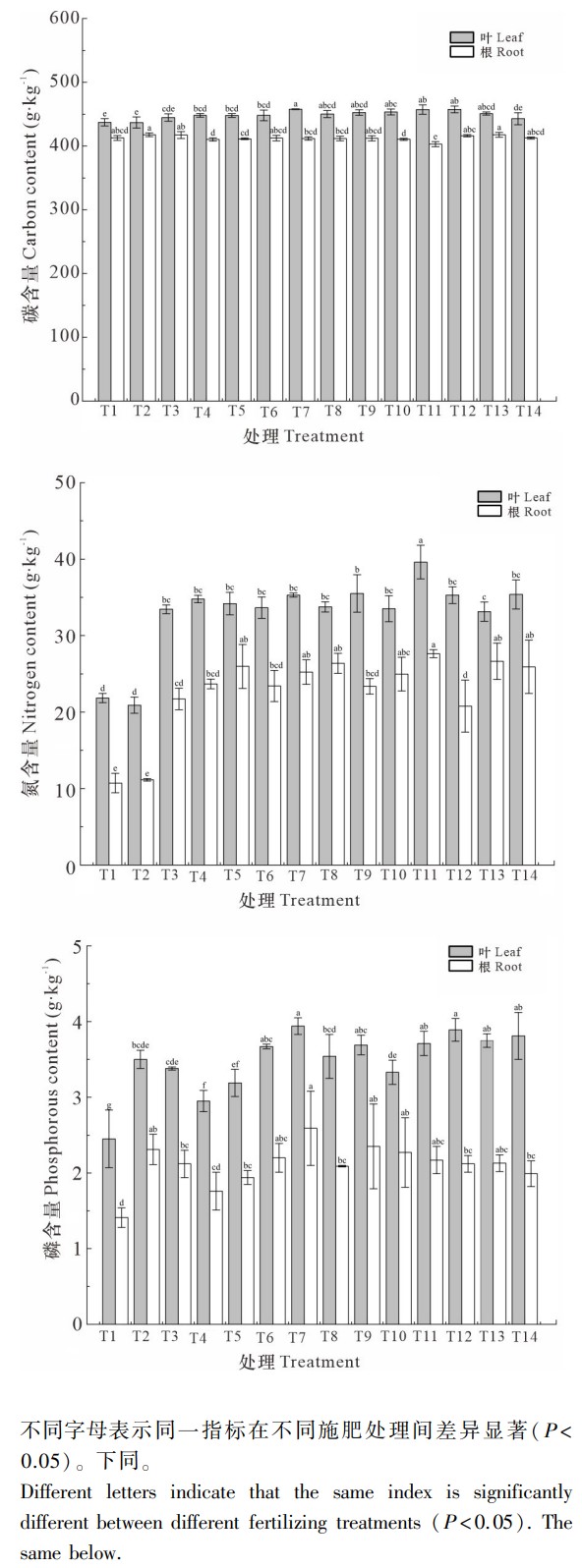
图
1
珙桐幼苗叶和根的碳氮磷养分含量
Fig.
1
Carbon, nitrogen and phosphorus nutrient contents in leaves and roots of Davidia involucrata seedlings
2.2 珙桐幼苗叶、根养分含量多重比较
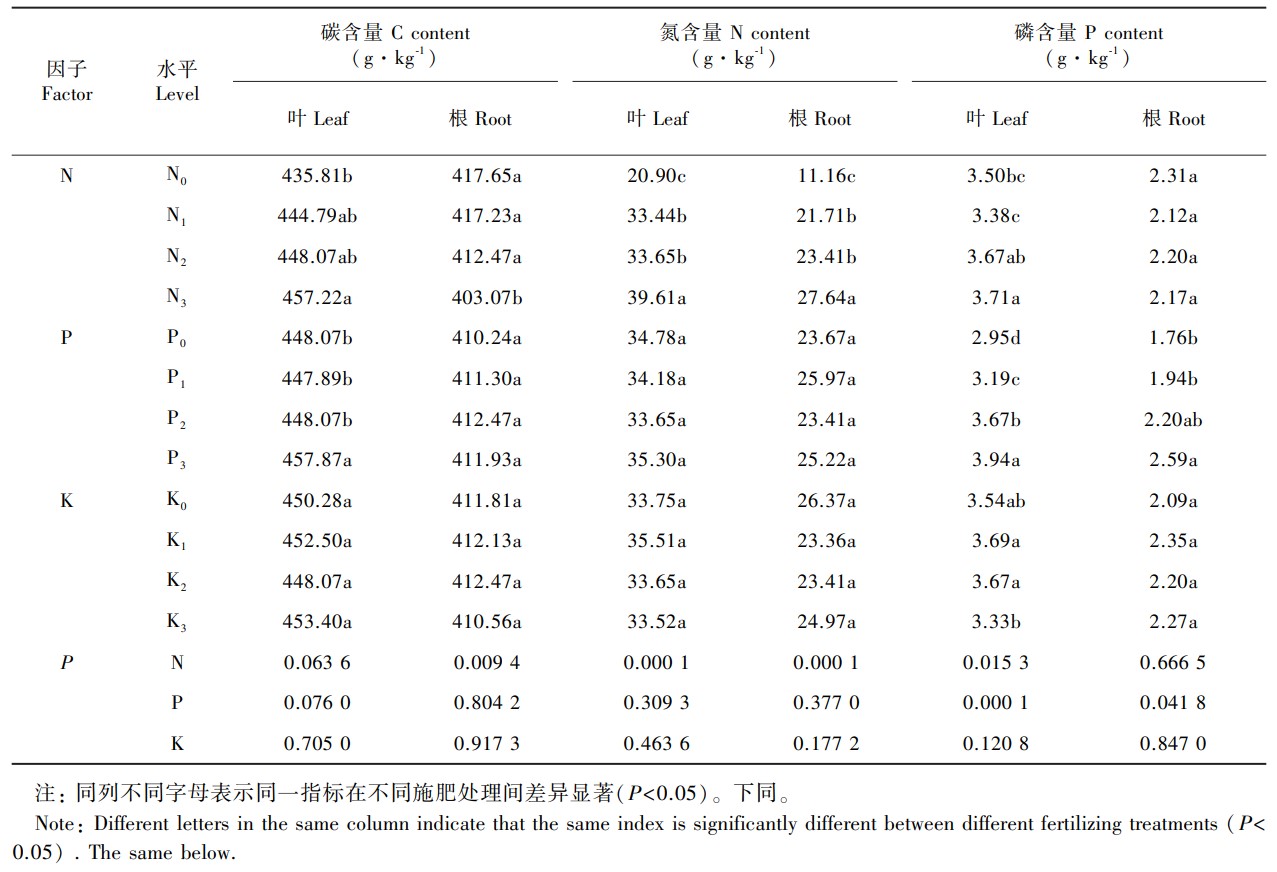
由表2可知,N对珙桐幼苗根的C、N含量及叶的N、P含量有显著影响(P<0.05),根的C含量具体表现为N3水平显著低于N0、N1和N2水平;叶、根的N含量表现为N3显著高于N1、N0和N2水平;叶的P含量具体表现为N1显著低于N2和N3水平,N0、N1差异不显著(P>0.05)。P对叶和根的P含量有显著影响(P<0.05),具体表现为P3>P2>P1>P0。K对珙桐幼苗叶和根的养分含量均无显著影响(P>0.05)。
表
2
珙桐幼苗叶和根的养分含量多重比较
Table
2
Multiple comparison of nutrient contents in leaves and roots of Davidia involucrata seedlings
2.3 珙桐幼苗叶、根化学计量比
由图2可知,珙桐幼苗叶的C∶N在T11下显著低于其他配方施肥处理(P<0.05),比T1低42.24%,T2下C∶N最高,比T1高4.44%。根的C∶N在T1和T2下显著高于其他配方施肥处理(P<0.05),T1最高。珙桐幼苗叶、根的C∶P比均表现为T1显著高于其他处理(P<0.05),T7最低。叶的N∶P表现为T2显著低于其他配方施肥处理(P<0.05),比T1低33.78%,T4最高,比T1高30.90%。根的N∶P表现为T1、T2显著低于其他处理(P<0.05),T2最低。
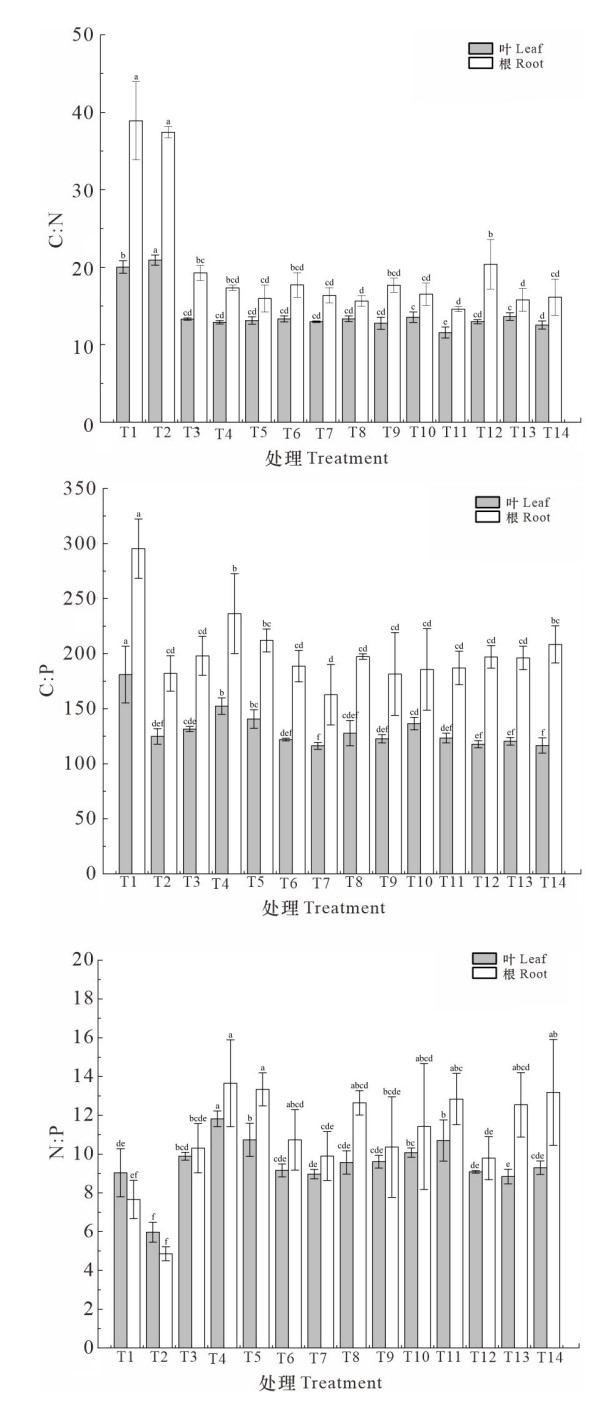
图
2
珙桐幼苗叶、根的碳氮磷化学计量比
Fig.
2
Stoichiometric ratios of carbon, nitrogen and phosphorus in leaves and roots of Davidia involucrata seedlings
2.4 珙桐幼苗生长特征
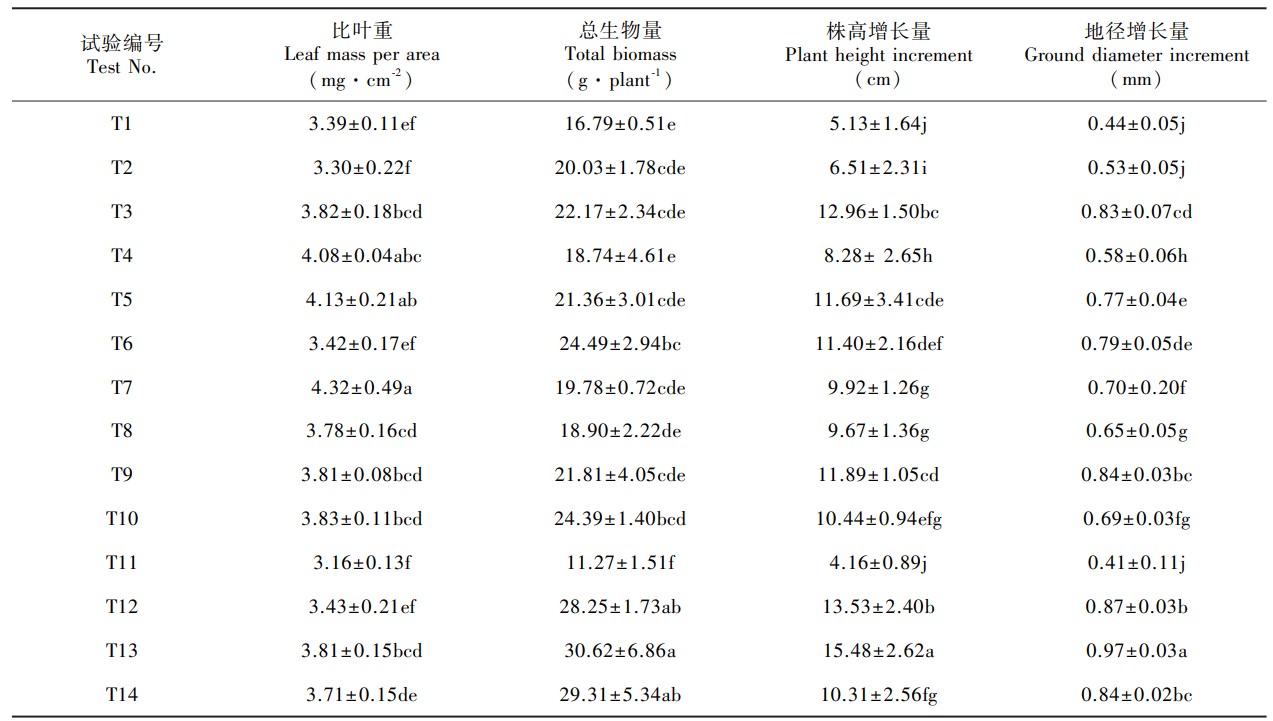
由表3可知,不同配方施肥处理间,珙桐幼苗的生长特征存在一定差异,比叶重具体表现为T11最轻,T7最重,T2、T6、T11、T12比叶重与T1差异不显著(P>0.05)。总生物量、株高增长量、地径增长量均表现为T13最大,T11最小,除T11以外,各处理总生物量、株高增长量、地径增长量均显著高于T1(P<0.05)。
表
3
珙桐幼苗生长特征
Table
3
Growth characteristics of Davidia involucrata seedlings
2.5 珙桐幼苗生长特征多重比较
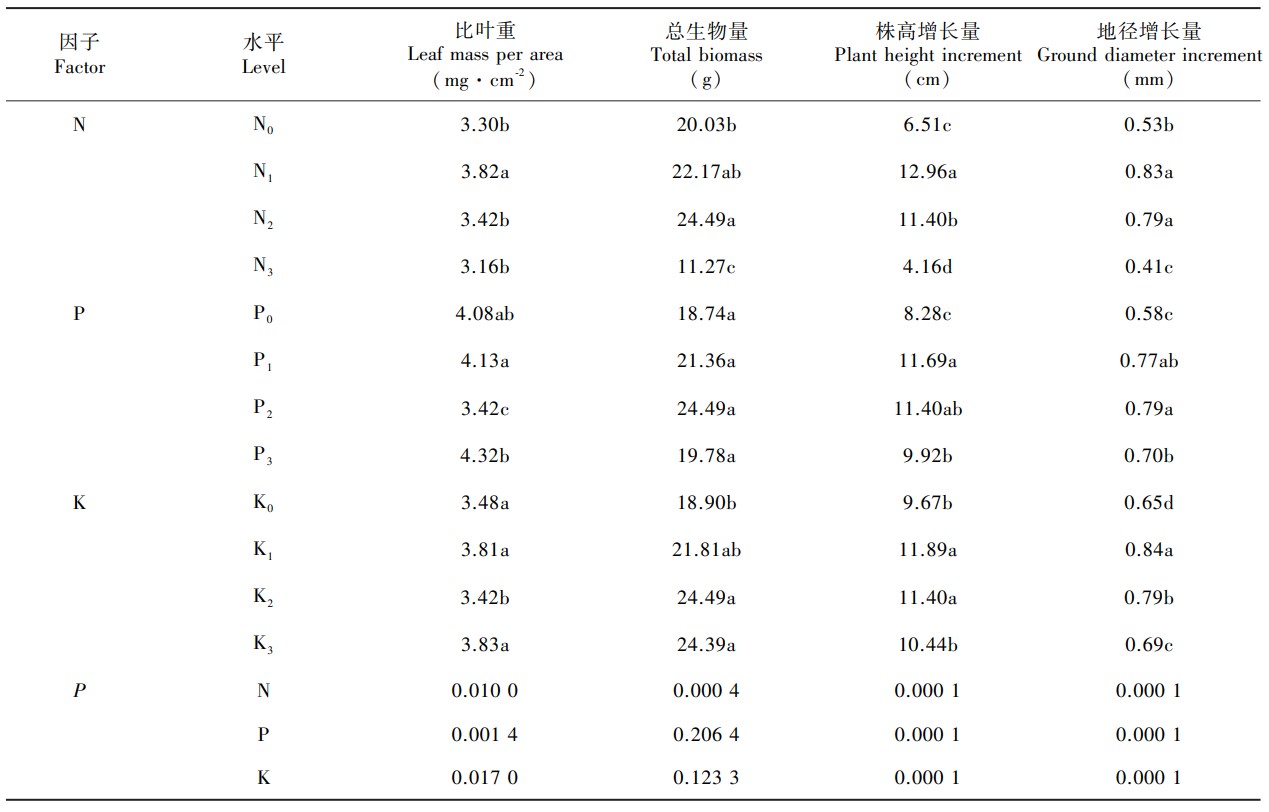
由表4可知,N对珙桐幼苗比叶重影响表现为N1水平显著高于N0、N2和N3水平(P<0.05);总生物量表现为N3水平显著低于N0、N1和N2水平(P<0.05);株高增长量在N的4个水平间呈现出极显著差异(P<0.01),具体表现为N1>N2>N0>N3;地径增长量表现为N3水平极显著低于N0、N1和N2水平(P<0.01)。P对珙桐幼苗比叶重的影响表现为P2水平显著低于P0、P1和P3水平(P<0.05);株高增长量、地径增长量均表现为P0水平显著低于P1、P2、P3水平(P<0.05)。K对珙桐幼苗比叶重影响表现为K2水平显著低于K0、K1和K3水平(P<0.05);株高增长量表现为K0、K3水平显著低于K1和K2水平(P<0.05);地径增长量在K肥的4个施肥水平间表现为极显著差异(P<0.01),具体表现为K1>K2>K3>K0。
表
4
珙桐幼苗生长特征多重比较
Table
4
Multiple comparisons of growth characteristics of Davidia involucrata seedlings
2.6 珙桐幼苗生长与叶、根生态化学计量特征相关关系
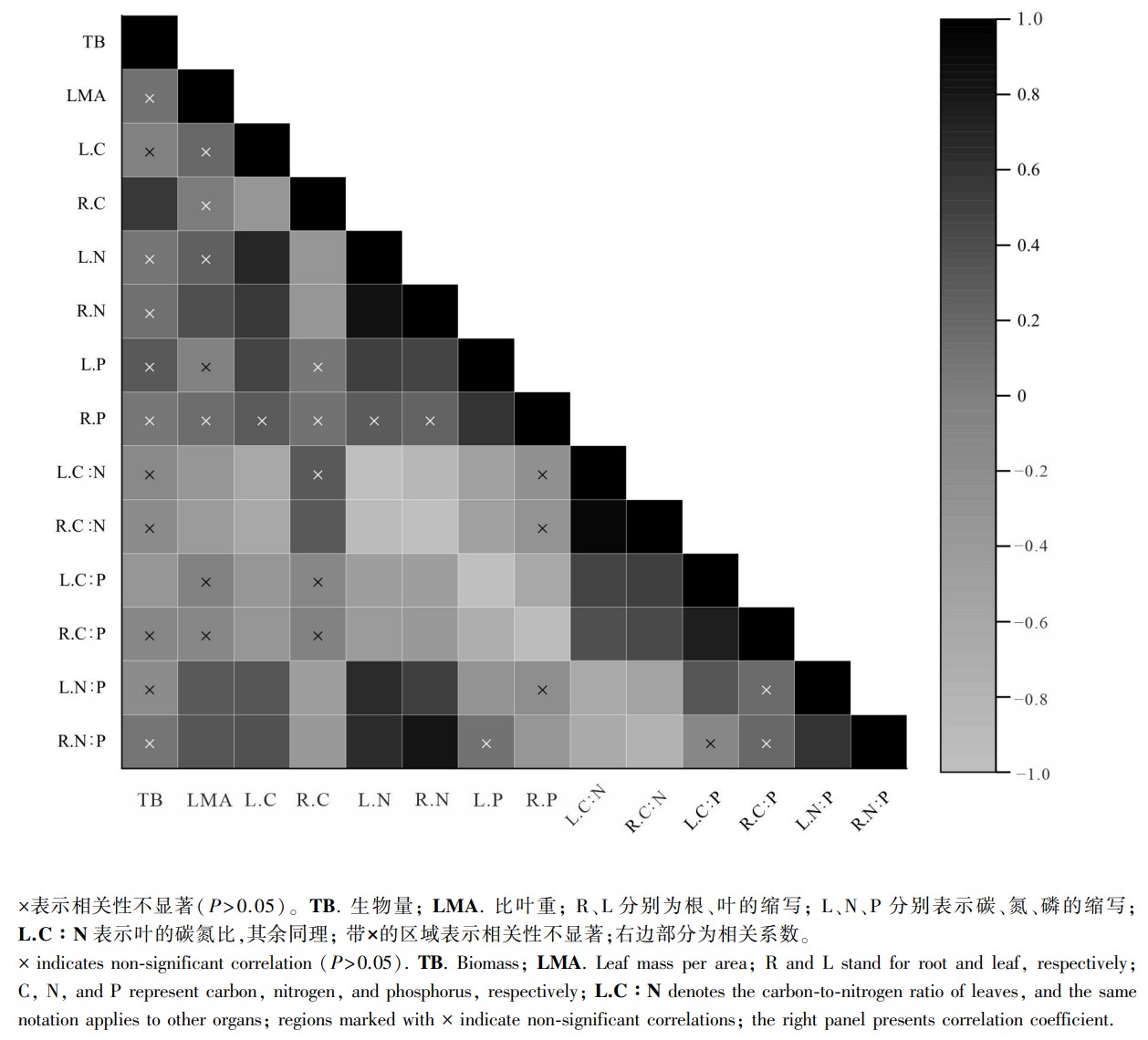
由图3可知,珙桐幼苗总生物量与其他指标的相关性较小,具体表现为与根的C含量呈显著正相关,与叶的C∶P呈显著负相关(P<0.05)。珙桐幼苗比叶重与根的N含量、叶和根的N∶P呈显著正相关(P<0.05),与叶和根的C∶N呈显著负相关(P<0.05)。叶的C含量与根的C含量、叶和根的C∶N及C∶P呈显著负相关(P<0.05),与叶的N、P含量及N∶P、根的N含量及N∶P呈显著正相关(P<0.05)。根的C含量与叶、根的N含量及N∶P呈显著负相关(P<0.05),与根的C∶N呈显著正相关(P<0.05)。叶的N含量与叶和根的C∶N、C∶P呈显著负相关(P<0.05),与叶的P含量、N∶P及根的N含量、N∶P呈显著正相关(P<0.05)。根的N含量与叶的P含量、叶和根的N∶P呈显著正相关(P<0.05),与叶、根的C∶N、C∶P呈显著负相关(P<0.05)。叶的P含量与根的P含量呈显著正相关(P<0.05),与叶和根的C∶N、C∶P及叶的N∶P呈显著负相关(P<0.05)。根的P含量与叶的C∶P及根的C∶P、N∶P呈显著负相关(P<0.05)。
图
3
相关性热图
Fig.
3
Correlation heatmap
3 讨论
3.1 配方施肥对珙桐幼苗叶、根碳氮磷养分含量的影响
植物体内的养分含量是决定其生产力的关键因素,某一养分元素含量过高或过低均会造成植物体内养分失衡,进而对植物的生长发育、抗逆能力及生理功能等产生负面影响(Bhat et al., 2016; Jahangir et al., 2025)。Chrysargyris和Tzortzakis(2025)研究表明,施肥会显著影响植物体内的养分含量,适宜的施肥模式有助于提高植物的养分与水分利用效率,从而达到增产增效的目的。本研究中,各配方施肥处理间珙桐幼苗叶和根的C含量的差异较小,这与赵铭等(2023)对杉木和Yang等(2020)对闽楠的施肥试验研究结果一致。Ma等(2018)研究认为,这是因为植物的碳含量是由物种遗传决定的“内在属性”,施肥主要影响的是植物的总碳储量,而非单位质量的碳比例。T2叶、根的N含量与T4叶、根的P含量显著低于除T1以外的其余处理(P<0.05),这是因为T2和T4为缺N和缺P处理,土壤中可吸收的N、P含量较低,呈现出养分失衡(养分亏缺)的状况。T11下叶和根的N含量与T7下叶和根的P显著高于其余施肥处理(P<0.05),这是因为T11和T7分别为高N和高P施肥处理,土壤中的N、P含量较高,呈现出养分失衡(养分过剩)的状况。同一因素不同水平间,珙桐幼苗叶和根的N与P含量呈现出3水平>2水平>1水平>0水平的趋势。
结合多重比较结果分析,N对珙桐幼苗根的C、N含量及叶的N、P含量有显著影响(P<0.05)。姜孝曾等(2025)和于江珊等(2022)研究认为,这是因为N供应会调控根系氮代谢关键酶活性,直接促进根系对N的吸收与向叶片的运输,进而显著影响叶、根的N含量。同时,N可以改善珙桐幼苗的养分需求与能量代谢状况,间接调控P向叶片的积累,显著影响叶片的N含量。P仅对叶、根的P含量有显著影响(P<0.05),这是因为植物N、P吸收通路相互独立,当N和K的施加量固定为N2、K2水平时,珙桐幼苗叶与根吸收的N含量已能满足其生长需求,施加P不会直接影响珙桐幼苗叶与根的N吸收,仅会导致其P含量表现出显著性差异。K对珙桐幼苗叶和根的C、N、P含量无显著影响(P>0.05),这是因为当土壤中的N、P含量充足时(N2、P2水平),K与N、P之间无显著互作效应。N、P、K对珙桐幼苗叶、根养分含量影响程度为N>P>K。
3.2 配方施肥对珙桐幼苗叶、根化学计量比的影响
植物化学计量比特征是植物适应环境变化的重要表现,养分元素的比例关系受到植株自身生理状态与外界环境的综合影响。配方施肥对珙桐幼苗叶和根的C含量影响较小,故呈现出在未施N的T1和T2下叶和根的C∶N显著高于其他施肥处理(P<0.05)。珙桐幼苗叶和根的C∶P在T1下显著高于其他各配方施肥处理(P<0.05),这是因为各处理叶与根的C含量差异较小,T1中无额外施入P导致珙桐幼苗叶和根的P含量低,表现出高C∶P。植物的N∶P在一定程度上可表征其生长发育受到N还是P限制,当N∶P<14时,说明受到N限制,当14<N∶P<16时,说明受到N、P同时限制,当N∶P>16时,说明受到P限制(文程敬等,2025)。本研究中,不同配方施肥处理的珙桐幼苗叶和根的N∶P为4.86~13.65,均低于14,说明受N限制,这与N影响珙桐幼苗生长特征最显著的结果一致。
3.3 配方施肥对珙桐幼苗生长的影响
植物生长受到内部遗传和外部环境两大核心因素影响,外部非生物环境变化是调控生长的关键变量(Zhang et al., 2023)。植物通过根系从土壤中吸收养分,而土壤中的N、P、K对于植物生长发育、开花结果与增强抗逆有着不可或缺的重要作用(杨培蓉,2024)。本研究中,不同配方施肥处理对珙桐幼苗比叶重、总生物量、株高增长量、地径增长量的影响有所差异,分别较T1(CK)最高提高了27.44%(T7)、82.37%(T13)、201.75%(T13)、120.45%(T13)。T11(N3P2K2)为高N水平处理,其比叶重、总生物量、株高增长量、地径增长量均低于T1(CK),分别低6.78%、32.88%、18.91%、6.82%,高N的施入严重抑制了珙桐幼苗的生长,这与Mestas等(2023)研究发现,施加过量N会降低盆栽杜鹃花的抗病性,影响杜鹃生长,和Sperling等(2019)研究发现,过量N会严重限制杏仁树的生长和生理功能发挥的结果一致。这是因为当施加N超过植物承载能力时会造成植物铵离子毒害,破坏珙桐幼苗细胞结构,从而抑制根系对磷、钾、钙等元素的吸收,造成氮过剩的养分失衡(Yang et al., 2021)。此外,高N胁迫会提高土壤盐分浓度、改变酸碱度,造成珙桐幼苗根系褐变坏死,进而导致根系无法发挥正常功能,影响植株生长(Sperling et al., 2019),严重时会造成烧根导致植物死亡(Kim & Kang, 2011)。
结合多重比较结果分析,N对珙桐幼苗生长特征影响最显著,这与Yang和Ji(2017)对楠木的研究结果一致,这是因为所选的盆栽基质(黄棕壤)的碱解氮含量为(60.87±2.47)mg·kg-1,远低于珙桐幼苗生长对N的需求。N是植物生长发育的核心限制性养分元素,其直接参与光合作用、细胞分裂及物质代谢调控过程,在土壤缺N的状况下,N限制效应表现最显著,这与各处理珙桐幼苗叶与根N∶P低于14的研究结果一致。总体上,同一因素的不同水平间,N1水平的N、P2水平的P、K1水平的K对珙桐生长指标的促进作用最显著。本研究可为珙桐幼苗精准施肥提供量化的施肥参考,达到节约资源和高效施肥的目的。
3.4 生长特征与生态化学计量特征的相关关系
植物体内养分含量与化学计量特征是决定植物生产力的关键因素之一,而生长特征一定程度上亦可表征植物生态化学计量特征(孙慧珍等,2023)。本研究中,珙桐幼苗总生物量表现为与根的C含量呈显著正相关,与叶的C∶P呈显著负相关(P<0.05),与其他指标相关性较小。这是因为根系是植物的核心营养吸收器官,根系的C含量越高说明其发育越好,可为植株提供充足的养分,进而提高植株总生物量,而叶片是光合作用的主要场所,需要P促进光合产物的合成与运输,当叶片缺P时会抑制植物生长,因此呈现出生物量与C∶P为负相关关系。珙桐幼苗比叶重与叶和根的N∶P呈显著正相关(P<0.05)。这可能是因为随着N肥的增加,叶片干物质积累增多,比叶重随之增加。叶与根的C含量呈现出显著负相关关系(P<0.05),这是因为珙桐处于幼苗期,此时C大量流向叶片用于构建光合器官,叶片C含量高、根部低。珙桐幼苗叶与根的N、P含量之间呈现出显著正相关关系(P<0.05),这与陈壹铭等(2024)对西北干旱区荒漠植物的研究结果一致,这是因为植物对N、P的吸收过程存在一定的同步驱动机制,二者吸收量通常呈正相关。总体上,珙桐幼苗生长特征与其叶和根的生态化学计量特征之间存在一定关联性。
4 结论
本研究以1年生珙桐幼苗为研究对象,以黄棕壤为盆栽基质,通过“3414”测土配方施肥法设置14个施肥处理,结果发现:N、P、K对珙桐幼苗生长的影响程度为N>P>K,缺N(T2)和施N肥达到7.95 g·plant-1(T11)均会导致N养分失衡进而抑制珙桐幼苗生长;珙桐幼苗比叶重、总生物量与其叶、根生态化学计量特征之间存在一定关联性;施加2.65 g N、1.00 g P2O5、1.50 g K2O(T13)的组合,是温室内以黄棕壤为基质进行珙桐幼苗盆栽繁育时的最佳施肥模式。本研究仅在短期内于温室环境中探究了N、P、K配方施肥对珙桐幼苗生长及其叶、根养分含量与化学计量比特征的影响,后续应持续探究不同栽培条件(如基质、水分、温度、栽种方式等)下,配方施肥对珙桐幼苗生长、生理特性、药用成分含量及抗逆性等指标的影响,进一步明确珙桐幼苗对N、P、K的地域性需求特征,为珙桐繁育提供更加系统的高效施肥方案。