


摘要
生态化学计量学是阐释植物关键生命周期中养分分配与利用机制的学科。为揭示竹类植物在生殖生长阶段的化学计量适应机制与养分资源调配策略,该研究以广西桂林北部开花毛竹(Phyllostachys edulis)为对象,系统分析其在开花前期、初期、盛期与末期各器官(竹秆、竹枝、竹叶/花穗、竹蔸、蔸根、竹鞭、鞭根)的C、N、P含量及其化学计量比。结果表明:(1)各器官C、N、P含量在不同时期均呈现显著性差异和动态变化。竹枝C含量始终最高;竹叶/花穗N含量在开花前期达峰值,P含量则在盛期最高;竹秆P、竹枝C含量及竹叶N含量呈持续下降趋势;竹鞭C、N含量先降后升;而竹枝、蔸根和鞭根P含量则先升后降。(2)在化学计量比方面,C∶N以开花初期的竹秆最高,C∶P以开花末期的鞭根最高,N∶P则以开花前期的竹鞭最高。(3)各时期器官间C、N、P含量及其比值存在显著(P<0.05)或极显著(P<0.01)相关关系,体现出高度协调的养分分配机制与鲜明的阶段性特征。综上,毛竹开花时,竹枝等营养器官富集C以维持稳态,竹叶/花穗则积累N、P支持代谢,整体呈现“C稳态、P受限、N再分配”的生态适应策略,保障其繁殖需求。
Abstract
Ecological stoichiometry is a discipline that elucidates how plants regulate nutrient allocation and utilization across critical life-history stages. To explore the stoichiometric adaptation mechanisms and nutrient resource allocation strategies of bamboo plants, using naturally flowering P. edulis in northern Guilin, Guangxi, China as the study material, we quantified carbon (C), nitrogen (N), and phosphorus (P) contents, along with their stoichiometric ratios (C∶N, C∶P, N∶P) across seven organ types (culm, branch, leaf/flower spike, culm stump, culm root, rhizome, and rhizome root) during four flowering periods: pre-flowering, initial flowering, peak flowering, and late flowering. The objective was to elucidate the underlying stoichiometric adaptation mechanisms and resource reallocation strategies that underpin reproductive investment in bamboo. The results were as follows: (1) The C, N, and P contents in different organs exhibited significant differences and temporal dynamics across different periods. Branches consistently exhibited the highest C content; leaf/flower spike N content peaked during pre-flowering, whereas P content peaked at peak flowering; culm P, branch C, and leaf N contents declined monotonically throughout flowering; rhizome C and N contents showed a unimodal pattern (decreasing then increasing); and P content in branches, culm roots, and rhizome roots followed an inverse unimodal trajectory (increasing then decreasing). (2) Stoichiometric ratios displayed distinct spatiotemporal patterns. C∶N reached its maximum in culms during initial flowering; C∶P peaked in rhizome roots at late flowering; and N∶P was the highest in rhizomes during pre-flowering. (3) Significant (𝑃 < 0.05) or highly significant (P < 0.01) correlations were observed among C, N, and P contents and ratios across organs within each period, indicating tightly coordinated, stage-dependent nutrient partitioning. In conclusion, during the flowering period of P. edulis, vegetative organs such as branches accumulate C to maintain homeostasis, while leaves/flower spikes accumulate N and P to support metabolic processes. This overall pattern reflects an ecological adaptation strategy characterized by “C homeostasis, P limitation, and N redistribution” ensuring reproductive demands.
Keywords
生态化学计量学为研究植物生命活动提供了新的视角,通过分析C、N、P元素的含量及其化学计量特征,能够揭示植物的生长状态和生理变化规律(Song et al.,2014)。C、N、P作为植物生长发育的三大关键元素,各自承担着不可替代的生理功能。C元素构成了植物结构基础并支撑生理代谢;N元素参与光合作用、有机物合成及酶活性调控,直接决定植物的营养生长和生殖生长进程;P元素在调节根系形态构型、提升养分吸收效率以及遗传信息传递和光合作用调控中发挥关键作用(Elser et al.,1996)。植物体内C、N、P元素的动态变化不仅反映林分生产力和生态系统养分利用效率,更是表征器官生理生化活性的重要指标(刘超,2014)。特别是在竹类植物开花这一特殊生理阶段,植株体内的养分代谢策略发生显著转变,以驱动其从营养生长向生殖生长过渡。现有研究已发现不同竹种在开花期间的元素响应存在差异:3年生紫竹(Phyllostachys nigra)开花叶片有机碳含量最低,受开花影响剧烈(孙慧等,2025);麻竹(Dendrocalamus latiflorus)在开花盛期,其竹枝与竹叶中的N含量较前期显著提升,显示N的主导作用(徐振国等,2017);雷竹(Phyllostachys praecox f. prevernalis)开花后,P含量比未开花植株高59.70%(何奇江等,2005);神农箭竹(Fargesia murielae)开花后,P优先向叶片和鞭根分配,驱动植物从营养生长阶段向生殖生长阶段的过渡(詹爱军和李兆华,2007)。尽管有研究证实了C、N、P在竹类生殖生长中的关键影响,但大多局限于少数特定竹种或单一器官,缺乏对竹类开花全进程中各器官C、N、P化学计量特征演变及其资源分配格局的系统性探讨。因此,深入解析竹类开花过程中多器官的元素化学计量特征与资源分配机制,对于完善植物生态化学计量理论具有重要的科学意义。
毛竹(Phyllostachys edulis)隶属禾本科(Poaceae)刚竹(Phyllostachys),是我国南方重要的笋材两用竹种,也是森林生态系统的重要组成部分(冯鹏飞和李玉敏,2023)。作为典型的多年生一次性开花植物,毛竹开花呈现出周期长、同步性高以及开花结实后立即枯死的特点(周芳纯,1998;Giordano et al.,2009;朱强根等,2015)。近年来,桂林北部地区毛竹频繁开花,为深入研究其开花生理生态学机制提供了珍贵的基础材料(郭靖,2025)。当前,学术界关于毛竹开花的研究大多聚焦于开花表型性状、种子发育(渡道政俊等,1984;孙立方,2012;贾冬冬等,2022)、内源激素动态(齐飞艳等,2013)以及相关基因的调控与克隆(齐飞艳,2012;张颖,2014;程占超,2016;陈磊,2017;Yu et al.,2025)等领域,而针对毛竹在不同开花时期各器官C、N、P化学计量特征的研究尚未见报道。鉴于此,本研究选取桂北地区开花毛竹为对象,通过测定并分析其在不同开花时期各器官的C、N、P含量及其化学计量比,拟探讨以下问题:(1)毛竹不同开花时期各器官C、N、P含量及其化学计量比的变化特征;(2)C、N、P化学计量特征在不同器官间的分配格局如何随开花进程演变;(3)C、N、P化学计量特征的动态变化揭示了毛竹开花过程中怎样的养分利用策略。本研究为揭示竹类植物在生殖生长阶段的化学计量适应机制与养分资源调配策略提供了理论依据。
1 材料与方法
1.1 试验地概况
试验地位于广西桂林市灌阳县洞井瑶族乡海洋山脉(110°46′—111°14′E,25°07′—25°26′N),地貌类型主要为山地、丘陵和低山,平均海拔842 m,属于中亚热带气候,夏热冬冷,四季分明,光照适宜,雨量充沛,年均气温17.9 ℃,偶尔会有极端零下天气。年均降水量1 540.7 mm,年均日照时长1 400.2 h(贾冬冬等,2022)。土壤以红壤为主,酸碱度为4.5~6.5(郭靖,2025)。试验地为无人工干预的近自然状态下开花的毛竹林,林下植被主要为光蜡树(Fraxinus griffithii)、马银花(Rhododendron ovatum)、中南鱼藤(Derris fordii)等。
1.2 试验设计
1.2.1 样地设置
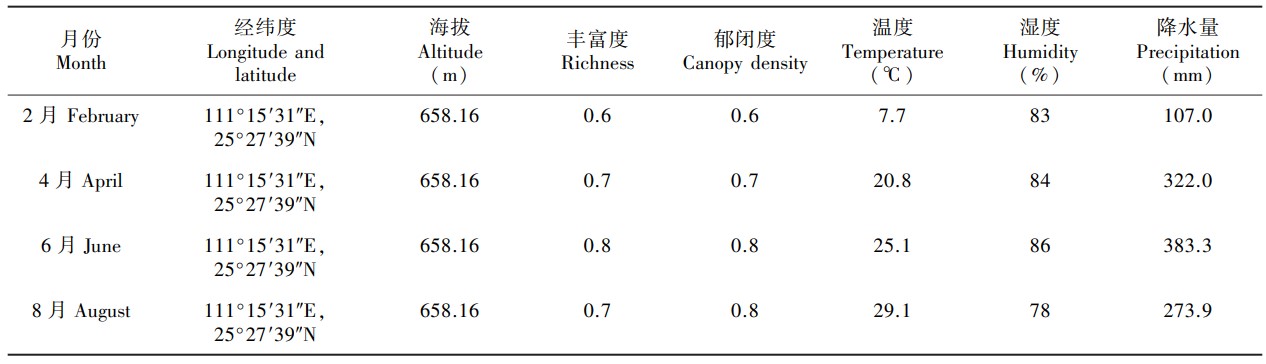
于2024年2月,在灌阳县海洋山中选择开花毛竹林(本研究区域内毛竹林全部处于开花状态,同区域内无未开花毛竹。因此,未设置正常毛竹对照组)。按坡度划分为上、中、下三部分,以10 m为最小间隔,每个部分设置3个10 m × 10 m的样地,共9个。记录坡度、坡向、海拔与经纬度;温度、湿度等气候因素参考灌阳县气象局当月平均数据;调查并统计竹林丰富度和竹林郁闭度(表1)。毛竹开花时间参考前人文献(周芳纯,1998;秦忠林,2015;徐振国等,2017)并结合本地竹农观测,可划分为4个时期:2月为开花前期,竹叶逐渐脱落,开始抽穗;4月为开花初期,部分竹叶未脱落,部分花穗发育完成;6月为开花盛期,竹叶已全部脱落,毛竹整株形成花穗并开始灌浆;8月为开花末期,大部分花穗逐渐枯萎凋落。
表
1
样地基本信息
Table
1
Basic information on plots
1.2.2 样品采集
分别于2月(开花前期)、4月(开花初期)、6月(开花盛期)、8月(开花末期)对毛竹器官进行取样调查。地上器官为竹秆、竹枝、竹叶/花穗;地下器官为竹蔸、蔸根、竹鞭、鞭根。
地上器官采集:对样地内开花毛竹进行每木检尺,计算平均胸径和株高。根据平均胸径随机选择无病虫害、生长健壮的开花毛竹为标准竹,共5株重复。将5株标准竹从竹株基部伐倒,竹秆按照每2 m进行分段,每段纵向十字破开取中部样品50 g,共取200 g。竹枝分一级枝和二级枝采样(其中二级枝含三级及三级以上枝),一级枝和二级枝各取100 g;采集每株的东、西、南、北4个方位毛竹叶片/花穗,用四分法取200 g。在9个样地内按照4个不同时期分别进行采样,竹秆、竹枝、竹叶/花穗分别进行5次重复,共计540份样品。
地下器官采集:沿标准竹基部四周下挖,自上而下逐层挖开土壤直至不见竹鞭,避免损伤竹鞭,区分来鞭、去鞭,用枝剪各取100 g,洗净带回;枝剪剪下竹鞭上的鞭根,混合后洗净并取样200 g。沿标准竹基部挖出竹蔸,清理竹蔸中碎石,用枝剪剪下全部蔸根,用清水冲净后取200 g,后用刀切下竹蔸样品200 g,装入密封袋中。在9个样地内按照4个不同时期分别进行采样,竹蔸、蔸根、竹鞭、鞭根分别进行5次重复,共计720份样品。
1.2.3 样品处理和测定
将所有样品带回实验室后,地上部分器官和竹蔸样品使用烘箱105 ℃杀青30 min以去除大部分水分,之后调至80 ℃烘至恒重。鞭根、蔸根样品用烘箱50 ℃烘出大部分水分,再放于通风干燥处自然风干,待鞭根样品自然风干后,将所有样品研磨成粉状,过100目筛以备化学分析。
C含量采用总C分析仪(MULTIN/C3100,德国耶拿)测定。N、P含量采用H2O2-H2SO4消煮,消煮后定容、静置过夜、稀释,分别参照土壤农化分析第三版中凯氏定氮法、钼锑抗比色法测定(鲍士旦,2000)。
1.3 数据统计与分析
应用Excel 2020和SPSS 27.0对获取的数据进行统计分析,采用多因素方差分析对不同开花时期各器官C、N、P含量及其计量比进行分析;采用单因素方差分析对各器官的C、N、P及其计量比进行差异性检验;使用Origin 2024进行绘图。C、N、P含量以单位质量的养分含量(g·kg-1)表示,C∶N、C∶P、N∶P采用质量比。
2 结果与分析
2.1 C、N、P含量和化学计量比及动态变化
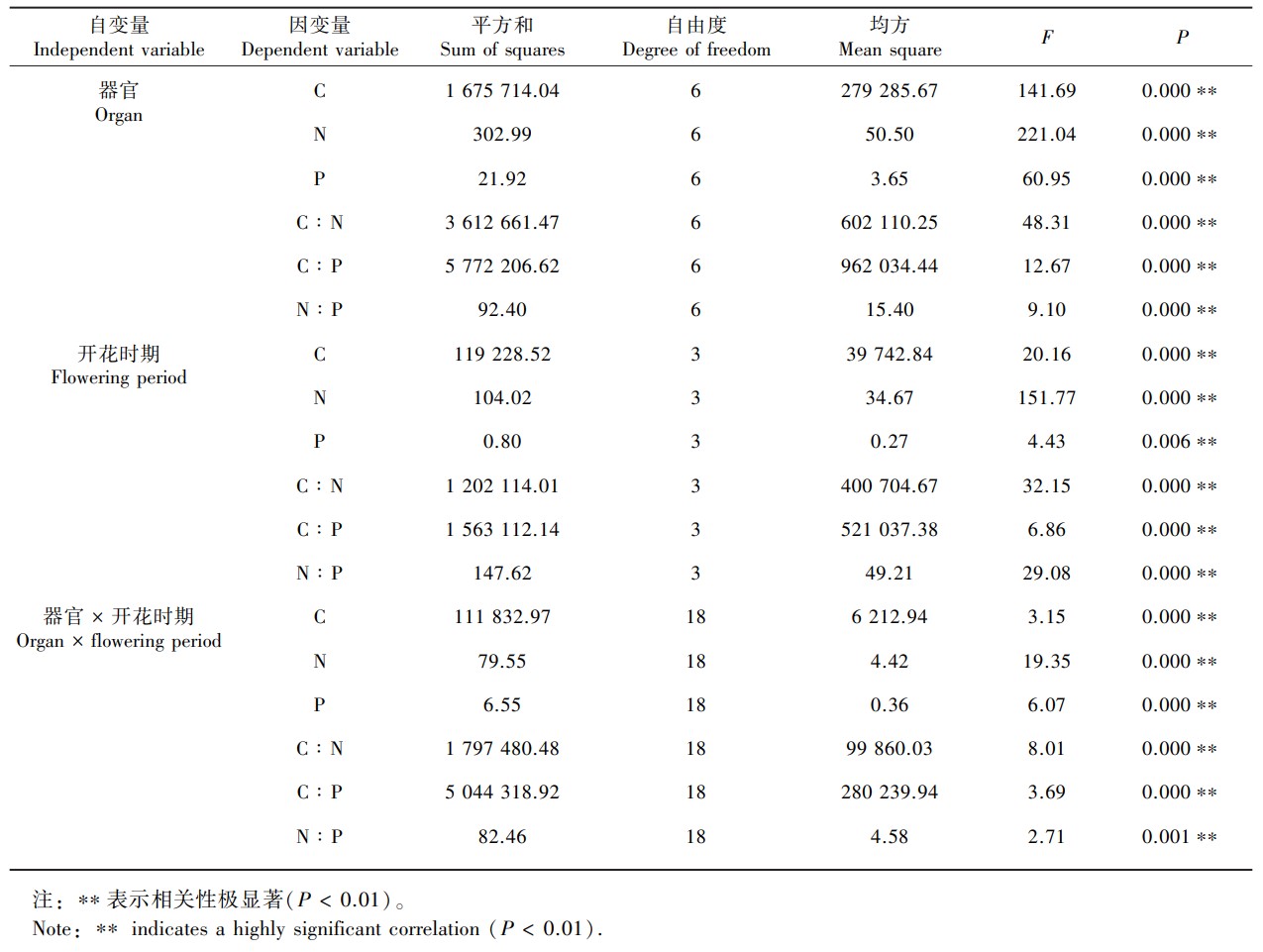
多因素方差分析(表2)表明,毛竹器官和开花时期的主效应和交互作用对C、N、P含量及其化学计量比均表现出极显著差异(P<0.01)。
表
2
毛竹开花器官与开花时期多因素分析
Table
2
Multivariate analysis of flowering organs and flowering periods in Phyllostachys edulis
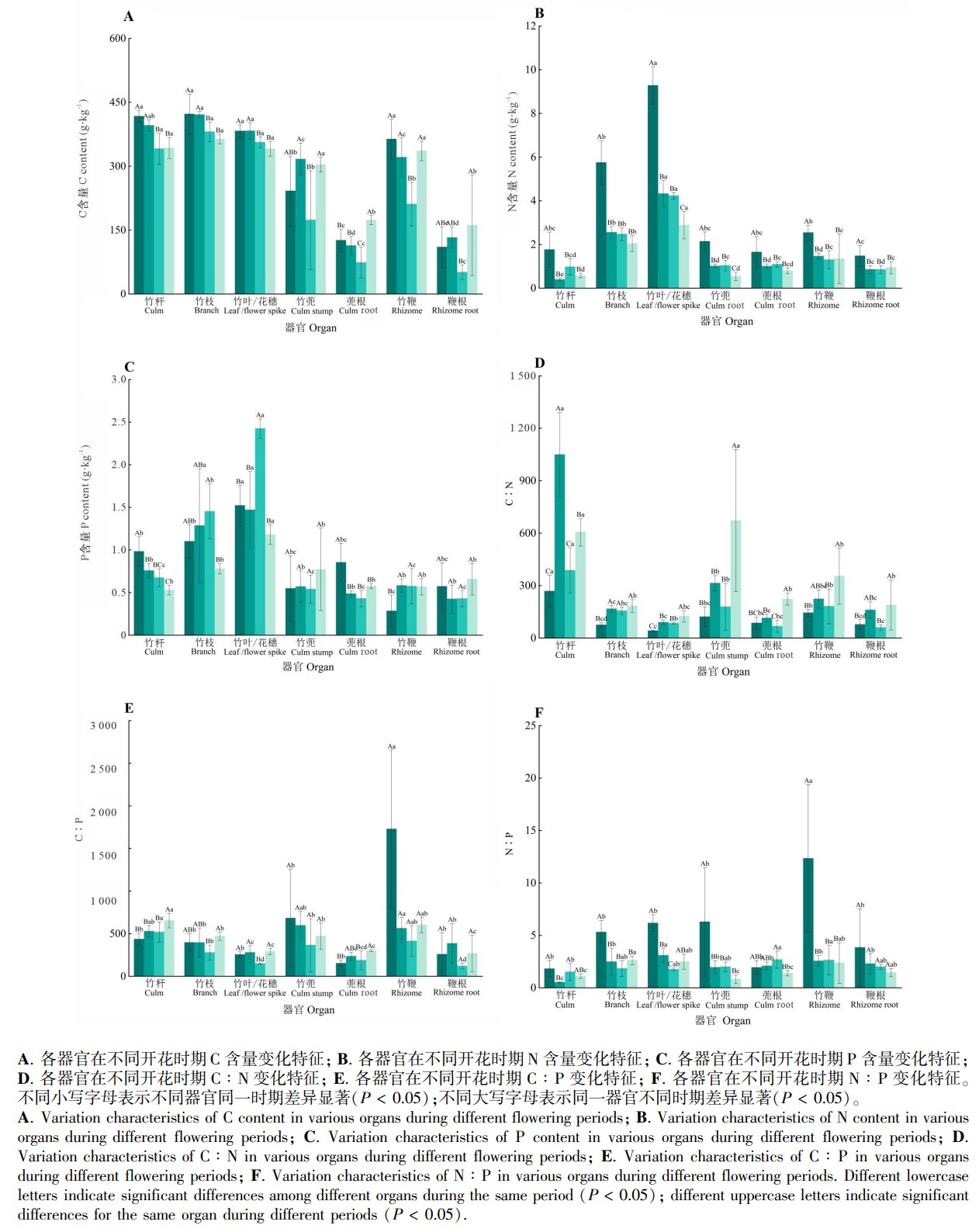
不同开花时期毛竹各器官C、N、P含量及其化学计量比具有显著性差异(P<0.05)。由图1可知,开花前期,竹枝C含量最高,为(422.32±47.03)g·kg-1,竹叶/花穗N、P含量最高,分别为(9.28±0.86)g·kg-1、(1.52±0.24)g·kg-1;竹枝C∶N最高,为268.08±90.74,竹鞭C∶P、N∶ P最高,分别为1 728.00±924.58、12.34±7.04。开花初期,竹枝C含量最高,为(420.94±7.47)g·kg-1,竹叶/花穗N、P含量最高,分别为(4.32±0.60)g·kg-1、(1.29±0.67)g·kg-1;竹秆C∶N最高,为1 049.04±242.39,竹蔸C∶P最高,为596.21±164.23,竹叶/花穗N∶P最高,为3.09±0.66。开花盛期,竹枝C含量最高,为(380.82±22.79)g·kg-1,竹叶/花穗N、P含量最高,分别为(4.23±0.14)g·kg-1、(2.42±0.11)g·kg-1;竹秆C∶N最高,为387.13±129.35,竹秆C∶P最高,为518.74±120.68,蔸根N∶P最高,为2.68±0.82。开花末期,竹枝C含量最高,为(363.94±11.38)g·kg-1,竹叶/花穗N、P含量最高,分别为(2.88±0.62)g·kg-1、(1.18±0.11)g·kg-1;竹蔸C∶N最高,为671.83±406.36,竹秆C∶P最高,为654.47±85.23,竹枝N∶P最高,为2.62±0.41。
不同开花时期毛竹各器官C、N、P含量具有显著的动态变化规律(P<0.05)。在C含量方面(图1:A):竹枝、竹叶/花穗呈现递减趋势,开花末期较开花前期分别降低了13.82%、10.93%;竹秆、蔸根、竹鞭呈现先减后增趋势,开花盛期较开花前期分别降低了18.27%、41.98%、41.52%;竹蔸、鞭根呈现“升高-降低-升高”的波动趋势,开花盛期较开花前期分别降低了28.22%、53.68%。在N含量方面(图1:B):竹秆、竹蔸、蔸根呈现“降低-升高-降低”的波动趋势,竹秆、蔸根开花初期较开花前期分别降低了77.84%、39.39%,竹蔸开花末期较开花前期降低了74.77%;竹枝、竹叶/花穗呈现递减趋势,开花末期较开花前期分别降低了64.52%、68.97%;竹鞭、鞭根呈现先减后增趋势,开花盛期较开花前期分别降低了48.82%、41.89%。在P含量方面(图1:C):竹秆呈现递减趋势,开花末期较开花前期降低了45.92%;竹枝、竹鞭呈现先升高后降低趋势,竹枝开花盛期较开花前期增加了31.82%,竹鞭开花初期较开花前期增加了107.14%;蔸根、鞭根呈现先降低后升高趋势,开花盛期较开花前期分别降低了49.41%、24.56%;竹蔸呈现“升高-降低-升高”趋势,开花末期较开花前期增加了40.00%。
不同开花时期毛竹各器官化学计量比呈现显著的动态变化规律(P<0.05)。在C∶N方面(图1:D):竹秆等器官均呈现“升高-降低-升高”的波动趋势,开花末期较开花盛期分别增加了36.04%、14.93%、32.06%、73.45%、69.79%、48.77%、68.16%。在C∶P方面(图1:E):竹秆、竹叶/花穗、蔸根、鞭根呈现“升高—降低—升高”的波动趋势,竹秆、蔸根开花末期较开花前期分别增加了50.52%、97.14%,竹叶/花穗、鞭根开花盛期较开花前期分别降低了66.17%、53.63%;竹枝、竹蔸、竹鞭呈现先降低后升高趋势,开花盛期较开花前期分别降低了29.89%、31.02%、65.18%。在N∶P方面(图1:F):竹秆、竹蔸、竹鞭呈现“升高-降低-升高”的波动趋势,开花末期较开花前期分别降低了61.98%、86.80%、80.79%;竹枝、竹叶/花穗呈现先降低后升高趋势,开花盛期较开花前期分别降低了50.66%、71.64%;蔸根呈现先升高后降低趋势,开花盛期较开花前期增加了38.86%,开花末期较开花盛期降低了48.51%,鞭根呈现递减趋势,开花末期较开花前期降低了61.99%。
图
1
毛竹各器官不同开花时期C、N、P化学计量特征
Fig.
1
Stoichiometric characteristics of C, N, and P in various organs of Phyllostachys edulis during different flowering periods
2.2 C、N、P化学计量特征的相关关系
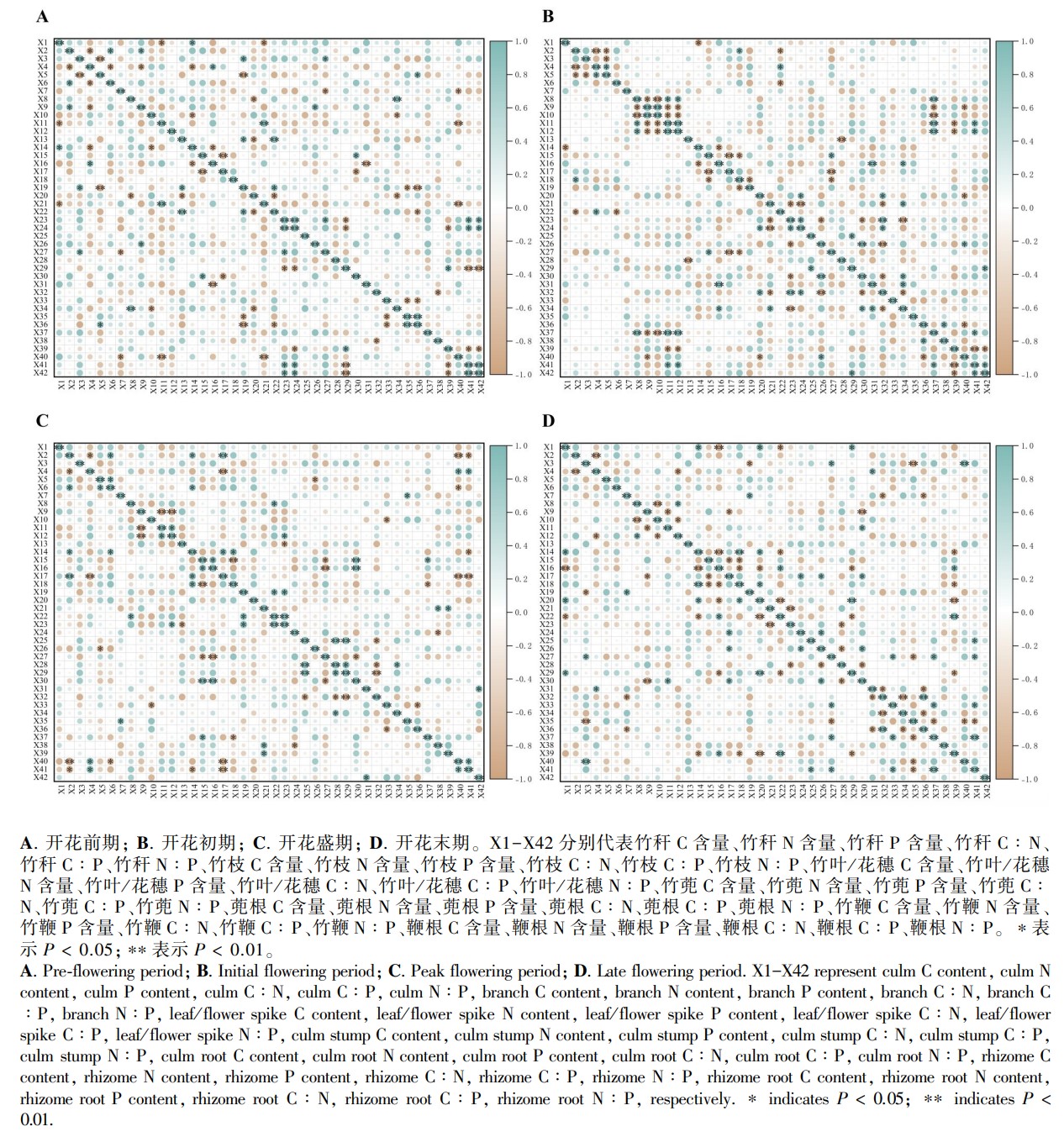
由图2可知,毛竹不同开花时期各器官C、N、P化学计量特征呈显著(P<0.05)或极显著(P<0.01)相关。
开花前期(图2:A),竹秆P含量与竹秆C∶P呈极显著负相关,竹秆C∶P与竹蔸C含量呈极显著负相关。竹枝N含量与竹鞭C∶N呈极显著正相关,竹枝C∶P与竹蔸P含量呈极显著正相关、与鞭根C∶N呈极显著负相关。竹叶/花穗C含量与竹蔸C∶N呈极显著正相关,竹叶/花穗C∶N与竹鞭C含量呈极显著负相关。竹蔸C与竹鞭N∶P呈极显著负相关,竹蔸P含量与鞭根C∶N呈极显著负相关。竹鞭N含量与鞭根N含量呈显著负相关,竹鞭P含量与竹鞭C∶P、竹鞭N∶P呈显著负相关。鞭根P与鞭根C∶P、鞭根N∶P呈显著负相关。
开花初期(图2:B),竹枝N含量与鞭根C含量呈极显著正相关,竹枝C∶N与鞭根C含量呈极显著负相关,竹枝C∶P与竹枝N∶P呈极显著正相关,与鞭根C含量呈极显著正相关。竹叶/花穗C含量与蔸根C∶N含量呈极显著负相关,竹叶/花穗C∶N与竹鞭C含量呈极显著正相关,竹叶/花穗C∶P与蔸根P含量呈极显著负相关,竹蔸P含量与竹蔸N∶P呈极显著负相关。竹蔸C∶P与竹鞭N含量呈极显著正相关,与竹鞭C∶N呈极显著负相关。蔸根N含量与蔸根N∶P呈极显著正相关,与竹鞭N含量呈极显著负相关。鞭根P含量与鞭根C∶P呈极显著负相关。
开花盛期(图2:C),竹秆N含量与竹叶/花穗C∶P呈极显著正相关、与鞭根C∶N呈极显著负相关,竹秆C∶N与竹叶/花穗C∶P呈极显著负相关。竹枝P含量与竹枝C∶P呈极显著负相关,竹枝P含量与竹枝N∶P呈极显著负相关。竹叶/花穗P含量与蔸根N∶P呈极显著正相关、与竹叶/花穗N∶P呈极显著负相关,竹叶/花穗C∶N与蔸根P含量呈极显著负相关,竹叶/花穗C∶N与蔸根N∶P呈极显著正相关,竹叶/花穗C∶P与鞭根的C∶N和C∶P呈极显著负相关。竹蔸C∶N与竹蔸C∶P呈极显著正相关,蔸根C含量与蔸根的C∶N和C∶P呈极显著正相关。蔸根C∶P与竹鞭N含量呈极显著负相关。
开花末期(图2:D),竹秆C含量与竹叶/花穗C∶N呈极显著负相关,竹秆N含量与竹秆C∶N呈极显著负相关,竹秆P含量与鞭根C∶N呈极显著正相关,竹秆P含量与竹鞭C∶P呈极显著负相关。竹枝N含量与竹枝C∶N呈极显著负相关,竹枝P含量与蔸根N∶P呈极显著负相关。竹叶/花穗N含量与竹叶/花穗C∶N呈极显著负相关,与竹叶/花穗N∶P呈极显著正相关;竹蔸N含量与竹蔸C∶N、鞭根P含量呈极显著负相关;竹蔸P含量与竹蔸C∶P呈极显著负相关;竹蔸C∶N与鞭根P含量呈极显著正相关;竹鞭N含量与竹鞭C∶N呈极显著负相关,与竹鞭N∶P呈极显著正相关;鞭根C含量与鞭根C∶P呈极显著正相关。
图
2
不同开花时期各器官C、N、P相关关系热图
Fig.
2
Heatmap of correlations among C, N, and P in various organs during different flowering periods
3 讨论
3.1 C、N、P含量及其动态变化毛竹作为多年生一次性开花植物,其营养生长向生殖生长的转换伴随剧烈的养分再分配(龙海艳,2014;王双燕,2015),这一过程直接决定了其“全株生命策略”下的生殖成功与种群延续(Janzen, 1976)。因此,深入揭示毛竹开花期间C、N、P含量的动态变化规律,对于阐明竹类植物在生殖阶段的化学计量适应机制及养分资源调配策略具有至关重要的科学意义。本研究多因素方差分析表明,毛竹器官与开花时期对养分含量及其化学计量比存在极显著的协同调控效应,二者间的交互作用揭示了不同器官在生殖转型过程中的养分响应模式具有明显的时空特异性。
C含量的变化揭示了光合产物向生殖器官的高度集中,这导致营养器官因补给匮乏而加速衰老。开花进程中,竹秆C含量逐渐降低,表明其储存的C被大量转运至生殖器官以支撑开花结实。相比之下,竹枝C含量在各开花时期均保持最高,这与未开花毛竹的研究结论一致(郭雯等,2021),说明竹枝虽为光合产物的主要积累与转运枢纽,但其储存的C在开花期未被过度消耗,暗示生殖发育更多依赖地下贮藏器官的养分供给及当期光合作用。竹叶/花穗C含量整体呈现递减趋势,这与山核桃(Carya cathayensis)等多次开花植物的研究结果(闫道良等,2013)相反,推测毛竹将C最大限度地直接用于生殖生长,导致叶片自身消耗殆尽并枯落,这与其“一次性开花后死亡”的生活史特性高度协同。值得注意的是,尽管开花初期竹叶/花穗C含量达到峰值,但仍低于全国未开花毛竹林叶片的常规含量范围(顾鸿昊等,2015;杜满义等,2016;黄树荣等,2020;柳佳莹等,2022)。这一现象表明,毛竹在开花过程中可能通过增强C的吸收与利用效率来应对巨大的生殖消耗,体现了其在特殊生活史阶段的资源调配策略。
N含量直观反映了毛竹开花过程中的消耗与再利用机制。相较于营养生长期的未开花毛竹(曾莹莹等,2015;徐超,2018)及苦竹(Pleioblastus amarus)(刘力等,2004)等竹种,开花毛竹各器官N含量显著偏低,揭示其采取了一种极端的养分再分配策略,即动员全株储存的N,以牺牲营养和贮藏器官为代价,将其集中输送至生殖器官。有研究发现,竹叶/花穗N含量随开花进程逐渐降低,这一趋势与山核桃(夏国华等,2014)、九叶花椒(Zanthoxylum armatum V. novemfolius)(王帅等,2018)等木本植物从开花至坐果的变化一致,表明N优先富集于花穗以支持其分化及种实形成,生殖生长对N的优先消耗特征显著(Yan et al.,2015)。此外,根系作为主要的吸收与贮藏器官,其代谢活动强烈(黄爱梅等,2023)。开花毛竹的蔸根和鞭根的N含量随花期推进整体呈显著下降趋势且各时期差异明显。这表明随着开花进程的深入,毛竹根系对养分的吸收能力逐渐衰退,植株愈发依赖体内存量N的再分配来维持生殖需求,进一步印证了毛竹“一次性开花”生活史中资源耗竭型的生理特征。
P的动态积累呈现显著的向生殖器官富集趋势。开花前期、初期、末期,毛竹地上器官(竹秆、竹枝、花穗)的P含量均高于未开花植株(吴家森等,2005;曾莹莹等,2015),而末期地下器官P含量回归至未开花水平,表明P在生殖阶段优先积累以支持发育,待任务完成后分配重归平衡。本研究显示,竹枝与竹叶/花穗的P含量在开花盛期达到峰值,说明P作为关键元素,全力支撑花穗发育、结实及光合作用所需的能量消耗(Schreeg et al.,2014)。与此同时,蔸根与鞭根的P含量呈现“初期和盛期降低、末期回升”的波动特征,这与红枣(Zizvphus jujube)(陈波浪等,2011)、山核桃(闫道良等,2013)等植物的规律一致。这表明开花盛期,根系储存的P被大量动员并集中输送至地上部分以支持生殖生长;至开花末期,随着生殖任务结束,P的分配重心回调,根系转而进行磷的再积累。这种动态变化体现了毛竹在生殖周期中对P存储库采取的“阶段性耗竭利用与后期恢复”策略,确保了有限资源在关键生命阶段的高效利用。
3.2 C、N、P分配格局
C∶N、C∶P和N∶P的化学计量比揭示了毛竹开花期间养分利用效率与限制类型的动态转变。C∶N增大通常促进生殖生长,反之则利于营养生长(陈建华等,2005;孙慧等,2025)。本研究发现,开花初期竹秆C∶N最高,表明此时N对比值起主导作用:C持续富集,而N被各器官优先转运并消耗,以全力支撑生殖需求。C∶P的变化则紧密关联生长与能量代谢。开花末期鞭根C∶P达到峰值,说明鞭根持续积累C以支持生殖生长,而P则被优先向花穗和种子转运。N∶P是判断养分限制的关键指标:N∶P<14为氮限制,14~16为共同限制,>16为磷限制(Koerselman & Meuleman,1996)。本研究中,竹枝与竹叶/花穗在4个开花时期的N∶P均小于16,表明其生长主要受氮或氮磷共同限制。特别是在开花盛期,N∶P降至最低,反映了该阶段植株对N的需求达到顶峰,N成为制约生殖生长的关键因子。
3.3 C、N、P化学计量关系
毛竹开花过程中,各器官C、N、P含量呈现显著的阶段性动态变化,化学计量关系与养分分配高度协调。前期:竹秆P与C∶P、竹枝N与C∶P、竹叶C与C∶N均呈显著负相关,表明此阶段养分分配侧重于营养生长,C被富集而N、P被优先消耗。初期:竹枝N与鞭根C呈极显著正相关,竹枝C∶N与鞭根C呈极显著负相关,反映生殖生长启动,N向生殖器官转运,C在营养器官中积累。盛期:竹秆N含量与竹叶/花穗C∶P呈极显著正相关,与鞭根C∶N呈极显著负相关,竹枝P含量与竹枝C∶P、N∶P均呈极显著负相关,显示生殖生长高峰期,N、P向花穗和种子集中,C在营养器官中持续积累。末期:竹秆C与竹叶/花穗C∶N、竹枝N与竹枝C∶N均呈极显著负相关,竹秆P与鞭根C∶N、鞭根C与鞭根C∶P均呈极显著正相关,表明生殖生长结束,养分向营养器官回流,C在竹秆中积累,N、P在鞭根中富集。整体而言,毛竹开花通过不同时期各器官间养分关联的动态调整,实现了从营养生长到生殖生长再到营养储备的资源优化分配,为毛竹一次性开花提供了系统理论支撑。
4 结论
毛竹开花过程中各器官C、N、P含量分配呈现显著阶段性变化:前期与初期养分由竹蔸、竹鞭等地下器官向地上生殖器官转移,竹枝富集C并消耗N以推动开花;盛期P在竹叶/花穗中富集,协同满足生殖与光合代谢能量需求;末期地下器官通过C、P再积累与N补偿调节实现养分再平衡。本研究表明,毛竹开花存在显著的时期差异:竹枝等营养器官主要维持C稳态,而竹叶/花穗则大量积累N、P以支撑生理代谢。综上,毛竹在开花过程中采取了“C保持稳态、P定向富集、N优先再分配”的生态适应策略,体现了其一次性开花生活史下的独特养分利用机制。